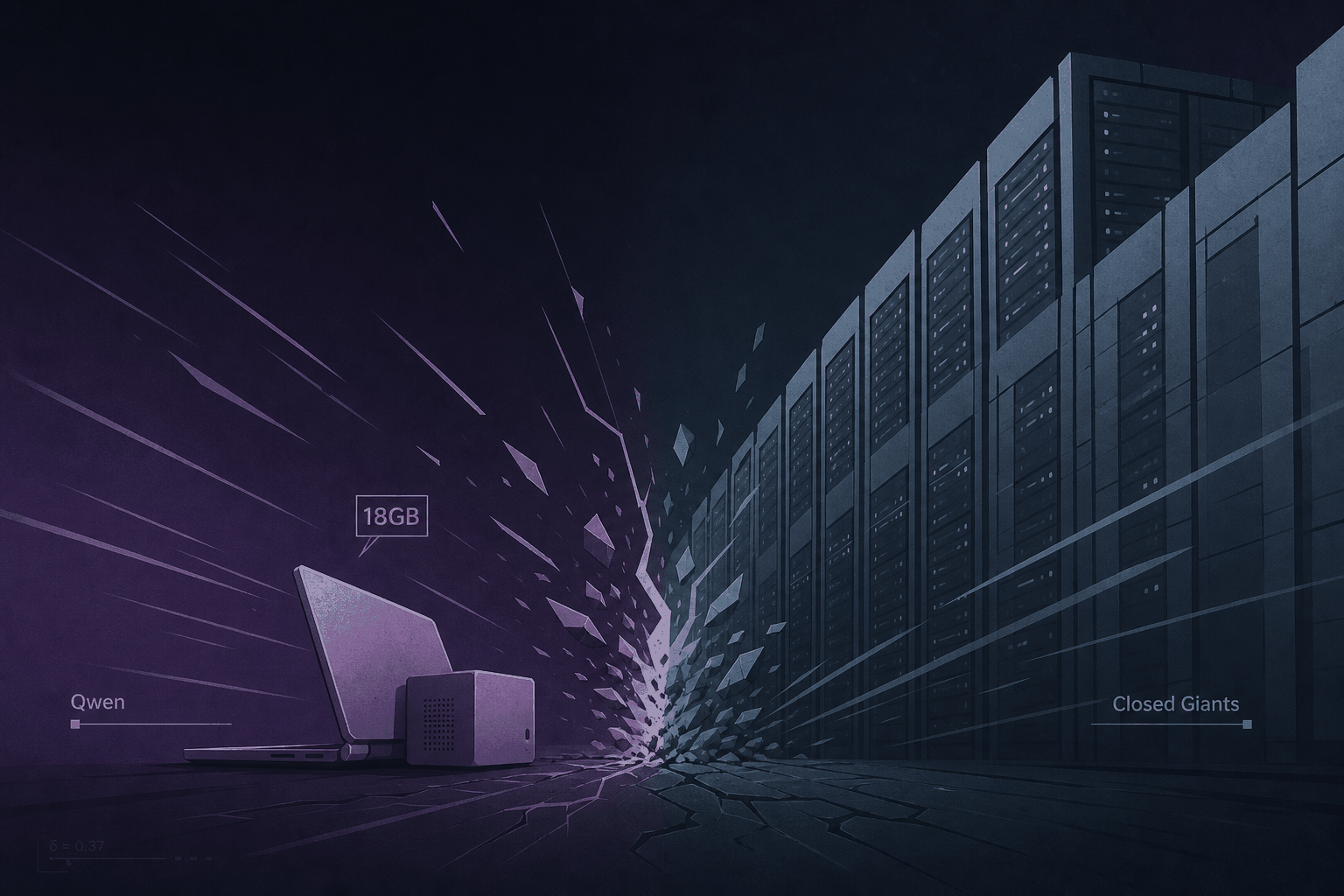
On August 14, 2026, Alibaba’s Qwen team open-sourced Qwen3.8-27B, a 27-billion parameter model. Within just two days of release, the model—requiring a mere 18GB of storage post-quantization—surpassed 1 million downloads on Hugging Face. On the real-world software engineering benchmark DeepSWE 1.1, its score skyrocketed by 217% compared to the previous generation, outperforming Anthropic’s flagship closed-source model, Claude Opus 4.6, in coding benchmarks.
For a long time, the LLM race has been dominated by a brute-force approach: piling up compute and scaling parameter counts. Closed-source tech giants maintained their dominance with hundreds of billions of parameters hosted on expensive datacenter clusters. Qwen3.8-27B shatters this inertia, proving that high-efficiency architecture can condense top-tier agent execution capabilities into ordinary personal computers. This breakthrough signals a second front in the AI arms race: victory is shifting toward whoever can deliver the highest practical engineering value on consumer-grade hardware.
27B Parameters Beat Trillion-Scale Giants: Practical Capability Over Raw Size
In the official model card published on Hugging Face, Qwen3.8-27B demonstrates execution capabilities far surpassing its size class. Artificial Analysis awarded the model an Intelligence Index score of 52, compared to a median score of just 9 for open-source models of similar size. This indicates that in the medium-parameter domain, algorithmic and architectural innovations have created a multi-generational gap over same-tier competitors.
In head-to-head performance against closed-source giants, Qwen3.8-27B took the lead in multiple task-oriented evaluations. On the software engineering benchmark SWE-bench Pro, it achieved a score of 61.7, surpassing Claude Opus 4.6 (estimated ~57%), a model over 10 times its size. In the OSWorld-Verified environment for operating system interactions, it scored an impressive 84.3. This demonstrates that in complex coding and system interaction tasks, real-world execution capacity has become decoupled from massive parameter counts.
Across 19 overlapping benchmarks evaluated by third-party benchmark platform local-ai-zone, Qwen3.8-27B won 15, yielding a 78.9% win rate. When pitted against Meta’s concurrent 30B release, Muse Glimmer, Qwen3.8-27B achieved a clean sweep across all 8 direct head-to-head comparisons. The empirical data proves that smaller models, by focusing on inference and execution efficiency, can decisively outperform cloud monsters in specific engineering workloads.
Although Qwen3.8-27B scored 89.2 on GPQA Diamond—slightly behind ultra-large cloud models on broad encyclopedic knowledge recall—this reflects a deliberate design trade-off. The model concentrates its parameter capacity on code logic and multimodal perception, intentionally foregoing passive memorization of obscure trivia. This relentless optimization for “getting work done” provides the core foundation for outperforming giants on local hardware.
Architectural Overhaul: From “Memorizing Dictionaries” to “Getting Work Done”
Compressing top-tier coding and agent capabilities into a 27B parameter footprint required a fundamental redesign of the underlying architecture by the Alibaba team. Qwen3.8-27B incorporates Gated DeltaNet linear attention across 75% of its network layers, reducing traditional Transformer context computation complexity from quadratic $O(n^2)$ to linear $O(n)$. This architecture natively supports a 262,144 token context window and enables extrapolation up to 1 million tokens with minimal memory overhead.
To maximize inference throughput on local devices, the model features built-in Speculative Decoding powered by MTP (Multi-Token Prediction). By predicting multiple sequential tokens in a single forward pass, actual generation speed is boosted by 15% to 25%. This significantly cuts down memory bandwidth transfer bottlenecks during long code generation and multi-step reasoning tasks.
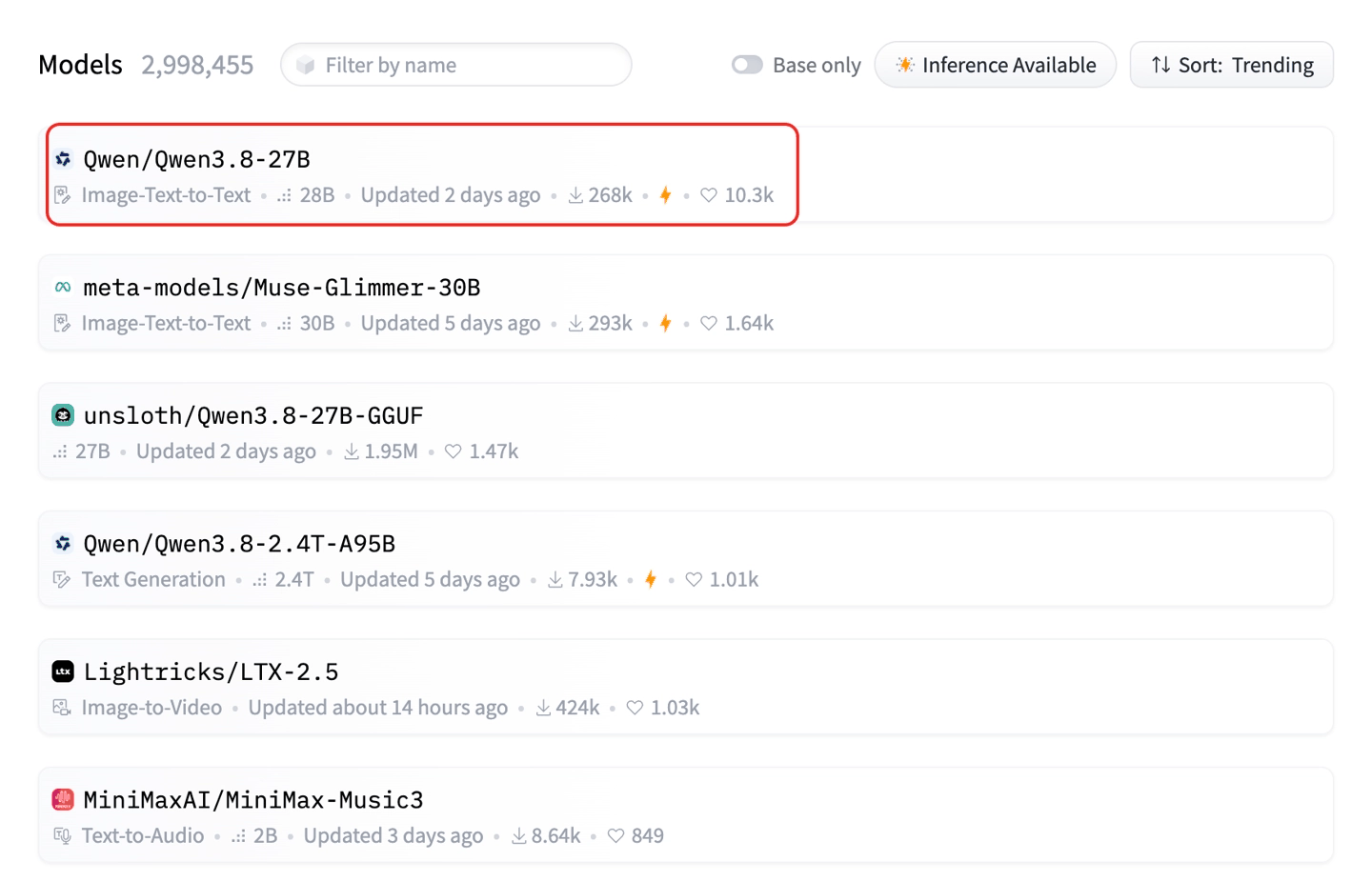 Figure: Qwen3.8-27B takes the top spot on Hugging Face Global Trending LLM Chart. Source: IT Home
On the deployment front, the Q4 quantized version of Qwen3.8-27B fits inside ~18GB of VRAM, running smoothly on a single consumer GPU with 24GB VRAM (such as an NVIDIA RTX 4090). Benchmarks show the card comfortably sustaining a text generation stream of 85 to 95 tokens per second. Everyday developers can now achieve an interactive response experience comparable to flagship closed APIs directly on their PCs without paying for costly datacenter GPU rentals.
Free Open-Source vs. Closed Cloud: The Local Counter-Offensive
By releasing Qwen3.8-27B under the Apache 2.0 license, Alibaba has granted global developers unrestricted rights for commercial use. Within 48 hours of release, the open-source community contributed over 500 quantization variants across various precision levels, driving cumulative downloads of derivative models past 5 million. This extreme openness dramatically lowers the barrier to adopting advanced AI, accelerating the spread of technological dividends to individual developers.
Across global tech communities like YouTube and Hacker News, developers have dubbed it “the local Opus 4.6 you can run on your home computer.” Renowned developer Simon Willison noted after hands-on testing that Qwen3.8-27B exhibits exceptional execution power with a strong default inclination toward deep reasoning. Community-driven fine-tuning and engineering adaptations around this model are rapidly eroding the moat built by closed-source providers behind paywalled APIs.
 Figure: Overseas developer testing Qwen3.8 running locally on a personal PC. Source: YouTube @Fahd Mirza
Looking at the broader open-source landscape, the Qwen model family accumulated 2.045 billion downloads on Hugging Face in the first seven months of this year, spawning over 150,000 derivative models and exceeding 3 billion global downloads overall. Enterprises such as Pinterest and Airbnb have already integrated Qwen models into core production workflows. The widespread adoption of open-source, locally deployable models by enterprise clients underscores that data privacy and cost-efficiency have become deciding factors in technology stack selection.
The Turning Point in the AI Race: The Victory of Efficient Local Compute
Qwen3.8-27B reaching the top spot signals that the LLM industry is moving away from the paradigm of blindly chasing scale. While convention once held that only cloud giants with hundreds of billions of parameters could handle complex engineering tasks, high-efficiency local architectures are dismantling that belief. When an 18GB model can handle the vast majority of real-world coding and system automation tasks, the marginal utility of piling up cloud compute diminishes rapidly.
Due to physical capacity limits, a 27B parameter model still faces an objective gap compared to massive cloud clusters when answering hyper-broad, cross-disciplinary trivia. However, in specific, high-frequency software development and autonomous agent workflows, its practical engineering efficiency is undeniably top-tier. The future AI market is splitting into a dual-track architecture: specialized, lean local models operating alongside massive cloud clusters.
From this perspective, Qwen3.8-27B represents more than just the success of a single model; it reveals a generational shift toward efficient edge computing. As top-tier intelligence capabilities land on millions of personal computers, local engineering imagination will become the primary multiplier of developer productivity. This local counter-offensive sparked by open-source innovation is only beginning to reshape the global AI industry landscape.
Reference Links:
- IT Home: Alibaba Open-Sources Qwen3.8-27B, Tops Hugging Face Trending List
- YouTube @Fahd Mirza: Hands-on Local Test of Qwen3.8-27B
- Artificial Analysis: Intelligence Index Evaluation Data for Qwen3.8-27B
- Hacker News Community Discussion: Qwen3.8-27B Release and Deep Analysis