Biological Secrets Hidden in Slippery Rain-Soaked Trails
When taking a morning stroll in the park, your shoes might occasionally step on a slippery, gooey spot. Most people assume the trail left by a passing snail is merely unremarkable soft secretion. However, a study published in Science on August 6, 2026, reveals that this seemingly ordinary fluid is actually an extraordinarily sophisticated smart biomaterial. A common grove snail (Cepaea nemoralis—a terrestrial snail widespread in European parks with distinctive yellow and black striped shells) relies on its internal physiology to precisely tune five types of mucus with completely different physical properties.
The stiffness range of these slimes is remarkably wide, spanning from fluid lubricants that facilitate foot gliding to rigid membranes engineered to withstand winter cold and summer heat. Researchers found that the physical switch governing whether the slime stays a soft liquid or hardens into a plastic-like protective cover is nothing other than common calcium ions. Every trail of snail slime beneath our feet is a custom-formulated output tailored by the snail to its immediate environment.
From Glass Bowls to Terrariums: How Scientists Harvested Five Types of Mucus
In nature, mucus serves as a vital survival weapon for animals. For instance, hagfish deploy vast quantities of slime to choke predators, while tube-lipped wrasses use thick oral mucus to protect their lips from razor-sharp coral reefs. Yet the grove snail takes the functional versatility of mucus to an extreme. A research team at the Max Planck Institute of Colloids and Interfaces in Potsdam, Germany, noticed that mucus secreted by snails under different behavioral states felt drastically different.
Biochemist Franziska Jehle initiated the investigation after observing how snails could glide effortlessly over glass surfaces while also adhering firmly to vertical walls. To unravel the chemical composition of these slimes, physical chemistry doctoral student Mariella Gabler and her colleagues carried out meticulous sample collection. They allowed snails to crawl across pristine glass dishes to scrape off crawling lubricant mucus; picked off adhesive granules from shell rims while snails clung tightly to terrarium walls; and gently scraped shells with spatulas to collect defensive foams and viscous yellow secretions.
Among crawling lubricant mucus, iridescent adhesive mucus, foamy defensive mucus, and thick yellow defensive mucus, the fifth type amazed the team the most: the dormant epiphragm. This is a hardened membrane secreted during winter hibernation or summer estivation to seal the shell aperture and prevent desiccation. Once dried, the epiphragm achieves exceptional stiffness, sealing the snail’s body tightly like a lid.
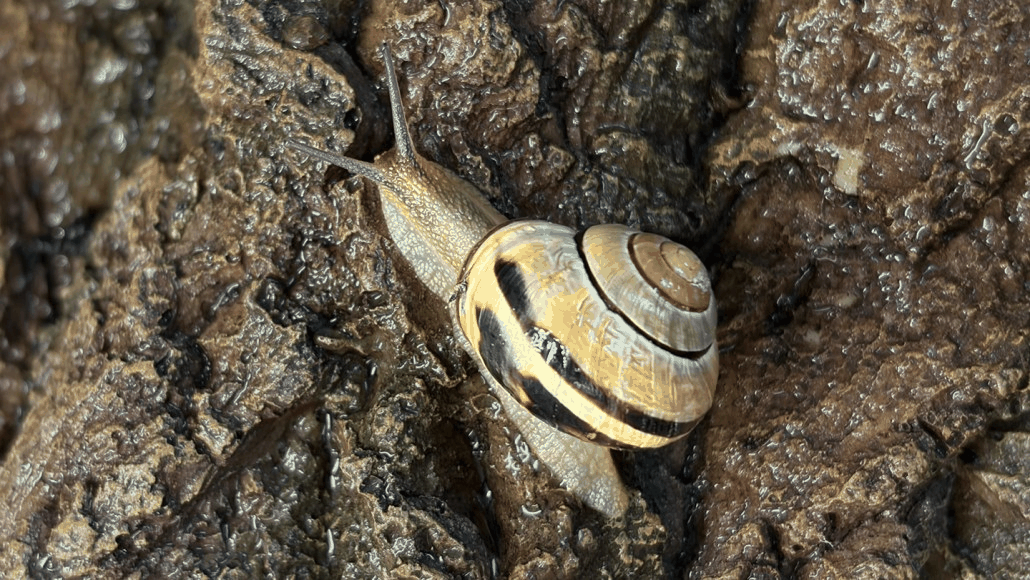 Figure: A grove snail crawling on a moist rock surface. Source: Science News (Credit: Max Planck Institute of Colloids and Interfaces)
A Calcium Pack in Slime: How a Single Protein Changes Stiffness via Chemical Switches
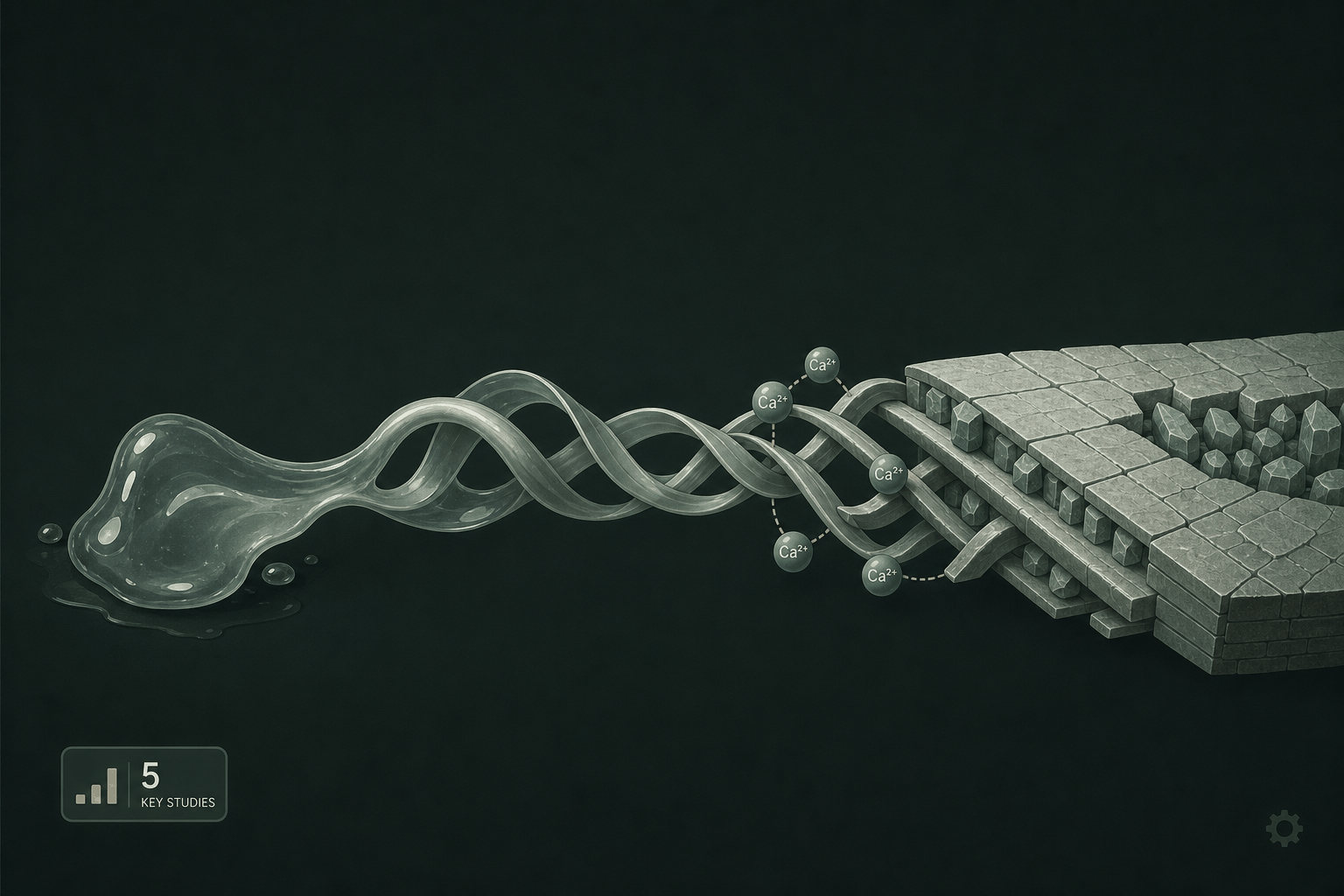
Conventional logic dictates that producing five materials with vastly different physical functions would require five separate protein recipes. Chemical analysis in the lab, however, yielded a counterintuitive finding: all five mucus types share the exact same protein foundation. Their primary constituent is collagen VI, a fundamental protein used across the animal kingdom to build connective tissues and structural cellular matrices.
Given the identical protein building blocks, what determines the physical state of each slime? The research team discovered that calcium ions act as molecular zippers and cross-linkers. At the microscopic scale, calcium ions interlace between long collagen VI molecular chains, tightly locking together what would otherwise be a loosely woven protein network.
The quantity of calcium added directly dictates the final material stiffness. In the epiphragm used to seal shell openings, calcium concentration reaches 420 milligrams per gram (42% of dry weight)—nearly 17 times higher than that found in crawling lubricant mucus. This concentration is equivalent to compressing an entire pack of calcium tablets directly into a dollop of mucus, instantaneously transforming a soft liquid into solid armor.
Portable Mineral Libraries: Foot Tissue Microscopic Studies
Beyond raising calcium ion concentrations, snails incorporate inorganic mineral particles into their stiffer slimes. Microscopic calcite crystals—a hard crystalline form of calcium carbonate that constitutes marble and sea shells—were identified within both the epiphragm and high-strength adhesive mucus. Intertwined within the collagen matrix, these mineral crystals provide a reinforced structure analogous to steel rebar and aggregate in reinforced concrete.
To understand how snails modulate calcium ions on demand, researchers examined tissue sections of the grove snail’s foot under microscopes. Histological observations revealed that mucus glands at the base of the foot store substantial reserves of calcium carbonate. Consequently, the snail operates like a mobile mineral warehouse, capable of injecting varying doses of calcium into its secretory channels at a moment’s notice.
Victor Ajisafe, a biomaterials scientist at the University of Texas at El Paso, noted that the scientific community previously assumed calcium ions were primarily deployed to construct rigid structures like bones and hard shells. This study demonstrates that calcium ions exert far greater regulatory control in soft biomaterials than previously anticipated, achieving multi-grade material tuning through simple concentration adjustments.
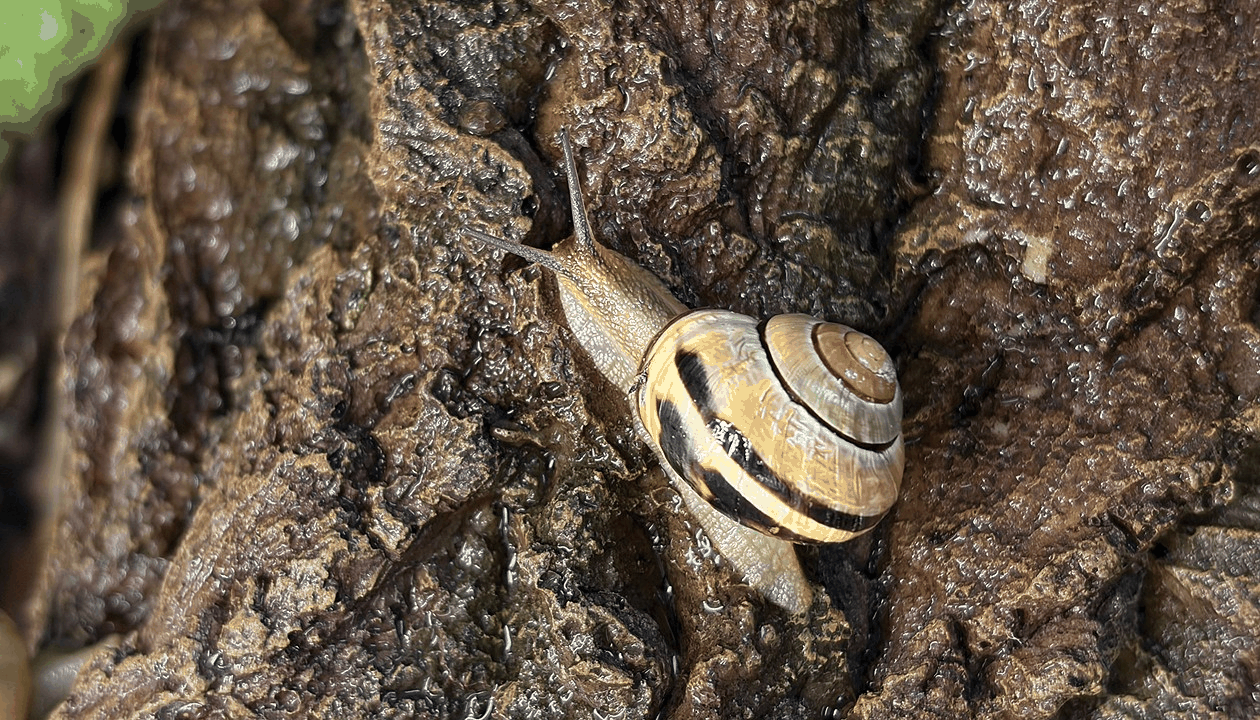 Figure: A garden snail slowly crawling along the rough surface of tree bark. Source: C&EN
Shear-Thinning and Solidification: Inspiration for Bio-Inspired Smart Materials
In addition to tunable stiffness, the lubricant slime secreted during crawling exhibits unique fluid dynamic properties. This mucus demonstrates shear-thinning behavior—becoming thinner and smoother when subjected to sliding forces, yet rapidly regaining viscosity and solidifying once the force stops. When muscles in the snail’s foot compress the mucus during movement, it flows as smoothly as oil; when the foot pauses to rest, the mucus reverts to a viscous state that anchors the snail in place.
In interviews, Mariella Gabler expressed fascination with the elegant mechanics of snail biomaterials. Engineers are now drawing inspiration from this mechanism to design novel medical protective coatings and hydrogel wound dressings. An ideal wound dressing should spread evenly like a liquid during application, yet rapidly solidify upon contact with ionic changes in bodily fluids, forming a durable barrier against bacterial infection.
From slippery crawling tracks to rigid protective seals, the grove snail exemplifies highly efficient natural material engineering. Without complex synthetic pathways, relying solely on a single protein template coupled with adjustable calcium ion concentrations, it accomplishes seamless switching across five material operational modes. The next time you spot a snail crawling after the rain, consider the trail underfoot—it is a programmable smart material perfected over millions of years of biological evolution.
Reference Links:
- Science News coverage
- NPR coverage
- C&EN research breakdown