26 Grams of Minimalism: Firing a Shot Against the Smartwatch Arms Race
In August 2026, Casio quietly released the F-B100W in Japan—a smart successor to the legendary F-91W digital watch—retailing for 8,800 yen (around $56). This new model lacks a high-refresh-rate OLED color screen, dispenses with heart rate or blood oxygen sensors, and relies on a standard button cell battery. Yet this little resin timepiece, visually almost identical to its 1980s ancestor, sold out instantly upon launch.
First introduced in 1989, the F-91W has sold hundreds of millions of units worldwide and was once dubbed “the world’s most popular watch” by Wired. This time, Casio upgraded the classic ~$22 watch with Bluetooth and step-tracking capabilities to create the F-B100W, nearly doubling the price. The fact that it sold out immediately despite doubling in price highlights how strong consumer willingness to pay remains for frictionless wearability and essential digital features, even as modern wearables push into the thousands of dollars.
Today’s smartwatch market is bogged down in a hardware arms race. Manufacturers pack high-power processors, oversized screens, and dense sensor arrays into devices, forcing wearers into a cycle of daily charging panic and endless notification pop-ups. Casio’s F-B100W stands in direct opposition to this extreme complexity. This rapid sellout signals a shift in wrist-wear preferences: technology returning to “good enough,” serving as a hardcore rebellion against hardware over-engineering.
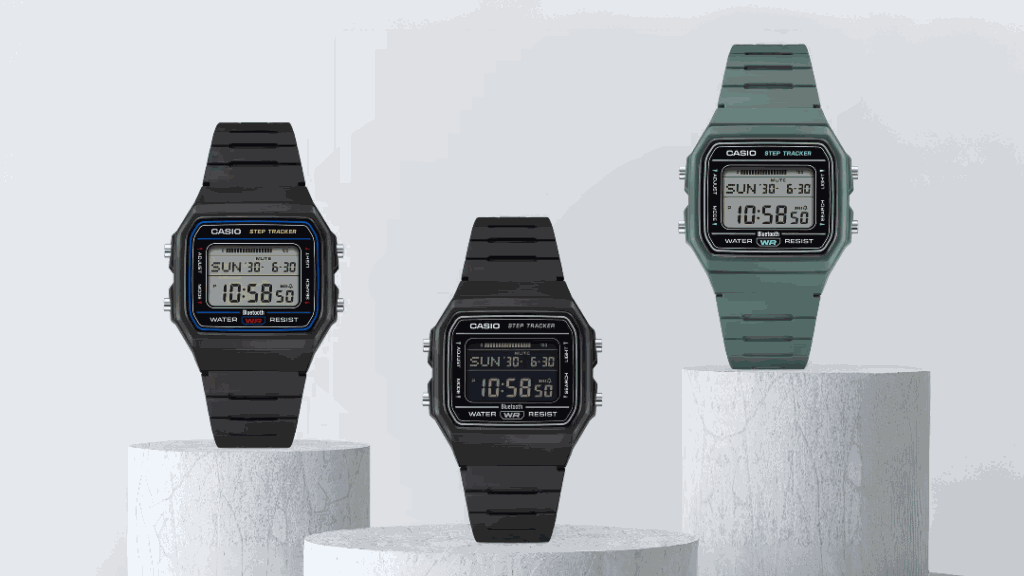 Photo: Three colorways of the Casio F-B100W resin digital watch. Source: Gizmochina
Engineering Under the Resin Shell: Bluetooth, Step Tracking, and 2-Year Battery Life
From an engineering perspective, the F-B100W preserves the slim 8.8 mm profile and ultra-lightweight 26 g body, with a case crafted from eco-friendly bio-based resin featuring ventilation holes. Inside, Casio packed a 3-axis accelerometer and a Bluetooth Low Energy (BLE) chip, supporting step chart plotting, daily goal progress alerts, and sedentary reminders. Maintaining a 26 g weight and an 8.8 mm thickness demonstrates that when worn on the wrist, millimeter-level lightness and comfort consistently trump an accumulation of redundant features.
To preserve the classic digital watch form factor, the F-B100W eschews battery-draining real-time continuous data pushes in favor of local offline storage and scheduled active sync. The watch records up to 200 lap records for the stopwatch, executing step-counting algorithms locally. Users simply open the official Casio App to automatically sync time and step count data over Bluetooth. This architectural logic of offline computation and low-frequency communication enables the device to achieve approximately 2 years of battery life on a single coin cell.
Regarding hardware interaction, the new series retains standard segment LCD screens and traditional amber LED backlights across all models, resisting the trend toward self-luminous panels. Across three variants—including the positive display F-B100W-1A and negative display F-B100W-1B—Casio retained 5 independent daily alarms and an hourly time signal. This commitment to segment LCD technology guarantees high-contrast legibility under direct sunlight at near-zero power draw, eliminating the wrist-raise display delay entirely.
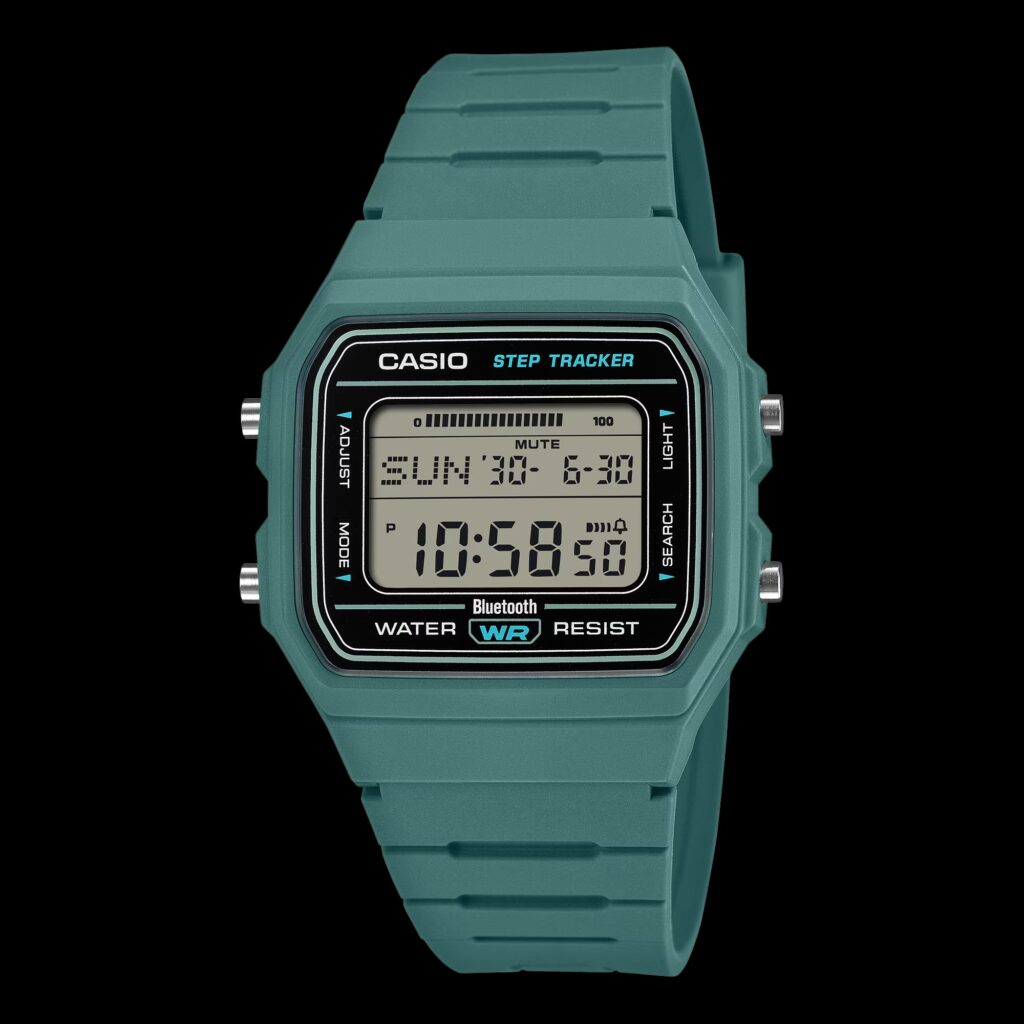 Photo: The F-B100W-1A positive display version retaining traditional LCD and amber LED backlight. Source: Gizmochina
From $95 Steel to $56 Resin: The Downward Cost Engineering Strategy
This is not Casio’s first venture into low-power smart digital watches. The earlier steel-cased ABL-100 retailed for $95, emphasizing a metallic texture and retro Bluetooth experience. By switching to a high-strength resin case for the F-B100W, Casio successfully brought the price down into the $56 range. Bringing smart modules down into an extremely cost-optimized resin enclosure is the crucial step for delivering frictionless smart experiences to the broader mass market.
From a supply chain and tooling perspective, the F-B100W maximizes reuse of the iconic industrial design and injection molding processes validated over nearly 40 years by the F-91W. Rather than expanding the case size to fit the accelerometer, Casio reconfigured the motherboard circuit layout and battery compartment sandwich. This minimally invasive modification of a classic platform guaranteed exceptionally high R&D speed and production yield.
Within a $56 price tier, consumer electronics face stringent bill-of-materials (BOM) constraints. Casio stripped out speakers, vibration motors, and complex touch layers, retaining only a piezo buzzer and the 3-axis sensor. This lean hardware stack eliminates numerous potential failure points while preserving the classic watch’s legendary water-resistant and drop-proof durability.
The Right to Be Left Alone: When “Good Enough” Becomes a Tech Rebellion
In tech communities such as Hacker News, discussions around the F-B100W surpassed 190 comments within hours. Many developers and engineers expressed fatigue over nightly smartwatch charging routines and constant wrist vibrations from work messages and emails. The tech community’s enthusiasm for the F-B100W reflects how offline functionality and low intervention are emerging as a fresh hardware aesthetic in high-stress work environments.
Modern smartwatches attempt to migrate smartphone functionality onto the wrist, transforming it into yet another battleground for human attention. The F-B100W restricts Bluetooth connectivity strictly to utility: it receives zero social media pop-ups, handling only background time calibration and activity step sync. This quiet design restores control of the wrist to the user, redefining the relationship between humans and wearable tech.
For years, the tech industry equated feature accumulation with progress, treating larger screens and more sensors as inherently superior. Yet the surge of interest in the F-B100W proves that subtraction holds immense market power in specific scenarios. When a product solves timekeeping and step tracking at a low barrier to entry, extra features become a burden that bogs down the experience.
Boundaries of Minimalist Hardware and Rational Restraint
Naturally, we should view the limits of minimalist digital watches rationally. The F-B100W cannot replace dedicated sports watches or health monitoring tools. For users requiring continuous ECG tracking, GPS outdoor routing, or wrist calls, full-featured smartwatches remain indispensable productivity tools. Casio’s success in lightweight wearability and ultra-long battery life outlines a viable niche coexisting alongside traditional smartwatches.
Debates in the community over whether buyers are paying for nostalgia or utility are answered by objective usage data. Providing basic step counting and automatic time sync while running two years without a charge completely eliminates battery anxiety. This engineering trade-off—surviving through restraint—demonstrates deep insight from a legacy hardware maker into genuine user needs for battery longevity and lightweight design.
The significance of the Casio F-B100W lies in proving that wearable tech can take diverse product forms. When a 26-gram watch achieves a delicate balance among battery life, weight, and core functionality, market demand answers the arms race. A tech revolution on the wrist does not depend on piling on complex algorithms, but on knowing when enough is enough.
Reference Links:
- Yanko Design Report: Casio Launches Smart F-91W Successor
- Gizmochina Report: Casio F-B100W Official Release
- HN Discussion (item?id=49362887)