In the spring of 2024, semiconductor vendor Zilog officially announced it would stop taking orders for the Z84C00 DIP chip, bringing an end to the 48-year mass production life of the standalone Z80 processor introduced in 1976. While modern GPUs stack 92 billion transistors and push users to upgrade hardware every two years, this 8-bit CPU with just 8,500 transistors quietly powered hundreds of millions of electronic devices across nearly half a century.
This remarkably long lifespan highlights a fundamental engineering reality: technological evolution ultimately converges on extremely cheap, rock-solid infrastructure—until no one needs it to be any faster. When a chip hits the sweet spot of efficiency and cost for a given domain, it escapes the relentless churn of standard upgrade cycles.
The 11-Person Intel Breakaway: Achieving Ultimate Compatibility on a $400K Budget
In late 1974, Federico Faggin and Ralph Ungermann, core engineers who led the development of the Intel 4004 and 8080, left Intel to found Zilog. In April 1975, Masatoshi Shima, the transistor-level designer of the 8080, joined them. Facing severe financial constraints, this 11-person startup had a total R&D budget under $400,000 for the entire project.
At the time, the dominant Intel 8080 required three separate power supplies (+5V, -5V, and +12V) and relied on external logic chips just to refresh Dynamic Random-Access Memory (DRAM). By increasing circuit integration, the Zilog team designed the Z80 to run on a single +5V supply and embedded a DRAM refresh controller directly on-chip.
Requiring only a single 5V line and integrating memory refresh logic eliminated 3 to 5 external logic chips and complex filtering circuits from the motherboard. This demonstrates that in the early microcomputer era, total motherboard procurement cost mattered far more than raw CPU clock speed in determining a product’s commercial survival.
Architecturally, the Z80 featured an 8-bit data bus, a 16-bit address bus, 20 eight-bit registers, and 4 sixteen-bit registers, addressing up to 64KB of memory. It offered full backward compatibility with the Intel 8080’s 78 machine-code instructions while introducing an expanded, highly efficient instruction set of its own.
A shadow register set allowed the system to perform rapid context switching in just a few instructions, drastically boosting interrupt response times. This design enabled software developers to migrate existing code without rewriting, significantly lowering the barrier to entry for terminal application software.
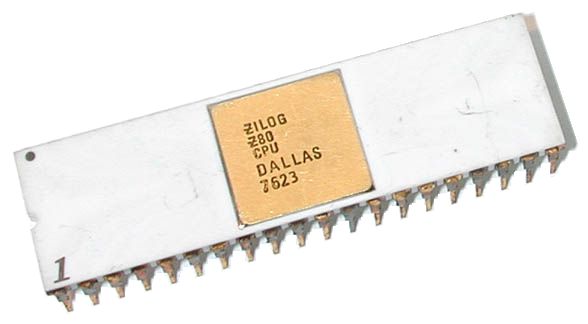 Photo: Physical Z80 chip. Source: Wikimedia Commons
Dawn of the PC Era: Building a Commercial Empire from the TRS-80 to the ZX Spectrum
On March 9, 1976, the first working prototype of the Z80 was delivered on schedule. Combining cost-effectiveness with machine-code compatibility, the Z80 was swiftly adopted as the primary CPU in pioneering personal computers like the Radio Shack TRS-80, Sinclair ZX81, ZX Spectrum, and KayPro II.
Thanks to seamless compatibility with the CP/M (Control Program for Microcomputers) operating system, the Z80 established the bedrock ecosystem of commercial computing from 1979 through the mid-1980s. The Sinclair ZX Spectrum alone sold over 5 million units in the UK, bringing computing into ordinary households at an affordable price and inspiring a whole generation of early programmers.
At a time when motherboard production costs were steep, the Z80’s streamlined peripheral design helped hardware manufacturers cut motherboard costs by nearly 30%. The tight coupling of a rich software ecosystem with low-cost hardware pushed the Z80 to the pinnacle of the 8-bit microprocessor era.
Once a hardware architecture becomes deeply bound to a dominant operating system, the chip’s commercial lifespan is artificially extended by system-level applications. Even as faster processors emerged later, the vast body of legacy software prevented the market from pivoting overnight.
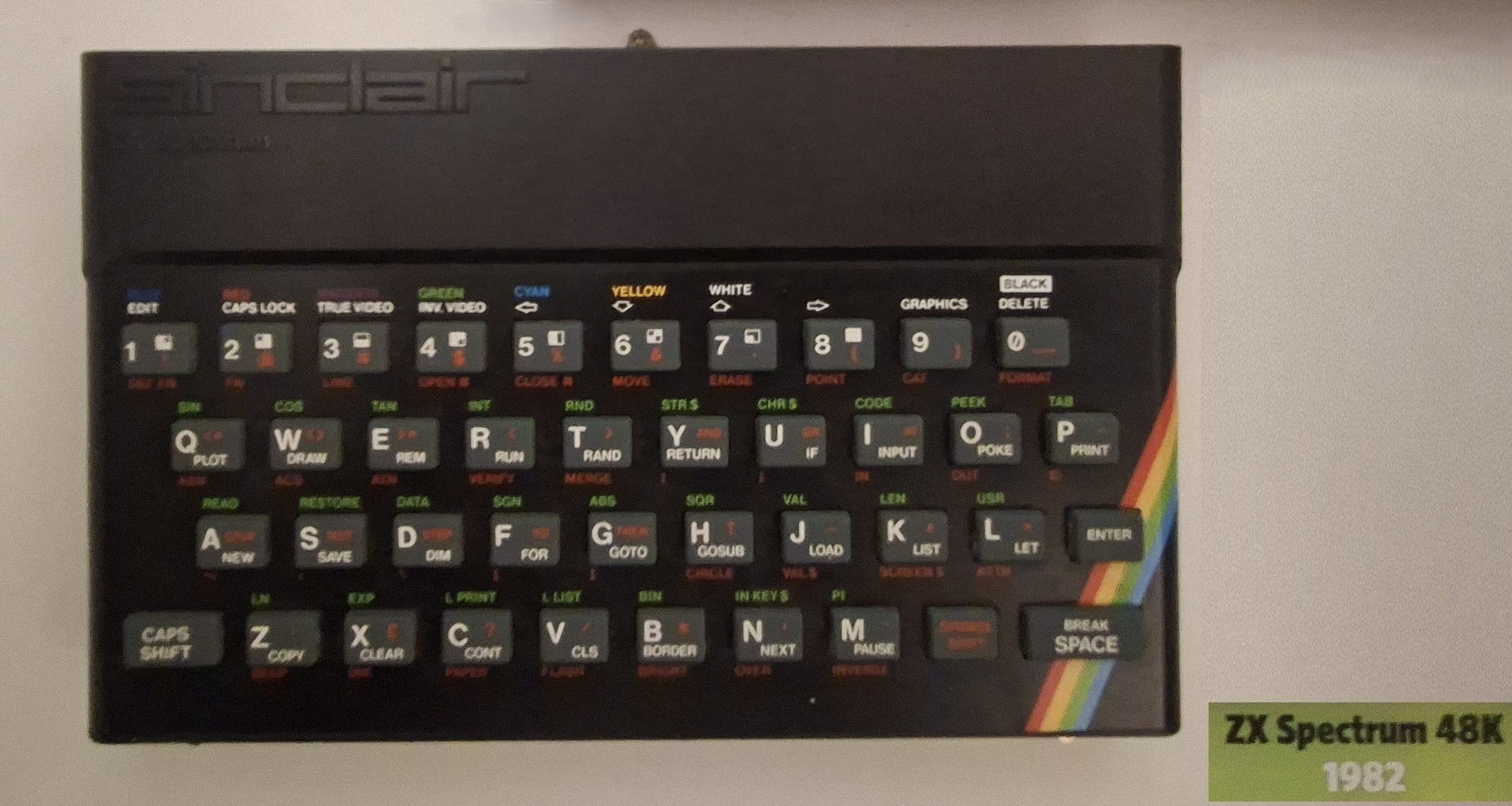 Photo: ZX Spectrum 48K, one of the most famous Z80 home computers. Source: Wikimedia Commons
Vanishing from the Main Stage: A Second Life in the Embedded World
By the mid-to-late 1980s, with the rise of 16-bit and 32-bit processors like the Intel 8086, the Z80 gradually stepped down as the main CPU of personal computers. But as new chips took over general-purpose compute, the Z80 seamlessly transitioned into embedded control, launching a multi-decade invisible second life.
In arcade and console gaming, the Sega Genesis relied on the Z80 as a dedicated sound coprocessor, while Nintendo selected a modified Z80 core for the Game Boy. In educational electronics, Texas Instruments continues to use Z80-derived architectures in its TI-84 and TI-84 Plus graphing calculators today. Furthermore, countless Application-Specific Integrated Circuits (ASICs) embedded the Z80 as a standard logic core inside industrial control systems and home appliances.
Deterministic instruction timing and unit costs of just a few cents gave the Z80 an irreplaceable advantage in applications that didn’t demand raw horsepower. When microprocessor performance outstrips the control requirements of a task, operational reliability and low procurement costs replace the clock-speed race as the core defense of a chip’s longevity.
The developer community has maintained a long-standing enthusiasm for this classic silicon. On Hacker News, tech enthusiasts observed that while the MOS 6502 brought arcade joy to millions using just 3,500 transistors, modern flagship GPUs stack 92 billion. Other developers noted that in today’s world of high-level LLM abstractions, writing Z80 assembly in an emulator remains a sobering, essential exercise for understanding bare-metal mechanics.
The open-source hardware community continues to breathe new life into the chip. From modular computer kits like the RC2014 to the Agon Light retro computer and modern Z80 systems built by FidoNet founder Tom Jennings, developers still relish the joy of bare-metal programming on 8-bit silicon.
Engineering Lessons in the 92-Billion-Transistor Era: Stability as the Endpoint
Spanning from its 1976 debut to its 2024 foundry discontinuation, the Z80’s 48-year production run stands as a marvel of the semiconductor industry. Even though standalone Z84C00 DIP packages are no longer produced, enhanced derivative architectures like the eZ80 and custom embedded ASIC cores will keep running inside devices for years to come.
While the modern semiconductor industry relentlessly chases higher transistor density and aggressive power metrics, the Z80’s longevity demonstrates a different engineering virtue. Once a solution’s cost is squeezed to the absolute limit and its reliability is proven over decades, it settles into the industrial foundation like a standardized screw.
In an industry obsessed with rapid iteration and specs races, the Z80’s half-century saga proves where enduring technical value truly lies. When a design can fulfill its given duty at minimal cost and cannot be simplified any further, it fades permanently into the background of everyday devices—and no upgrade cycle can ever truly displace it.
References:
- IEEE Spectrum Coverage
- Hacker News Community Discussion (item?id=49398158)