Ancient Allies in the Gut: Starting with a Sip of Yogurt
When a person drinks a bottle of yogurt or enjoys dinner, trillions of tiny microbes in their gut are silently at work, helping the body break down food and synthesize essential vitamins. This closely interdependent way of life between animals and microbes is commonplace in today’s natural world. But for a long time, people were accustomed to viewing animals as independent evolutionary subjects, believing that early life completely relied on the evolution of its own organs to adapt to environmental changes.
Biologists have long wondered exactly when animals began to entrust part of their metabolic responsibilities to microbes. In August 2026, a research team led by Wang Zhenfei from the School of Earth Sciences and Engineering at Nanjing University published their findings in the academic journal Proceedings of the National Academy of Sciences (PNAS). The researchers found the oldest known chemical traces of animal-bacteria cooperation in rock samples dating back over 550 million years.
Straw-Thin Petrified Traces: The Seafloor Tube-Dwelling Conotubus
The protagonist of this research is a small marine animal that lived during the Ediacaran period (a geological era about 635 to 539 million years ago, marking the first widespread appearance of complex multicellular animals)—Conotubus (Conotubus spp., a small conical tube-dwelling animal that lived on the seafloor over 500 million years ago). The diameter of its fossilized tube is only a few millimeters, similar to a thin plastic drinking straw used today. On field stratigraphic sections, these fossils look like nothing more than inconspicuous, tiny traces deposited in gray mudstone.
The era in which these tiny creatures lived is over 550 million years ago—a time when there were no plants or animals on land, and the first multicellular life was just beginning to sprout in the vast oceans, more than 300 million years before the first dinosaurs appeared. For a long time, although the scientific community speculated that there might have been some kind of symbiosis (a cooperative way of life where two different organisms live together for a long time, relying on each other or achieving mutual benefit) in early life, there had been a lack of direct fossil evidence in ancient strata before the Cambrian period. The discovery of Conotubus fossils provided precious physical material to solve this mystery.
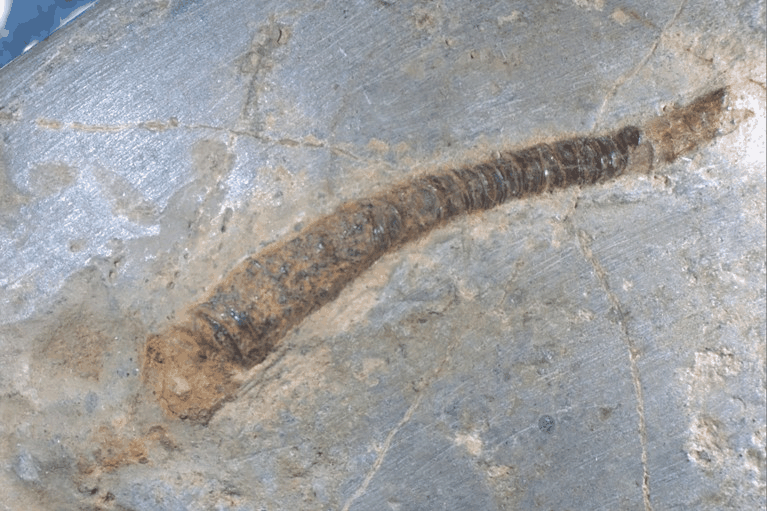 Image: Close-up of Conotubus tube fossils embedded in gray rock. Source: Li & Schiffbauer / Nature
Clues from Elemental Residues: How Multiple Isotope Systems Solved the Case
To search for clues of bacterial activity in a hard rock that has undergone over 500 million years of geological changes, merely observing the physical morphology of the fossils through ordinary microscopes cannot provide a conclusion. The Nanjing University research team employed multiple isotope systems (a method of tracking the dietary and metabolic characteristics of ancient organisms by detecting different atomic mass forms of multiple chemical elements such as carbon and sulfur). The researchers conducted high-precision layer-by-layer geochemical element scanning and comparison on the fossil tube walls and their surrounding micro-regions.
The analysis results showed that the interior of the fossil tube wall retained special chemical signals formed during the pyritization process. The carbon and sulfur isotope values in the tube wall region exhibited extremely significant anomalous deviations, and this unique isotopic signature cannot be attributed to inorganic physical precipitation in ordinary seawater environments. The research team compared fossil samples from multiple different sections, confirming that this chemical anomaly was widespread around the Conotubus tube walls, ruling out the possibility of later geological intrusion and contamination.
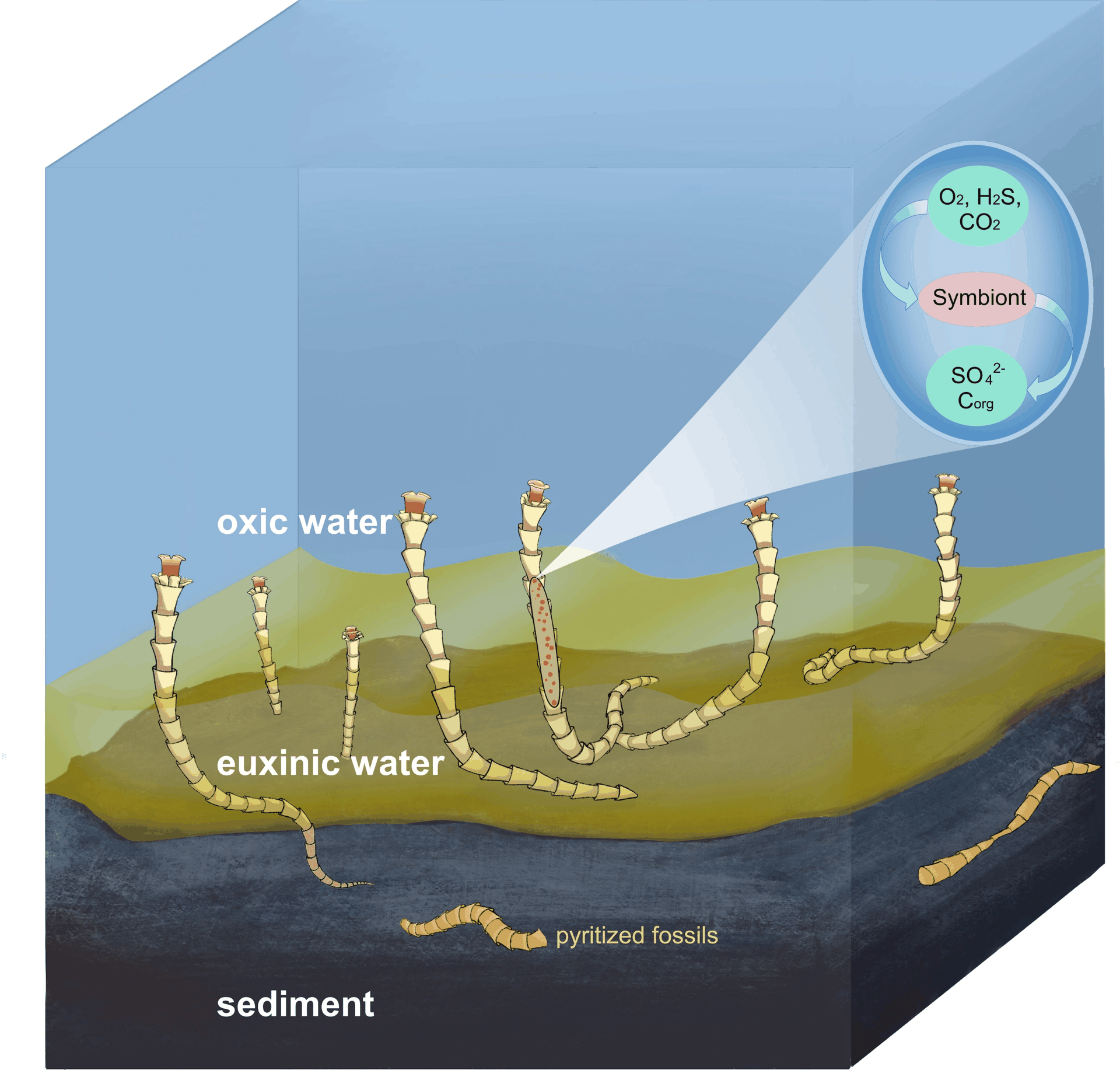 Image: Ecological reconstruction of Conotubus in symbiosis with sulfur-oxidizing bacteria. Source: Jiahao Li / School of Earth Sciences and Engineering, Nanjing University
Outsourcing Part of Life to Bacteria: Survival Strategies of Early Animals
These anomalous isotopic data precisely point to a special mode of biological survival: chemosymbiosis (a symbiotic mode in which an organism relies on chemical-reacting bacteria inside its body or attached to its surface to obtain nutrients). In the ancient seafloor environment lacking sufficient free oxygen, sulfur-oxidizing bacteria (tiny bacteria that can synthesize organic nutrients from inorganic substances by utilizing the energy released from oxidizing sulfides) gathered in large numbers on the tube walls of Conotubus. The bacteria performed chemical metabolism and released energy by absorbing sulfur compounds emitted from the mud and sand, while continuously transporting the synthesized organic nutrients to their host.
Conotubus itself had a very simple body structure and did not develop a digestive system capable of handling complex predation. By relying on the nutritional alliance formed with sulfur-oxidizing bacteria, this tube-dwelling creature did not need to expend a large amount of energy searching for food, enabling it to take root and survive at the resource-poor seafloor sediment interface. This cooperative approach lowered the physiological threshold required for the survival of early multicellular animals, allowing them to win precious living space in the harsh competition of the primordial ocean.
Complex Life Did Not Fight Alone: A 500-Million-Year History of Cooperation
In the past, the mainstream view in the academic community was that the highly specialized symbiotic partnership between animals and microbes was a result that evolved only after the Cambrian explosion, alongside the surge in biodiversity. The international academic journal Nature pointed out in its Research Highlight on this study that the discovery by the Nanjing University team provided the earliest known physical evidence of animal-microbe symbiosis. This achievement pushes the history of cross-species cooperation back tens of millions of years, refreshing our understanding of early evolutionary relationships.
The establishment of the symbiotic relationship between animals and microbes in the Ediacaran period indicates that the origin and evolution of complex life have always relied on cross-species nutritional alliances. Early animals did not face the complex environment of the primordial ocean alone; instead, from the very beginning of evolution, they chose to fight side by side with bacteria from the microscopic world. Those tubular fossils slumbering deep in the rock layers clearly record that: as early as over 500 million years ago, life had already mastered the survival wisdom of win-win cooperation.
References:
- Nature Research Highlight Report
- News Report by the School of Earth Sciences and Engineering, Nanjing University
- PNAS Original Paper e2526201123