
The Expensive “Single Byte”
In the tech world of 2026, companies are frantically purchasing servers for compute and memory. But inside the data centers of web infrastructure giant Cloudflare, engineers halted expansion and instead scrutinized low-level code to hunt down wasted bytes.
Cloudflare’s DNS system, “Big Pineapple”, processes a massive volume of global web requests daily. With over 250 billion cache entries, in the face of such astronomical numbers, wasting just 1 byte means the cluster consumes an extra 250GB of memory.
 Image: Cloudflare service node distribution. Source: Cloudflare Blog
Compared to AI models demanding terabytes of VRAM, a few hundred gigabytes might sound trivial. However, for low-level systems requiring ultra-fast responses, bloated memory not only brings expensive hardware bills but also leads to unacceptable latency.
Pixel-Level Squeezing
Confronting this resource waste, they took the most hardcore approach: extreme memory layout optimization at the Rust language level. This is akin to reorganizing the shelving structure in a packed warehouse to forcefully free up a large empty space.
Conventional practice involves using dynamic arrays (Vec) or strings (String) to store data. These types come with a “capacity” field, reserving space for future expansion. Cloudflare engineers replaced all of them with fixed-length Box<[T]> and Box<str>, directly severing the waste of reserved space.
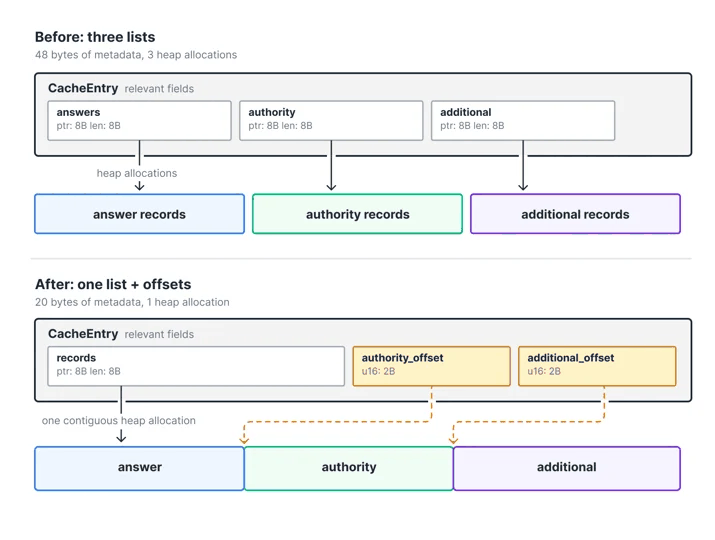 Image: Memory structure comparison before and after removing the capacity field of dynamic arrays. Source: Cloudflare Blog
They also refactored data structures, merging multiple scattered lists into a single list and using offsets for precise positioning. If a queried domain matches the record owner, the system outright drops the owner field. Through this combination of maneuvers, the memory footprint per cache entry was slashed by more than 50%.
A Win-Win for Performance and Cost
This extreme frugality yielded staggering returns. Five consecutive optimizations cumulatively freed up about 100TB of memory. This is equivalent to the total memory of 130 Gen 13 servers.
This not only saved a massive amount in server procurement costs but also significantly boosted overall system performance. More compact data structures led to higher CPU cache hit rates, ultimately increasing the system’s insertion throughput by 43% and reducing query latency by 19%.
System optimization seems to have become a niche craft in this era. Yet, facts prove that immense power still hides within those overlooked low-level details.
The Forgotten Lever
100TB of memory was squeezed out line by line by engineers. In this era of crazed hardware stacking, Cloudflare has given everyone an old-school lesson.
Everyone is used to solving compute bottlenecks with cash, easily leaving fundamental code quality behind. When we talk about hundred-billion parameter models and ten-thousand GPU clusters, perhaps we should look down at the invalid bytes sleeping in memory.
The intuitive data from Cloudflare’s 100TB memory release proves one fact. In an age where everyone is burning money on AI, classic system optimization remains the largest, most overlooked cost lever. Rather than blindly piling on hardware, it is better to re-examine the infrastructure beneath our feet. I believe this is the most powerful response system engineers can give in this era.
References:
- Cloudflare Blog