On a kitchen windowsill in Bergen, Norway, sits an electronic picture frame. When the crisp chirp of a bird occasionally drifts in from outside, the screen quietly refreshes, revealing a natural history print from the 1800s.
This personal open-source project, named Fugleramme, scored 1190 points on Hacker News today, shooting to the number one spot across the site. The repository’s stars surpassed 1400 in just a few hours and received 34 forks.
It bypassed the currently popular large parameter models. All the work is cleanly divided: listening to audio is handed over to a traditional audio classification network, and visual presentation relies entirely on authentic historical paintings from the public domain. The developer’s original intention was direct and clear: he just wanted a poster that could display what birds are currently in his garden in real time.
Audio Classification Beats General-Purpose LLMs in Bird Calls
In an era where every requirement yearns to be integrated with a Large Language Model (LLM), Fugleramme chose a different path. It stuffed an audio classification program called BirdNET-Go into a Raspberry Pi. This is a traditional neural network built specifically for recognizing bird calls. Its workflow is remarkably simple: it only listens to the microphone, determines the bird species, and outputs the result to the frontend page.
General-purpose LLMs appear quite clumsy when handling such tasks. Developers in the community who have run actual tests concluded that general LLMs with audio input basically treat audio as material for text transcription. They cannot hear the texture of music, distinguish the accents of birds, let alone isolate complex background noises in nature. Assigning a clear classification job to a dedicated small model costs far less in compute, while the recognition accuracy increases exponentially.
Some community members dug deeper into this tech stack and found that BirdNET-Go can now even mount the Google Perch v2 model, and some hardcore players have even integrated bat sound recognition models. When facing specific, bounded tasks, exchanging compute overhead and poor response speed for generalized capabilities is often a bad deal.
800 Vintage Prints over Machine-Generated Art
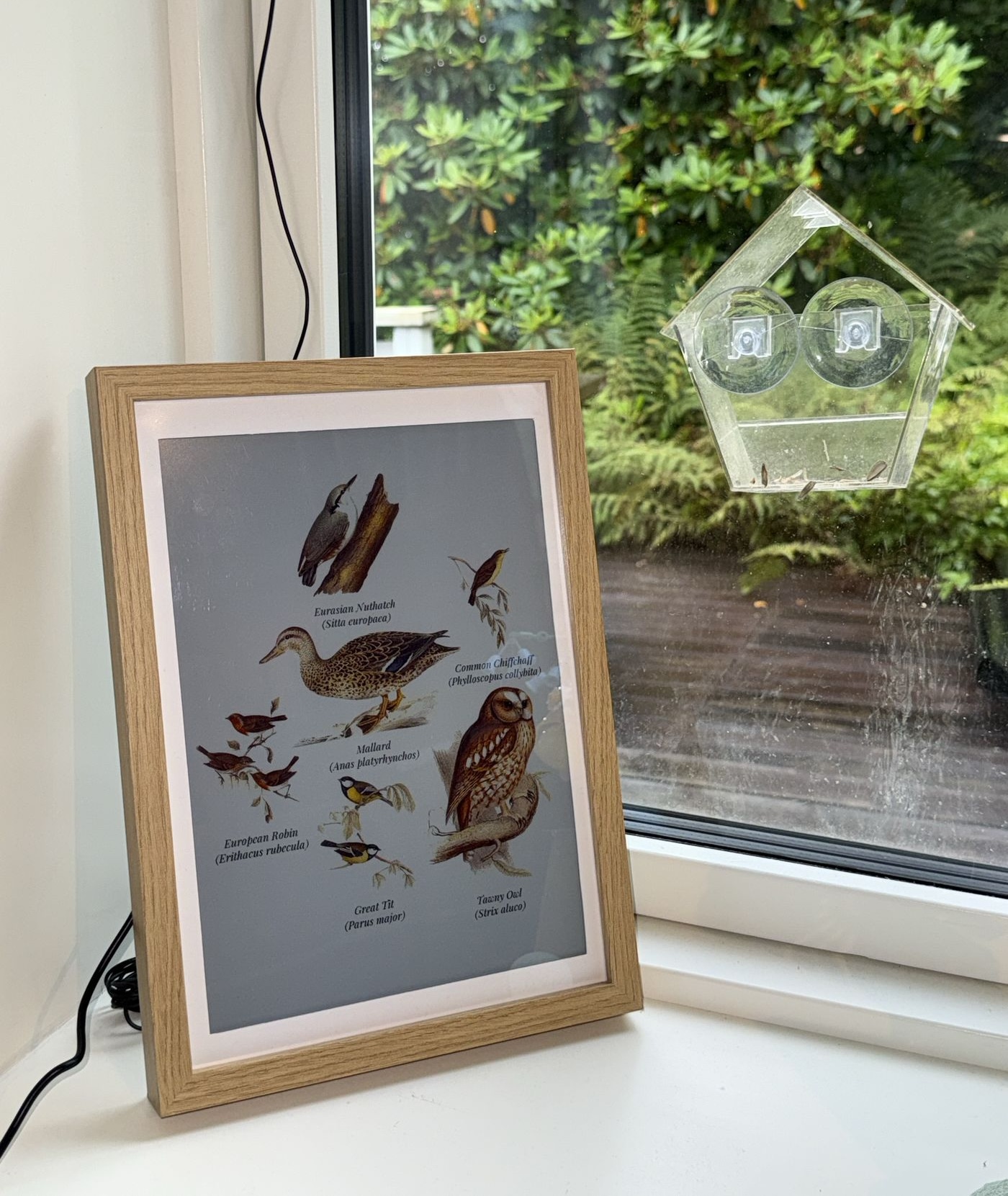 Image: The picture frame on a kitchen windowsill, displaying six birds heard in the garden. Source: arnegiacomo, fugleramme repository
Every bird displayed on the screen comes from the genuine accumulation of human history. The developer manually filtered over 800 19th-century natural history prints covering more than 400 species. These images were originally sourced from public domain archives in Scandinavia, Britain, and Central Europe, and were individually processed by hand before being added to the project’s library.
Visual aesthetics demand this kind of authentic historical weight. Generating hundreds of bird images using a diffusion model takes only a few lines of code, but the pixel-perfect output from machine calculations often carries an inescapable, homogenous plastic feel. Hand-crafted prints bring an accuracy and elegance polished by time, and even carry the reverence of early naturalists observing nature—a temperament that machines cannot simulate.
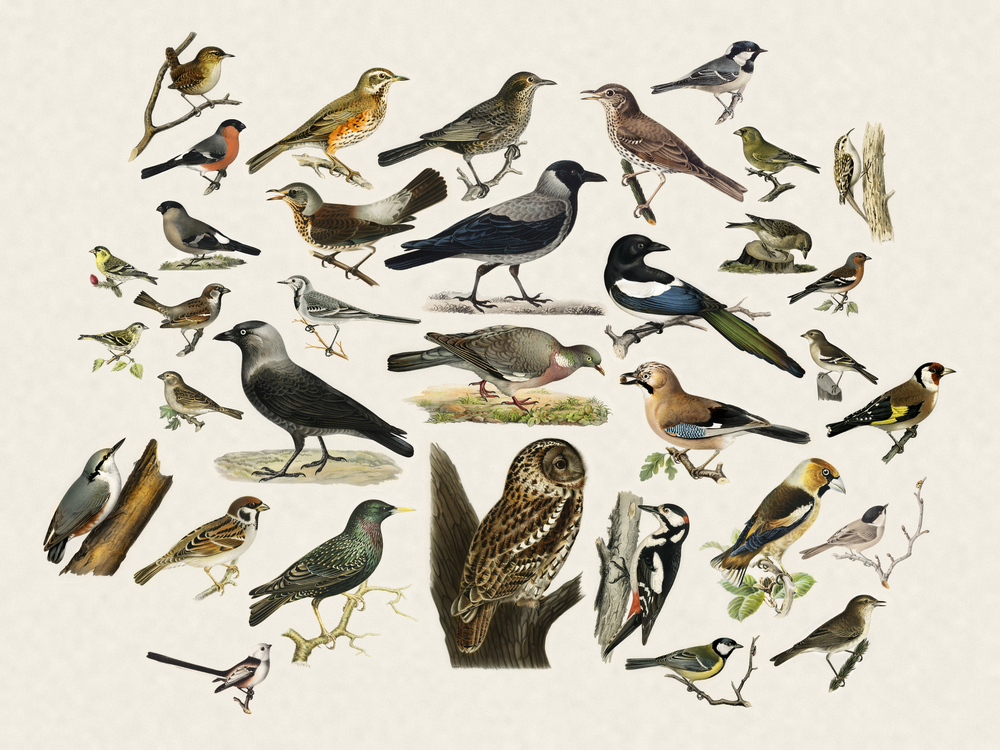 Image: Full-page illustrations arranged by weight, with the largest bird in the center. Source: arnegiacomo, fugleramme repository
The frame’s layout logic exudes a finely crafted feel. The frontend page determines the size of the illustrations on the screen based on the bird’s actual weight, placing larger birds closer to the center. When there are no birds in the garden, the frame displays nothing but an empty branch, quietly waiting for the next visitor.
Embracing Physical Constraints with Minimalist Screens
To make the frame truly blend into a kitchen environment, the project uses a 13.3-inch Spectra 6 six-color e-ink display. The physical limitations of e-ink screens are very obvious: they refresh extremely slowly, with a noticeable pause during image transitions. Fugleramme works with this flaw; the frame polls the API for current bird information and only redraws the entire layout when a new bird species appears in the garden.
This restrained refresh strategy resolves the display latency issue while dramatically extending the device’s deployment radius. Hacker News e-ink enthusiasts did the math: if a Bluetooth Low Energy (BTLE) screen refreshes only a few times a day, a 2000 mAh battery is enough to keep such devices running for years.
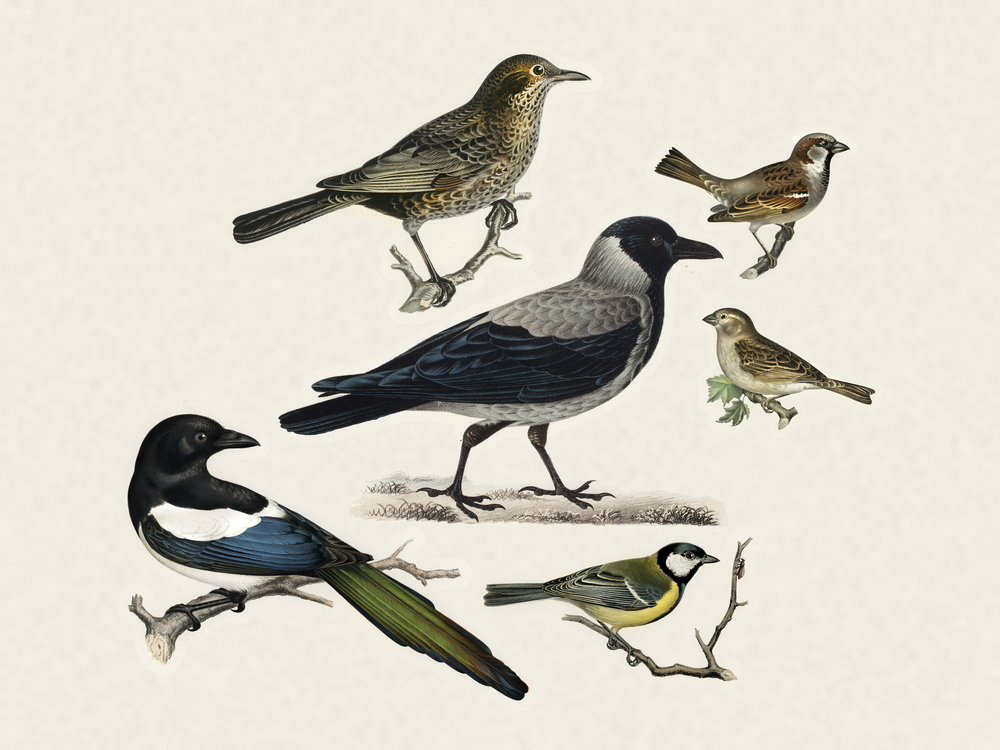 Image: Layout when there are only a few visitors. Source: arnegiacomo, fugleramme repository
Under the right application scenarios, hardware shortcomings can be cleverly transformed into advantages. The picture frame doesn’t need to emit light constantly like an LCD screen; it only reacts when a guest visits. This sense of quiet companionship perfectly aligns with the essence of birdwatching.
Pushing Compute to the Edge Changes Deployment Boundaries
If a multimodal LLM were used to achieve the same listening functionality, even via a cheap cloud API, the environmental audio from the kitchen windowsill would need to be continuously streamed to the cloud. This creates two engineering hurdles: the reliance on an always-on internet connection and a steadily accumulating cloud bill. In Europe, where privacy awareness is particularly strong, connecting a home microphone to a cloud LLM 24/7 is a system design bound to spark controversy.
Fugleramme achieved pure local computation using a Raspberry Pi 5. The BirdNET-Go model is small enough to run smoothly on the Raspberry Pi’s ARM architecture without a single byte of data ever leaving that kitchen windowsill.
This edge computing approach pushes compute down to the closest point of the scenario. With no need for an external network and zero cloud bills, the system can survive independently once the user buys the hardware. Amidst an AI wave that frequently demands gigabit fiber and server clusters, this offline system running on a windowsill demonstrates incredible resilience in engineering design.
Community Consensus Validates Genuine Needs
In the over 160 comments on Hacker News, the top-voted discussion starts by correcting the misconception that the project uses an LLM. The dominance of traditional neural networks in specific vertical domains is fully acknowledged here.
The project’s starting point was very specific: the author had a WWF bird poster on his wall and wanted a living poster that showed what birds were currently in his garden. The need preceded the tech selection, so the right components were chosen at every step.
This demand-driven selection is the exact opposite of building a hammer first and then looking everywhere for nails. Solving the most specific problems with the most suitable tools is far more effective than stuffing a universal model into every scenario.
Returning Traditional Components to Their Essential Tasks
Fugleramme is still in its early stages, and the developer admits in the documentation that there are plenty of bugs in the code. The project provides a Docker image, a one-click install script, and even includes a pure Web Kiosk mode for users without e-ink displays.
The fact that this project claimed the top spot on Hacker News comes down to its precise dismantling of the task. It places different components in exactly the right places. When the entire tech industry is caught in an arms race of whose model has more parameters and who is more versatile, this picture frame on a Norwegian windowsill offers a sobering alternative solution.
Breaking down complex tasks, letting a dedicated audio network handle recognition, and letting historical prints handle beauty—products built by subtraction can equally conquer a picky tech community. Returning components to their essence and interlocking the right gears in the right places is far more captivating than blindly chasing frontier technology.
Reference links:
- HN Discussion (item?id=49711544)
- fugleramme repository