
2,039 Points on Hacker News: A Raspberry Pi Unlocks Ambient Interaction
On September 17, 2026, Fugleramme—an open-source electronic picture frame project that transforms birdsong into 19th-century vintage botanical illustrations—soared to the top of Hacker News, racking up 2,039 points and 236 comments. Hanging on a wall, this 13.3-inch display requires zero network API calls. It passively listens to the backyard, quietly rendering a vintage illustration whenever a bird chirps outside.
The underlying hardware combines a Raspberry Pi 5 with an Inky Impression 13.3-inch six-color E Ink panel. Paired with a standard A4 picture frame and an off-the-shelf USB microphone, the complete bill of materials reaches €500. This pricey collection of electronic building blocks is not designed to push high-frame-rate animations; its sole responsibility is to maintain continuous audio detection in a tightly bounded domain. By concentrating compute entirely on ultra-low-frequency refreshes, the device’s hardware lifespan is dramatically extended.
Fugleramme embodies a restrained engineering aesthetic. At the base layer, a continuous BirdNET-Go background process monitors the microphone 24/7, extracting acoustic features and performing classification. An upper-layer Python process periodically polls an internal API for identification results, mapping detected species names against a bundled, CC-BY-SA licensed illustration repository. Only when a newly identified species appears does the E Ink screen trigger a slow, full-panel refresh. Favoring polling over complex bidirectional real-time sockets drastically decouples inter-process state, ensuring the unattended wall display can run reliably for months.
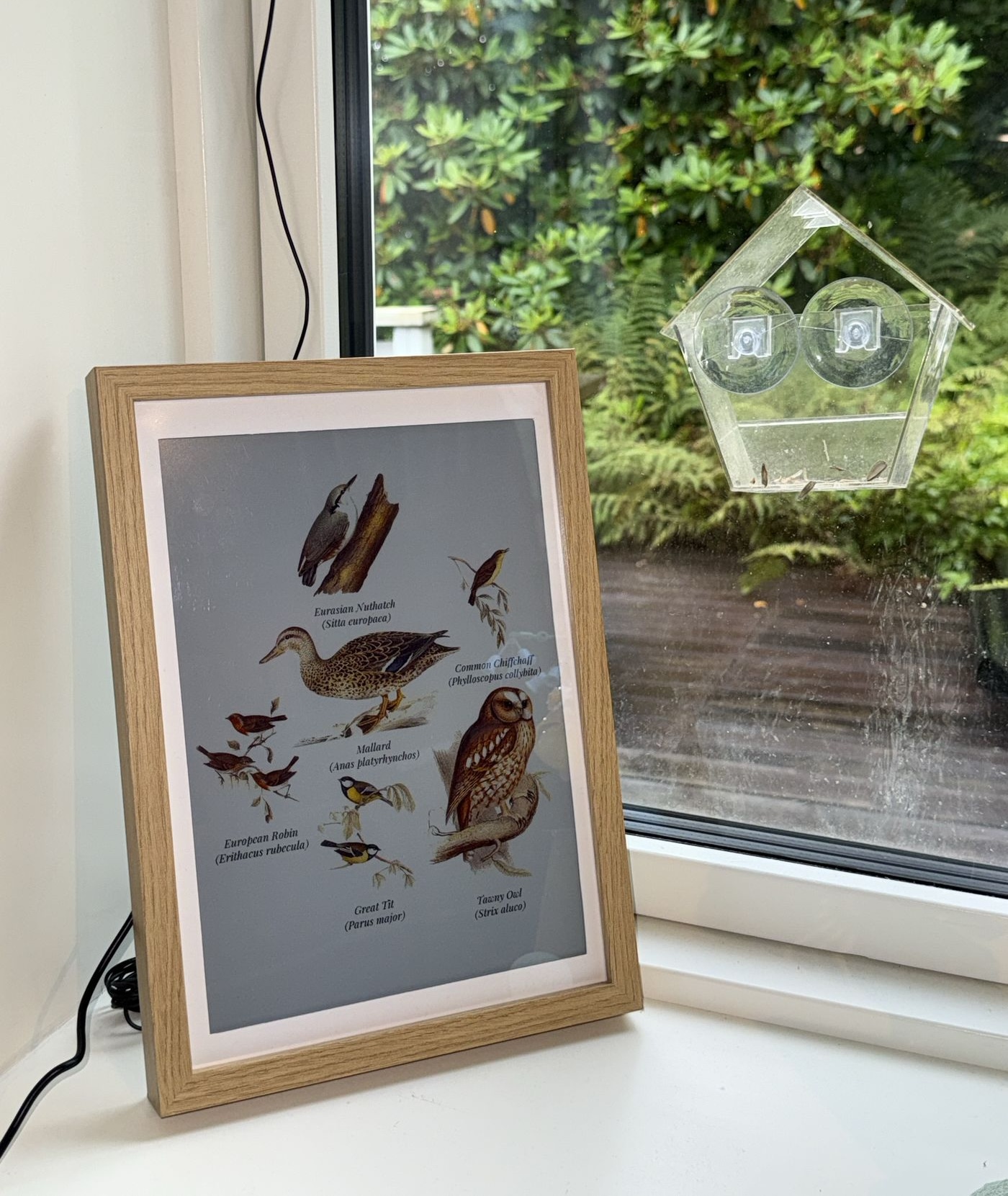 Figure: The Fugleramme wall-mounted picture frame. Source: GitHub arnegiacomo/fugleramme
Ditching General LLMs: Audio Classification Returns to Classic Neural Networks
Powering the entire listening and recognition pipeline is a dedicated small model called BirdNET, rather than any of the massive, venture-funded Large Language Models dominating tech headlines. Originally published in 2021 in the journal Ecological Informatics, the research highlights a fundamental distinction in acoustic processing: birdsong identification is fundamentally an acoustic fingerprinting and pattern matching problem. Funneling this problem into a hundred-billion-parameter general-purpose multimodal LLM simply creates a computational black hole.
On Hacker News, one developer punctured the hype surrounding multimodal LLM audio capabilities with real-world benchmarking. Most current open-weight multimodal models merely treat audio input as a precursor to text transcription. Feed them forest field recordings filled with complex ambient noise, and they frequently fail to differentiate music, accents, or rustling leaves. Because their training pipelines forcibly couple audio embeddings with textual tokens, their model architectures fundamentally miss out on learning weights optimized for non-human acoustic features.
BirdNET takes a thoroughly classic Convolutional Neural Network (CNN) approach. It converts continuous audio streams into spectrograms, delegating visual pattern recognition models to match texture features across bird calls lasting just a few hundred milliseconds. By focusing exclusively on narrow, specialized datasets, this dedicated model easily outperforms bloated general-purpose models on a micro single-board computer. When navigating ambient environmental acoustics in the physical world, the parameter efficiency of a traditional small model far surpasses massive multi-billion-parameter architectures.
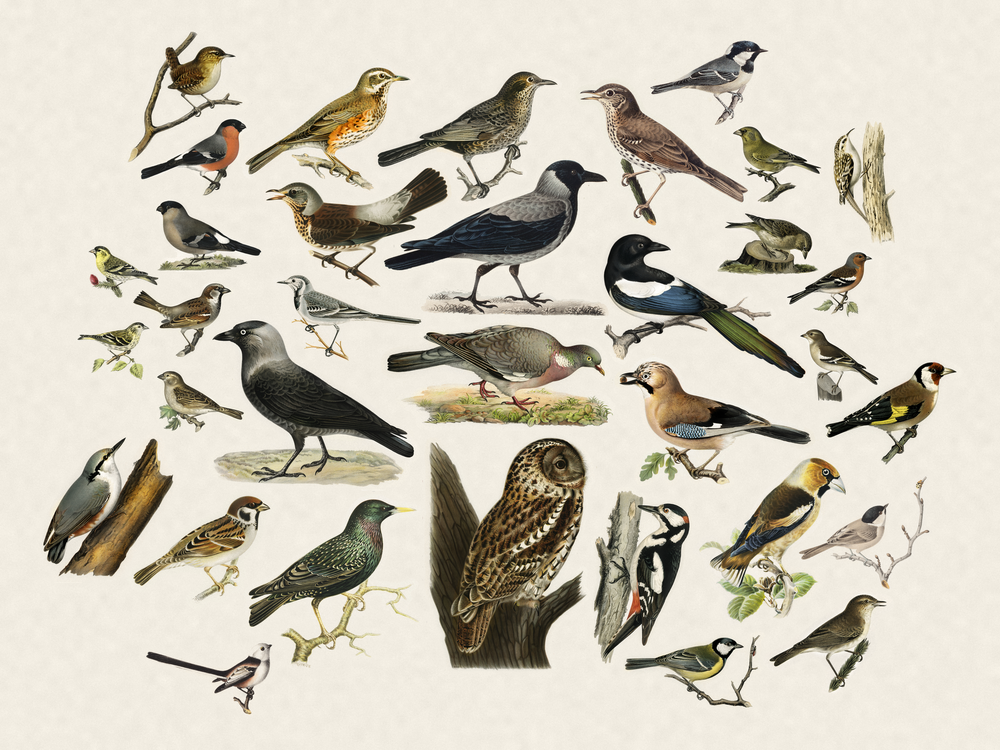 Figure: Dynamic multi-grid layout when multiple bird species appear simultaneously. Source: GitHub arnegiacomo/fugleramme
Deconstructing the €500 BOM: Breaking the Color E-Ink Monopoly
The project’s primary engineering obstacle lies in its steep €500 price tag. For a single-purpose indoor ambient display, that cost exceeds the casual tinkering budget of most hobbyists. Analyzing the bill of materials reveals that virtually the entire price premium is absorbed by the 13.3-inch Spectra 6 color E Ink panel. Large-format color electronic paper remains constrained by upstream supply chain monopoly pricing, directly limiting the adoption rate of physical open-source hardware builds.
| Hardware Component Layer | Current Estimated Cost | Hacker Cost-Cutting Alternative | Adjusted Estimated Cost |
|---|---|---|---|
| Compute Core (Raspberry Pi 5) | €120 | Used Raspberry Pi 4 / 3B | €40 |
| Display Output (13.3” Color E-Ink) | €350 | Used Kobo E-Reader + Cobalt | €110 |
| Audio Capture & Power Module | €30 | Spare generic USB peripherals | €15 |
| Total Build Cost | €500 | Used Parts DIY Build | €165 |
In the discussion threads, developers outlined architectural paths to decouple the display layer. Fugleramme’s rendering engine is not hardwired exclusively to the physical E Ink screen. Without that high-end panel, the system gracefully falls back to an internal Web Kiosk server. Users can connect any spare HDMI monitor or simply open the local network URL on a smartphone browser, preserving the vintage illustration layout intact. For those determined to keep the glare-free, paper-like aesthetic of E Ink, picking up a used Kobo e-reader for around $120 and flashing it with the Cobalt browser to display the full-screen web app cuts the total hardware bill by more than 60%.
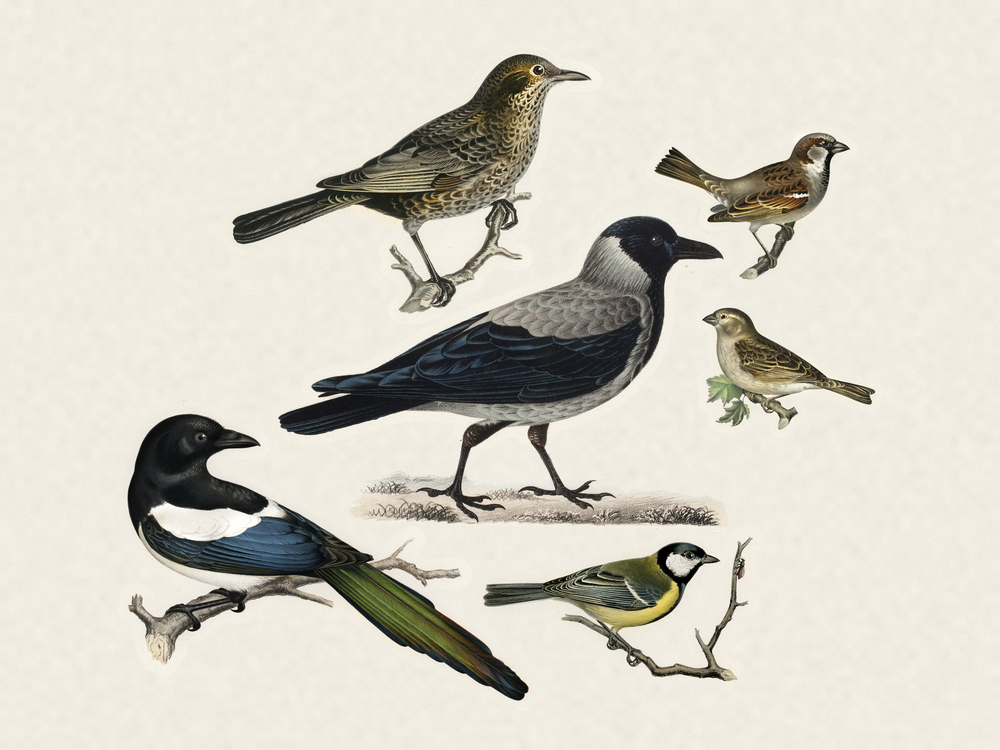 Figure: Focused layout for days with fewer bird visitors. Source: GitHub arnegiacomo/fugleramme
Local Inference Draws the Privacy Line: 24/7 Ambient Listening Stays at Home
Keeping a high-sensitivity microphone continuously active is an undeniable privacy minefield for smart home appliances. Fugleramme resolves this tension by completely severing outbound inference requests. Backyard audio feeds pass directly from the USB microphone into the Raspberry Pi, where feature extraction, scoring, and classification occur entirely inside the local BirdNET-Go process. Not a single byte of raw environmental audio is uploaded to cloud servers in exchange for species tags.
The project began from a simple personal desire: the author wanted an ambient dynamic poster displaying birds visiting his garden, inspired by Axel Thorenfeldt’s vintage prints for the WWF. While similar projects like AvianVisitors or birdframe on Samsung Frame TVs rely to varying degrees on external cloud APIs, Fugleramme contains the entire pipeline—from audio capture and pattern matching to final layout rendering—entirely on the edge. This design achieves an airtight privacy standard equivalent to an air-gapped system.
The flip side of a dedicated model is its content bottleneck: illustrations must be manually curated one by one. The built-in art library currently focuses on common species found in the UK and Northern Europe. Hanging this frame in a California backyard would leave many American species accurately identified by BirdNET without matching artwork, resulting in blank spots on the display. While cloud LLMs can scrape Wikipedia in real time to assemble global species trivia, mapping hyper-local avian subspecies to CC-BY-SA vintage illustrations still relies on painstaking community contributions.
Narrow Tasks Reshape Edge Compute Economics
The modern software industry has developed a reflex of routing every text box and microphone array directly to unified cloud AI APIs. Yet for focused scenarios like backyard birdsong—where the input domain is tightly constrained and exhibits strong regional characteristics—traditional machine learning models reclaim their home turf in the physical world. With weight files measuring only dozens of megabytes, these models consume less than one percent of the VRAM demanded by general-purpose LLMs, while delivering signal-to-noise separation that generalist models still struggle to match in specific acoustic environments.
Fugleramme topped Hacker News not because of flashy UI gimmicks, but because it provides a counter-narrative blueprint for hardware engineering. When addressing concrete, localized edge interaction, developers do not need to pay per token to ping a 70-billion-parameter behemoth. Finding a battle-tested, high-quality specialized convolutional model, squeezing it onto a sub-10-watt single-board computer, and architecturally ensuring that audio never leaves the local network is a winning formula. As cloud compute consolidates relentlessly into hyperscale data centers, the pairing of small models and edge hardware wins both the hardware economics bill and the non-negotiable battle for user privacy.
Reference Links:
- GitHub Repository: arnegiacomo/fugleramme
- Hacker News Discussion (item?id=49711544)
- BirdNET Paper (Ecological Informatics, 2021)
- Inky Impression 13.3” Display
- BirdNET-Go