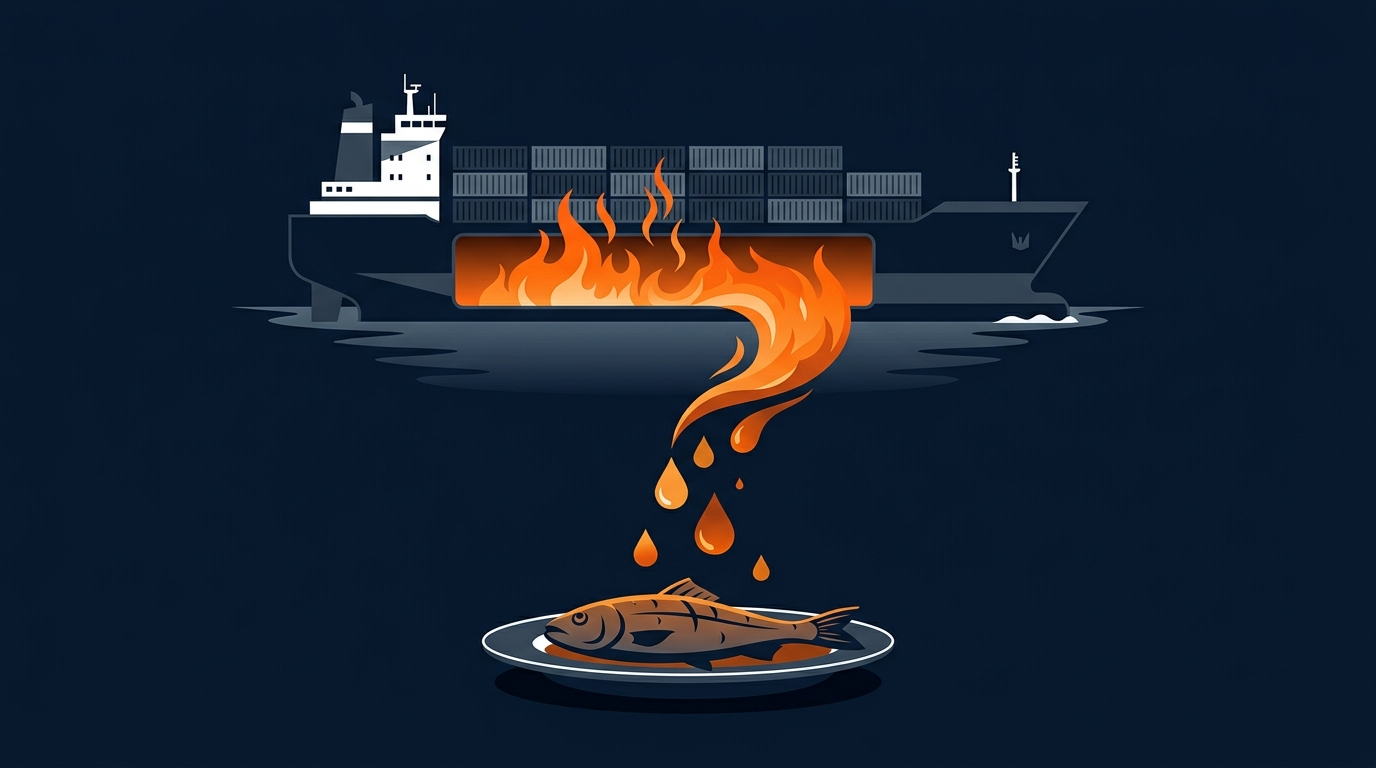
Between the 1950s and 1970s, cargo ships transporting fishmeal suffered at least 87 spontaneous combustion incidents across the globe. At the height of the crisis, as many as 16 vessels were catching fire at sea each year. To save ships and crew lives, multinational agribusinesses introduced an industrial chemical additive into animal feed. That compound was ethoxyquin—a synthetic antioxidant originally developed to protect rubber from aging.
Fifty years later, that cargo hold fire retardant has washed ashore, flowing straight through the aquaculture supply chain and onto dinner plates worldwide.
A Fire Every Three Weeks: How Ocean Disasters Forced a Chemical Mandate
In maritime transport history, bulk fishmeal was notoriously volatile. Rich in protein and highly polyunsaturated fatty acids, thousands of tons packed into unventilated cargo holds would steadily oxidize upon contact with air, generating intense heat.
Without ventilation to disperse the warmth, the core temperature of the dry powder would rise until it reached its ignition point, bursting into flames with zero warning. As hulls burned and sank, maritime underwriters grew so alarmed that some refused to insure untreated fishmeal shipments altogether.
 Figure: A fishmeal cargo vessel engulfed in flames from spontaneous combustion in 1966. Source: Inside Climate News
In 1967, American agribusiness giant Cargill announced an engineering countermeasure: treating bulk fishmeal with ethoxyquin. Originally formulated to prevent rubber tires from perishing, ethoxyquin—which Cargill clarified in statements it did not invent—acted as a potent scavenger of peroxyl free radicals, possessing chemical stability far superior to natural tocopherols.
Spraying small amounts per ton onto freshly milled fishmeal halted the chain reaction of oxidation. Following its widespread adoption, shipboard fires plunged to roughly five a year worldwide. The maritime peril was quelled, and an institutionalized fire barrier was erected across ocean transport.
Locked in Maritime Code: How Aquaculture Brought a Ship Preservative to the Table
Once the technical efficacy was proven, regulatory bureaucracy codified it permanently. In 1976, the U.S. Coast Guard issued a mandatory rule requiring all bulk fishmeal entering U.S. ports to be pre-treated with ethoxyquin.
Three years later, the International Maritime Organization (IMO) updated its dangerous goods regulations, officially designating ethoxyquin as the benchmark stabilizer for maritime transport of fishmeal. Maritime regulators operated on a singular mandate: navigation safety and vessel integrity. In the shipping ledger, preventing ships from burning outstripped every other priority.
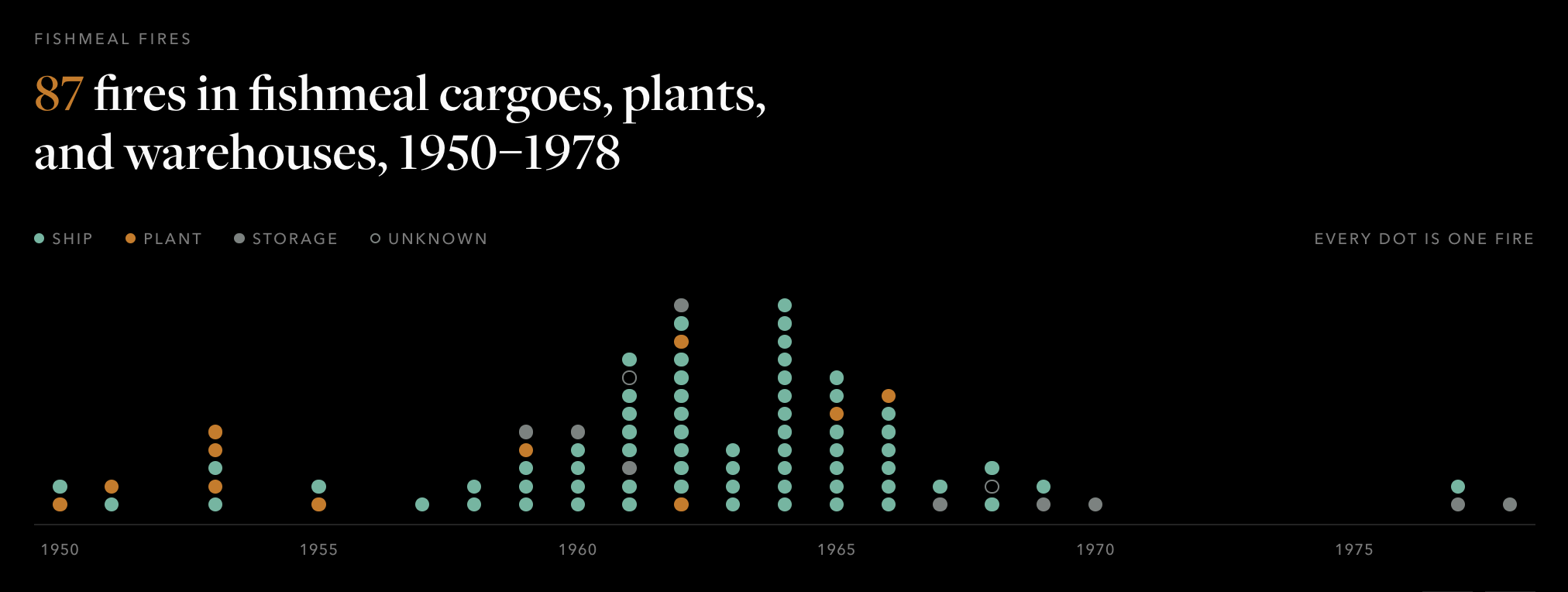 Figure: Frequency of fire incidents across fishmeal transport chains between 1950 and 1978, showing a sharp drop after antioxidant treatment. Source: Inside Climate News
This strict directive locked the synthetic additive directly into processing lines. Without chemical treatment, bulk fishmeal could not even secure seaworthiness certification. In those early decades, fishmeal served primarily as livestock and poultry feed, where prolonged animal life cycles and terrestrial diets kept chemical accumulation relatively unnoticed.
By the 1990s, however, wild fisheries approached biological limits, and industrial aquaculture exploded. Today, more than half of all seafood consumed worldwide is raised in net pens and aquaculture ponds. High-value carnivorous species such as Atlantic salmon, sea bass, and shrimp rely heavily on protein-dense feed pellets. The very antioxidant once mandated to keep cargo ships from incinerating entered the dietary core of farmed seafood.
Mutagenic Impurities and Transatlantic Divergence
Unease within food toxicology was not entirely new. As early as 1969, a joint UN expert committee flagged potential risks of additive bioaccumulation. In 1987, British toxicological feeding trials showed hepatic and renal damage in laboratory rats after long-term ingestion.
Early rodent studies failed to shake entrenched industrial distribution networks. It was not until 2015, when the European Food Safety Authority (EFSA) completed a systematic safety re-evaluation, that concerns crystallized into regulatory action. EFSA researchers found that industrial synthesis of ethoxyquin generated persistent impurities, most notably p-phenetidine.
In vitro cellular assays confirmed that p-phenetidine poses recognized mutagenic risks, inflicting potential DNA damage. Furthermore, metabolic byproducts in farmed fish accumulated within lipid tissues. Faced with fresh toxicological evidence, European regulators took decisive action.
In 2017, the European Union suspended authorization of ethoxyquin in animal feed. The UK, Norway, and other EEA jurisdictions quickly followed suit with full bans. In stark contrast, regulatory bodies in the United States, Japan, Australia, and South Korea have maintained decades-old tolerances. The U.S. FDA continues to permit defined chemical residues in fishmeal and aquaculture feeds.
Enforcement capacity has also eroded. A 2024 EU audit of Canadian regulatory oversight revealed that authorities had performed only around 40% of planned feed inspections, with auditors documenting what they termed “systemic and serious shortcomings” in enforcement.
The Cost of Alternatives: A Global Standoff Over Who Pays
The Transatlantic regulatory divide illuminates a broader deadlock across global supply chains: replacing an entrenched chemical requires capital investments that few players are willing to finance alone.
Alternatives exist on laboratory benches. Mixed tocopherols and rosemary extracts have long demonstrated viable antioxidant properties. Yet natural extracts remain significantly more expensive and degrade more rapidly under the intense ambient heat of tropical shipping routes. The cheaper alternative within conventional processing remains BHA (butylated hydroxyanisole)—an equally contentious synthetic compound.
BHA carries its own baggage: the U.S. National Toxicology Program classified BHA as “reasonably anticipated to be a human carcinogen” back in 1991, Japanese researchers induced forestomach tumors in rodents in 2008, and the FDA announced in February 2026 that it would re-evaluate BHA’s safety status as a food additive. In South America, Peru and Chile dominate global fishmeal exports. Local processing mills face an economic dilemma when shipping abroad.
As the head of Peruvian fishmeal firm MSICeres explained during an industry webinar in 2022, market demand has shifted rapidly away from ethoxyquin, starting locally: shipments leaving Peru for Europe, Canada, the United States, and Australia are now entirely ethoxyquin-free, with British and Norwegian buyers demanding the same. Yet many export operations continue running dual production tracks, channeling chemically treated fishmeal into Asian and Latin American markets where regulations remain permissive.
This regulatory patchwork lands directly on supermarket shelves. In European supermarkets, farmed seafood is certified free of ethoxyquin residues; across the Atlantic or Pacific, identical species containing traces of the compound remain fully legal for retail sale.
Legal liabilities mount whenever treated seafood carries “sustainability” marketing. In the United States, around half a dozen lawsuits have targeted corporate greenwashing. In 2022, New York consumers brought a class action against Aldi, alleging its Atlantic salmon was deceptively marketed as “sustainable” despite containing ethoxyquin residues; that same year, plaintiffs in New York and California sued Gorton’s over “sustainably sourced” frozen tilapia carrying the chemical. Both cases settled out of court.
Locked In by Safety Rules: Why Outdated Additives Linger
Looking back over half a century, ethoxyquin exemplifies institutional lock-in. Elevating a chemical compound into an indispensable industrial fixture takes just one dramatic safety catastrophe.
Vessels burning at sea prompted maritime authorities to mandate fire-retardant stabilizers. That administrative edict carved a specific chemical formulation into shipping standards. Maritime regulators focused on ensuring ships stayed afloat and ports did not burn. Food safety agencies, meanwhile, require decades of painstaking epidemiology to quantify the risks of trace chronic intake.
By the time definitive toxicological warnings arrive, legacy chemicals have become load-bearing pillars of global commerce. Overturning established standards carries enormous friction: maritime seaworthiness must be re-tested, and premium natural alternatives require sustained subsidies.
Maritime agencies have little incentive to rewrite fire safety codes, multinational grain giants resist absorbing retooling costs on their own, and regulators outside Europe often favor regulatory inertia. The retirement of industrial chemicals is rarely governed by discoveries under a microscope; rather, it hinges on who is forced to write the check.
As long as the cost of regulatory re-evaluation remains unassigned, the legacy additive will persist. Formulated half a century ago to keep cargo ships from combusting at sea, ethoxyquin continues its journey—caught in the institutional rift between maritime navigation and dinner table safety.
References:
- Inside Climate News Investigative Report
- Hacker News Discussion (item?id=50134359)
- European Food Safety Authority (EFSA) Safety Assessment Report