Surrounded by Algorithmic Slop on a Friday Night, He Decided to Clean House
At 11 PM on a Friday, renowned AI researcher Andrej Karpathy wrapped up a long workweek. Looking to unwind, he opened a commercial video platform, only to be confronted by a wall of algorithmically assembled slop. Giant red arrows, exaggerated screaming open-mouthed thumbnails, and uniform clickbait headlines dominated the screen. Frustrated, he closed the tab and decided to take matters into his own hands.
As the former Director of AI at Tesla and a founding member of OpenAI, Karpathy understands the mechanics of modern recommendation architectures better than almost anyone. Mainstream video platforms tune their models strictly for click-through rate (CTR) and watch time, which inexorably drags the system toward satisfying median stimuli across mass audiences. In his own words, while such algorithms might work for the median user on the internet, they broke down for him long ago.
Commercial recommendation engines originally emerged to solve information overload. But as monetization metrics took precedence, the core optimization target shifted to maximizing engagement and dwell time. To capture wandering attention during endless scrolling, creators found themselves trapped in formulaic, hyper-stimulating production loops. Thumbnails grew louder, emotional bait intensified, and substantive, in-depth knowledge was buried beneath the noise.
Everyday users endure this exact exhaustion daily. To retain eyes on the screen, recommendation engines steadily ramp up stimulation doses, turning front pages into digital scrapyards. The more fatigued users become, the more abrasive the feeds get. In this zero-sum commercial engagement trap, the real casualties are those who simply want to acquire meaningful knowledge in peace.
Leveraging LLMs to Filter Hacker News Comments: Distilling 6,454 High-Signal Videos
Early Saturday morning, Karpathy kicked off a rapid prototyping experiment. Instead of assembling a sprawling engineering team, he offloaded the entire data pipeline and cleaning workflow to large language models, specifically Opus 5.5. The first challenge was identifying a trustworthy source of raw signal. He turned to Hacker News, where serious, high-quality technical discussions have accumulated for nearly two decades.
The pipeline began by ingesting historical community comments spanning the platform’s history. Next, Sonnet parsed and filtered the data under strict semantic criteria to strip away spam, self-promotion, and pedantic arguments. The workflow discarded negative reviews and retained only posts expressing authentic appreciation and recommendations. Ultimately, from 40,000 high-confidence endorsement comments, the model distilled 6,454 unique video URLs.
These 6,454 videos span from 2007 through 2026, across 150 granular topic niches. The catalog ranges from foundational computer architecture lectures to niche watchmaking documentaries. What unites them is that every single entry was actively vetted by real humans over an extensive period. Each link carries the spontaneous reputational endorsement of an engineer sharing what genuinely mattered to them.
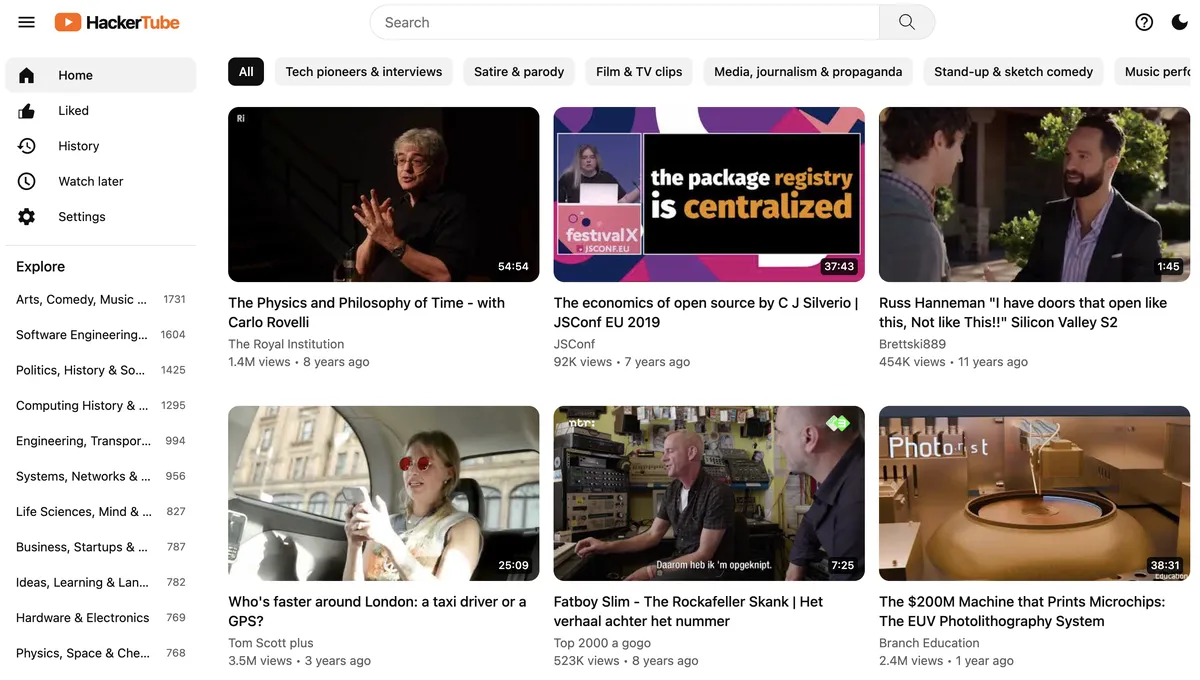 Figure: The minimalist HackerTube interface showcased in Karpathy’s personal blog post. Source: karpathy.bearblog.dev
Stripping Away Sensationalist Thumbnails: A Frame at 50% Reveals the Truth
With the curated dataset in place, Karpathy built the front-end interface, naming the project HackerTube. The visual layout mimics the classic three-column grid of mainstream platforms, but incorporates one radical counter-design decision: completely discarding creator-uploaded custom thumbnails. Instead, the site automatically extracts the exact middle frame of the video at 50% duration (50% thumbnail) to serve as the preview card.
This single design choice instantly dismantles the visual deception of the algorithmic attention economy. On typical platforms, creators plaster thumbnails with garish arrows, shock-face reactions, and saturated clickbait graphics. By enforcing a single, unvarnished frame taken directly from the middle of the actual footage, theatrical marketing collapses. A viewer can tell in a fraction of a second whether a video offers rigorous technical analysis or empty hype.
Minimalism extends equally to data privacy and telemetry. HackerTube requires no registration, enforces no user accounts, and collects zero behavioral profiles. The site’s “For You” section stores watch state strictly in the visitor’s local session. Once the tab is closed, all traces vanish instantly. Users can also export their full watch history with a single click to feed into personal AI agents.
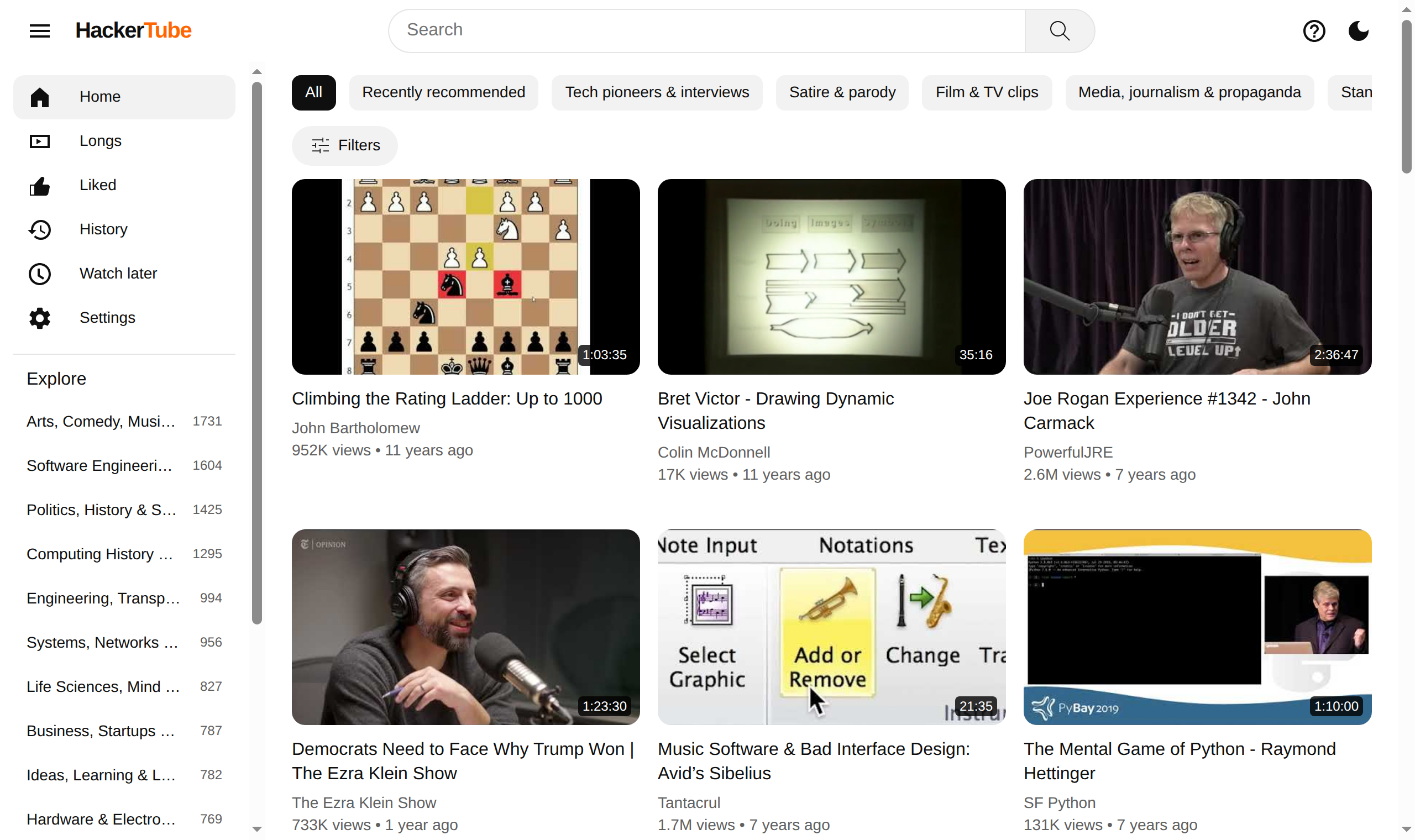 Figure: The hackertube.org homepage features a pure content grid, entirely free of tracking and algorithmic recommendation feeds. Source: hackertube.org
A Two-Hour Static Deployment: Why No Algorithm Yields Higher Accuracy
From writing static templates to deploying code onto a cloud VPS and registering the domain name, the entire build took barely two hours. When the initial deployment came online, Karpathy remarked in his post: “I can breathe now.” That sense of cognitive relief struck a deep chord across the developer community, prompting countless users exhausted by feed optimization to embrace the algorithm-free portal.
User feedback consistently pointed to a striking paradox. Despite having no complex predictive models running in the background, HackerTube’s clean grid of video tiles reliably surfaced content with extraordinary information density and intellectual depth. A comment widely circulated across developer forums captured the sentiment: this homepage, devoid of any personalized recommendation engine, delivered a higher hit rate than the recommendation algorithms of major tech monopolies. The determining factor in user experience is the purity of the underlying content pool; no amount of compute can refine toxic sludge into gold.
When Software Writing Costs Trend to Zero, Human Taste Becomes the True Scarcity
The rapid emergence of HackerTube highlights a fundamental shift in software creation. Building an equivalent platform in the past would have required a dedicated team of engineers collaborating over several weeks. Today, assisted by frontier LLMs, a lone developer can iterate from concept to production in two hours. As Karpathy noted, the real operational bottleneck has shifted toward systems administration: deploying infrastructure securely to the cloud still demands solid engineering discipline.
As the cost of writing code drops toward zero, competitive advantage shifts fundamentally. The value of a software product no longer lies in complex UI boilerplate or the sheer compute consumed by its recommendation pipeline. The defining asset becomes the quality and integrity of the underlying data pool. Two decades of human thought, debate, and genuine appreciation preserved across technical forums represent a scarce reserve of signal that algorithms cannot manufacture out of thin air.
Tech giants will likely continue leveraging behavioral mechanics to maximize user watch time. But HackerTube illustrates an entirely different thesis: eliminate algorithmic trickery, step aside, and place genuine, high-signal work directly in front of curious minds. In a digital landscape overrun by low-effort algorithmic noise, platforms built on rigorous human curation will ultimately demonstrate the most enduring vitality.
Reference links:
- Karpathy’s blog post: “HackerTube”
- Official website: hackertube.org
- Hacker News discussion thread