On November 21, 2026, the mathematical world received an unprecedented proof: 17 million lines of code claiming to conquer the Riemann Hypothesis. Not a single mathematician could read through this vast ocean of code. Yet within 24 hours, the authoritative community formally certified its validity. The community celebrated, even as virtually no one could explain how the author actually proved it.
Four Acceptance Criteria Built for Logic, None Requiring Human Understanding
Mathematician Levent Alpöge divided the proof into 175,187 modules and submitted them to the open-source theorem prover Lean. The Lean community and the Mathlib leadership immediately stepped up, initiating a joint review against four acceptance criteria established ten days earlier. Twenty-four hours later, an official statement confirmed that both the statement and the proof were valid.
This four-step verification procedure required zero human comprehension from start to finish. The first stage checked the statement: the proof directly referenced the pre-certified definition of the Riemann Hypothesis in Mathlib, preventing any subtle shifts in terminology. The second stage was independently compiled by dozens of researchers, verifying zero build errors and producing an identical raw proof file.
The third stage isolated the statement of the Riemann Hypothesis and performed a strict textual comparison using diff tooling. The fourth and most rigorous stage fed the exported proof into multiple independent external checker kernels—only a unanimous pass counted as valid. The entire pipeline was designed solely to guarantee gapless deductive logic, showing zero concern for whether human mathematicians could develop an intuitive grasp of the argument.
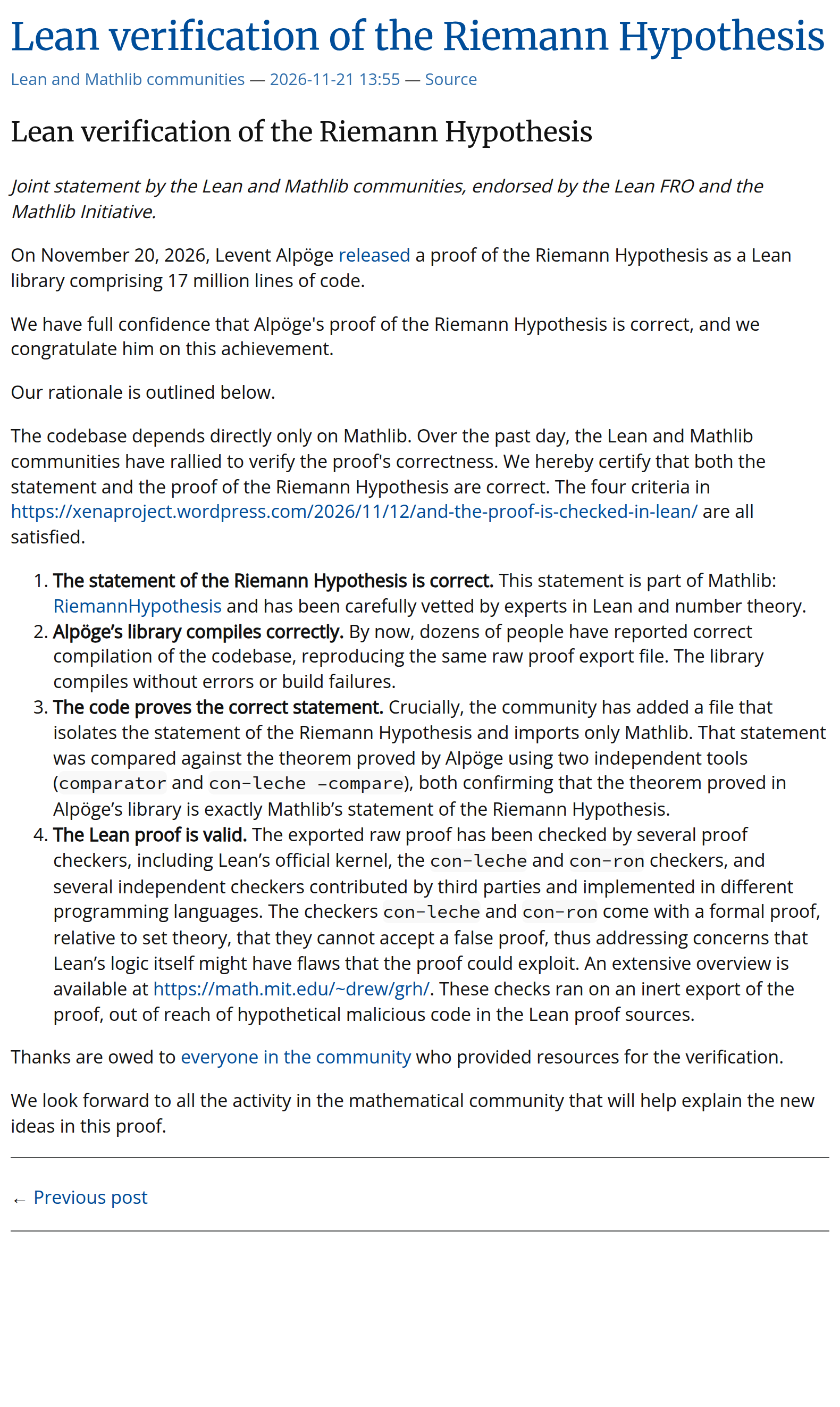 Figure: Joint certification announcement issued by the Lean community and Mathlib. Source: Lean community blog
80 Threads in 27 Minutes: Multiple Kernels Lock Down Proof Soundness
MIT mathematician Andrew Sutherland set up a public dashboard to track and automate the verification pipeline. The data showed that all 175,187 modules compiled successfully under Lean 4.33.1. Five core theorems depended on only three fundamental logical axioms, without introducing any external hypotheses.
The independent Rust-based checker kernel nanoda finished its run in 27 minutes and 42 seconds across 80 threads. Another verification tool, con-leche, operating in high-security mode, swept through all 1,468,418 declarations in just 3 minutes and 15 seconds. Notably, con-leche comes with its own formal proof guaranteeing it will never accept an unsound statement.
Across the entire library, all 8,322 underlying files and 378 dependencies matched official hashes byte-for-byte. With checkers written in different programming languages by completely different authors giving their green light, overturning the result would require finding flaws in every independent verification engine simultaneously. This multi-layered redundancy closed theoretical loopholes at an engineering scale.
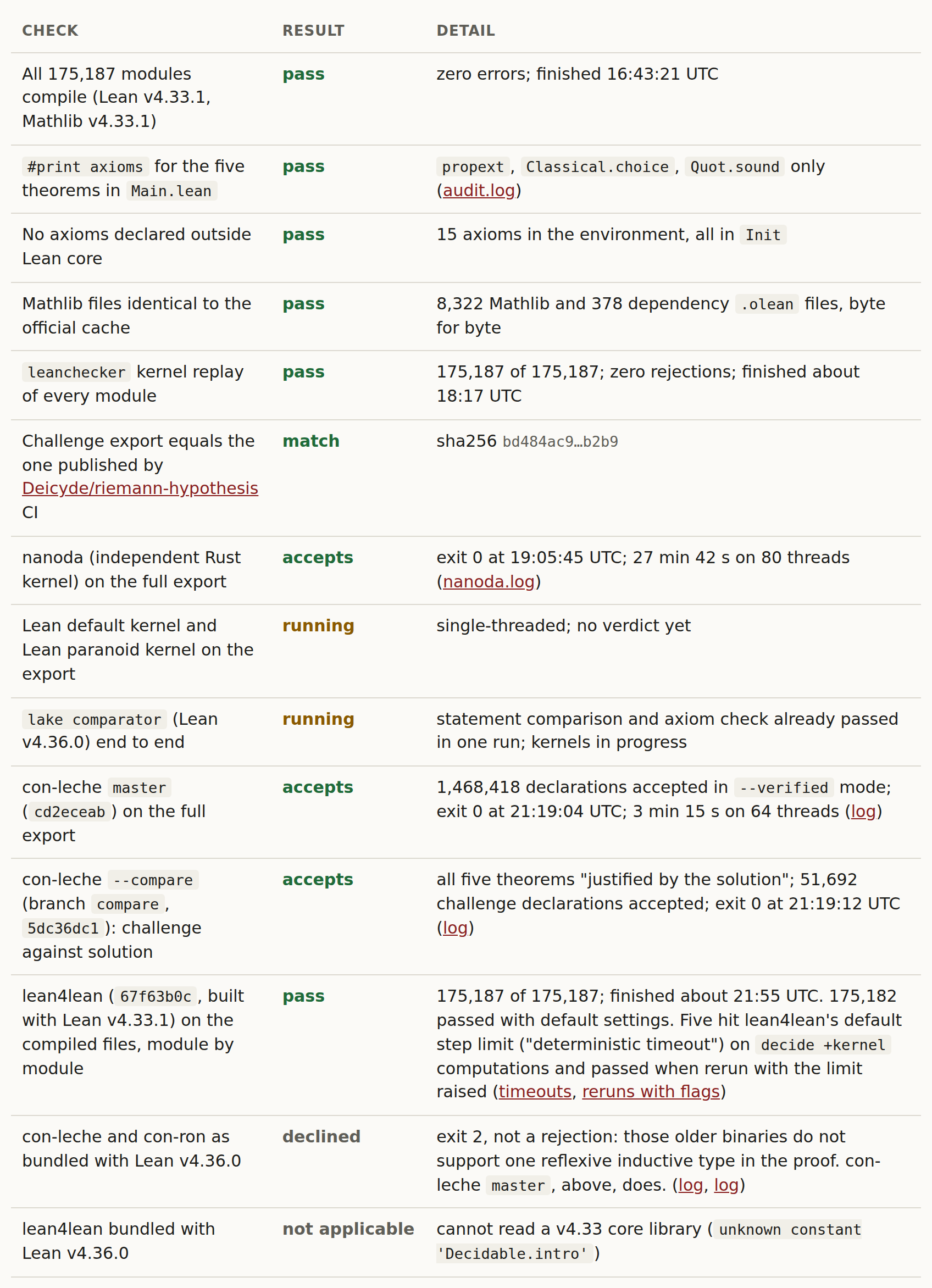 Figure: Details of independent kernel checks recorded on the MIT verification dashboard. Source: Andrew Sutherland / MIT
A 940-Page Human Manuscript Crumbles in Eight Hours, Exposing the Limits of Peer Review
On the very same day, Stanford mathematician Ravi Vakil released a purely human-written manuscript by Alessandro Masullo. Titled The Music of the Primes, the 940-page work addressed the Generalized Riemann Hypothesis. The paper claimed zero AI involvement and had already undergone months of private review, with plans for a full year of polish—until Alpöge’s announcement forced an early disclosure.
Yet this colossal manuscript suffered a devastating blow within eight hours of publication. Several peers scanned the text with AI-assisted tools and quickly uncovered fatal inconsistencies in the deduction. Vakil issued an urgent update stating he could no longer vouch for the viability of the paper’s core strategy. Readers even discovered that the paper’s very first section was left entirely blank.
The contrast was stark. A 940-page human manuscript could not withstand hours of machine-assisted scrutiny, unraveling almost immediately. In contrast, 17 million lines of code, though incomprehensible to humans, erected an unassailable wall of trust in a single day through deterministic rules.
Even When Every Kernel Agrees, History Remembers False Positives
Placing absolute trust in automated checkers is not without historical caution. Mathematicians recalled previous incidents: a flawed counterexample to the Collatz Conjecture had once slipped cleanly through supposedly independent checker kernels. A subsequent autopsy revealed that the checkers silently shared the exact same unchecked assumption deep in their underlying logic.
Once human intuition steps out of the deductive loop, hidden reefs lurk within translation logic. Although the four acceptance criteria formed an airtight chain, they explicitly omitted a “human-in-the-loop” requirement. As of today, no mathematician can translate these 17 million lines of formal symbols into human-understandable mathematical concepts.
Compiling code and understanding mathematics remain two fundamentally distinct achievements. Scholars may be certain that the theorem holds inside the machine, yet they can hardly distill generalizable conceptual tools from it. The black box delivered the ultimate verdict, leaving humanity with lasting bewilderment.
Machines Took Over Verification; The Burden of Understanding Remains Ours
The fundamental dilemma revealed by this breakthrough is where the boundaries of machine-verified mathematics lie. Four rigorous verification standards operated at maximum efficiency on silicon, relieving humans of tedious verification labor.
The simultaneous release of the 940-page manuscript made the gulf between the two approaches painfully clear. The parts machines can adjudicate have settled. The remaining enigma belongs to those willing to dissect the code. Yet in reality, far fewer people are willing to digest tens of millions of lines of code than are willing to run a script.
Mathematics did not freeze because the code compiled. It simply served a profound reminder: machines have taken over verifying the truth of proofs. The privilege of giving mathematics its soul remains in human hands.
Reference links:
- Xena Project: Riemann Hypothesis Acceptance Criteria
- MIT Department of Mathematics: Riemann Hypothesis Lean Verification Dashboard
- Lean Community and Mathlib Joint Certification Announcement
- Stanford University Department of Mathematics: Academic Announcement Regarding the 940-Page Proof Manuscript