
In November 2026, OpenAI released a preprint revealing that GPT-6—a general-purpose model with no specialized biological training—can independently design functional, novel proteins. In wet-lab experiments conducted with Onava, binding evidence was detected across all five disease targets tested. As general models step outside their textual comfort zones, they are beginning to directly take over high-barrier molecular design tasks.
At the heart of this milestone is generalist AI stepping in to replace specialized software toolchains. While this drastically cuts development cycles, it also puts powerful design capabilities into the hands of anyone capable of crafting prompts. The tension between these two forces was on clear display throughout the experiment.
Bypassing Specialized Toolchains: Language Models Design Proteins Natively
Proteins are microscopic molecular machines. Essentially chains of amino acids folding into intricate 3D geometries, their shapes must fit precisely into receptor binding pockets for drugs to work. Whether blocking cancer signaling pathways or capturing greenhouse gases, the core challenge has always been crafting the right key for the lock.
Historically, forging such keys required a fragmented relay of specialized tools. Scientists had to juggle multiple incompatible software pipelines—calculating backbones in one tool, generating sequences in another, and filtering for stability in a third. Tweaking a single parameter often triggered cascading reconfigurations or even retraining. This formidable barrier kept molecular drug discovery slow and resource-intensive.
GPT-6 bypasses this dedicated pipeline entirely. Leveraging general reasoning and native code execution, the model resolves 3D coordinates and amino acid sequences within a single interaction loop. Across 14 benchmark tasks, such as antibody inverse folding, GPT-6 matched or exceeded domain-specific tools. Its generalized reasoning yielded an out-of-distribution performance that surprised biochemists.
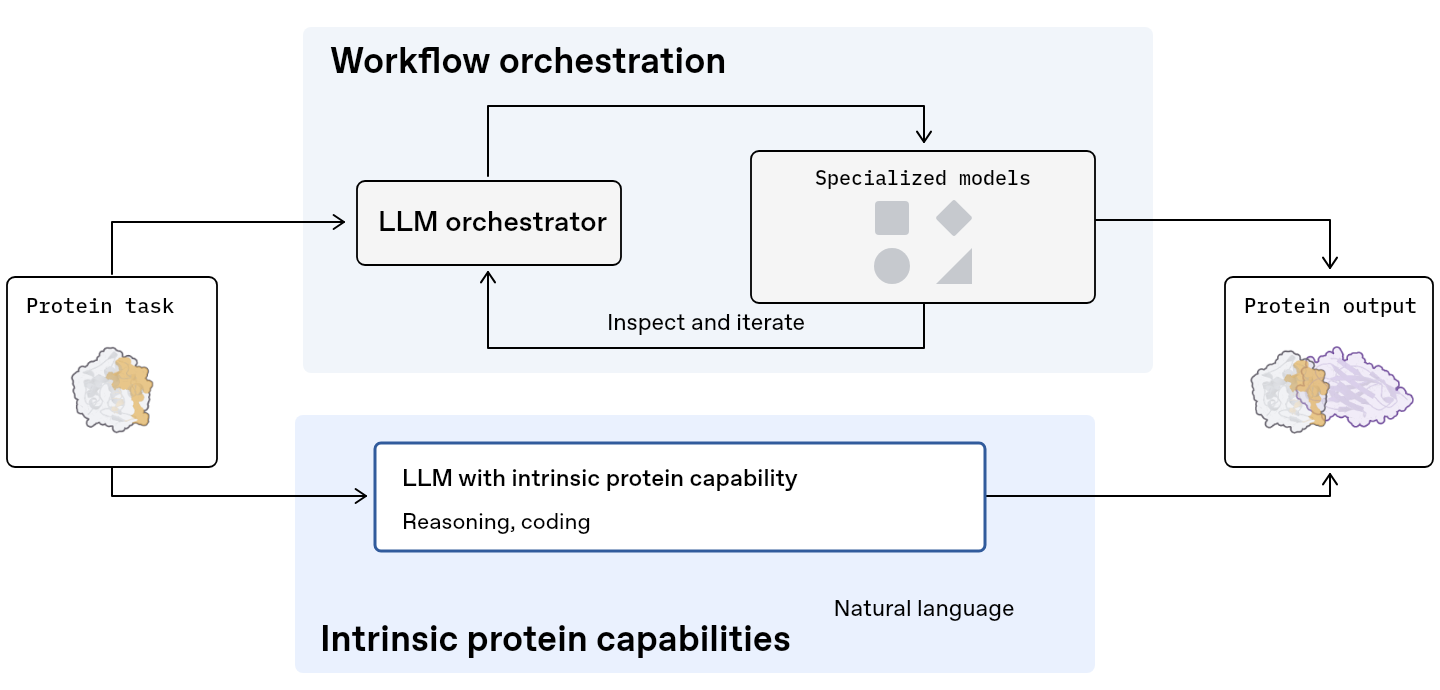 Figure: Language model coordinating multiple specialized tools versus a single model directly handling protein tasks. Source: OpenAI
This breakthrough yields a key engineering insight. Dedicated models resemble specialized, rigid machine tools; general frontier models behave more like artisans who understand physical laws. By orchestrating physical constraints through executable code, the boundary between biological design and software engineering is rapidly dissolving.
Assembling Molecules Like Code: Precision Fitting with Five Helices
The model’s standout capability is its strict adherence to natural language instructions. Traditional structural biology software operates strictly on rigid coordinate arrays and cannot interpret conversational design requests. Researchers can now specify binding sites and the desired number of alpha-helices in plain text, with the model executing 3D spatial constraints with near-perfect fidelity.
In targeting the immune receptor IL-7Rα, the model’s reasoning mirrored a developer debugging an API integration. Confronted with the irregular target surface, it first evaluated electrostatic charge distributions and pocket depths. It then executed Python scripts to place five spring-like helical segments into 3D space, driving the entire spatial arrangement via general-purpose code.
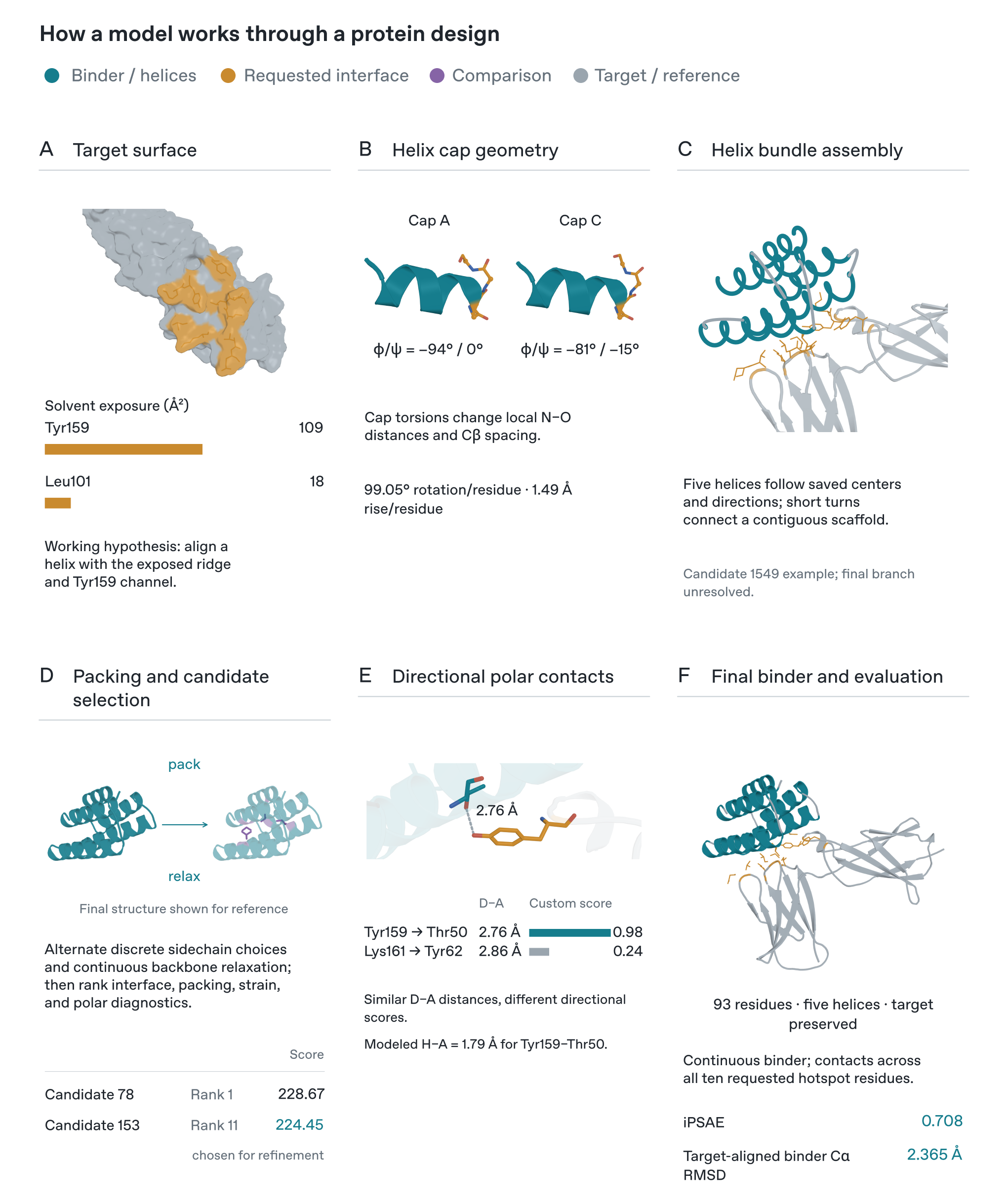 Figure: The model’s reasoning and code when designing a protein to bind IL-7Rα: analyzing target topography, arranging five helices into a bundle, and verifying interfacial fit. Source: OpenAI
Once the backbone was placed, the model ran iterative collision-detection scripts. It refined angular alignments until all five helices nestled tightly against the receptor pocket like a tailored glove. This cycle of hypothesis generation and automated code verification eliminates the reliance on rigid biological scaffolds. The efficiency of algorithmic geometric search directly slashed early-stage validation costs.
Yet clear technical blind spots remain. Benchmark data show that GPT-6 still lags behind specialized predictive models when forecasting the native structures of full-length, highly complex natural proteins. It excels at modular, lego-like assembly driven by explicit constraints, but its understanding of nature’s raw folding mechanisms remains incomplete. This contrast clearly defines the current boundaries of generalist models in molecular biology.
Leaving the Screen for the Test Tube: Binding Activity Across Five Experimental Targets
A molecular structure on a screen means little if it fails in a real test tube. To validate real-world biological activity, OpenAI partnered with biotechnology lab Onava to synthesize candidates in wet-lab experiments. The team used a pre-release version of GPT-6.2 to design backbones alongside sequence generation algorithms, translating algorithmic proposals into physical molecules.
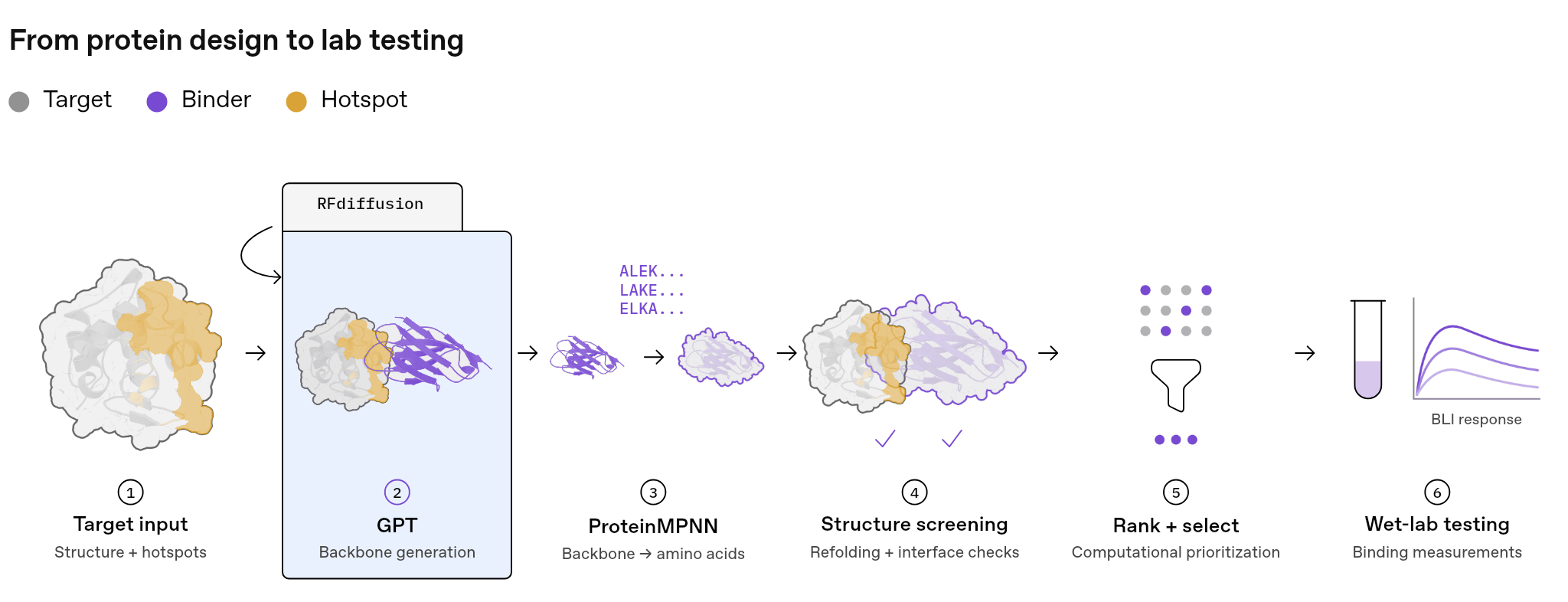 Figure: The complete workflow from target selection, backbone and sequence design, structural filtering, and ranking, to wet-lab validation. Source: OpenAI
The physical evidence proved unequivocal. Across all five disease targets evaluated, at least one synthesized candidate designed by the model exhibited measurable binding activity. In antibody optimization experiments, the majority of proteins with sequences redesigned by the model preserved target-binding capabilities. The biochemical evidence confirmed that the model’s outputs were far more than theoretical musings.
This milestone is a major accelerator for biopharma. It demonstrates that 3D designs from general-purpose models hold up in physical and chemical reality. Bringing a candidate to market still requires years of screening, but the most painful bottleneck of early exploration—going from “knowing what we need” to “producing a viable candidate structure”—has been dramatically lowered. This will inevitably reshape early-stage R&D roadmaps.
This efficiency jump also rewrites the cost calculus of drug discovery. Previously, only deep-pocketed pharmaceutical giants could sustain dedicated computational biology teams. Accessible general models allow smaller laboratories to explore de novo molecules simply by querying an API. Compute is substituting for manual wet-lab trial and error, shifting technical dividends toward a broader ecosystem of researchers.
From Biochemists to Anyone with a Prompt: Lowering the Barriers to Dual-Use Risks
Lowering barriers to entry often erodes traditional defensive depth. Historically, biological defense relied heavily on deep knowledge moats: designing dangerous toxins required master-level fluency with arcane, dedicated software. These steep friction points kept malicious actors at bay for decades.
General AI disrupts that balance. When engineering biologically active proteins requires only a few descriptive prompts, dual-use capabilities become accessible to anyone with a keyboard. OpenAI acknowledged these proliferation risks and initiated biological security tracking under its Preparedness Framework. However, the swift generalization of frontier models continues to outpace safety evaluations.
Software guardrails alone struggle to contain proliferation risks. Filtering natural language prompts rarely catches malicious queries cleverly disguised as legitimate academic inquiries. OpenAI’s approach of channeling these risks through its Preparedness Framework for ongoing mitigation testing is a procedural safeguard, not a cryptographic guarantee. When the exact same tool accelerates both life-saving cures and lethal pathogen design, the offensive advantage widens.
Technological leaps cannot be undone. GPT-6’s latest feat shows how swiftly general models are dismantling interdisciplinary silos, democratizing skills once confined to specialized domains. The fast lane for drug discovery has opened—now the industry faces its next critical test: building robust biological defenses fit for the AI era.
Reference Links:
- OpenAI Official Blog
- Preprint Paper
- Hacker News Discussion