In 2014, programmer Gary Bernhardt delivered a fictional talk at a tech conference. He boldly imagined that by 2035, all desktop software and operating system kernels would run entirely inside web browsers. Even the heaviest system-level workloads, he posited, would eventually be swallowed by the web environment.
The audience erupted in laughter, treating his talk as brilliant satire. At the time, consensus held that browsers were merely display windows for static documents and simple interactive scripts, sealed tightly inside restrictive security sandboxes and fundamentally incapable of hosting real low-level computing.
Twelve years later, that sci-fi joke has landed well ahead of schedule. In November 2026, developer Farid Zakaria pushed his experimental project, trynix.dev, into an entirely new phase: open a standard browser tab, and a genuine, full-featured Linux desktop appears on your screen.
Inside this web-based desktop, a standalone Firefox instance launches smoothly. Classic solitaire can be played with smooth drag-and-drop. 3D gears spin fluidly at high frame rates. Text-to-speech synthesis and live weather lookups work seamlessly.
Atwood’s Law is proving its relentless inevitability: any application that can be written in JavaScript or web technologies will eventually be written in them. For thirty years, the prevailing hierarchy placed the host operating system at the top, confining browsers to safe, isolated sandboxes.
Now, that dynamic is turning on its head. A complete operating system kernel now thrives inside the browser environment, flattening the barrier between virtual sandboxes and physical host control.
Ditching Sluggish Hardware Emulation: Compiling the Kernel Straight to WebAssembly
Running an operating system inside a browser is not a brand-new concept. Historically, however, such attempts rarely evolved beyond sluggish tech demos. Early iterations of trynix.dev relied on heavily patched QEMU hardware emulators.
Traditional emulation requires software running in the browser to virtualize an entire motherboard, CPU, and memory subsystem. Every tiny machine instruction must be repeatedly interpreted and translated. This layer-upon-layer overhead was agonizingly slow: users often stared at a frozen cursor for several seconds just waiting for a simple echo or print command to execute.
The breakthrough arrived on November 19, 2026, when Pooya Parsa released unkernel. Rather than piling on more emulation hacks, the project took a radically different architectural path.
Instead of emulating hardware through slow software loops, the new architecture compiles the Linux kernel source code directly into standard WebAssembly bytecode. The kernel and critical system components execute natively at near-hardware speeds within the browser engine. Emulation is reserved strictly for arbitrary top-level user-space binaries.
This architectural shift yielded immediate, dramatic speedups. In identical test environments, the new engine ran common commands 2x to 32x faster than before. Benchmark data showed that checking an opencode version took half the time. A three-million-iteration summation loop ran in one-third the duration.
Starting a basic echo process accelerated by 5x. Running the text search utility rg was 10x faster. The simplest hello-world print command executed an astonishing 32x faster. A leap of up to 32x transforms what was once an amusing novelty into a genuinely usable computing environment.
Floating Windows, Audio Output, and 60 FPS 3D Graphics in a Browser Tab
Once the speed barrier was shattered, genuine graphical desktop components sprang to life inside the browser tab. Modern Linux relies on the Wayland display server protocol to render application interfaces.
The new setup integrates wland, an in-browser compositor that layers desktop application windows cleanly above the web terminal. When a user runs a graphical app from the command line, a classic window complete with drop shadows and title bar decorations pops up immediately. Users can move and drag windows freely across the screen.
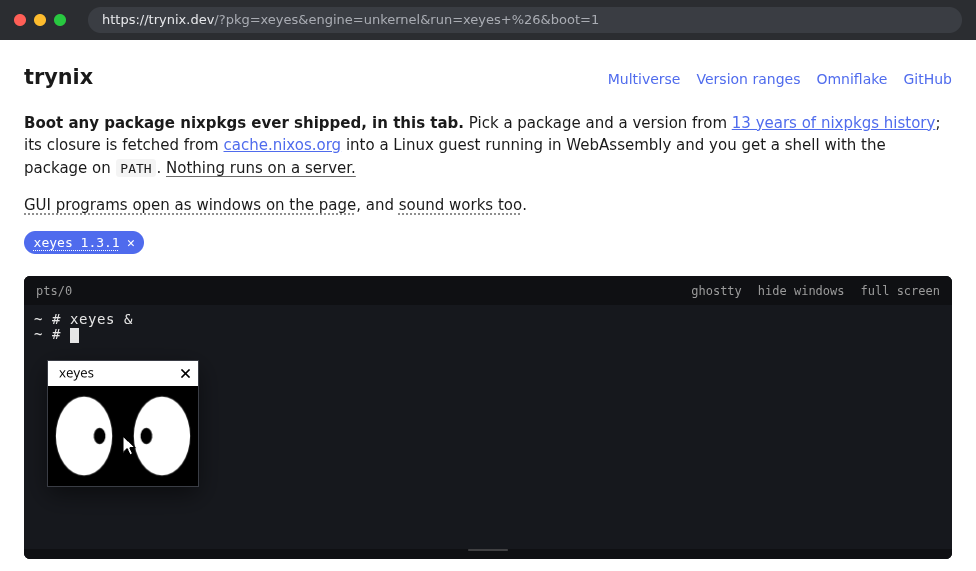 Figure: trynix.dev running the classic X11 application xeyes in the browser, with the window floating above the terminal (Source: fzakaria.com)
Progress in 3D graphics and audio I/O has been equally striking. The web-based OS establishes a hardware acceleration bridge via WebGL2. This graphics pipeline allows the 3D es2gears demo to spin smoothly inside the terminal at a rock-solid 60 frames per second.
Under the hood, the system virtualizes a standard ALSA audio device. Routed through the Web Audio API, synthesized speech from text-to-speech utilities streams cleanly out of the physical computer’s speakers.
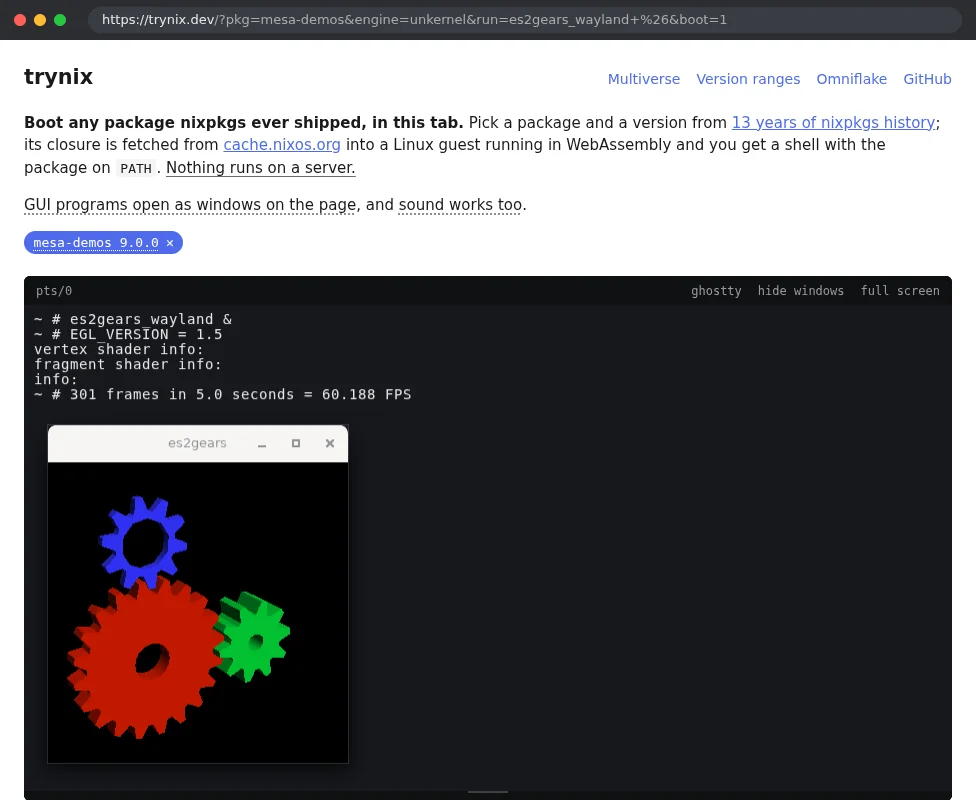 Figure: es2gears rendered via WebGL2, displaying roughly 60 FPS in the terminal (Source: fzakaria.com)
The networking stack has also proven itself in real-world scenarios. Standard web sandbox constraints normally prevent code from issuing arbitrary raw network packets.
To solve this, developers routed the virtual system’s network traffic through dedicated WebRTC channels. Package installations, Git repository cloning, and live weather API calls all function flawlessly. From display and audio to full networking, the core capabilities of an operating system running on bare metal have been fully assembled inside a browser tab.
The Ultimate Four-Hour Russian Doll: Nesting Firefox Inside Firefox
To push this engineering stack to its theoretical boundaries, the developer embarked on an extreme recursive experiment. First, he launched a desktop build of Firefox inside the Linux environment running in his web browser.
Then, inside that virtual Firefox instance, he navigated back to trynix.dev. In the newly spawned inner desktop, he attempted to launch a second nested instance of Firefox. This multi-layered feat took over four hours of relentless debugging, pushing modern computing abstractions to their absolute breaking point.
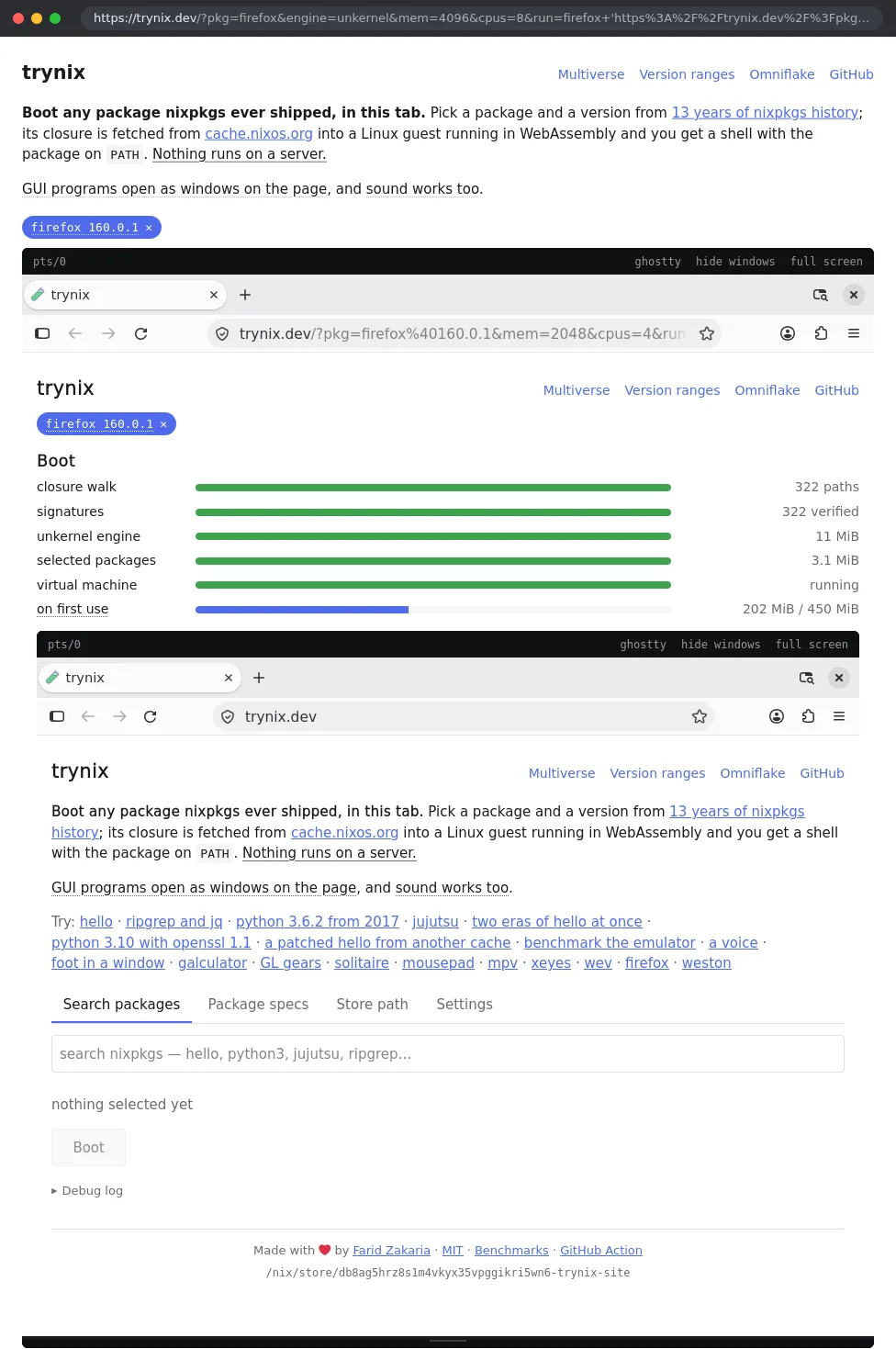 Figure: Firefox running inside a browser, loading trynix.dev, which in turn loads another Firefox instance (Source: fzakaria.com)
Making this recursive nesting work demanded deep compromises across the stack. The innermost Firefox had its JIT compilation disabled to sidestep memory execution hurdles. The middle tier had hardware acceleration turned off due to the lack of direct GPU passthrough.
The outermost layer required a local network relay proxy to resolve localhost routing collisions. Yet despite these hurdles, the nested demonstration proved the structural coherence of modern web standards: so long as standard interfaces are respected, the browser can recursively swallow itself layer upon layer.
The vast software repository behind the Nix ecosystem provides real-world utility to this experiment. Thanks to Nix packages, users can access over 300,000 pre-built software packages directly inside a browser tab.
No local dependencies are needed, and there is no risk of polluting the host registry or filesystem. With a single URL and a keystroke, a complete, self-contained software ecosystem boots directly in browser memory.
Browsers Are No Longer Just Viewports: The Boundary Between Host and Sandbox Has Fallen
The tech industry long held a steadfast belief: web technologies are meant for lightweight interfaces, while heavy system-level heavy lifting belongs strictly to the host operating system.
Today, with the Linux kernel compiled directly into web bytecode and complex desktop windows and 3D graphics executing at near-native speeds inside a browser tab, that mental barrier has dissolved.
The fictional future Gary Bernhardt imagined twelve years ago reflects the relentless evolution of software abstraction layers. The web browser has undergone a fundamental metamorphosis: from a humble document viewer into a robust, autonomous foundation capable of hosting an entire operating system.
The 2035 prophecy has arrived nine years early. As the lines between personal computers and remote cloud servers continue to blur, software distribution may never be the same. Instead of complex installers and platform-specific packaging, a universal web link is all it takes to spin up an instant, disposable, and fully functional computer on any device.
Reference Links:
- Original post on fzakaria.com
- unkernel Project
- Hacker News Discussion