On October 18, 2026, Wired published an in-depth review of the Valerion VisionMaster Max, the brand’s flagship projector. Priced at $3,999, this home theater device packs physical iris controls and optical lens shift—features historically reserved for high-end commercial and pro-grade cinema machines—into a compact, lifestyle-friendly chassis.
For years, portable smart projectors have relied on computational trickery to mask optical compromises. Automatic keystone correction and digital zoom lower the barrier to placement, but at a steep cost: DMD micromirrors are cropped and resampled, degrading sharpness and throwing away effective pixels from nominal 4K feeds.
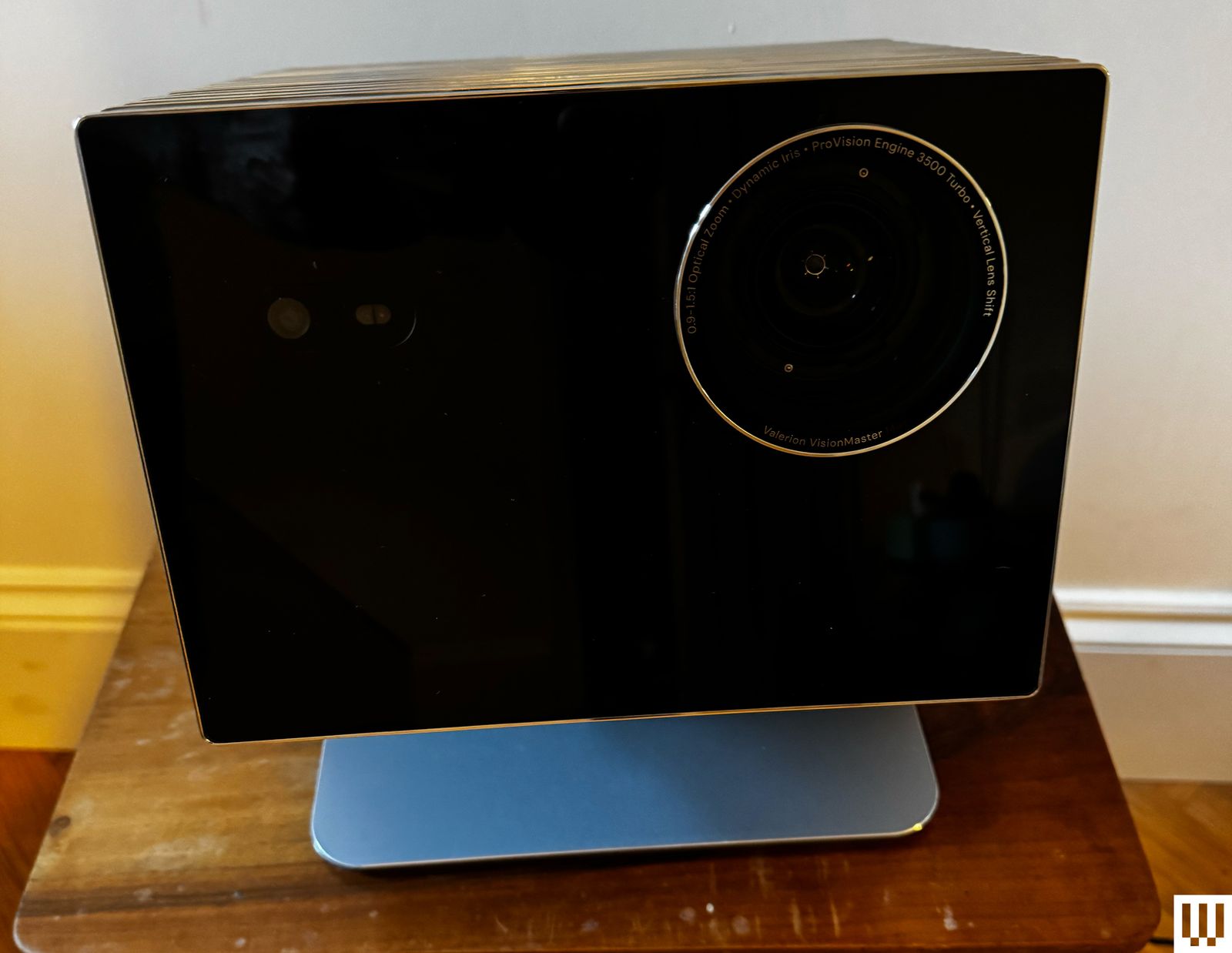 Photo: Front panel close-up of the VisionMaster Max, housing the motorized optical zoom assembly and mechanical iris. Source: Chris Haslam (Wired)
Over $8 Million Crowdfunded: 3,500 ISO Lumens of Tri-Color Laser Power
Valerion’s engineering foundation stems from AWOL Vision, a brand renowned for ultra-short-throw laser TVs. In 2024, the team launched a Kickstarter campaign that raised over $8 million. Positioned as the halo model in the lineup, the VisionMaster Max makes zero compromises on light engine specifications.
The optical engine utilizes a pure RGB triple-laser system delivering a claimed 3,500 ISO lumens. This spec directly tackles the chronic weakness of ambient-light washout in home living rooms. Real-world testing shows that even in daylight with open curtains, a 75-inch projection retains crisp contrast and punch.
Color coverage is arguably the projector’s crowning achievement, spanning 110% of the ultra-wide Rec.2020 color gamut. Pure laser diodes offer exceptional monochromatic purity, steering clear of the color cast artifacts common to phosphor-wheel hybrid setups. The projected image delivers vibrant saturation while preserving natural, true-to-life skin tones. With 3,500 lumens backing a pure laser source, the projector delivers the punch required for true large-screen HDR.
Such a potent laser array demands substantial thermal management. Weighing in at 16.5 lbs (roughly 7.5 kg), the interior is packed with dual-loop heat pipes and aluminum heatsink fins. After hours of continuous playback, exhaust vents remain moderately warm, while fan acoustic levels stay hushed below 28 dB.
Goodbye Digital Keystone: Optical Zoom and Lens Shift Preserve Native 4K Fidelity
The standard usage scenario for lifestyle projectors involves placing the unit off-angle on a nightstand or coffee table, leaving digital keystone algorithms to square the image. This digital warp resamples pixels geometrically, turning a rectangular optical beam into a trapezoid. The surrounding DMD mirrors are forced to render black borders, slicing away both active resolution and usable light output.
The VisionMaster Max returns to classic cinema-grade optical engineering. Equipped with an optical zoom lens assembly offering a 0.9 to 1.5:1 throw ratio, users can adjust screen sizes without physically shifting the projector. A touch of the remote motorizes the glass elements, switching smoothly between an 80-inch and 130-inch image from just 2.5 meters away. Because physical glass shifts relative to the chip, all DMD micromirrors remain engaged in image formation.
Vertical optical lens shift offers even greater installation versatility, supporting up to ±105% optical vertical offset. Whether set low on a coffee table or mounted high on a ceiling shelf, the projected image shifts vertically to align with the screen without tilt. Physical lens shifting guarantees 1:1 pixel mapping for 4K content, completely eliminating the soft focus and aliasing artifacts introduced by algorithmic interpolation.
While a LiDAR rangefinder and camera array retain rapid auto-focus routines, purists can disable all digital keystone processing entirely. This pristine optical passthrough gives demanding cinephiles untouched, native optical sharpness.
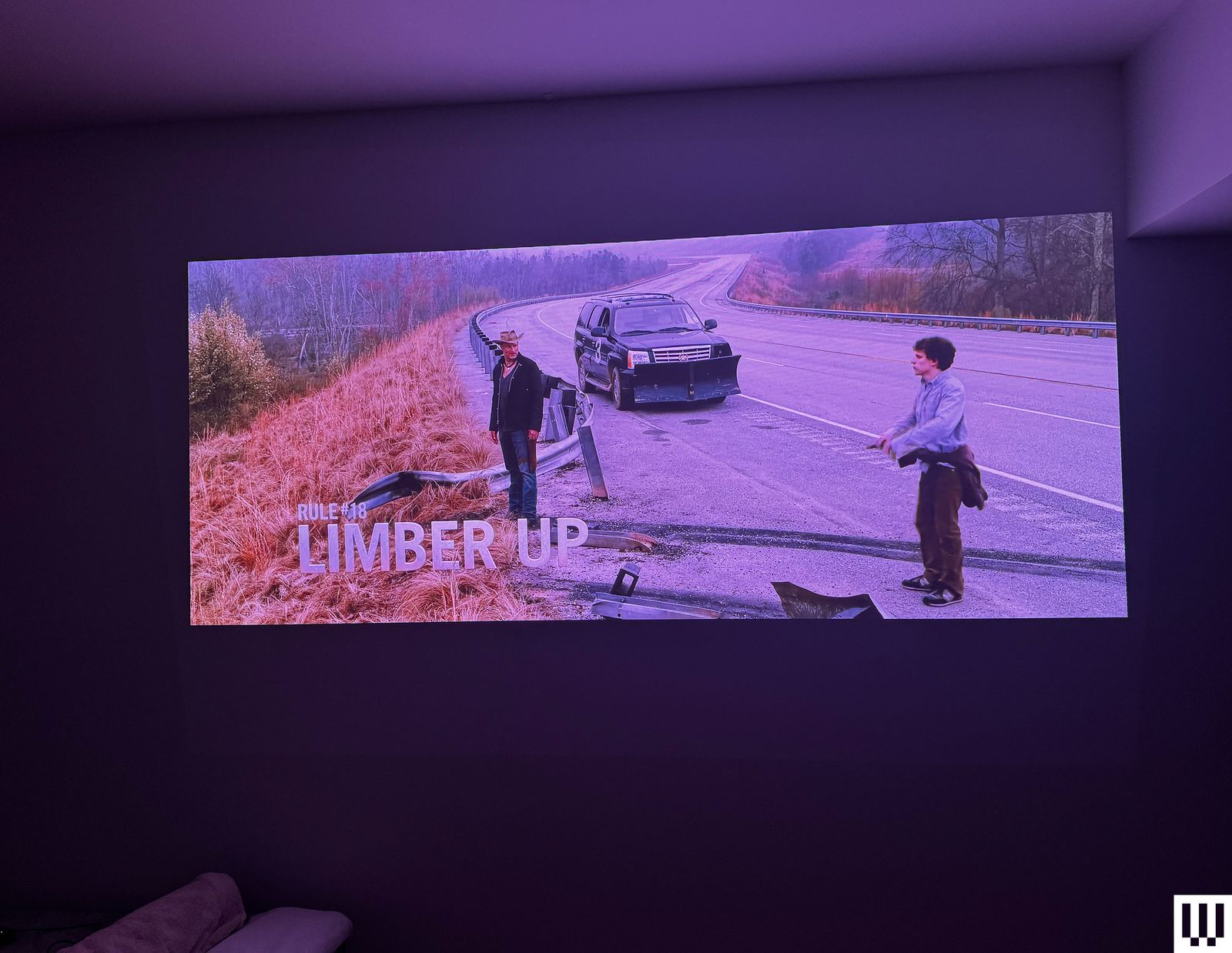 Photo: Real projection showing nighttime scenes with clear shadow delineation and road details. Source: Chris Haslam (Wired)
Dynamic Iris Meets EBL Dimming: 6 Physical Stops Tackle DLP Elevated Blacks
The Achilles’ heel of single-chip DLP projectors has long been mediocre native contrast. When DMD mirrors tilt away to turn off pixels, internal laser light scatter cannot be completely arrested, casting a hazy, elevated gray veil across shadows. Starlit night skies turn into murky gray backdrops, swallowing fine shadow gradations in stray light.
Valerion tackles this by inserting a physical dynamic mechanical iris into the optical path. Constructed from six precision stainless steel blades with anti-reflective optical coatings, the mechanism expands and contracts aperture diameter within milliseconds as scenes shift between light and dark. Stray laser reflections are physically stopped inside the lens barrel.
The mechanical iris works in tight synchronization with the proprietary Enhanced Black Level (EBL) dimming algorithm. In low-lit night scenes, the system throttles laser output while closing the iris to a pinpoint pinhole. With dual-stage light attenuation, dynamic contrast climbs to a claimed 50,000:1.
Testing with Christopher Nolan’s The Dark Knight revealed deep, ink-like building shadows in high-contrast night scenes while vehicle headlights remained punchy and crisp. The tandem operation of physical aperture throttling and dynamic dimming successfully cures the washed-out black levels typical of home DLP projectors.
240Hz High Refresh and 4ms Input Lag: Gaming Strengths vs. Thin Onboard Audio
Beyond movie playback, the VisionMaster Max makes a strong bid for console gamers. It features dual HDMI 2.1 ports with Auto Low Latency Mode (ALLM) support, powered by a high-end MediaTek SoC paired with 4GB of RAM and 128GB of storage.
At 1080p, refresh rates ramp up to 240Hz, dropping input lag to a blazing 4ms. Switching to 4K 60Hz yields a responsive 15ms latency. Firing up first-person shooters on the PlayStation 5 delivers snappy crosshair tracking. The only notable omission is Variable Refresh Rate (VRR) support, meaning scenes with volatile frame rates can still show subtle tearing until addressed via firmware.
Onboard audio remains the unit’s most noticeable compromise. With internal volume largely consumed by the optical engine and dual cooling channels, the chassis accommodates only dual 12W stereo speakers. While vocal dialogue comes across clearly, low-end bass extension lacks punch, missing the physical rumble expected from cinematic soundstages.
Pushing volume beyond step 25 produces thin, strained acoustics inside the compact chamber. Fortunately, the integrated Google TV platform supports Dolby Atmos and DTS bitstream passthrough. For home theater enthusiasts, routing audio through HDMI eARC to a dedicated soundbar or multi-channel AV receiver is an essential pairing.
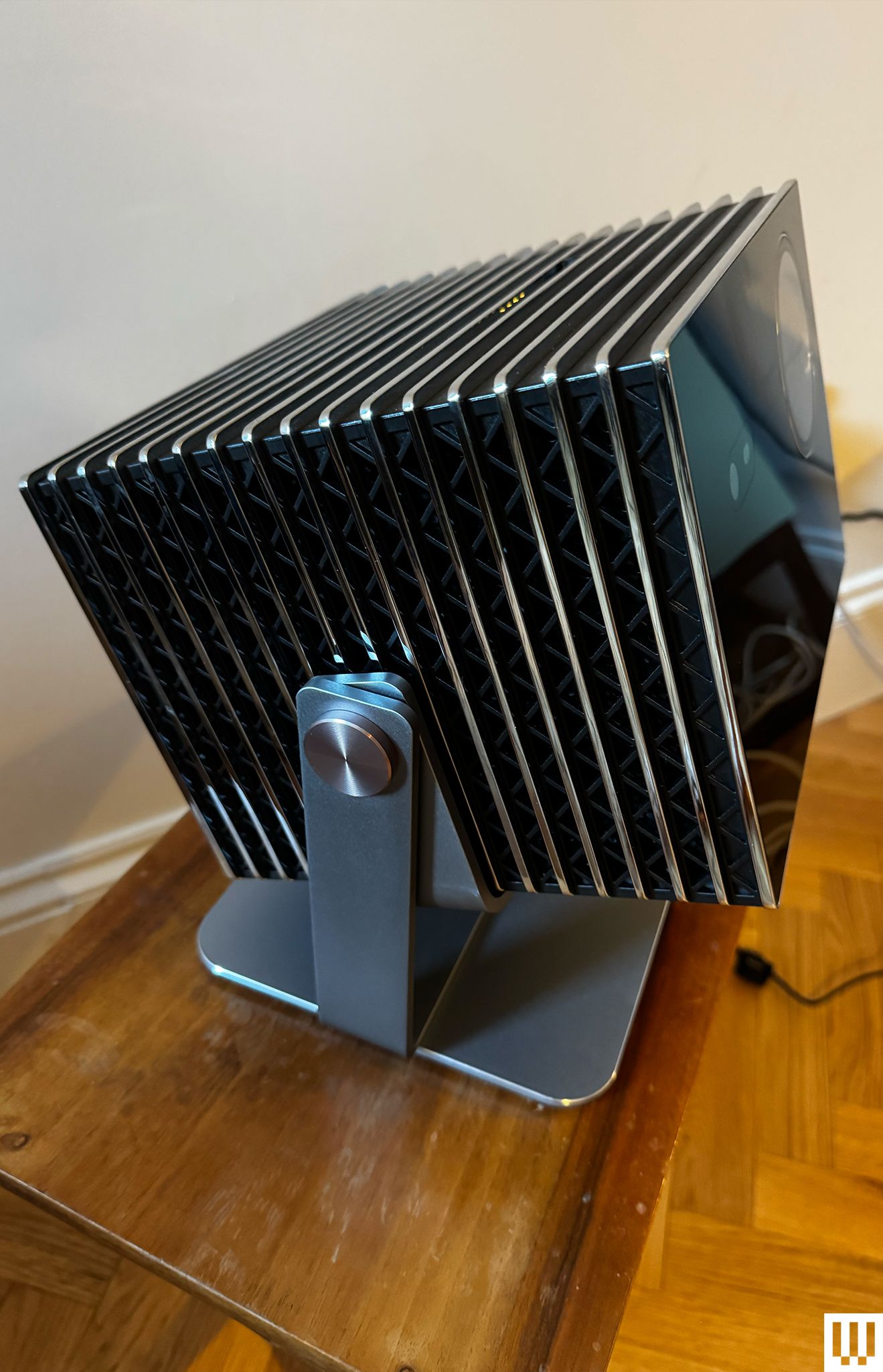 Photo: Extensive ventilation grilles along the chassis side housing dedicated intake channels and cooling modules. Source: Chris Haslam (Wired)
Challenging Sony and JVC at $3,999: Carving a Niche Between Portable and Dedicated Darkrooms
The $3,999 price point puts the VisionMaster Max in a unique market intersection. Downmarket competitors like XGIMI and Anker dominate the $1,500 to $2,500 bracket. Upmarket, dedicated cinema behemoths using Sony SXRD or JVC D-ILA liquid crystal panels start well north of $6,000.
Internal competition also exists within the lineup. Valerion simultaneously offers the $2,999 VisionMaster Pro 2, which retains 3,000 lumens of tri-color laser illumination and motorized optical zoom, omitting only lens shift and the physical iris. For permanent living room setups where positioning is fixed, pocketing the $1,000 difference is a tempting alternative.
Community feedback across AV forums reflects clear demographic lines. Enthusiasts celebrate the ability to achieve rectilinear geometry and deep black levels without tearing down walls or mounting cumbersome hardware. Cautious purists argue that near $4,000, one might cross-shop native 4K LCoS panels paired with fixed ambient-light-rejecting (ALR) screens. At $3,999, Valerion draws a distinctive line, aiming squarely at home theater upgraders who demand uncompromised optical fidelity without the friction of custom installation.
Early shipments include a bundled accessory package featuring a mounting stand and projection screen, minimizing setup friction and solidifying out-of-the-box performance.
True home theater upgrades ultimately defer to the immutable laws of optics. Digital algorithms can stretch a warped frame, but they cannot restore pixels thrown away in software cropping. By trickling down pro-tier mechanical irises and optical zoom assemblies, the VisionMaster Max puts an end to the culture of computational compromise. Situated between portable toys and massive cinema rigs, it proves that physical, uncropped light paths remain the true foundation of authentic home cinema.
Reference Links:
- Wired In-Depth Review Report
- Valerion Official Technical Specifications Whitepaper
- ProjectorCentral Hardware Review Column