On October 20, 2026, Craig Couden of Make: published a detailed hands-on review of Sunlu’s AMS Lite filament heater. Priced at $130 for the review kit ($119.99 list price on Sunlu’s North American store, and $99.99 for early-bird buyers during its July 20 launch), the accessory is tailored specifically for the open-frame four-spool AMS Lite feeder paired with Bambu Lab’s A1 and A1 Mini printers. Without tossing out the stock feeder base, makers can convert the exposed spool holder into an actively heated 70°C drying chamber.
Bambu Lab brought multi-color printing to entry-level creators with the A1 series, but the exposed AMS Lite leaves four spools vulnerable to ambient humidity. Workarounds have historically meant choosing between clunky standalone dry boxes with messy feeder tubes or splurging on an enclosed high-end multi-material unit. Sunlu targets this void with a modular sandwich enclosure that enables inline dry-and-print operations while maintaining the exact desk footprint of the original rack.
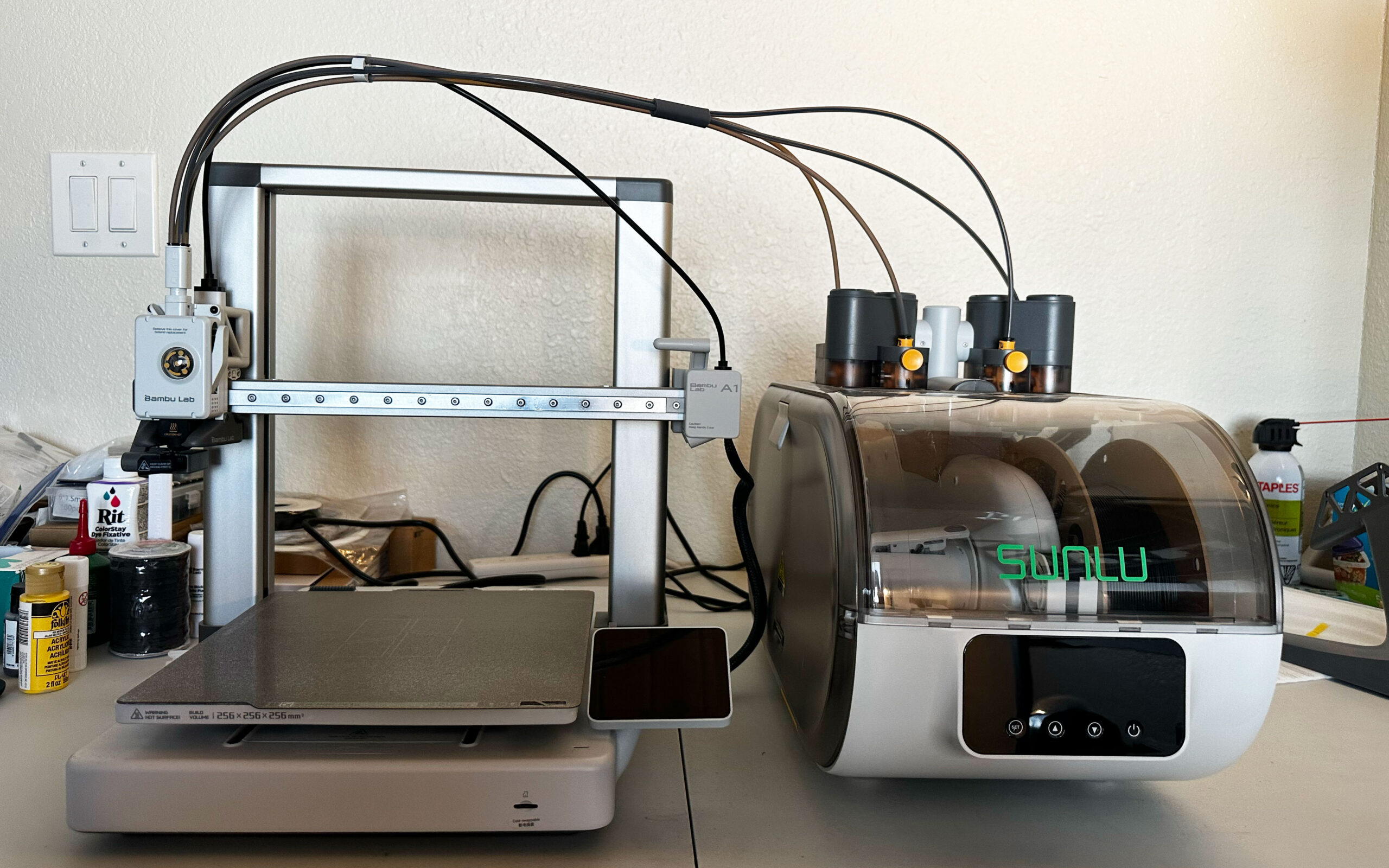 Figure: The modified Sunlu heater stands beside a Bambu Lab A1; top display shows live temperature and humidity while matching the stock stand footprint. Source: Craig Couden (via Make:).
Sandwich Mod Preserves Stock Feeding and Splits Power Rails
Standalone four-spool dry boxes on the market are notoriously bulky. Sunlu’s own FilaDryer S4 measures 460×220×310 mm and requires four long PTFE tubes trailing across the workbench. The AMS Lite heater skips external enclosures in favor of an in-place retrofit. Installation involves removing a few screws, splitting the original AMS Lite stand in half, sandwiching the central heating core between the halves, and plugging in two internal cables before securing the shell.
During hands-on installation, Couden noted minor screw-hole tolerances and a finicky plastic cover plate reinstall, but the overall modification leaves stock hardware completely intact. The original feeder motors, four-way color-switching hub, and RFID reader modules for official Bambu spools remain in place. After modification, the entire unit’s desk footprint is virtually identical to an unmodified AMS Lite.
An even more practical design choice is power decoupling. The AMS Lite stepper motors and motherboard continue drawing power directly from the 3D printer, while Sunlu’s PTC (Positive Temperature Coefficient) heating module runs off a dedicated AC power cable. Borrowing specs from Sunlu’s broader AMS heater lineup, the unit is rated at 220W with a peak draw of 390W and standby consumption of just 0.6W. The in-place sandwich architecture and decoupled power rails protect desk space and feeding mechanics, ensuring offline drying and unheated printing never hold each other hostage.
70°C Ceiling with Six Presets and a 50% Humidity Watchdog
An open-frame spool holder rarely poses major issues for short PLA prints. However, across multi-day print marathons or with moisture-hungry filaments like PETG and PA (nylon), exposed filament rapidly absorbs atmospheric water. When damp filament hits the hotend nozzle, trapped water boils instantly, triggering stringing, bubbling, extrusion gaps, and severe layer delamination. Passive silica desiccant only slows down moisture absorption; it cannot drive out water already bound in polymer chains.
The top control panel features an integrated screen with presets for PLA, PETG, TPU, ABS, PA, and PC. Users can also manually tune temperatures between 35°C and 70°C, and configure target humidity between 25% and 50%. Standard drying protocols dictate 45°C–55°C for 4–6 hours on PLA, 65°C for PETG, and 60°C–70°C for ABS. The 70°C upper limit comfortably covers everyday consumer filaments.
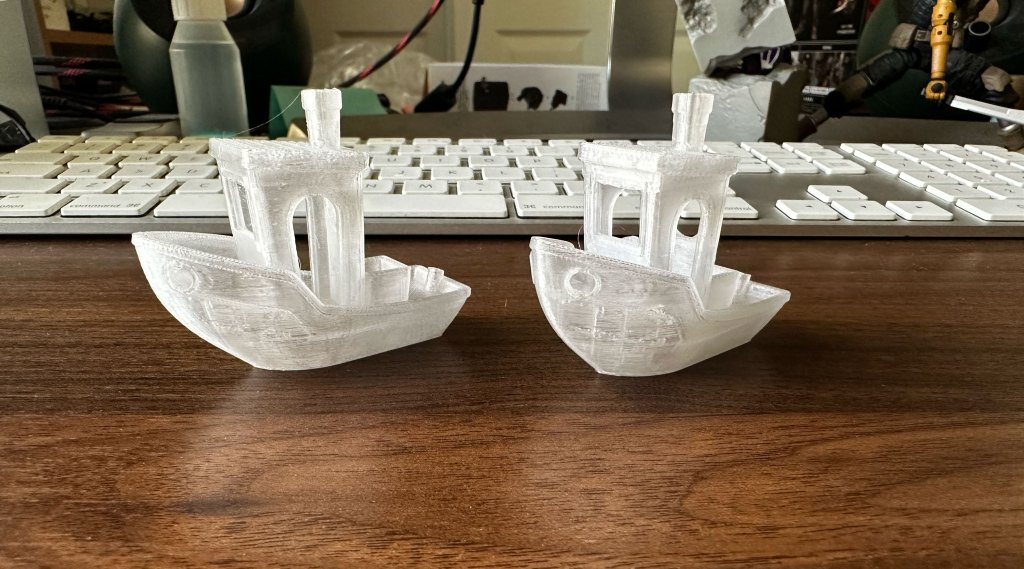 Figure: Test prints using Polymaker clear PETG; left undried, right dried in the heater, showing noticeable bubble reduction depending on ambient humidity. Source: Craig Couden (via Make:).
To combat hot spots across four spools, dual air channels circulate heated air simultaneously to both flanks, reaching 70°C in about 20 minutes. An integrated exhaust vent expels moisture outward during heating rather than trapping humid air in an internal loop. Timers default to 6 hours and can run up to 99 hours. Once the cycle finishes, if chamber humidity creeps back to 50%, the heater automatically wakes up to drive levels back down. Dual-fan exhaust circulation paired with 50% auto-wake turns filament conditioning into an automated background process.
Single-Zone Compromises and PTFE Tube Door Clearance
On an everyday workbench, the compact design reveals several mechanical trade-offs. Testing in California’s dry San Francisco Bay Area with Polymaker PETG, Bambu Lab PETG HF, Polymaker PLA Pro, and Sunlu PLA+ 2.0, Couden found modest visual differences before and after drying. The performance benefits of inline drying become truly dramatic only during rainy seasons or in consistently humid climates.
A trickier issue stems from thermal cross-talk across mixed materials. Many makers load mismatched spools across four slots, such as pairing PLA with PETG. Because all four spools share a single undivided heating chamber, temperatures cannot be isolated per slot. Running a 65°C dry cycle for PETG will soften and fuse adjacent PLA spools. Furthermore, Bambu Lab recommends baking PC filament in an 80°C forced-air oven for 8 hours; Sunlu’s 70°C limit and the A1’s open build volume rule out demanding engineering plastics.
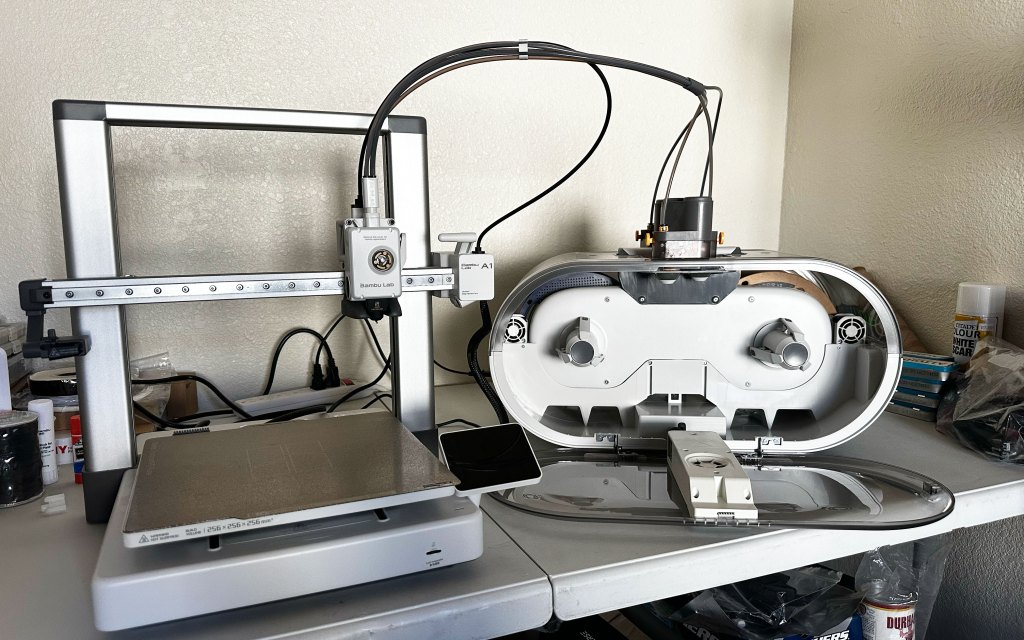 Figure: Transparent side doors fold downward; constrained by stock short PTFE tubes, opening the printer-facing door requires rotating the entire unit. Source: Craig Couden (via Make:).
Ergonomics also demand compromises. The side doors fold downward, requiring side clearance on the desk. Worse, Bambu Lab’s relatively short stock PTFE tubes catch on the printer-facing door, forcing users to turn the entire unit around whenever swapping spools on that side. Testing by 3D printing outlet Fabbaloo noted operating noise above 50 dB at 1 meter. On the upside, the exterior shell stays only warm to the touch, and magnetic door sensors paired with a 10°C over-temperature cutoff ensure safe operation without room overheating. The single shared chamber limits mixed-material workflows, while drop-down doors and short feeder tubes elevate spool-swapping friction on crowded desks.
A $130 Middle Ground: Why Existing A1 Owners Benefit Most
In the consumer 3D printing landscape, a $120 to $130 price point puts Sunlu’s heater in a distinct bracket against competing multi-material drying approaches.
| Drying Solution | Price (USD) | Thermal Specs | Desk Space & Compatibility Trade-offs |
|---|---|---|---|
| Sunlu AMS Lite Heater | $119.99–$130.00 | 35–70°C, dual air channels, 50% auto-wake | Preserves stock footprint; AMS Lite only; cannot mix filaments with high temp gaps. |
| Sunlu FilaDryer S4 | $116.99 | Up to 70°C, 350W PTC, triple fans | 460×220×310 mm footprint, long external tubes; universal printer compatibility. |
| Bambu Lab AMS 2 Pro | $149.00–$180.00 | Integrated active heating, upgraded feeding & RFID | Complete feeder replacement; renders original AMS Lite obsolete. |
Weighing these options clarifies the target buyer. New buyers entering multi-color printing or those upgrading their feed system get far better value by spending an extra $20 to $50 on an integrated Bambu Lab AMS 2 Pro. Meanwhile, multi-printer maker spaces can opt for the $116.99 Sunlu S4 dry box, whose eight feed ports offer cross-brand versatility that single-machine mods cannot match.
Sunlu’s AMS Lite heater is purpose-built for existing A1 Combo owners. These users possess perfectly functional AMS Lite units; they have no desire to spend $180 on a brand-new feeder that sidelines their existing hardware, yet lack the desk depth for a half-meter standalone dry box. With North American availability established and rollout pending in the UK, EU, and Australia, this $130 upgrade provides existing A1 owners in humid climates with an efficient, space-saving compromise that keeps their original workflow intact.
References:
- Make: Magazine: Sunlu AMS Lite Filament Heater Review
- 3DBite: Sunlu AMS Lite Heater: Active Drying Comes to the AMS Lite
- Makers101: SUNLU AMS Lite Heater Price: Specs and Who Should Consider It
- 3DJake: SUNLU AMS Heater Technical Specifications