Maker Riley recently dusted off an older Prusa i3 FDM (Fused Deposition Modeling) 3D printer with a severely damaged hotend assembly. Instead of tossing the machine onto the e-waste heap, he decided to retrofit it with a specialized liquid dispensing system. What was once designed to extrude rigid thermoplastic filaments was transformed into a sophisticated platform capable of printing fluids.
Discarded hardware all too often ends up sold by the pound at scrap facilities. Here, the standardized, modular interfaces inherent to open-source architectures provided the baseline guarantee for extending machine life. Physical component failure was no longer an end state, but rather an invitation to retool the platform for an entirely different mission.
Ditching the Damaged Hotend: Swapping Air for Support Gel
Conventional FDM printers extrude molten thermoplastics into ambient air, relying on rapid cooling and layer-by-layer adhesion to maintain structural integrity. This approach works remarkably well for rigid polymers. However, when switching the printing medium to liquids or soft hydrogels, unsupported air leads to instantaneous structural collapse. To circumvent this limitation, Riley adopted the paradigm of Embedded 3D Printing (E3DP), substituting ambient air with a high-density liquid support bath.
For the physical conversion, he stripped away the burnt-out Prusa hotend assembly altogether. In its place went an open-source Allstruder syringe pump, engineered specifically to dispense viscous fluids with high volumetric precision. The factory control board was swapped for a Caribou Duet 3 to accommodate the new stepper kinematics and dispensing routines. The cost of hardware reconfiguration remained minimal, filling damaged slots directly with off-the-shelf open-source hardware modules.
This plug-and-play modularity underpins the indefinite lifespan of open-source hardware. The mainboard and axis stepper motors remained fully operational. By merely replacing the terminal effector, a plastic deposition tool became a fluid processing workstation.
Academic Frontiers Replicated in a Garage
Long before grassroots makers tackled this hack, E3DP had undergone multiple rounds of academic exploration. In 2026, Rongji Tang et al. published a comprehensive review in Frontiers in Materials, surveying the technological frontier of E3DP and addressing critical issues such as print quality control, matrix medium selection, and matrix recyclability. The technique holds tremendous commercial potential across soft robotics, bioprinting living tissues, and microfluidic chip fabrication.
Printing difficulty varies wildly across fluid rheologies. Reliable deposition of Newtonian fluids remains a major challenge; Hejoon Jun et al. highlighted the physical boundaries of this problem in a 2025 paper in Applied Materials & Interfaces. In 2026, Min Ye et al. pushed the boundary further in the International Journal of Extreme Manufacturing for bioprinting viable cells, proposing a self-healing hydrogel matrix called EPICS.
Riley’s project dismantled the cost barrier traditionally guarding such laboratory equipment. He adapted techniques developed on high-end scientific rigs and ported them to a salvaged, sub-$500 desktop printer. The open-source ecosystem and hacker spirit collectively closed the equipment divide separating elite laboratories from backyard garages.
The 40-Minute Window: Time Becomes the Critical Variable
Once the hardware framework was assembled, the true bottlenecks shifted to material science and fluid dynamics. Riley’s initial calibration run utilized ordinary cream cheese—a low-cost, easily cleanable medium ideal for tuning stepper thrust and linear motion speeds. After validating mechanical stability, he shifted toward using commercial off-the-shelf hair gel as a buoyant support bath to print two-part epoxy resin.
Once blended, two-part epoxy offers an operational pot life of just 40 minutes. The machine had to accurately dispense and clear the syringe within this tight timeframe. Replacing ambient air with a liquid support bath radically alters the governing physics of deposition. While available material options expanded dramatically, time emerged as an unforgiving constraint. Extrusion rate, fluid viscosity, and resin gelation curves had to achieve perfect equilibrium across that 40-minute window. Any hesitation threatened to permanently seize the dispensing nozzle.
Because commercial hair gel exhibited poor chemical compatibility with the epoxy, the extrusion dynamics became erratic. Ultimately, the experimental feedstock was changed to Sylgard 184 silicone elastomer, which features a substantially more forgiving curing window.
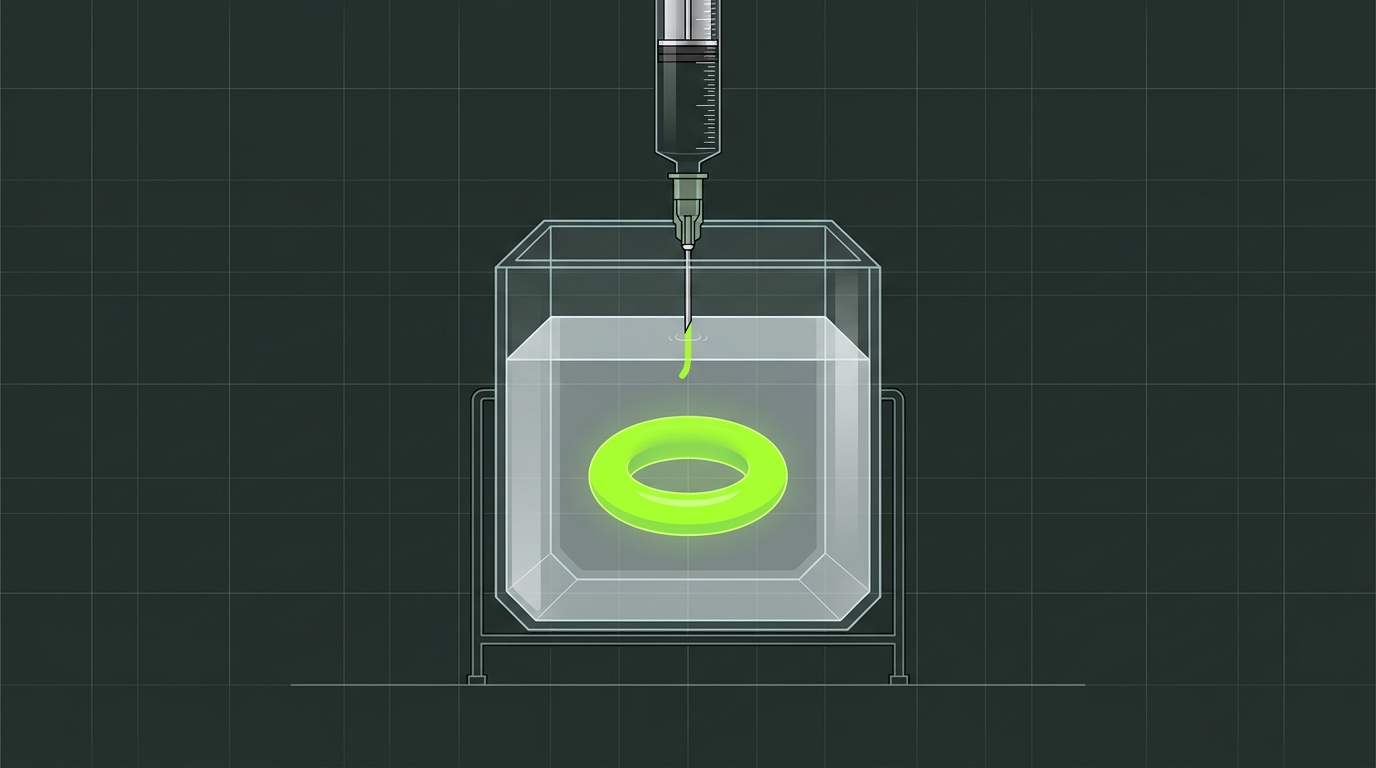
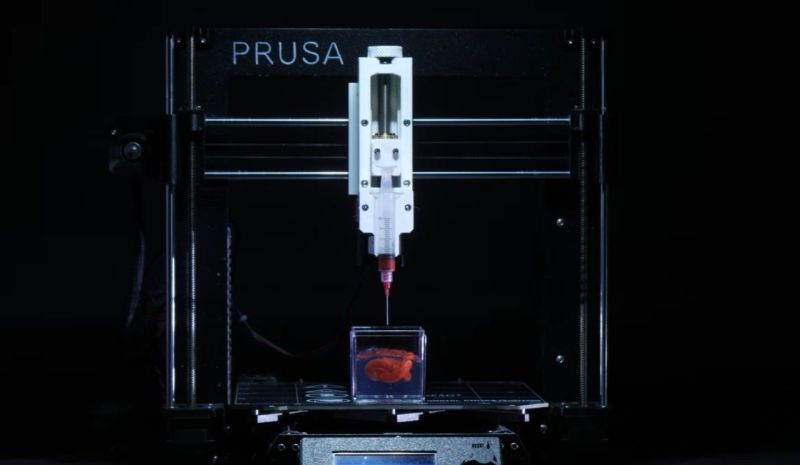 Figure: Extruding silicone suspended inside a hair gel support bath. Source: Hackaday
Cross-Domain Material Chemistry Stalls the Cure
The retrofit machine succeeded in depositing a delicate triple-torus silicone structure suspended cleanly inside the transparent hair gel without collapse, validating the precision and spatial control of the motion platform. Yet days later, the silicone remained a tacky, semi-liquid slurry, failing to crosslink into the expected resilient elastomer.
Certain chemical additives within the hair gel had poisoned the silicone’s platinum curing catalyst. This highlights the hidden engineering tax of cross-domain consumer material hacks. Everyday personal care products contain complex formulations of stabilizers, surfactants, and fragrances whose catalytic or inhibitory interactions with technical polymers cannot easily be predicted.
The true barrier to liquid 3D printing lies not in kinematics, but in the chemical compatibility between the support bath and the extrudate. Motion accuracy can be refined in firmware, and stepper motors position down to the micron. Yet fundamental polymer chemistry offers no concessions.
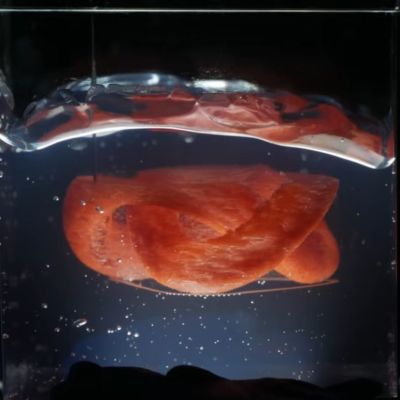 Figure: The incompletely cured silicone torus. Source: Hackaday
A bricked Prusa i3 has found a second life as an experimental liquid 3D printing platform. Open-source hardware knows no mandatory end-of-life. As long as a tinkerer has access to a syringe pump and an open controller, burnt-out hardware can step into entirely new technical dimensions. Until the structural axes themselves wear out, the performance ceiling of open hardware is bounded only by the modules plugged into its mainboard.
Reference:
- Hackaday Report