At $209 compared to $175, it costs just $34 more. Yet the multi-core compute throughput on this single-board computer opens up a staggering three-fold gap. In Geekbench 6 benchmarking, the Shenzhen-developed Radxa Dragon Q8B clocked a multi-core score of 6,302, decisively outpacing the 8GB Raspberry Pi 5. For the first time, open-source single-board hardware has squeezed in laptop-grade Qualcomm Snapdragon silicon.
Once boards reached early adopters, community reactions diverged rapidly. The sheer multi-core throughput turned heads across the maker scene, but rough out-of-the-box firmware quickly threw cold water on the excitement. Scaling compute raw power can be achieved through beefier hardware specs, but vaulting past the software ecosystem Raspberry Pi has cultivated over more than a decade demands far greater engineering rigor.
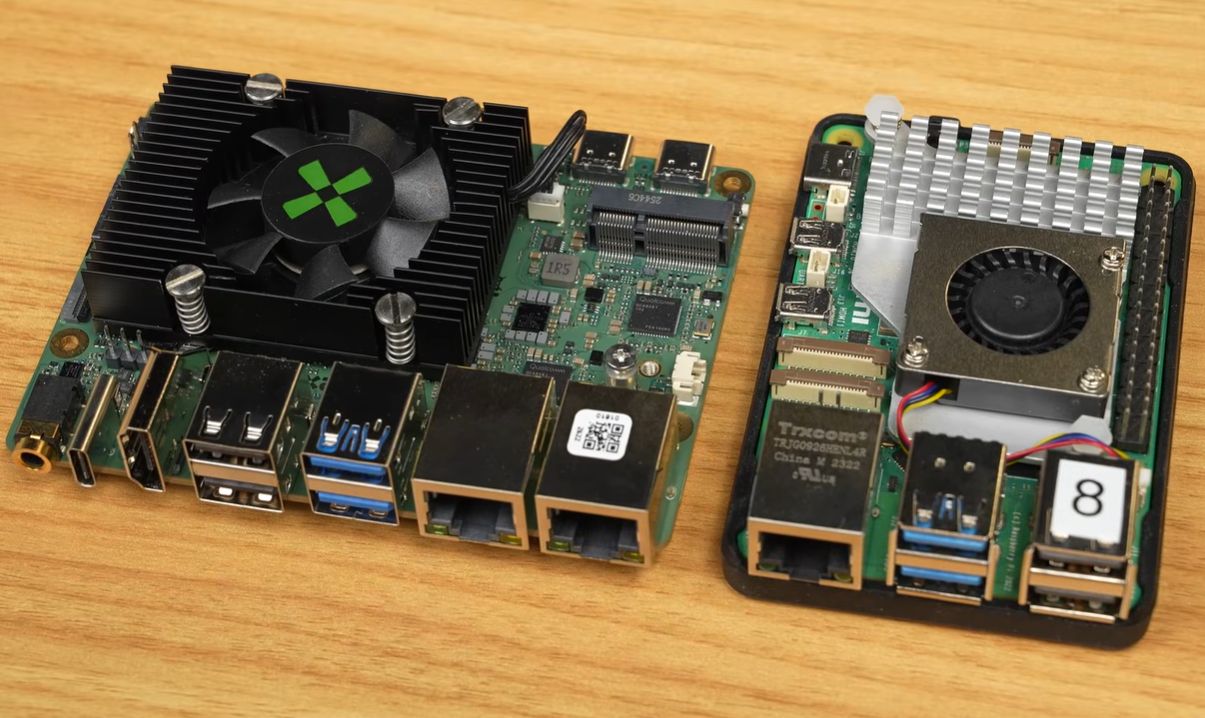 Figure: Side-by-side comparison of the Radxa Dragon Q8B and Raspberry Pi 5, featuring nearly identical board dimensions. Source: Jeff Geerling benchmark review
Breaking 6,300 Multi-Core Score Shatters the SBC Compute Ceiling
At the heart of the Dragon Q8B sits Qualcomm’s Snapdragon 8cx Gen 3 SoC, fabricated on TSMC’s 5nm process node. Originally designed for lightweight Windows on ARM ultraportables, its CPU topology packs four Cortex-X1C prime cores clocked at 3.0GHz alongside four Cortex-A78C performance cores running at 2.4GHz.
Hardware reviewer Jeff Geerling released hands-on benchmark findings. In Geekbench 6 runs, the Dragon Q8B posted a single-core score of 1,405 and a multi-core score of 6,302. In contrast, the Raspberry Pi 5—powered by Broadcom’s BCM2712 with just four Cortex-A76 cores—tops out around 2,100 in multi-core performance. That gives the Q8B an ~80% single-core uplift and an outright 3x multi-core lead. In Geekbench 7 testing, the Q8B pushed scores even further to 1,465 single-core and 7,114 multi-core.
Floating-point benchmarks tell an identical generational story. In Linpack benchmarking, the Dragon Q8B churned out 123.05 Gflops of compute throughput while maintaining total system power at 33W, achieving an energy efficiency of 3.73 Gflops/W. Under the same workload, the Raspberry Pi 5 only reached 2.75 Gflops/W. Qualcomm’s large-core architecture demonstrates an unmistakable compute efficiency edge.
This surge in horsepower comes at the expense of power draw. Idling on an active network connection, the Dragon Q8B draws nearly 4.9W. Under matrix stress testing, total system consumption jumps to 20.9W, reaching 33W when all cores are pinned under heavy floating-point loads. Accounting for external high-speed peripherals, Radxa recommends pairing the board with a 65W power supply. The unit has clearly stepped out of the traditional 5W to 15W SBC envelope, behaving much closer to a compact desktop PC.
Dual 2.5GbE and 128-Bit Memory Bus Match Desktop Specs
Unlocking compute throughput requires balanced supporting hardware. The Dragon Q8B comes standard with 8GB of LPDDR4X memory, with board options ranging from 4GB up to 32GB. Its memory bus spans 128 bits wide, operating at speeds up to 4,266 MT/s.
Mainstream single-board computers have long suffered from memory bandwidth bottlenecks caused by narrow bus designs. The Raspberry Pi 5 relies on a 32-bit low-power memory bus, often running into frame buffer and memory bandwidth starvation during concurrent data transfers and graphics rendering. The Dragon Q8B’s 128-bit memory subsystem provides a generous data pipeline, making lightweight on-device LLM inference practical and stable.
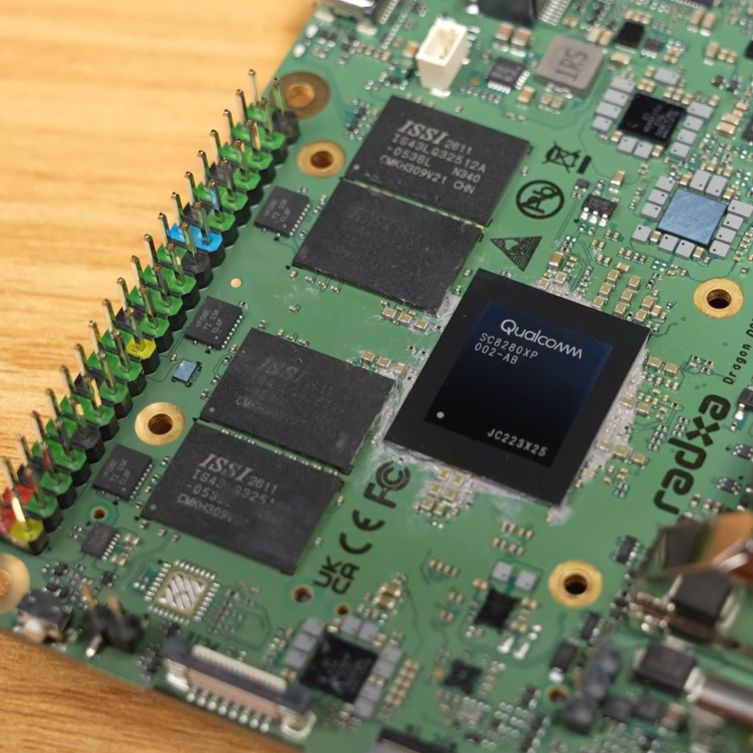 Figure: Close-up of Qualcomm’s Snapdragon SC8280XP SoC at the center of the Dragon Q8B. Source: Jeff Geerling benchmark review
Networking provisions also leap into workstation territory. An onboard Toshiba TC956x PCIe switch breaks out dual 2.5GbE high-speed Ethernet ports. In throughput testing, single-direction transfers saturated the full 2.35 Gbps physical line rate. Coupled with two onboard PCIe lanes, users can hook up high-speed NVMe solid-state storage directly, making it straightforward to assemble a micro network-attached storage node.
For display output, the integrated Adreno 690 GPU can drive up to three independent 4K displays at 120Hz. The SoC also embeds a Hexagon NPU rated at 29 TOPS for machine learning acceleration. At the $209 price point, these specifications elevate this developer board into industrial PC territory.
Generic OS Boot Failures Expose Factory Firmware Flaws
While the hardware spec sheet impresses, getting software up and running has proved bumpy. Promotional materials promised standard UEFI firmware support, but the factory firmware on early release units exhibited glaring regressions.
Testers hit multiple hardware detection roadblocks right at boot. During cold starts, the onboard firmware failed to reliably enumerate USB keyboards. Hardware KVM switches could not establish input control during the BIOS phase. When plugged into certain high-resolution monitors, users were met with black screens and no signal, forced to power-cycle repeatedly in hopes of entering the setup menu.
Attempting to install generic OS images outside official distributions proved even more problematic. Users trying to boot standard arm64 Ubuntu 26.04 installation media saw boards crash and reboot immediately after selecting menu entries in GRUB. The advertised plug-and-play UEFI boot capability effectively broke down in practice.
Radxa acknowledged the issue on its community forums, confirming that specific factory BIOS builds suffered regressions that stripped low-level compatibility needed by generic distributions. The manufacturer rushed out pre-release BIOS patches to resolve the boot sequence. To manage thermal headroom, early system images also throttled clock speeds, capping Cortex-X1C cores at 2.5GHz—only 83% of their rated peak. Getting full performance out of the hardware still depends on official custom OS images and vendor tuning scripts.
Sixty Out-of-Tree Patches Signal an Open Hardware Ecosystem Divide
Downstream distribution efforts by independent communities have highlighted this software gap even further. The open-source Armbian team faced an uphill battle while porting support to the Dragon Q8B.
To get the board booting cleanly on mainline Linux kernels, maintainers had to stack more than 60 out-of-tree patches on top of the kernel tree. These patches span backported Ethernet driver stacks, HDMI bridge chips, DisplayPort hot-plug handling, and hardware video decode pipelines. Without this heavy patch set, the board remains essentially non-functional on upstream kernels.
Everyday makers and systems engineers can hardly shoulder the technical overhead of maintaining such a complex driver stack independently. By contrast, the software ecosystem cultivated by the Raspberry Pi Foundation demonstrates durable long-term advantages. Thanks to unified Device Tree standards and mature official OS releases, Raspberry Pi 5 maintains seamless synergy between hardware and software. Beginners can flash an SD card, boot up, and have peripherals light up instantly, with extensive driver libraries installable via standard package managers.
While Qualcomm boasts deep heritage in the mobile space, its presence in single-board computing lacks decades of embedded open-source foundation. Proprietary drivers supplied by the chipmaker raise the bar for independent community porting. Hardware vendors must invest massive engineering resources simply to piece the software puzzle together.
Hardware Specs vs. Community Stickiness: Two Paths to Survival
The open-source single-board computer market is diverging into two distinct evolutionary tracks.
Industrial gateways, dedicated build clusters, and edge video analytics demand sheer raw horsepower. Enterprise developers have non-negotiable requirements for high-bandwidth interfaces and bring deep in-house engineering expertise to bear. These teams are comfortable compiling custom kernels and patching drivers to harness Qualcomm’s multi-core compute density.
Yet for the broader maker community, Raspberry Pi remains the uncontested default despite lagging raw performance. Stable, frictionless software constitutes a defensible moat. With out-of-the-box GPIO libraries and exhaustive community documentation, newcomers rarely encounter insurmountable friction.
The Dragon Q8B proves the immense performance potential of bringing laptop silicon down to maker boards. Yet firmware stability and developer ecosystem maturity will ultimately dictate any single-board computer’s staying power. Spinning up high-spec hardware takes only a few months of board layout; cultivating a resilient software ecosystem takes years of patient refinement.
Reference Links:
- Hackaday review coverage
- Jeff Geerling SBC benchmarking project notes
- Radxa Dragon Q8B official technical documentation
- Radxa official technical forum discussions