A 49,999 RMB sticker on the chassis side panel shatters the long-held consumer perception that mini PCs are cheap, sub-$500 machines. On October 11, 2026, Peladn officially launched the YO2 flagship mini workstation powered by the AMD Ryzen AI Max+ PRO 495 processor. Sporting a top-tier configuration of 192GB unified memory alongside a 2TB SSD, this palm-sized machine has thrust compact desktop hardware straight into the enterprise spotlight.
Historically, mini PCs have been relegated to low-cost living room media hubs, software routers, or lightweight office duties. With the YO2, Peladn is directly targeting enterprise R&D teams and developers hungry for edge compute power. By allowing users to dynamically allocate up to 160GB of unified memory as GPU VRAM, this compact system takes on one of local large language model deployment’s steepest bottlenecks: raw model parameter footprint.
 Image: Peladn officially launches the YO2 flagship mini workstation with standard 192GB memory. Source: Peladn Official Store
192GB Unified Memory Breaks Consumer GPU 24GB VRAM Limits
When deploying large language models on desktop workstations, the first physical barrier developers hit is almost always video memory capacity. Mainstream consumer flagship graphics cards like Nvidia’s GeForce RTX 4090 top out at 24GB of GDDR6X VRAM. To load a quantized 70B parameter model, weight files alone eat up nearly 40GB of memory. Desktop users are forced to either link multiple GPUs together or settle for severely trimmed-down smaller models.
While enterprise workstation cards provide ample memory, a single 48GB RTX 6000 Ada card costs north of $7,000 on its own. Setting up a multi-GPU rig easily pushes total hardware procurement beyond $15,000, not to mention the kilowatt-level power supply and heat management requirements. These prohibitive VRAM costs have kept most small and medium-sized teams locked out of deploying private, on-premises large models.
The Peladn YO2 charts a different path using AMD’s Strix Halo architecture. The processor features 192GB of onboard quad-channel LPDDR5X unified memory, enabling the integrated GPU to directly harness up to 160GB as video memory. On a single compact desktop device, developers can run quantized 70B and even 120B parameter models in full. The VRAM bottleneck is neutralized inside a compact chassis thanks to unified memory architecture.
40 Compute Units and 160W Cooling Squeezed Into a Palm-Sized Chassis
At the heart of the system is the AMD Ryzen AI Max+ PRO 495, AMD’s flagship commercial APU. Built on TSMC’s 4nm process with Zen 5 architecture, the chip packs 16 cores and 32 threads, boosting up to 5.2GHz. The platform also integrates an onboard NPU delivering 55 TOPS of dedicated AI compute, bringing total system AI performance to 131 TOPS.
On the graphics side, the processor integrates a Radeon 8065S GPU built on RDNA 3.5 architecture. Featuring 40 compute units (CUs) clocked up to 3000 MHz, the iGPU approaches the compute core scale of discrete performance GPUs, upending traditional assumptions about integrated graphics limitations.
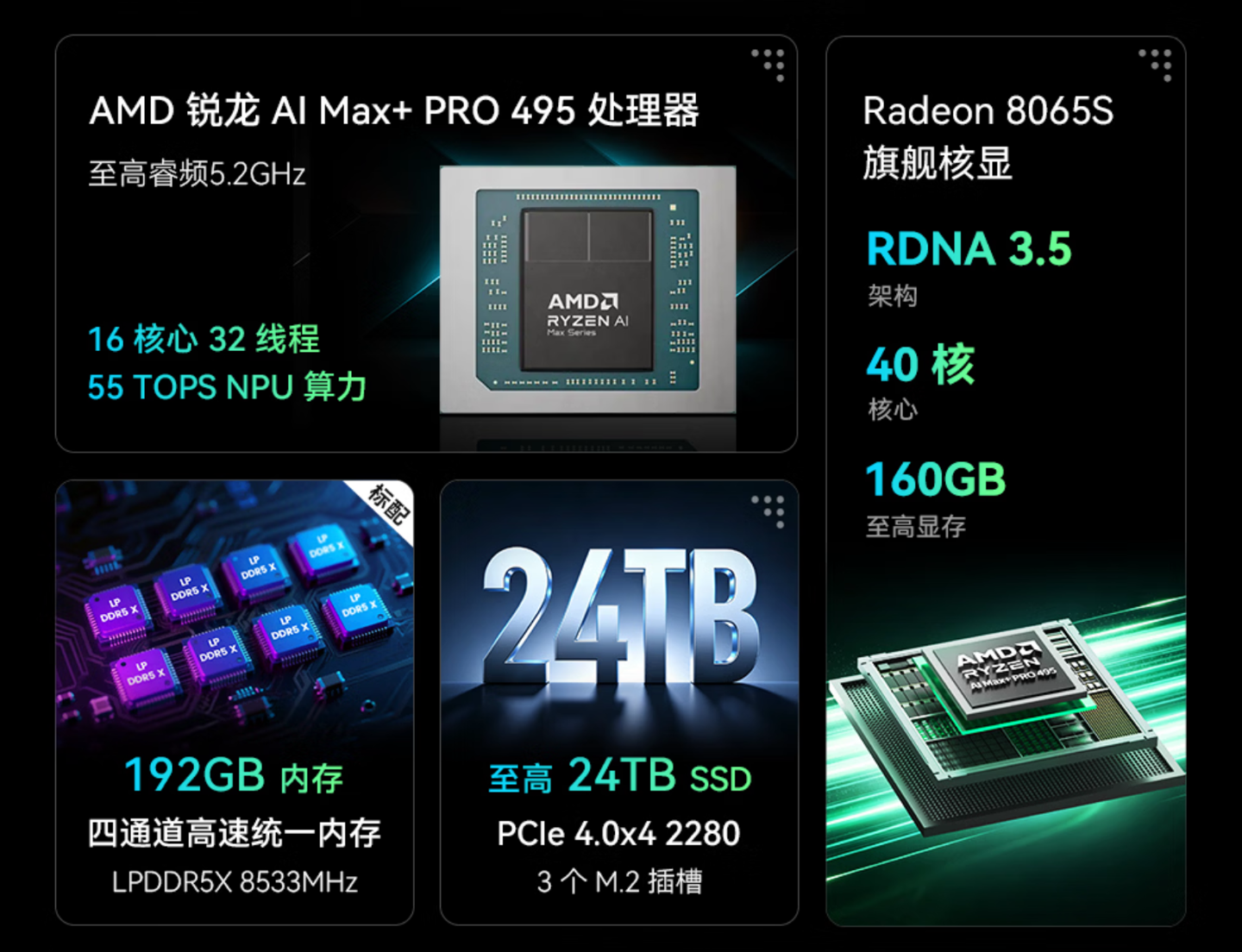 Image: The processor integrates 16 Zen 5 CPU cores and 40 RDNA 3.5 compute units. Source: AMD Official Whitepaper
To tame the thermal load generated by heavy computing workloads, Peladn equipped the YO2 with dual 9020 centrifugal blower fans coupled to three composite copper heatpipes, supplemented by a dedicated auxiliary system fan on the motherboard side. A physical toggle switch on the front panel allows users to quickly shift between 55W Silent, 85W Balanced, and 120W Performance modes, with peak sustained thermal output reaching up to 160W. A high-grade cooling module enables this mini PC to continuously sustain triple-digit wattage loads.
The I/O configuration is equally tailored for workstation workflows. The chassis integrates dual USB4 40Gbps ports, dual 2.5G Ethernet ports, HDMI 2.1 and DisplayPort 2.0 outputs, and three internal PCIe 4.0 x4 M.2 slots for storage expansion. Interconnect protocols also support clustering up to 4 units together to share memory pools, unlocking an aggregated VRAM footprint of up to 640GB.
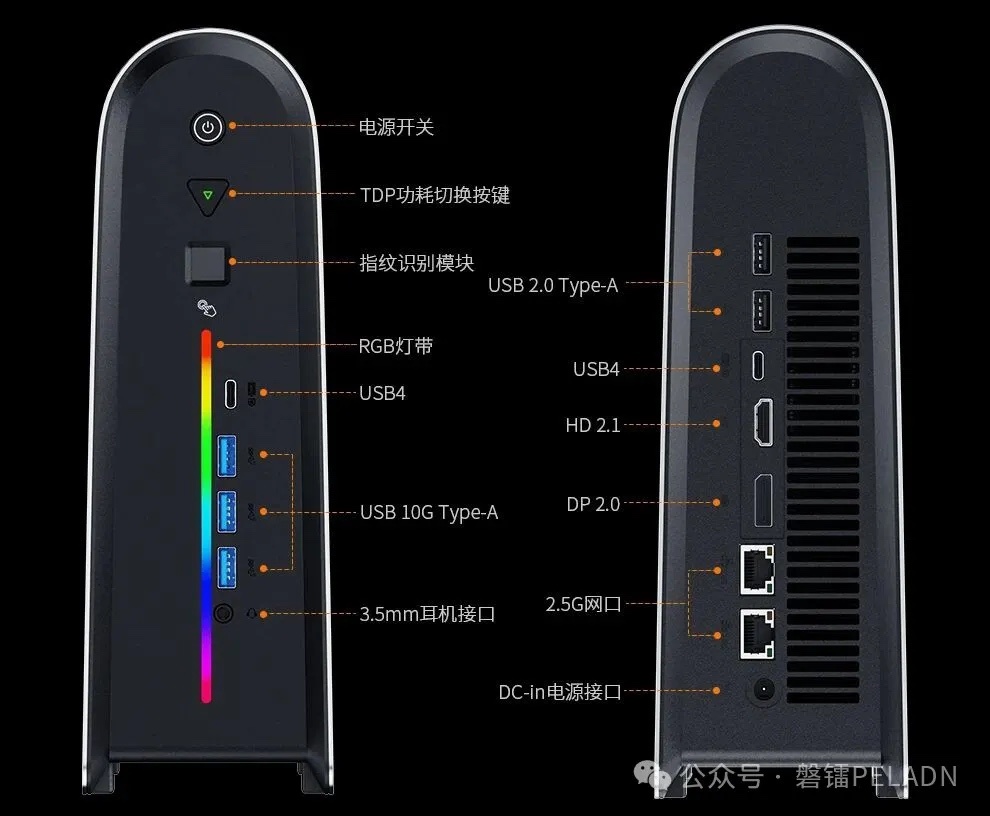 Image: Dual USB4 ports and dual 2.5G LAN ports provide expansion conduits for local clustering. Source: Peladn Official Product Documentation
273 GB/s Memory Bandwidth Sets Hard Limits on Inference Throughput
Although 192GB of unified memory removes the capacity barrier, the hardware architecture still faces intrinsic physical trade-offs. The generation phase in large model inference is heavily memory bandwidth bound. For every new token generated, tens of gigabytes of model weights must be streamed entirely through memory.
The Ryzen AI Max+ PRO 495 pairs a 256-bit memory bus with LPDDR5X-8533 memory, achieving a peak theoretical bandwidth of approximately 273 GB/s. While this is more than triple standard dual-channel DDR5 memory (~80 GB/s), it remains far behind dedicated workstation GPUs. An RTX 4090 delivers 1,008 GB/s of GDDR6X bandwidth, and Apple’s M-series Ultra chips provide up to 800 GB/s.
Under this 273 GB/s bandwidth ceiling, text generation speeds when running a 70B model average around 4 to 5 tokens per second. While adequate for single-pass code reviews, offline long-form summarization, and automated background batch jobs, it exhibits noticeable pauses in high-frequency, interactive multi-turn conversational agents. Unified memory solves the capacity puzzle of fitting huge models, but bandwidth dictates the upper bound of token generation speed.
A $7,000 Price Tag Challenges the ROI of On-Prem Private AI
Priced at 49,999 RMB, the YO2 has sparked sharply divided takes regarding hardware ROI in local computing.
Proponents emphasize the privacy, zero latency variation, and operational control of on-premises isolation. Medical institutions, law firms, and engineering design teams handle strictly confidential data, where public cloud APIs raise compliance and data leak concerns. For $7,000, teams get a whisper-quiet, palm-sized, plug-and-play inference node without needing dedicated server racks, three-phase power, or specialized cooling infrastructure.
Skeptics argue the price-to-performance ratio remains questionable. With the same budget, organizations could assemble two liquid-cooled desktop towers housing dual RTX 4090 GPUs, delivering substantially faster token generation. Moreover, as commercial cloud API pricing continues to drop, $7,000 can buy hundreds of millions of tokens from frontier hosted models.
Peladn is betting on an emerging niche: developers and engineering teams who need native x86 environments, extensive memory headroom, and compact footprints without server room operational overhead.
Mini PCs Cross the Chasm From Gadgets to Production Workstations
From budget sub-$300 plastic boxes to luxury aluminum workstations, PC makers are redefining the boundaries of small-form-factor computing. Brands like Beelink, Minisforum, and Peladn rolling out workstation-grade APUs reflect a fundamental shift in compute distribution.
Upstream chipmakers are tearing down the rigid walls separating CPUs and GPUs. By implementing ultra-wide memory buses and massive unified memory pools, semiconductor architects are bringing memory capacities once exclusive to enterprise server racks directly to personal desks. Mini PCs are no longer just display terminals—they are evolving into self-contained edge compute engines capable of hosting massive neural networks.
The Peladn YO2 serves as a vanguard experiment in this hardware evolution. While 49,999 RMB represents an early-adopter ticket for specialized organizations, the technical trajectory it validates is unmistakable: when compact desktop machines can comfortably house hundred-billion parameter models, the momentum of local, private AI becomes impossible to halt.
Reference Links:
- Peladn Official Store Product Documentation
- AMD Ryzen AI Max+ PRO Official Technical Whitepaper
- Notebookcheck Coverage
- IT Home Coverage