In September 2026, the 8th Nokia 3310 Game Jam drew to a close, with the physics-based pinball title Trick Shot II taking top honors among 51 submissions. While most entrants submitted entries targeting web-based emulators, developer Hoani Bryson took a decidedly physical route. Sourcing a vintage turn-of-the-millennium Nokia 3310 handset, he gutted its internal electronics and slotted a custom-designed printed circuit board hosting a Raspberry Pi Pico into the original plastic enclosure.
This was an open-heart transplant for an iconic feature phone chassis. Writing a cross-platform engine in Go, the author drove the vintage dot-matrix LCD and piezoelectric beeper directly on the bare-metal microcontroller. The classic handset flickered back to life with its familiar green glow, its tactile buttons producing sharp, mechanical clicks. Armed with open-source toolchains and modern microcontroller compute, the project revived classic human-machine ergonomics while completely reimagining the silicon beneath.
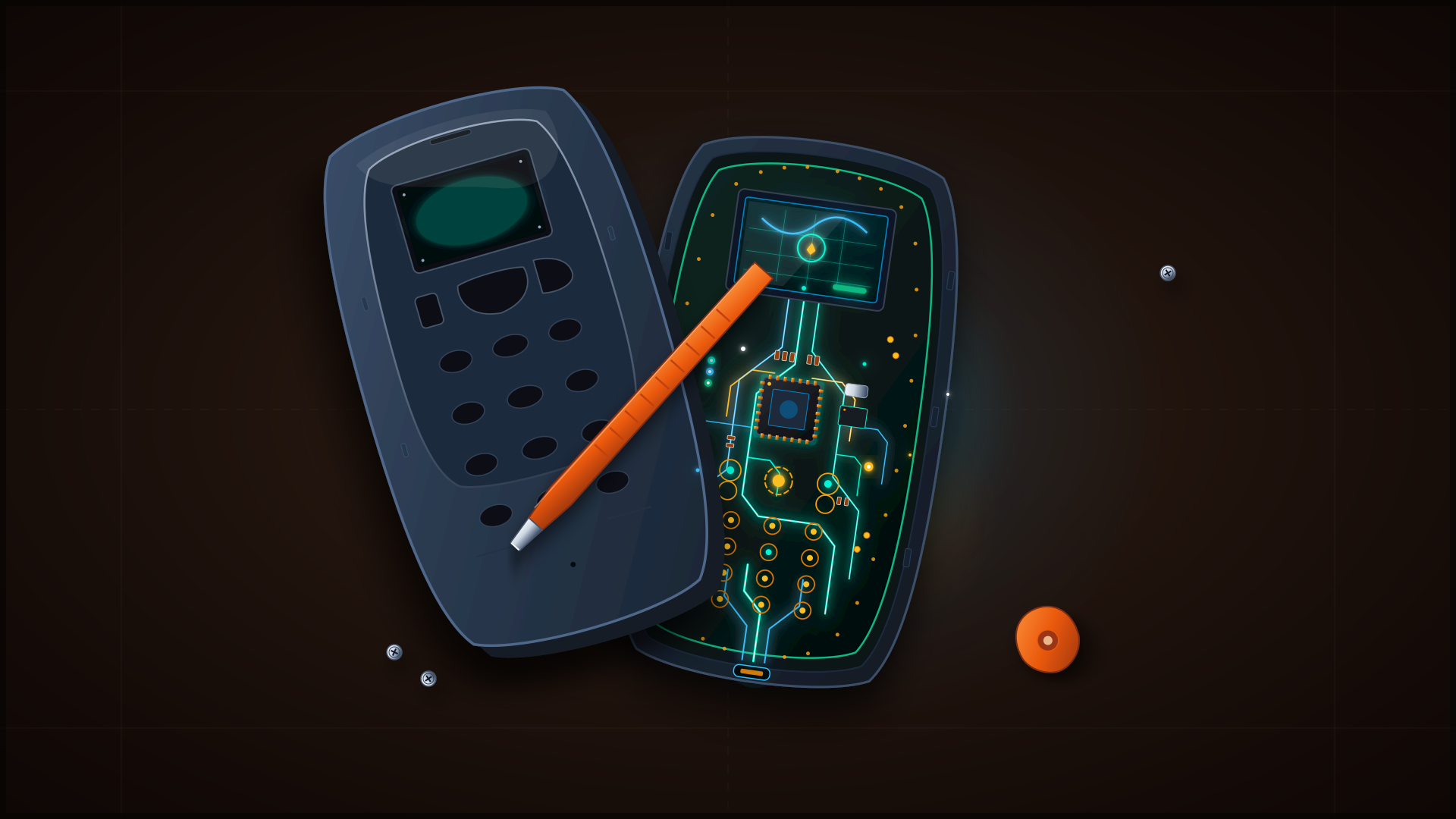
Measuring a Custom PCB with a 20-Centimeter Plastic Ruler
Cracking open the Nokia 3310 reveals a tightly integrated proprietary chipset. The factory board houses baseband processors and power management units whose technical documentation is virtually nonexistent. Stymied by the lack of public datasheets for native interfaces, Hoani abandoned reverse-engineering the stock processor. Instead, he stripped the original electronics entirely and designed a bespoke drop-in replacement board for the authentic casing.
Capturing the board’s physical contours and cutout positions proved paramount. Without access to a coordinate measuring machine or precision digital calipers, the creator grabbed an ordinary 20-centimeter plastic ruler, relying on naked-eye alignment against millimeter tick marks to draft the PCB outline. Keypad pads, backlight window cutouts, and chassis snap-fit notches were all derived through manual estimation. When prototype boards arrived just three days before the jam deadline, hand soldering quickly laid bare unforgiving mechanical tolerances.
Industrial design leaves no margin for half-millimeter discrepancies. While the original Nokia 3310 motherboard was precisely 1.0 mm thick, the author had initially ordered the industry-standard 1.6 mm substrate. That extra 0.6 mm jammed the plastic enclosure’s retention clips, leaving the shell bulging open along its seams.
Alignment tabs along the board perimeter also collided with internal plastic ribs due to measurement tolerances. Donning safety glasses and gripping a rotary multi-tool, Hoani ground away the interfering PCB edges to force a workable prototype fit. Subsequent board revisions reverted to the standard 1.0 mm thickness, finally snapping together cleanly without external strain.
Inside the handset, electrical connectivity relies entirely on compression contacts. Battery terminals, the display interface, the speaker, and the eccentric vibration motor all press against copper pads on the board surface solely through mechanical enclosure pressure. Consequently, the top layer of the PCB had to remain completely flat, strictly forbidding any surface-mount components that would break the planar surface.
To backlight the keypad, reverse-mount LEDs were soldered onto the bottom side of the board, beaming light upward through 2 mm through-holes drilled into the substrate. Component vertical clearance was capped at 2 mm across the board, with only the top antenna cavity offering extra headroom.
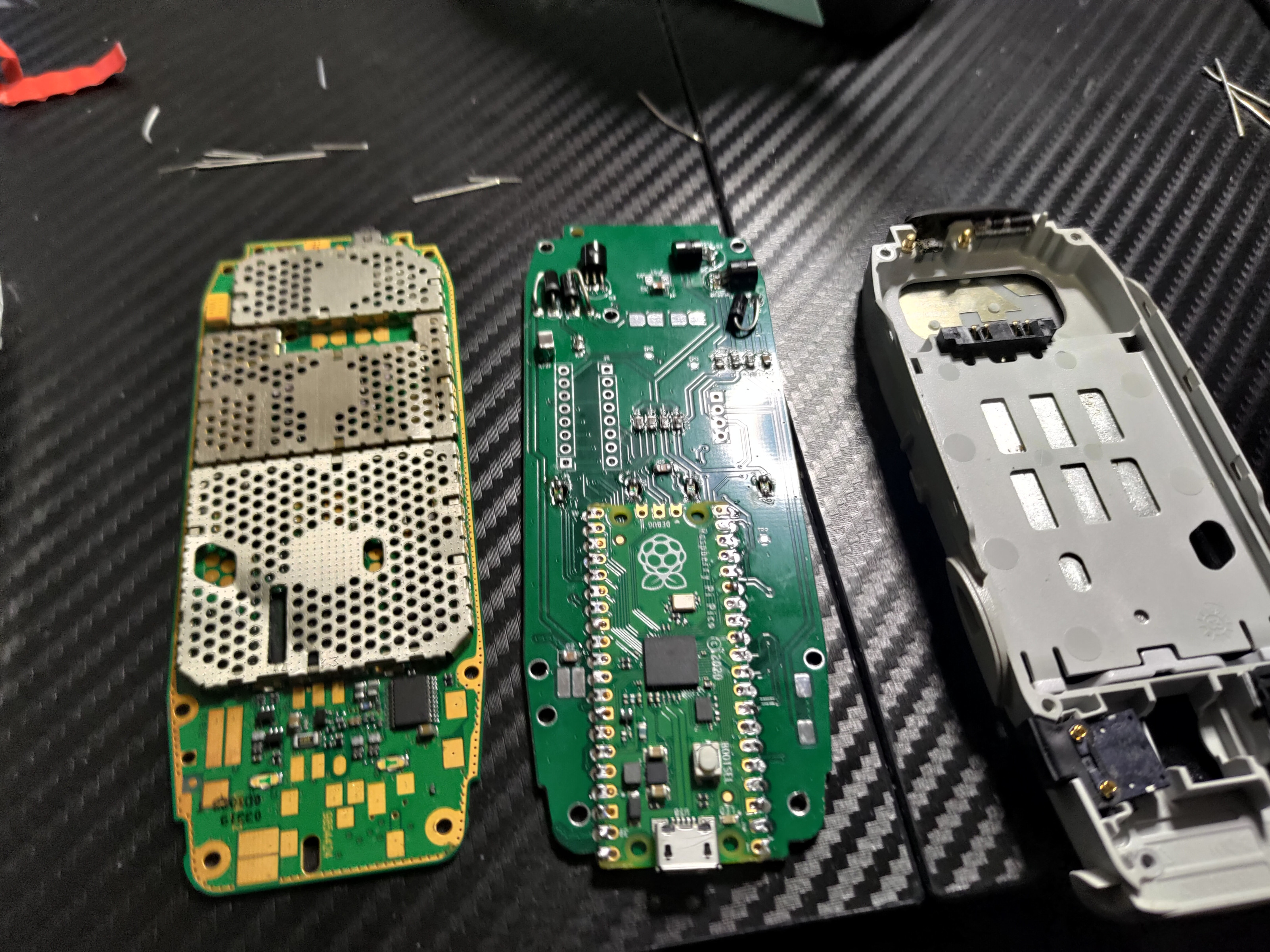 Figure: Stock green Nokia 3310 motherboard compared against the hand-soldered Raspberry Pi Pico replacement PCB. Source: Hoani.net (Hoani Bryson’s blog).
Non-Square Pixels Force Physics Engine Coordinate Overhaul
The PCD8544 monochrome LCD bundled with the Nokia 3310 represents an enduring classic of industrial design. Delivering a native resolution of just 84x48 pixels, its viewable area spans roughly 30.5 mm wide by 21.5 mm high. Each physical pixel measures 0.363 mm by 0.448 mm, yielding an aspect ratio close to 4:5. Rendering two-dimensional physical simulations on non-square pixels immediately created geometric distortions.
Rendering on an assumed square grid stretched circular pinballs into tall ovals. To maintain visually round projectiles on screen, the author overhauled the physics engine’s internal coordinate geometry. The underlying subsystem mapped 5 horizontal pixels and 4 vertical pixels to identical real-world dimensions. By decoupling physical calculation space from the display pixel grid, collisions and ricochets regained visual realism across the physical dot-matrix screen.
Vintage liquid crystal panels are notoriously sluggish. Although the PCD8544 panel can refresh at up to 67 Hz, its liquid crystal molecules exhibit pronounced transition latency. Pixels require roughly 50 ms to transition from clear to opaque, and take a sluggish 125 ms to decay back to clear.
High-speed pinballs left heavy ghost trails across the display. The author initially tried exploiting this persistence of vision by flickering alternating frames to simulate shades of gray, but live tests produced severe tearing and horizontal banding. The panel’s physical latency fundamentally broke temporal dithering techniques.
Software algorithms stepped in to overcome optical limitations. Abandoning temporal frame toggling, the developer embraced spatial ordered dithering. Implementing an 8x8 Bayer threshold matrix, the engine mapped 64 brightness gradations into spatial black-and-white pixel densities. The title screen artwork and in-game ball trails promptly gained smooth, legible shading.
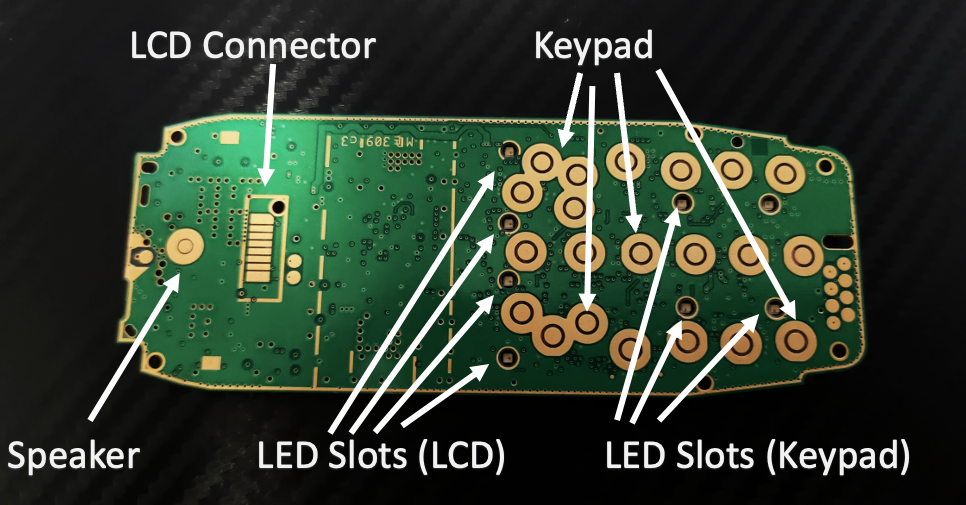 Figure: Planar copper keypad contact pads and backlight through-holes on the front side of the custom PCB. Source: Hoani.net (hardware teardown guide).
Dual-Target Architecture Brings Go to Microcontrollers
At the software layer, the central engineering challenge was crafting an engine spanning both desktop browser simulation and bare-metal embedded execution. Hoani developed a framework dubbed 3310_engine, leaning on Go’s conditional compilation toolchain to split the target builds. Through compiler build tags, identical game logic seamlessly compiled into two fundamentally distinct output binaries.
The embedded target builds via the TinyGo compiler. Targeting the Raspberry Pi Pico’s dual-core RP2040 chip, the software executes as lightweight bare-metal firmware. Free from operating system scheduling overhead, the main loop runs deterministically at a locked frame rate. Each tick sequentially polls the keypad matrix, updates physical dynamics, computes audio waveforms, and blits graphics to the LCD buffer, capturing switch transitions on 16 buttons with microsecond latency.
On-chip memory on microcontrollers demands extreme conservation. With the RP2040 offering only 264 KB of SRAM, decompressing standard runtime images would quickly exhaust memory budgets. The author omitted image decompression libraries entirely, adopting direct flash streaming. Visual assets were pre-converted into uncompressed PBM monochrome bitmaps, baked into read-only flash at compile time, and pushed directly to framebuffers without runtime decompression.
A single piezoelectric buzzer imposed further audio constraints. The Nokia 3310 carries only one piezo transducer, unable to output polyphonic arrangements. The developer drove the buzzer using square-wave pulse-width modulation (PWM), varying duty cycles between 0% and 50%. Notes below C3 lost acoustic resonance and collapsed into feeble buzzing, prompting the audio engine to incorporate custom transposition routines that shifted melodies into the transducer’s sweet spot.
Hardware Transplants Highlight Compute Disparities in Retro Nostalgia
The Raspberry Pi Pico’s RP2040 boasts dual cores clocked at 133 MHz paired with 2 MB of external flash. The original Nokia 3310 processor operated at modest clock frequencies in the teens of megahertz, backed by memory counted in kilobytes. The compute disparity spans orders of magnitude. This dramatic generational gap sparked spirited discussion across hardware modding circles.
Purist tinkerers contend that gutting the original PCB sacrifices the historical integrity of retro hardware. Swapping in modern ARM silicon feels closer to a case mod than true computer preservation. The quirks, bottlenecks, and timing jitter of vintage chips represent the genuine character of turn-of-the-century engineering. Emulating older hardware on modern microcontrollers risks turning iconic hardware into hollow shells.
Conversely, proponents of functional restoration offer a compelling counterpoint. With vintage silicon undocumented and legacy development tools lost to time, demanding pure reverse engineering often condemns classic hardware to gather dust as unfixable e-waste. Custom open-source replacement boards extend the physical lifespan of classic enclosures while providing modern programming interfaces. Anyone can order PCBs using open design files, tethering nostalgic industrial design to today’s vibrant maker community.
This philosophical debate illustrates how retro culture continues to evolve. Nostalgia no longer demands preserving bygone electronics under glass in static museum cases. When classic industrial design intersects with modern open-source ecosystems, retro hardware transforms into a dynamic creative medium.
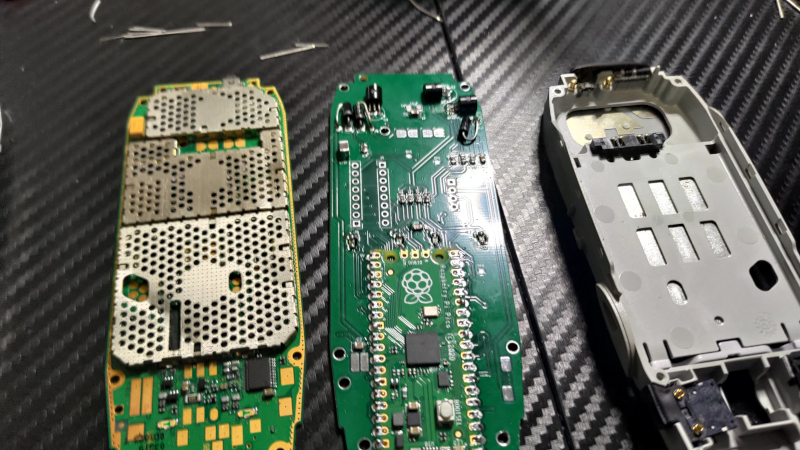 Figure: The modified Nokia 3310 hardware running Trick Shot II. Source: Hackaday (reporting by Jenny List).
Tactile Keypads Anchor the Millennial Interactive Soul
Bridging browser-based emulation and handheld feature phones reveals that the core difference lies in tactile certainty. Tapping on modern capacitive touchscreens provides only smooth, frictionless glass. Lacking mechanical key travel and tactile snap, interactions forfeit muscle memory.
The Nokia 3310’s silicone keypad and metal dome switches deliver unambiguous physical feedback. The resistance of thumb presses and the solid heft of the chassis grant an immersive feel no touch surface can replicate. That haptic reassurance remains something pure code emulation cannot emulate.
The widespread availability of open-source PCBs and accessible microcontrollers has radically lowered the barrier to hardware hacking. Makers no longer need lab-grade reverse-engineering gear to take an idea from layout sketches to custom firmware over a weekend. By infusing modern compute into classic designs, hardware hackers preserve the tactile warmth that defined an era.
Reference Links:
- Hackaday Report: Taking A Nokia 3310 Game Jam To The N’th Degree
- Hoani Engineering Blog: Multiplatform Engine for Nokia Jam 3310
- Hoani Teardown Guide: Nokia 3310 Hardware Teardown