While Share with Apple devices is turned on, your phone may temporarily disconnect from Wi-Fi networks while searching for or sharing with Apple devices.
Transfer speed for Apple devices may be slower than other devices that support Quick Share.
These two frank system prompts quietly surfaced on the screen of a Samsung mid-range smartphone, the Galaxy A56. Between October 20 and 21, 2026, Samsung began rolling out One UI 9.0—based on Android 17—to users worldwide. Galaxy A56 and A57 owners spotted an unexpected new toggle under the system’s “Connected devices” menu: “Share with Apple devices.” Once enabled, these $300–$400 handsets can initiate direct, two-way AirDrop transfers with the iPhone 18 Pro lineup, iPads, and Macs—without installing any third-party apps.
For years, full-resolution cross-ecosystem file transfer served as Apple’s most formidable moat for user retention. Even when Android flagships managed to poke holes in that wall, manufacturers treated it strictly as a premium luxury. By democratizing cross-platform Quick Share on the Galaxy A56 and A57 to communicate directly with iPhone 18 Pro, Samsung and Google are dismantling the walled garden from the network layer up. OEMs have realized that artificial transfer barriers cannot prevent platform switching—and maintaining isolated silos only compromises the competitive edge of mass-market volume drivers.
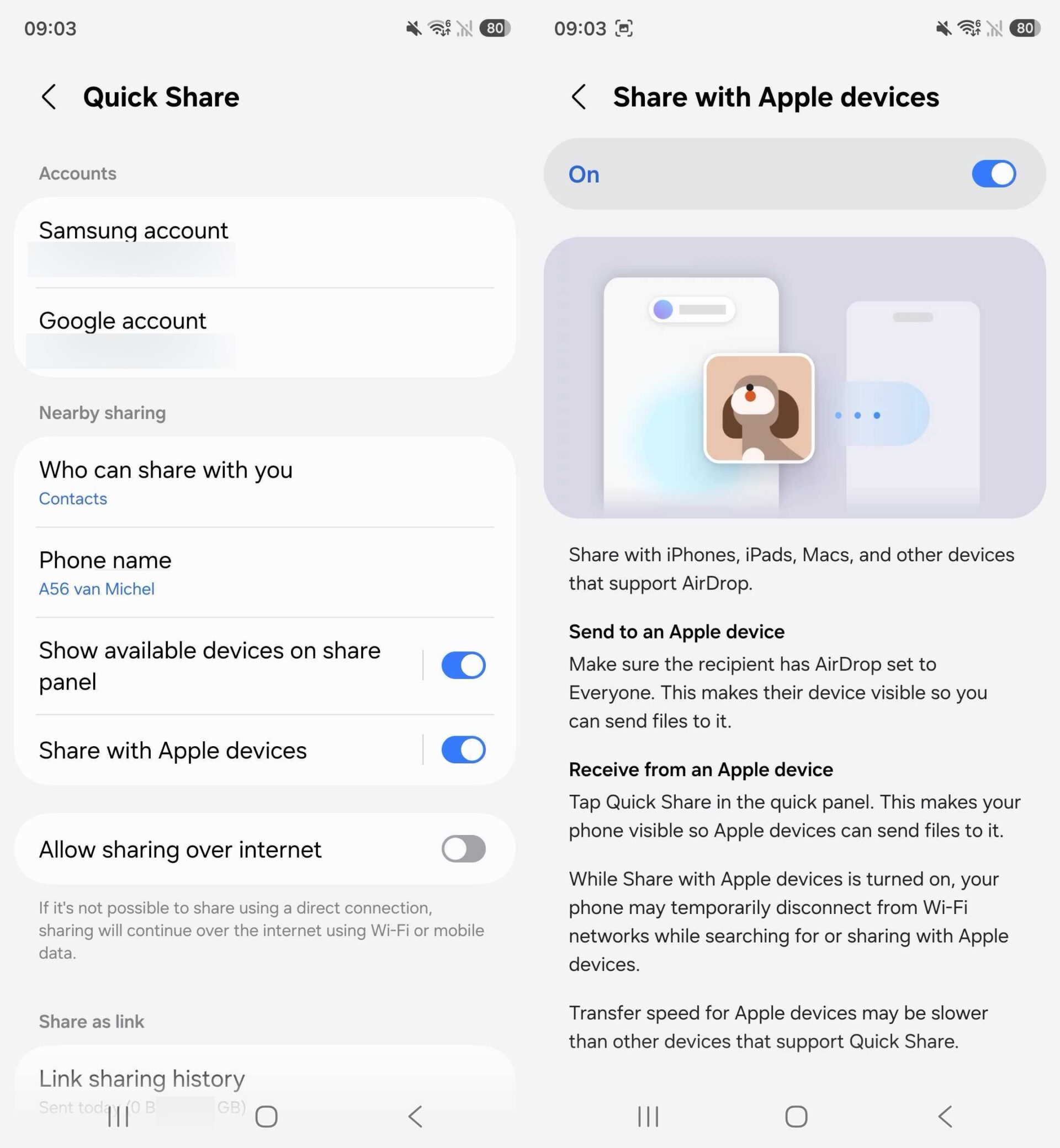 Figure: A Galaxy A56 named “A56 van Michel” displays the “Share with Apple devices” toggle after updating to One UI 9.0; the right-hand panel outlines transfer rules and the temporary Wi-Fi disconnection notice. Source: SamMobile.
From Pixel 10 to Galaxy A56: An 11-Month Journey Downmarket
Rewind 11 months, when native Android-to-iOS transfer was still an exclusive privilege reserved for experimental flagship hardware. On November 20, 2025, Google first bridged Quick Share with Apple’s AirDrop protocol on the Pixel 10 series, pledging to open the underlying protocol stack to Android hardware partners. Four months later, on March 22, 2026, the Samsung US Newsroom officially announced that AirDrop compatibility would land on the Galaxy S26 series starting March 23. The rollout kicked off in South Korea before expanding to North America, Europe, Latin America, Southeast Asia, and Greater China.
In technical footnotes accompanying the March rollout, Samsung outlined clear software prerequisites: devices required Quick Share version 13.8.51.27 or higher alongside Google Play services build 26.11.xx or later, with the feature enabled by default out of the box. At the time, Samsung’s official language remained distinctly cautious, noting that as of March 2026, “Share with Apple devices” was exclusive to the Galaxy S26 series, with future expansion planned only for select premium flagships.
Yet the software trickled down far faster than Samsung’s initial posturing suggested. Over the following six months, the capability reached preceding flagship generations, followed by the Fan Edition (FE) lineup and foldable flagships. By late October, as the stable One UI 9.0 build hit mid-range channels, the Galaxy A56 and A57 finally received the cross-platform switch that had been omitted from One UI 8.5. As of October 22, 2026, Samsung’s roster of devices supporting direct AirDrop connectivity spans 19 models across 8 distinct product tiers.
| Product Tier | Supported Models | System & Component Requirements | Rollout Timeline |
|---|---|---|---|
| Flagship (S Series) | Galaxy S26 / S26+ / S26 Ultra, S25 series, S24 series | Quick Share 13.8.51.27+, Play services 26.11.xx+ | Debuted March 23, 2026 on S26; expanded to S25/S24 |
| Foldable Flagship (Z Series) | Galaxy Z Fold 8 Ultra / Z Fold 8 / Z Flip 8, Z Fold 7/6, Z Flip 7/6 | Pre-installed or upgraded to One UI 9.0 / One UI 8.5 compatible builds | Launched Summer 2026 with Gen 8 foldables; backward-compatible 2 generations |
| Sub-Flagship (FE Series) | Galaxy S25 FE, Galaxy S24 FE | One UI 9.0 stable build + Galaxy Store module update | Rolled out mid-October 2026 alongside stable firmware |
| Mid-Range Volume (A Series) | Galaxy A56, Galaxy A57 | Upgraded to One UI 9.0 (Android 17) with sharing toggle enabled | Confirmed by global users October 20–21, 2026 |
From four-figure flagships like the Galaxy S26 Ultra and Z Fold 8 Ultra down to the $300 Galaxy A56, Samsung compressed the journey from flagship exclusivity to mass-market availability into under seven months. By opening the floodgates to mid-range devices within seven months of launch, cross-platform interoperability shifted from a premium upsell gimmick into an indispensable baseline utility across every price bracket.
Google Rewrote Parsing in Rust: Unilateral Engineering to Bypass Apple Handshakes
How can a budget handset trigger the native transfer prompt on an iPhone? In an official post on the Google Security Blog, the VP of Platform Security and Privacy detailed the underlying communication architecture. The entire data pipeline strictly bypasses cloud servers and intermediate web links. Payloads are transmitted exclusively over peer-to-peer (P2P) wireless channels, generating zero sharing logs and stripping non-essential metadata.
In cross-platform wireless operations, the greatest threat stems from malformed incoming binary packets. The receiver must continuously parse Bluetooth Low Energy (BLE) beacons and local wireless frames. If implemented in legacy languages like C or C++, parsing errors can easily lead to memory corruption and buffer overflow exploits—granting attackers an entry point for remote code execution. To eliminate this attack surface, Google’s engineering team rebuilt the core interop communication and packet parsing engine entirely in memory-safe Rust.
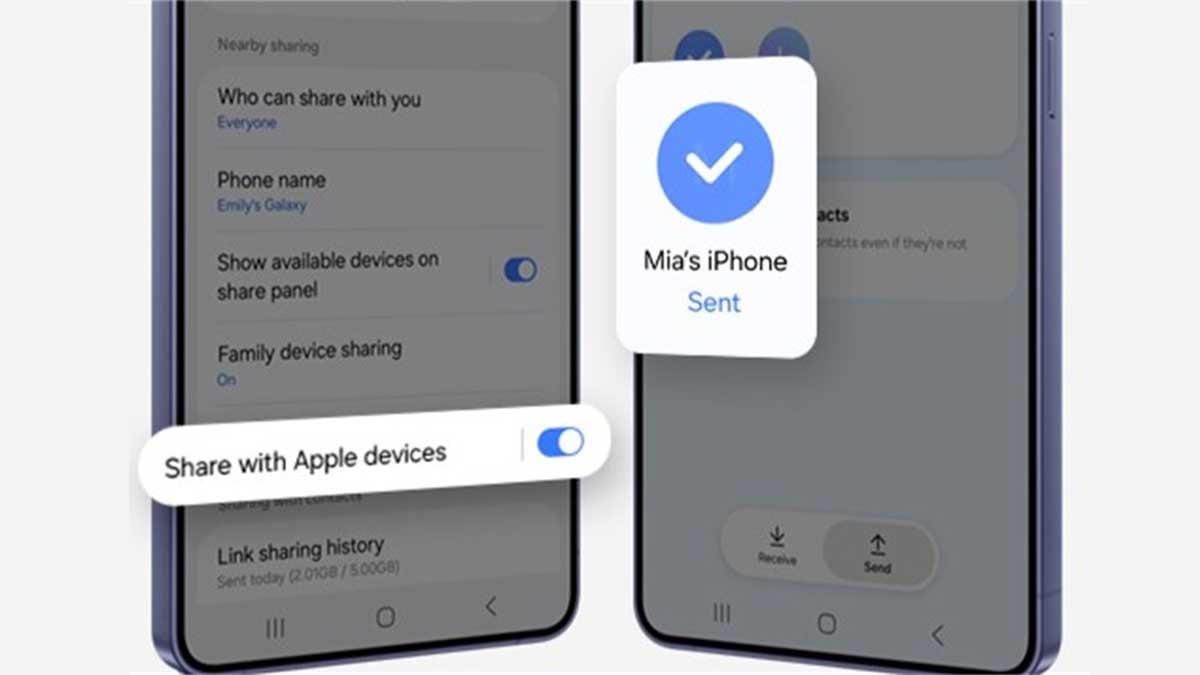 Figure: With “Share with Apple devices” turned on, a Samsung handset scans and transmits files directly to an Apple device named “Mia’s iPhone”—entirely bypassing third-party software. Source: SammyFans.
Leveraging Rust’s compile-time ownership guarantees and borrow checker, the translation stack eradicates spatial and temporal memory bugs at the source. Prior to shipping on Pixel 10 and Galaxy hardware, Google conducted threat modeling, privacy audits, and internal red-teaming, alongside an independent third-party assessment by cybersecurity firm NetSPI. NetSPI’s report affirmed that the stack’s security posture substantially surpasses comparable implementations without telemetry leakage. Stanford cryptography professor Dan Boneh likewise praised the design, calling Google’s adoption of Rust in low-level networking an engineering benchmark for secure cross-platform protocols.
Nonetheless, the two advisory lines at the top of this article illustrate the physical tradeoffs inherent in unilateral compatibility. Because Apple has never granted Android access to its iCloud identity and key-exchange framework, the Galaxy A56 must dynamically hop wireless channels when scanning or transmitting. This radio retuning causes the handset to momentarily disconnect from active Wi-Fi networks. Rebuilding the parser in Rust while accepting temporary Wi-Fi drops reveals the reality of this integration: an unauthorized, unilateral protocol bridge where the Android device shoulders the entire RF switching penalty.
The DMA Cracks Open Proprietary Protocols: Mid-Rangers Lead the Charge
Why hasn’t Apple slammed the door on this unilateral workaround? The answer lies in the European Union’s regulatory framework. Under the Digital Markets Act (DMA), Apple is designated as a “gatekeeper” and legally bound to provide interoperability hooks for third-party hardware. Consequently, Apple has been forced to gradually unwind the proprietary lock-in surrounding Apple Wireless Direct Link (AWDL), steering iOS toward open Wi-Fi Alliance standards like Wi-Fi Aware.
Were Apple to deliberately alter AirDrop broadcast schemas to lock out Android, millions of legacy iPhones, iPads, and Macs would suffer version-mismatch dropouts across Apple’s own hardware matrix. Such a retaliatory move would also trigger antitrust investigations and punitive fines from the European Commission. Recognizing this regulatory deadlock, Google safely containerized the Rust interoperability components inside Google Play services 26.11.xx, allowing Samsung to roll out the feature across the high-volume Galaxy A family via One UI 9.0.
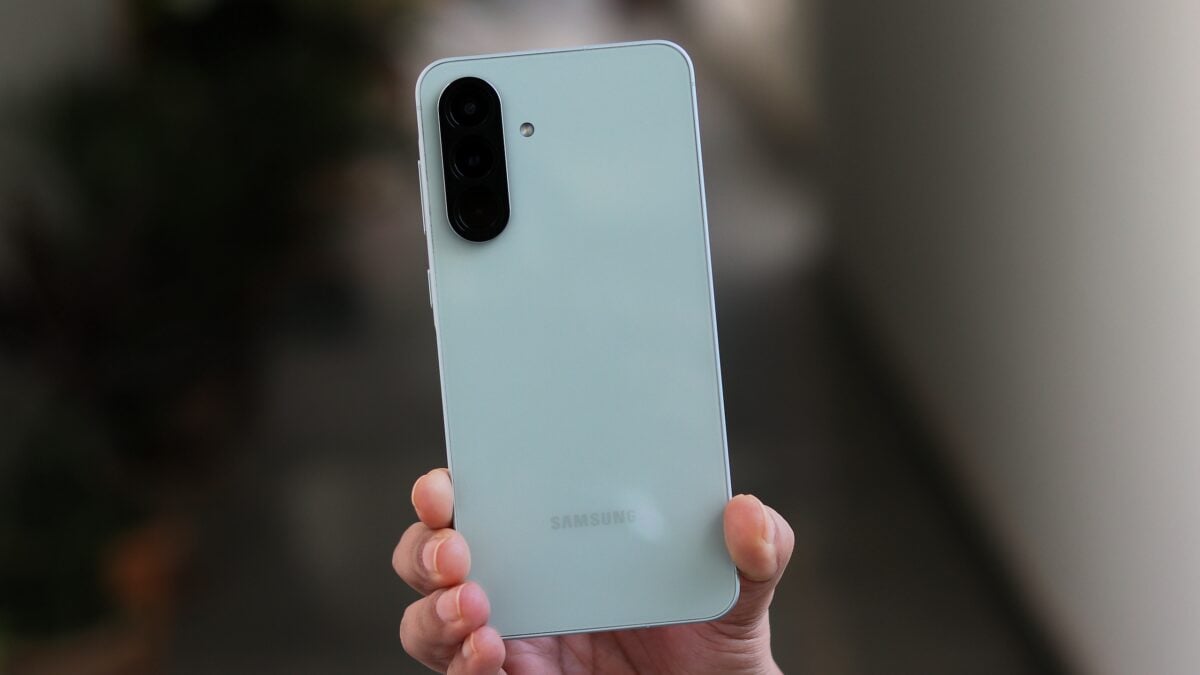 Figure: The Galaxy A56, Samsung’s core mid-range offering and backbone of its global shipping volume, gains cross-ecosystem file sharing for the first time with One UI 9.0. Source: SamMobile.
From a commercial standpoint, Samsung is playing aggressive retention defense. Across key markets in North America, Europe, and Asia, devices like the iPhone 18 Pro command immense social mindshare among younger demographics. Historically, young professionals and students wielding mid-range Android phones faced persistent social friction whenever photo transfers cropped up at group gatherings; unable to AirDrop original files, they were relegated to compressed messaging apps. This recurring friction served as a prime catalyst pushing entry-level Android users toward secondhand or entry-level iPhones. With regulatory pressure prying open proprietary RF protocols, packing cross-platform AirDrop parity into a $300 handset has become Samsung’s sharpest weapon for retaining younger consumers.
The 10-Minute Friction Window: Contacts Matching Awaits Apple’s Cooperation
Community sentiment regarding the update remains split into two distinct perspectives. Engineers and enthusiastic adopters praise “Share with Apple devices” for its sheer practicality, rendering ad-hoc Wi-Fi hotspots and cloud uploads obsolete. Furthermore, Samsung opted not to aggressively advertise the feature, rolling it out silently via One UI 9.0 system firmware and Galaxy Store background modules. Budget buyers receive identical cross-platform capabilities to those found on the flagship Z Fold 8 Ultra at zero premium.
Conversely, hands-on tests from SamMobile and SammyGuru point out persistent real-world friction. When transmitting to an iPhone 18 Pro, the Galaxy A56 cannot bypass Apple’s default “Contacts Only” AirDrop gate. The receiving iPhone user must manually swipe down the Control Center and switch AirDrop visibility to “Everyone for 10 minutes” before the Android device can discover it. When transferring in reverse—from iPhone to Galaxy A56—the Samsung user must first activate Quick Share in the Quick Settings shade. Furthermore, cross-protocol translation overhead means transferring hefty 4K video files remains noticeably slower than native Samsung-to-Samsung transfers.
Google’s security team conceded in its whitepaper that “Everyone for 10 minutes” is merely the opening step toward truly seamless cross-platform sharing, openly inviting Apple to collaborate on cryptographic contact-matching. From the Pixel 10’s initial breakthrough to the Galaxy S26 and now the mainstream Galaxy A56/A57, the Android ecosystem has dismantled its own walls down to the foundation. Unilateral reverse engineering has solved the fundamental question of whether a mid-range Android phone can transfer data to an iPhone 18 Pro; yet until Apple opens its contact verification keys, cross-platform sharing will always demand one extra swipe of the control shade compared to same-ecosystem transfers.
Reference Links:
- Samsung US Newsroom: Samsung Brings AirDrop Support to Quick Share with Galaxy S26 Series
- Google Security Blog: Android Quick Share Support for AirDrop: A Secure Approach to Cross-Platform File Sharing
- SamMobile: Galaxy A56 One UI 9.0 update brings AirDrop support to Quick Share
- SammyGuru: Galaxy A56 Gets Quick Share AirDrop Support With One UI 9 Update
- SammyFans: Samsung quietly expands Quick Share AirDrop support to Galaxy A series with One UI 9.0
- IT Home: Samsung democratizes cross-platform transfer: Galaxy A56/A57 phones can share directly with Apple iPhone 18 Pro