
[2026] FCA 1552 — Federal Court of Australia (Justice Jonathan Beach)
"a paradigm example of Apple's enforcement of its restrictive terms,
in contravention of s 46 of the Competition and Consumer Act 2010 (Cth)"
Orders:
1. Sideloading & alternative marketplaces effective 1 March 2027
2. Fortnite readmitted to Australian App Store immediately upon application
3. Apple to pay 85% of Epic Games' trial costs
The judgment excerpt above comes from the decision issued by the Federal Court of Australia on October 22, 2026, docketed as [2026] FCA 1552. Justice Jonathan Beach authored this sweeping 235-page remedies judgment, setting a clear enforcement timetable for the six-year legal clash between Epic Games and Apple. Starting March 1, 2027, Australian iPhone users will be allowed to download and install applications directly from the open web as well as alternative marketplaces. Meanwhile, Fortnite, expelled from the ecosystem for over five years, is exempt from that March deadline: upon Epic submitting a written application, the game must be readmitted to the Australian App Store immediately.
Looking strictly at the phrase “opening sideloading,” one might easily dismiss this decision as a mere replica of the European Union’s Digital Markets Act (DMA). A closer reading of the 235-page orders reveals a far more radical intervention. Justice Beach systematically dismantled the compliance backdoors Apple previously erected in the EU, Japan, and Brazil to preserve its toll collection. The iOS walled garden in Australia has not merely faced an isolated concession; its entire secondary line of defense—the surrogate “Apple Tax”—has been judicially disassembled.
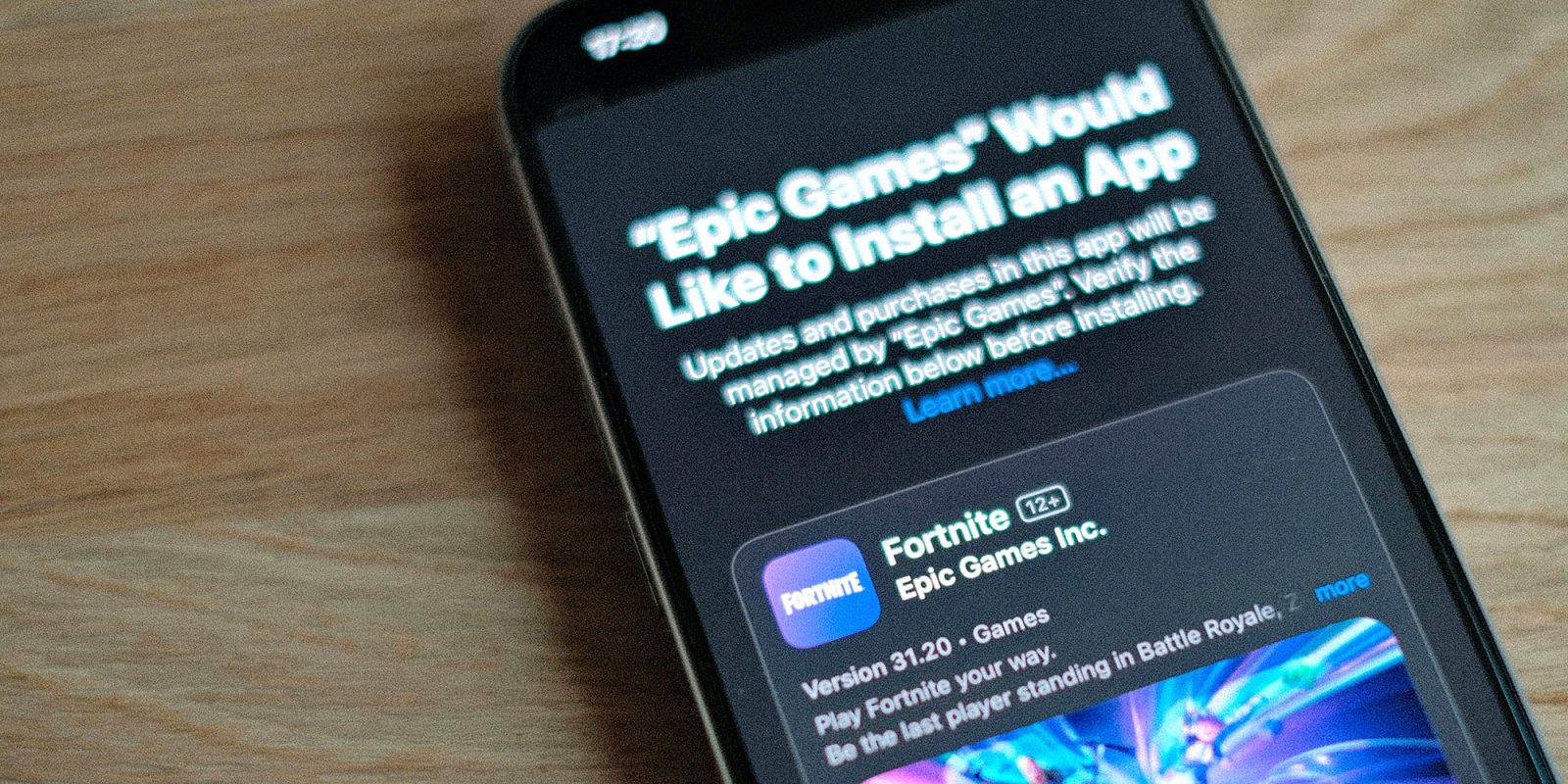 Figure: The system confirmation prompt for installing Fortnite via sideloading on iPhone, where updates and in-app transactions are handled directly by Epic. Source: 9to5Mac
Barring External Ledger Audits and Dual-Track Mandates: Secondary Tolls Blocked
Over the past two years, Apple honed a refined defensive playbook in response to antitrust enforcement across global jurisdictions. While ostensibly relinquishing its exclusive distribution monopoly, it unbundled its standard 30% commission into multi-tiered, ancillary levies. The framework introduced under Japan’s Mobile Software Competition Act (MSCA) in iOS 26.2 (December 2025) institutionalized this tiered ledger; Brazil’s antitrust compliance blueprint in iOS 26.5 (June 2026) mirrored the exact same mechanism. Even when developers adopted third-party payment rails inside App Store apps, they remained subject to a 21% store commission. If they routed checkout flows via external web links, Apple levied a 15% “Store Services Fee” on transactions within 7 days. Even if developers abandoned the App Store altogether for third-party marketplaces, they still faced an inescapable 5% “Core Technology Commission.”
To ensure this tiered tariff machinery functioned, Apple imposed two prerequisite shackles in Japan and Brazil. The first was a “dual-track presentation mandate”: developers offering alternative payment methods inside an app were obligated to display Apple’s native In-App Purchase (IAP) flow side by side. The second was an “external ledger reporting requirement”: developers had to submit regular transaction statements to Apple so it could calculate the 15% or 21% cut. Furthermore, both frameworks strictly restricted outside distribution to authorized third-party app stores, explicitly barring consumers from sideloading software directly from the open web.
| Regulatory Jurisdiction | Web Sideloading | Parallel Display of Apple IAP | Reporting External Payment Ledgers | Surcharges on Third-Party Distribution & Payments |
|---|---|---|---|---|
| Japan (iOS 26.2) | Prohibited | Mandatorily parallel | Mandatory transaction reporting | 21% store commission / 15% external link fee / 5% Core Technology fee |
| Brazil (iOS 26.5) | Prohibited | Mandatorily parallel | Mandatory 7-day volume reporting | 21% store commission / 15% external link fee / 5% Core Technology fee |
| Australia (FCA 1552) | Mandatorily permitted | Explicitly prohibited | Explicitly prohibited | Banned access fees for external channels; restricted external link tolls |
In the [2026] FCA 1552 orders, Justice Beach dismantled this Japan–Brazil compliance architecture down to the studs. The court explicitly enjoined Apple from charging access or placement fees on external distribution channels and curtailed ancillary surcharges on alternative payments; developers are further permitted to offer lower prices outside Apple’s ecosystem. Far more consequential, however, are two procedural injunctions: the court barred Apple from demanding transaction reports or financial telemetry on third-party payment activity, and prohibited it from forcing developers to offer Apple IAP alongside alternative checkout rails. Without the legal authority to audit off-platform transaction records, Apple loses the factual ledger required to enforce precision tariffs on off-market commerce.
Paved by a 900-Page Liability Finding: Relevant Markets Locked to iOS
The severity of this remedies package had already been foreshadowed in the court’s 900-page liability judgment handed down in late 2025. The central battleground of the entire litigation centered on how to define the “relevant market” under competition law. Throughout the trial, Apple repeatedly contended that the relevant market should encompass the broader “smartphone market” or the “cross-platform application market.” Under such expansive denominators, the iPhone does not hold an absolute majority share in Australia or most of the world; Apple argued that it therefore lacked market power or a dominant position.
The Federal Court of Australia flatly rejected the tactic of diluting a software ecosystem monopoly with hardware volume metrics. Justice Beach restricted the relevant markets to two distinct, self-contained domains: “iOS application distribution” and “iOS in-app payment solutions.” For any developer seeking access to iPhone consumers, the App Store was the sole and unavoidable conduit. Within those two submarkets, Apple exercised 100% exclusionary control. The court ultimately found that Apple’s retaliatory campaign in August 2020—rejecting Epic Direct Pay, expelling Fortnite, and terminating developer accounts—breached Section 46 of the Competition and Consumer Act 2010 (Cth). Justice Beach explicitly characterized Apple’s actions as a “paradigm example” of enforcing anti-competitive terms.
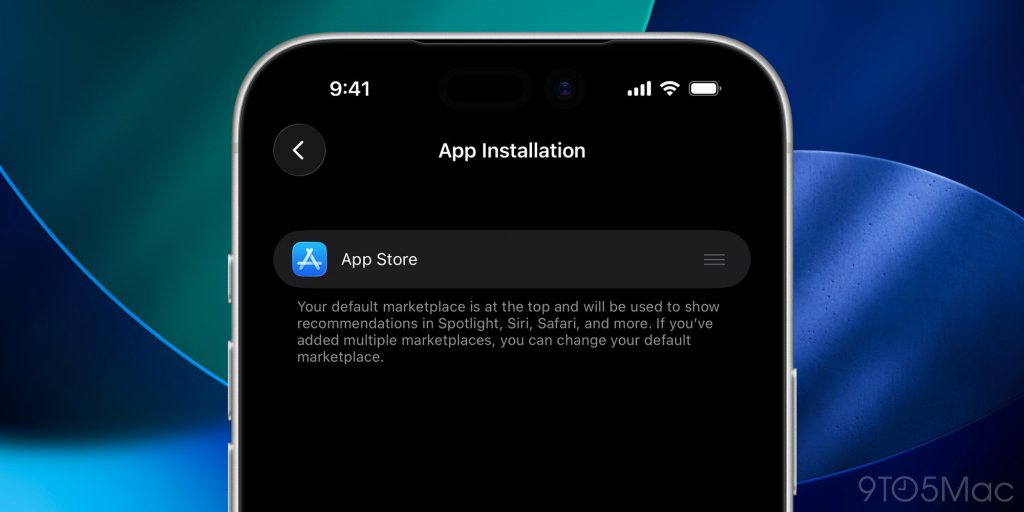 Figure: The default app marketplace configuration screen in iOS settings, which hands over system discovery and installation entry points once toggled. Source: 9to5Mac
To prevent Apple from using operating system choke points to hamstring competing marketplaces, the remedies order set binding technical benchmarks at the API and engineering levels. The court directed Apple to provide alternative distribution channels with developer tools and application programming interfaces on terms substantially equivalent to those enjoyed by the App Store itself. Foundational frameworks such as MarketplaceKit, default installer switching hooks, and refund permission architectures must be extended without disparate treatment. Once system-level APIs are categorized as essential public facilities, the hardware vendor’s shield of exclusive gatekeeping ceases to exist.
Preserving Notarization and Territorial Boundaries: Security Retreats to the Low-Level Layer
Apple concentrated the crux of its legal defense on platform security and user protection. Throughout the proceedings and in public statements to Reuters, Apple maintained that opening web sideloading and external link payments would expose iPhone users to malware, malicious payloads, and financial fraud, while undermining parental controls like Screen Time. Apple had also publicly accused Epic of seeking a “free ride” without paying commissions, asserting that Epic intended to capitalize on billions of dollars in R&D and proprietary iOS intellectual property without compensation.
Justice Beach did not dismiss Apple’s security concerns out of hand, carving out three explicit protective boundaries within the judgment. First, the court dismissed Epic’s bid for a global injunction, constraining the remedies exclusively to devices operating under Australian Apple accounts. Second, while Apple must support third-party marketplaces at the operating system level, it has no legal obligation to host rival app stores inside its own App Store catalog. Third, the court permitted Apple to continue running automated malware scans and enforcing a developer “Notarization” process for external applications, alongside defined procedural bounds for remotely revoking harmful software.
This regulatory framework closely mirrors the security architecture that macOS has successfully operated for decades. On the Mac, users have always been able to download binaries directly from the open web. Apple safeguards integrity through automated malware scanning and developer cryptographic notarization, without ever demanding a blanket 30% toll on every piece of software. The court effectively enforced a physical decoupling between security vetting and commercial rent extraction: Apple may still use notarization to intercept trojans, but it can no longer wield security as a pretext for monopolistic distribution.
Transoceanic Precedents Close In: No Retreat Left for the Apple Tax
Apple has little more than four months left to rewrite its codebase. Under the terms of [2026] FCA 1552, if Apple cannot complete the engineering adaptations prior to March 1, 2027, it must file an extension request by February 15, with the absolute outer deadline capped at May 3, 2027. The court also ordered Apple to indemnify 85% of Epic Games’ legal costs incurred during the liability phase, with remedies costs to be taxed and resolved in subsequent proceedings.
Apple confirmed to Reuters on the day of the ruling that it will seek a stay of execution and file an appeal. On the other side, Epic announced that Fortnite would return to the Australian App Store the following day. Across the global chessboard, U.S. federal courts have referred Apple’s anti-steering non-compliance for potential criminal investigation; the European Union, Japan, and Brazil have successively forced open competing marketplaces; and now the Federal Court of Australia has eliminated external ledger audits and dual-track payment mandates altogether. Apple’s buffer to preserve its walled garden rents by proliferating fee categories has run out; the commercial rules of the iOS ecosystem are being rewritten by judicial force into genuine open competition.
Reference Links:
- Federal Court of Australia [2026] FCA 1552 Remedies Judgment (Epic Games, Inc. v Apple Inc.)
- 9to5Mac: Federal Court of Australia Rules Apple Must Open iPhone to Alternative App Stores
- Reuters: Epic Games’ Fortnite to Return to Australian Apple App Store Following Ruling
- 9to5Mac: Analysis of Apple’s Third-Party App Store and Commission Structures in Brazil and Japan