On October 26, 2026, GMKtec officially launched the NucBox M3S, a compact desktop powered by Intel’s new Wildcat Lake architecture. With an introductory list price of $389.99, it is among the very first desktop machines built on Intel’s 18A process to break into the sub-$400 market. Yet as soon as specifications went live, enthusiast discussions shifted away from cutting-edge silicon: despite boasting an on-die NPU rated at 15 TOPS, the system permanently solders 12GB of system memory directly onto the PCB, providing zero SODIMM expansion slots.
In the budget mini PC space, dual RAM slots have long served as an unspoken baseline guarantee. GMKtec’s decision to break from this convention marks a troubling shift in desktop hardware economics. To suppress initial sticker prices and accommodate low-power mobile architectures, budget desktops are drifting toward non-serviceable soldered designs—turning long-term hardware maintainability into a casualty of upfront margin optimization.
18A Architecture Debuts Under $400
At the heart of the NucBox M3S sits the Intel Core 3 304, an entry-tier member of the Wildcat Lake processor family fabricated on Intel’s 18A node. The chip implements a hybrid 5-core, 5-thread topology consisting of 1 performance core and 4 efficiency cores. The P-core leverages the Cougar Cove microarchitecture, clocking up to a 4.3 GHz boost, while the E-cores rely on Darkmont cores sharing a unified 6MB L3 cache.
Early benchmark figures show a clear generational leap in single-threaded performance. In Cinebench R15 single-core benchmarks, the Core 3 304 posts a score of 264 points—matching AMD’s Zen 4-based Ryzen 3 210 and outpacing the previous-generation Twin Lake N350 by over 40%. Idle system power settles at a mere 3.65W, delivering both cool operating temperatures and minimal electricity draw under light office workloads.
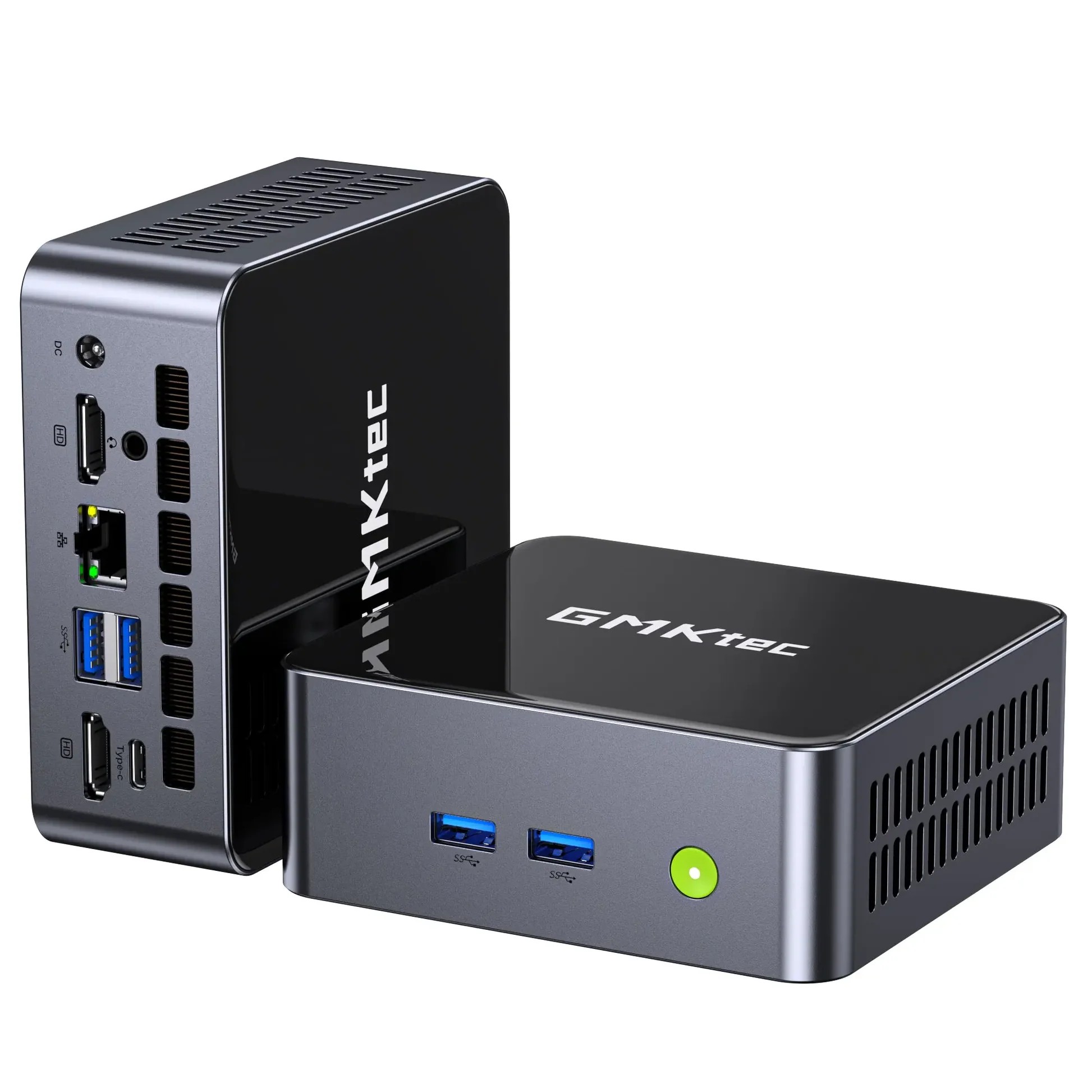 Figure: The GMKtec NucBox M3S measures 114 × 106 × 42.5 mm. Source: GMKtec
GMKtec pairs the processor with a single copper heatpipe cooling assembly. Firmware enables three selectable power profiles: Silent Mode caps the package at 15W, Balanced Mode runs at 20W, and Performance Mode allows power delivery up to 25W. Weighing just 430 grams in a chassis measuring 114 × 106 × 42.5 mm, the device should have been an exemplary template for everyday office computing.
Soldering 12GB RAM for 5,600 MT/s Bandwidth
The controversy revolves entirely around GMKtec’s memory implementation. The NucBox M3S integrates 12GB of LPDDR5 memory soldered directly to the underside of the mainboard, eliminating any path for aftermarket upgrades.
From an engineering perspective, soldered memory offers distinct measurable gains. LPDDR5 operates at 5,600 MT/s, delivering far higher bandwidth than traditional socketed DDR4 modules. Because the Core 3 304 features a modest integrated GPU with only 1 Xe3 core, graphics performance and the 15 TOPS NPU throughput rely heavily on memory bandwidth. Soldering chips directly to the board also saves interior z-height and streamlines surface-mount assembly workflows.
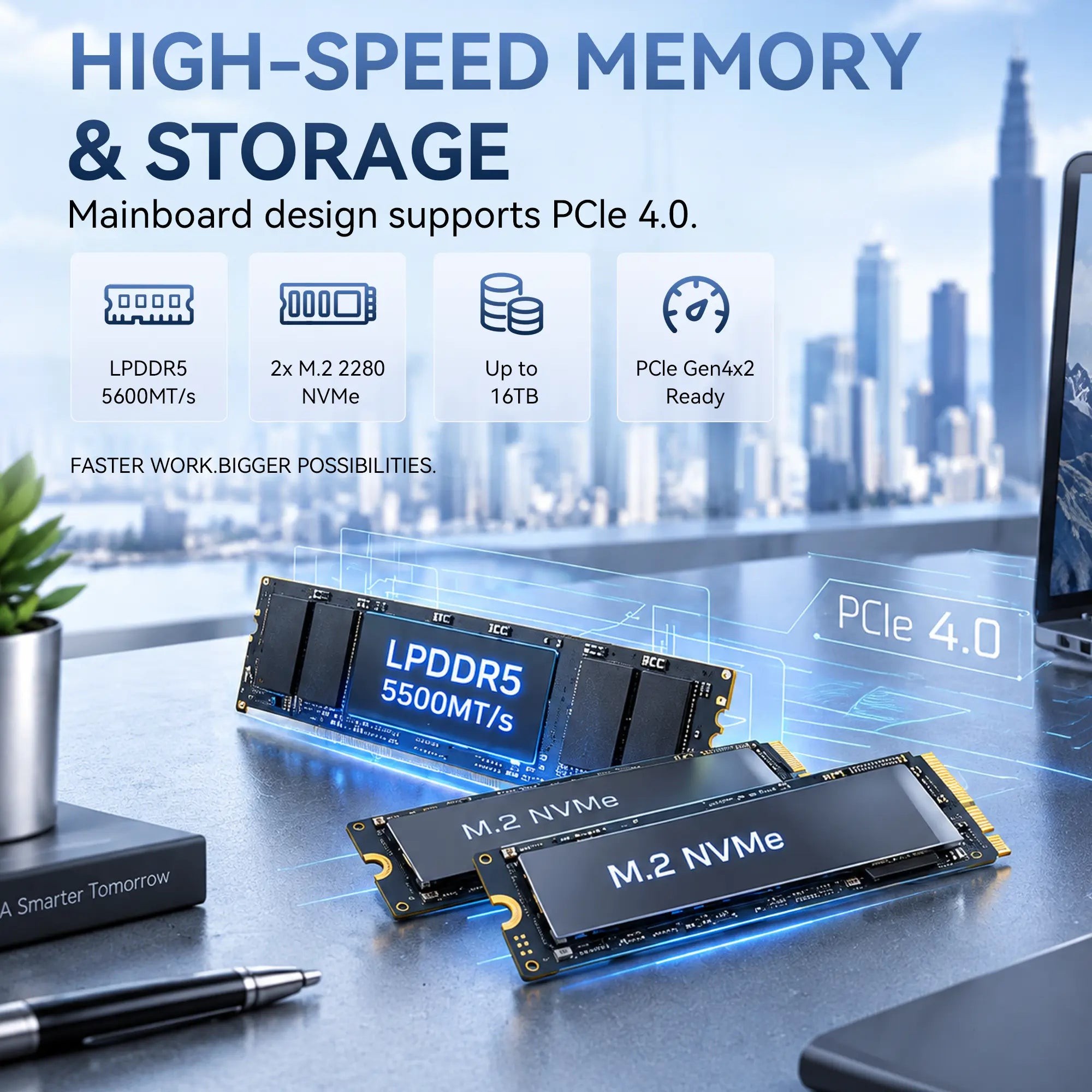 Figure: The motherboard integrates soldered LPDDR5 5600 MT/s memory alongside dual M.2 2280 expansion slots. Source: GMKtec
However, an unconventional 12GB ceiling introduces immediate longevity risks. Under Windows 11 Pro, basic operating system services and background tasks routinely tie up 4GB to 5GB of RAM. Once the integrated GPU dynamically allocates 2GB of shared video memory, heavy multitasking across modern browser tabs and large productivity spreadsheets quickly encounters swap memory bottlenecks. While Intel’s Wildcat Lake platform natively supports up to 64GB of RAM, GMKtec hardwired a 12GB ceiling that prematurely caps the machine’s functional lifespan.
This limitation becomes even starker for on-device AI workloads. While the NPU delivers 15 TOPS of compute, running local small language models requires dedicated memory reserves. With 12GB stretched thin across OS overhead, desktop display buffers, and application heaps, the mismatch between processor compute capability and available memory capacity becomes impossible to ignore.
Dual M.2 Slots Undone by the Memory Ceiling
In stark contrast to its restrictive memory design, the NucBox M3S offers unexpectedly generous external connectivity and storage expansion. The chassis ships configured with a 256GB or 512GB NVMe SSD while preserving a second full-size M.2 2280 slot. The secondary slot supports PCIe 4.0 speeds, offering straightforward, low-cost capacity upgrades for massive local storage pools.
External I/O is equally capable. The front panel features a full-featured 40Gbps USB4 Type-C port, complemented by dual rear HDMI 2.0 outputs that together drive up to three concurrent 4K displays at 60Hz. A 2.5GbE Ethernet port and three USB 3.2 Gen 2 ports match or surpass the connectivity of many high-end enterprise ultrabooks.
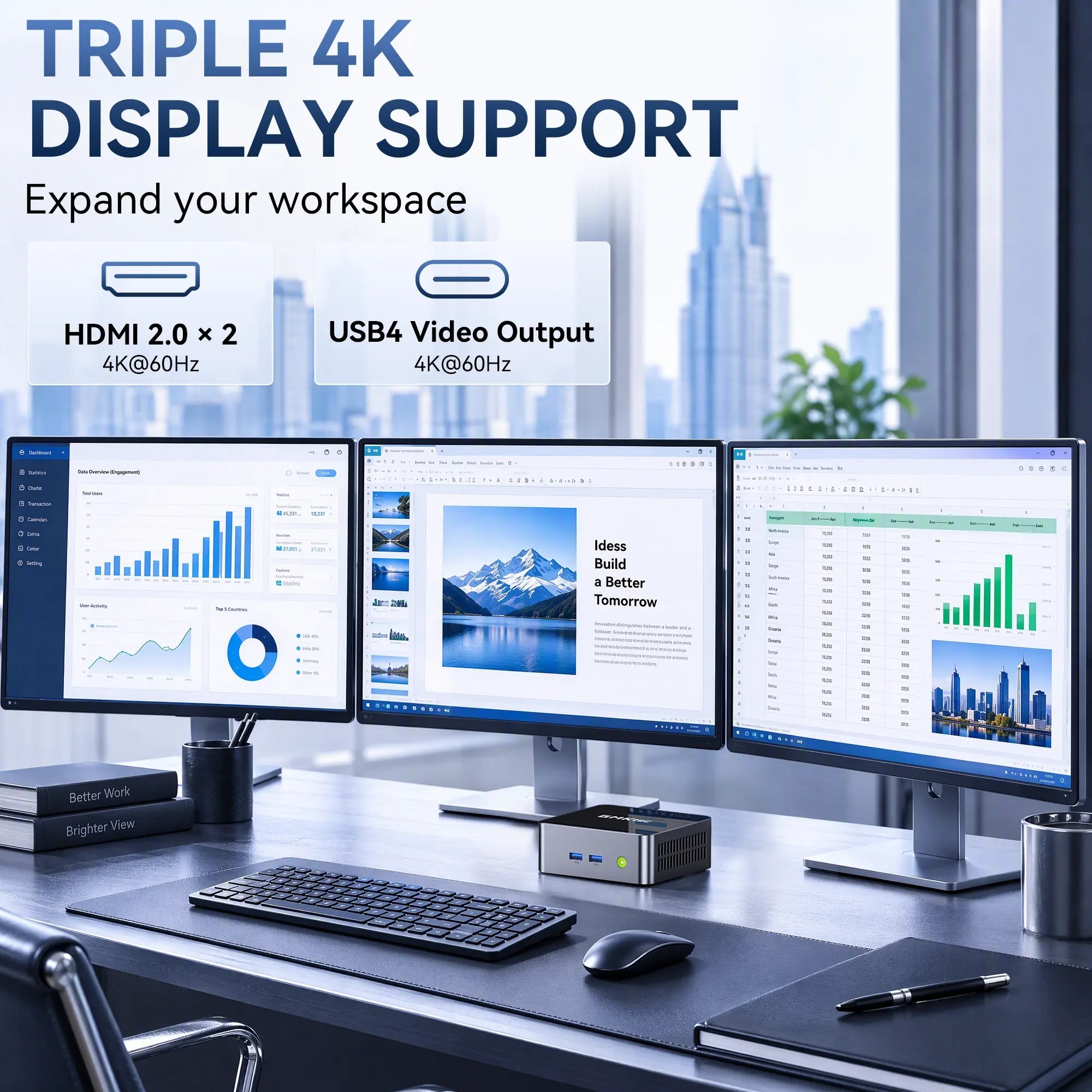 Figure: Dual HDMI 2.0 ports and a 40Gbps USB4 port support triple 4K 60Hz video output. Source: GMKtec
This sharp contrast highlights an uneven architectural compromise. A motherboard robust enough to host dual high-speed NVMe drives and power triple 4K monitors finds its compute headroom hamstrung by a soldered 12GB ceiling. In home server or lightweight virtualization setups, running multiple containerized services rapidly exhausts RAM long before storage throughput or CPU cores are saturated.
Mini PC hobbyists frequently repurpose small desktops into dedicated home labs, running local router firewalls, media servers, or container clusters. Yet hypervisors demand generous memory capacity. Trapped at 12GB, the NucBox M3S struggles to host meaningful multi-service deployments, leaving its 2.5GbE port and dual storage slots underutilized.
Competing Balance Sheets in the Entry-Level Desktop
At $389.99, competition in the mini PC ecosystem is fierce. Other ODM white-label offerings, such as Maxsun’s MU01, rely on identical reference designs. The commoditization of these unified board layouts is accelerating the spread of non-upgradeable memory across the low-cost tier.
Looking across current market alternatives, a $400 budget readily buys an AMD Ryzen 7 7735HS mini PC. Those mature platforms feature dual SODIMM slots capable of upgrading to 64GB of high-speed memory alongside a substantially more powerful Radeon 680M integrated GPU. Across comprehensive performance metrics, the architectural efficiency gains of Intel’s 18A process are largely neutralized by soldered memory constraints.
Hardware manufacturers prioritize bill-of-materials math: soldering LPDDR5 cuts $15 to $20 from raw manufacturing costs, granting precious price-rank advantages on retail storefronts. Eliminating SODIMM brackets and surrounding bypass circuitry also simplifies automated assembly.
End users, however, bear total cost-of-ownership liabilities. Without socketed memory, the machine cannot grow alongside software requirements. What began as a modest upfront discount transforms into an early hardware replacement cycle.
Desktops Shouldn’t Adopt Smartphone Compromises
Soldering memory makes sound engineering sense in mobile phones, where millimeter-thin profiles and compact battery compartments necessitate aggressive thermal and packaging compromises. But desktop mini PCs run on wall power with generous internal airflow. Lifting closed mobile packaging paradigms directly into desktop chassis lacks structural justification.
The GMKtec NucBox M3S illustrates an unsettling shift in entry-level computer design. In pursuit of cost reduction, vendors are transposing smartphone-style integration onto desktop workstations, sacrificing core serviceability to win price-sensitive buyers.
Equipped with high-bandwidth I/O and dual M.2 slots, the machine’s true potential remains locked behind a 12GB memory ceiling. The initial assembly savings ultimately translate into premature hardware obsolescence. The enduring value of desktop computing rests on modular adaptability; blindly embracing mobile disposable design paradigms turns entry-level PCs into fast-fashion electronics.
Reference Links:
- Notebookcheck Reporting
- GMKtec Official Product Specifications