On November 9, 2026, PC power supply manufacturer Golden Field released a formal warranty notice. Addressing the persistent issue of melted graphics card power connectors, the vendor drew a definitive liability boundary.
The notice states that if terminal burnout stems from contact pin aging or surface oxidation on secondhand graphics cards, Golden Field will only service the PSU itself and replace modular cabling. The damaged graphics card, classified as a third-party accessory, is explicitly excluded from compensation.
In traditional PC building circles, power supply catastrophic failures historically implied joint liability where vendors covered secondary system damage. Golden Field’s upfront inspection requirement shatters this tacit agreement. Under extreme current delivery, the fault tolerance of the PC hardware ecosystem has been exhausted.
Secondhand GPU terminals undergo frequent insertion cycles, accelerating mechanical wear and metal oxidation. Confronted with power delivery exceeding several hundred watts, component manufacturers are resorting to strict forensic root-cause analysis as a legal and economic firewall.
Liability Cutoff Ends Tacit Consequential Damage Protection
According to Golden Field’s handling procedure, users filing connector burnout claims must return the complete set of affected hardware. The technical engineering team conducts forensic inspection and generates an official failure analysis report.
The inspection conclusion dictates liability. If failure originates from factory manufacturing defects, terminal crimping flaws, or internal circuit faults, Golden Field honors statutory warranty obligations, reimbursing the PSU and all collateral component damage in full.
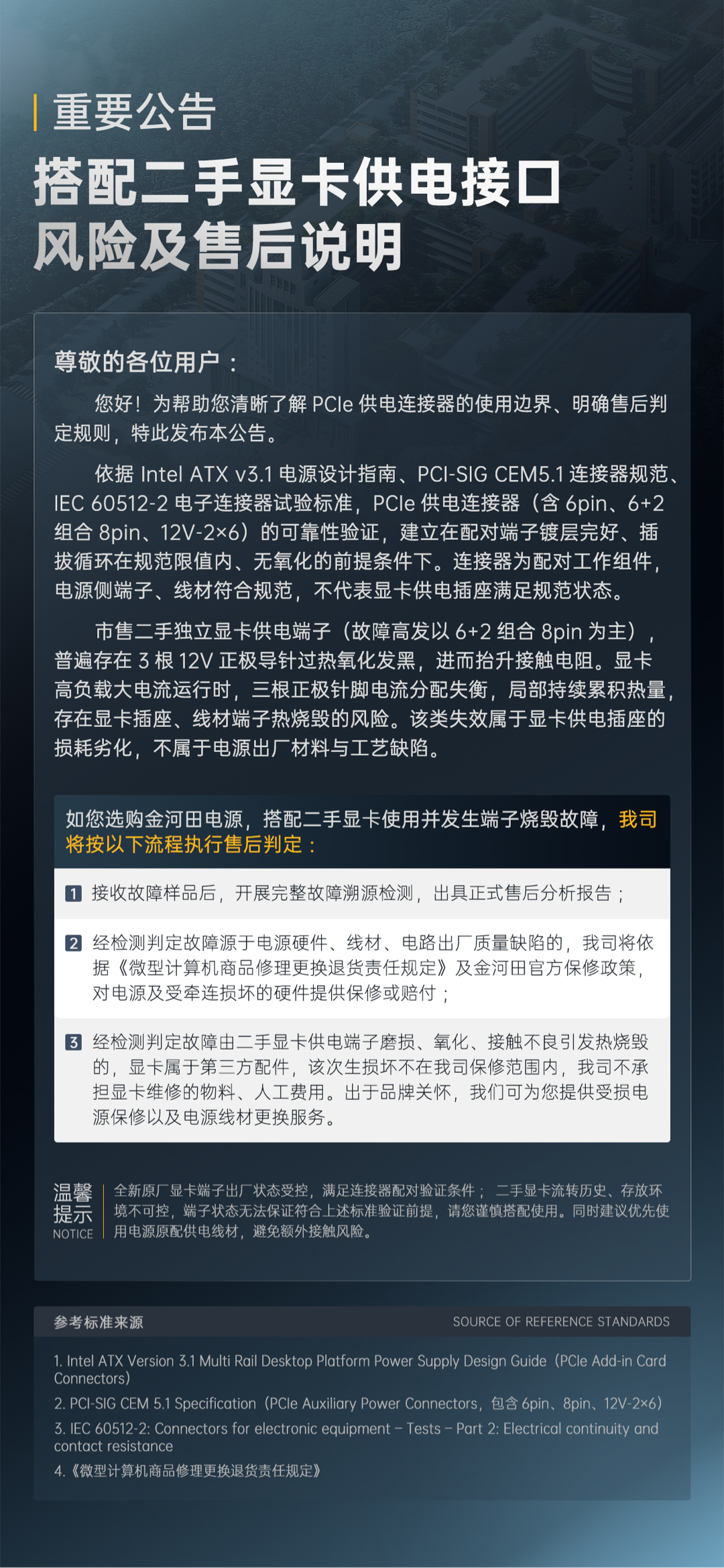 Figure: Golden Field’s official announcement detailing power connector risks and warranty terms for secondhand GPUs. Source: Golden Field.
However, once testing reveals that burnout was triggered by worn GPU sockets or oxidized terminal pins, liability is immediately severed. Golden Field explicitly refuses to cover repair parts or labor costs for the graphics card. Secondary GPU damage is strictly excluded from PSU warranty coverage.
This cutoff reflects an asymmetric cost imbalance across the component supply chain. Mid-range 80 PLUS Gold power supplies typically retail for $40 to $80 (300 to 600 RMB), while companion high-end graphics cards routinely cost thousands of dollars. Expecting low-margin power supplies to shoulder consequential losses for worn secondhand hardware with unverifiable operating histories is economically unsustainable.
600W Massive Current Meets Micro-Ohm Physical Tolerances
The evolution of power standards drove this policy into place. Under legacy PCIe specifications, a single 8-pin connector carried a rated load of 150W. Even when utilizing multiple parallel 8-pin inputs, the card’s total power draw was distributed across isolated physical circuits.
High-performance GPUs pushed power demands to new extremes. The PCI-SIG CEM 5.1 and Intel ATX 3.1 specifications introduced 12V-2x6 and 12VHPWR connectors. These standards condense up to 600W into a single compact plug, driving rated current across individual conductor pins past 9.2A.
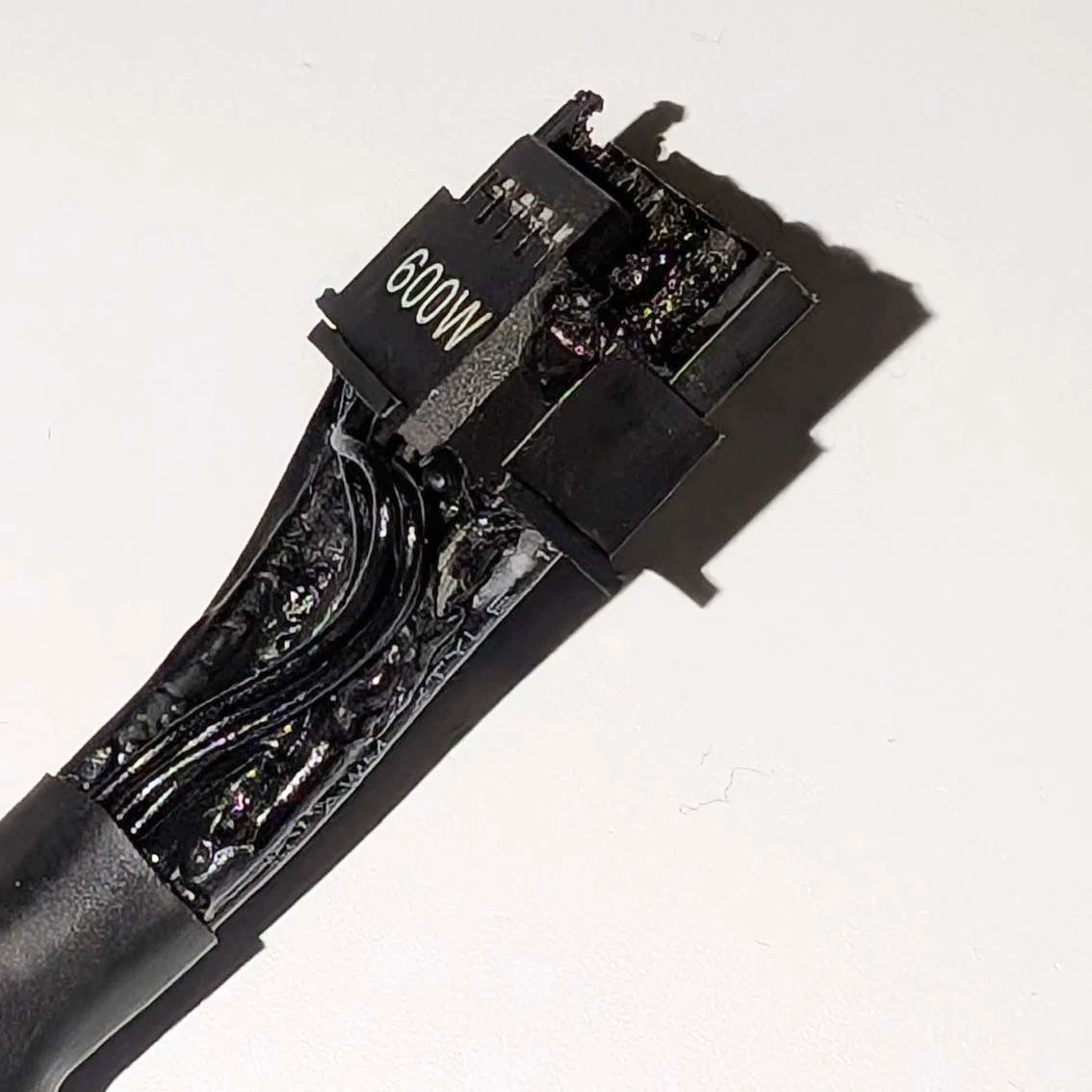 Figure: Power cable connector severely carbonized and melted after localized thermal runaway under a 600W load. Source: Hardware community failure benchmark sample.
At full 600W load, mechanical contact tolerances shrink to the micrometer level. Under the IEC 60512-2 connector standard, pin contact resistance must stay in the micro-ohm regime. Even slight plug misalignment, pin tilt, or surface contamination multiplies contact impedance dramatically.
ATX 3.1 further mandates that power supplies absorb transient excursions up to 200% of rated capacity. A 600W interface must withstand instantaneous pulses of 1200W on microsecond scales. Such violent power spikes amplify both mechanical and thermal stress across degraded contact points.
Intense current across abnormal resistance generates Joule heating capable of melting engineering plastics in seconds. While the revised 12V-2x6 standard recesses sense pins to ensure full mating, it cannot prevent physical wear and tear on the conductive terminals themselves.
Aging Positive Conductor Pins Disrupt Current Balance
Golden Field noted that failure cases on secondhand GPUs are heavily concentrated in traditional 6+2 composite 8-pin connectors. This finding shatters the widespread belief that older interfaces are virtually indestructible.
Secondhand graphics cards frequently endure prolonged heavy workloads. Long-term thermal cycling causes the micrometer-thin gold plating on female GPU receptacles to wear away. Exposed copper substrates oxidize rapidly, turning the contact surfaces of the three 12V positive pins dark.
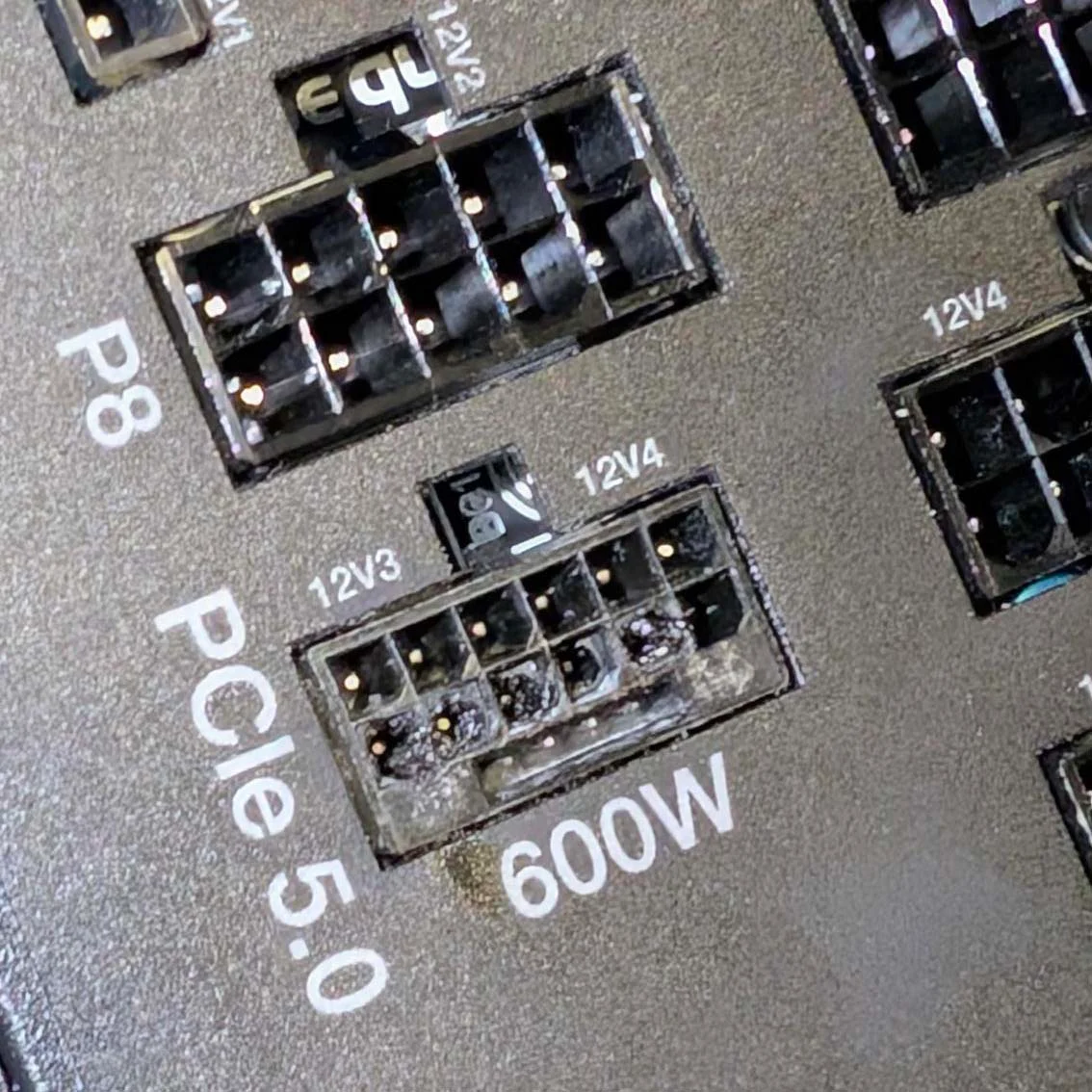 Figure: Modular terminal connector on the PSU side melted during sustained operation with high-power graphics cards. Source: Hardware forensic warranty analysis.
Factory-fresh terminal pins exhibit contact resistance of only a few milliohms. Once copper pins oxidize and tarnish, resistance can spike by orders of magnitude. In parallel electrical circuits, branch current distributes inversely to impedance. The moment one pin develops poor contact, neighboring pins must absorb excess current.
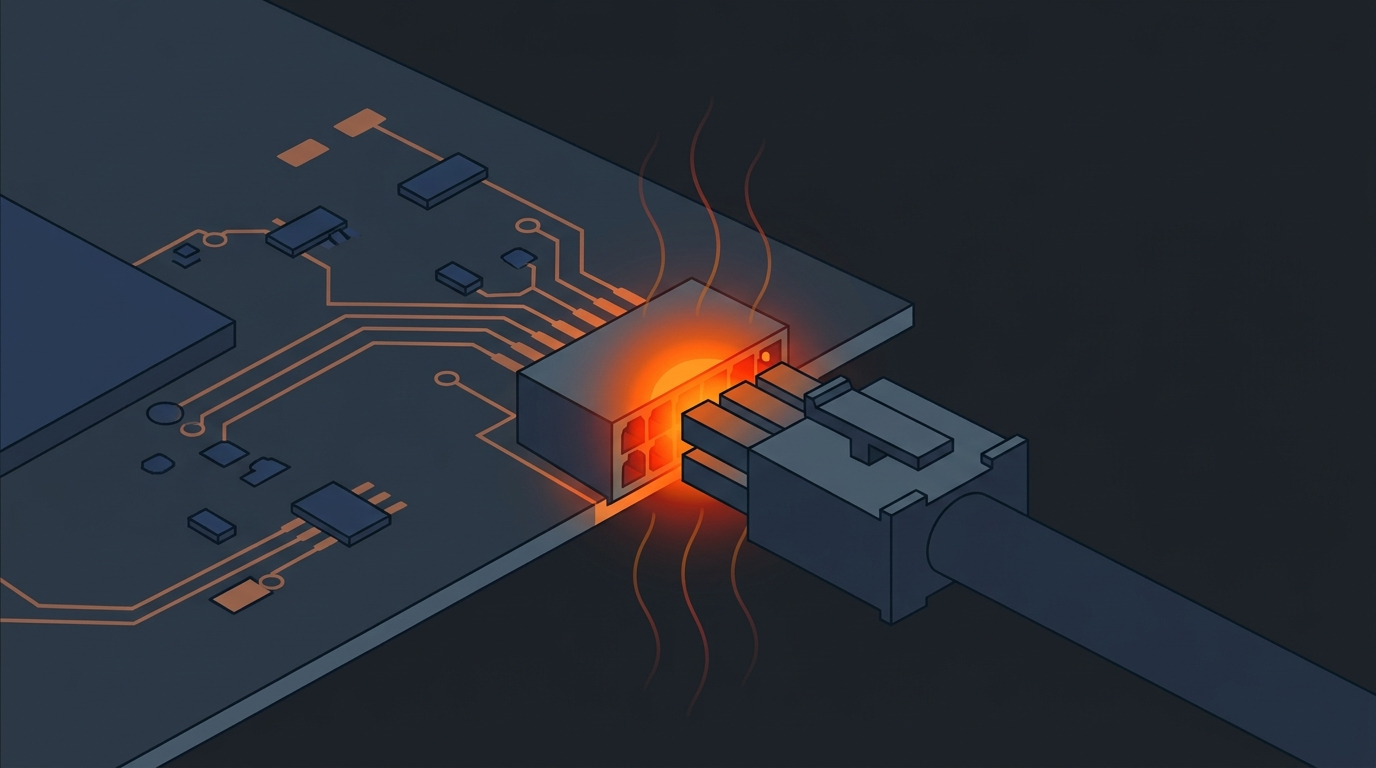
Under a localized current flow of 20A, an abnormal resistance of several dozen milliohms dissipates more than 10 watts of heat. Confined within a tiny volume of only a few cubic millimeters, temperatures swiftly exceed 200 degrees Celsius. Surrounding nylon housings soften, melt, and carbonize, triggering catastrophic insulation failure.
Pre-Installation Inspection Reshapes Hardware Warranty Boundaries
To mitigate the risk of catastrophic connector failure, Golden Field is enforcing pre-installation inspection. The company advises builders purchasing secondhand graphics cards to inspect pin headers with a high-intensity flashlight prior to installation, verifying that receptacles show no signs of discoloration, pitting, or mechanical deformation.
The vendor also mandates the exclusive use of original factory cables. Third-party custom cables vary wildly in metal metallurgy, terminal crimping precision, and plating thickness. Substandard aftermarket cables frequently introduce excess mechanical tolerance during mating.
The hardware community responded with heated debate. Some builders argue that because power supplies feature over-current protection (OCP) and over-temperature protection (OTP), they should automatically cut power during localized anomalies. However, electrical engineers point out that individual pin current imbalances do not breach aggregate circuit trip thresholds.
Through its updated warranty policy, Golden Field has drawn an unequivocal line in the sand. When 600W loads are pushed through degraded secondhand connectors, delicate contact surfaces leave no margin for assembly error. From broad consequential liability to shared individual responsibility, hardware consumer rights are being rewritten by the unforgiving physics of Joule’s law.
Reference Links:
- Golden Field Official Announcement: “Risk and Warranty Notice for Power Connectors Paired with Secondhand GPUs”
- Intel ATX Version 3.1 Multi Rail Desktop Platform Power Supply Design Guide
- PCI-SIG CEM 5.1 Specification
- IEC 60512-2 Electronic Connectors Measurement and Testing Standard