In front of a scrap yard’s metal crusher, a half-century-old laboratory high-voltage power supply was rescued at the last minute. The entire repair required replacing just one capacitor to bring the machine back to its original factory specifications.
The survival of this Fluke 407 also answers a fundamental question: what does true repairability actually depend on?
Rescuing a 555V Tube Regulated Supply from the Scrap Yard
On November 8, 2026, vintage electronics channel Mr. Carlson’s Lab documented a comprehensive bench repair. A 1960s Fluke Model 407 high-voltage regulated DC power supply was saved from impending destruction. It had been dumped at a metal recycling facility, waiting to be tossed into the shredder. While the heavy chassis was coated in decades of dust, its internal mechanical structure remained intact.
This instrument was once top-tier laboratory gear. Weighing dozens of kilograms, it features a heavy-gauge steel chassis paired with an anodized aluminum front panel. In an era before silicon transistors took over, it served as a reference standard for calibrating vacuum-tube equipment.
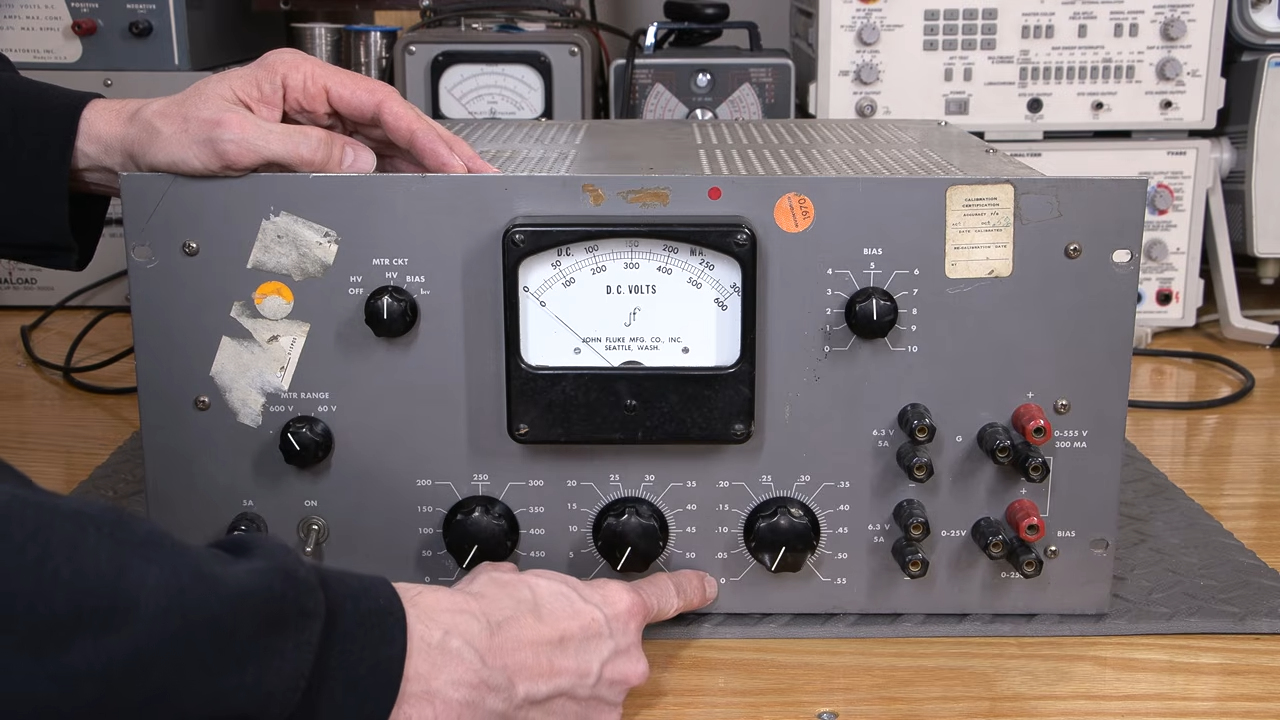 Figure: The Fluke Model 407 high-voltage power supply on the workbench undergoing diagnostics. Source: Hackaday
The electrical specifications of the Fluke Model 407 remain impressive today. Its primary DC output covers 0 to 555V with a continuous current rating of 300mA. The unit also provides two independent negative bias adjustment circuits and dedicated AC windings for tube heaters.
Decades in storage, however, introduced significant hazards. The dielectric film in the electrolytic capacitors was likely dried out. If the insulation broke down under load, the irreplaceable custom transformers would be destroyed. Safely waking this vintage supply became the first crucial test.
Bringing It Up Slowly on a Variac to Prevent Explosions
Plugging a high-voltage instrument straight into mains power after decades of hibernation is a recipe for disaster. Ancient aluminum electrolytic capacitors that have sat unpowered suffer from drastically elevated leakage current. Hitting them suddenly with full operating voltage can cause localized overheating, boiling the electrolyte and rupturing the aluminum cans.
The technician set up a current-limited line of defense. The unit was first routed through an isolation transformer to break unintended ground loops, followed by an autotransformer (Variac) with current-limiting protection, gradually ramping the AC voltage up from zero volts.
Inside the chassis, the tube filaments began glowing a soft orange-red. The high-voltage transformer settled into a steady 60Hz hum. The ammeter needle hovered well within the safe zone, confirming no hard shorts existed in the primary windings or rectification stages.
Although there was no smoke, core performance metrics immediately flagged a problem. Rotating the three-decade voltage selector switches caused the output needle to swing erratically. The high-voltage output refused to settle at the selected value—the regulation feedback loop had completely lost lock.
Differential Probing Isolates the Fault to a Single Feedback Capacitor
In modern highly integrated gear, a similar failure often ends in the trash because a proprietary controller IC is obsolete. Facing the Fluke 407, the technician spread out the original factory schematic that shipped with the unit. The documentation clearly detailed DC voltages at every test node, signal flow paths, and component tolerances.
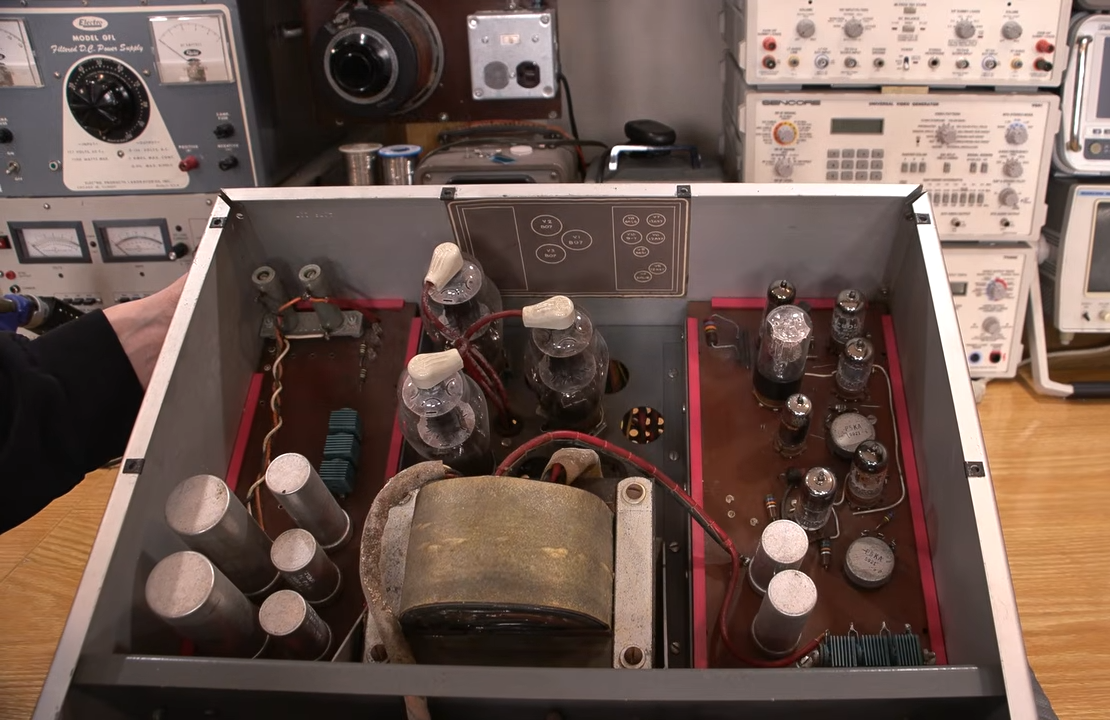 Figure: Densely packed vacuum tubes and discrete components inside the Fluke Model 407 chassis. Source: Hackaday
The supply employs a classic vacuum-tube linear series regulator architecture. Multiple 807 beam power tetrodes run in parallel as the pass elements. A 6AU6 pentode and a 5651 gas-discharge voltage reference tube form a high-gain error amplifier stage. The output voltage is sampled through a precision divider network and fed back to drive the control grids of the pass tubes.
Working systematically with a high-voltage differential probe, the technician traced each stage. When probing an AC bypass node in the regulation loop, the oscilloscope revealed an abnormal DC offset.
Desoldering the hermetically sealed paper capacitor at that node and testing it on a megohmmeter revealed its insulation resistance had degraded to just several hundred kilohms. This DC leakage disrupted the input bias of the amplifier tube, preventing the circuit from pulling down the grid voltage of the series pass tubes.
A modern 630V metallized polypropylene film capacitor was soldered into place. Powering the unit back on, the high-voltage meter snapped right to the dialed value, with peak-to-peak ripple dropping into the millivolt range.
Discrete Architecture Gives Hardware a Multi-Decade Lifespan
Replacing a single inexpensive capacitor brought a piece of scrap metal back to factory calibration. This ease of repair stems directly from the core design principles of mid-20th-century industrial engineering: physical legibility and component universality.
Fluke engineers relied entirely on standard industrial discrete components rather than proprietary packages. Every solder joint is accessible; every test point can be probed with standard multimeter leads.
Comprehensive engineering documentation is the true foundation of maintainability. Manufacturers provided full schematics and detailed bills of materials directly in the user manual. The vendor assumed the buyer owned the hardware outright and treated field servicing as an expected part of the product lifecycle.
Six decades later, long after the original assembly line shut down, any competent technician can still read the schematic and source standard passive parts to keep the hardware running indefinitely.
Structural Adhesive and Software Locks Are Killing the Right to Repair
In contrast, modern consumer electronics have steadily degraded repairability. Smartphones and headphones are held together with structural adhesive, where opening the chassis risks fracturing display panels or severing ribbon cables. Delicate SMD components are entombed in potting compound or underfill, preventing physical probes from reaching IC pins.
Software restrictions are even more insidious than physical glue. Manufacturers bind replacement parts to cryptographic serial numbers. Even when swapping an identical, genuine OEM component, missing an authorized cloud handshake will trigger warning prompts or deliberately disable hardware functions.
Schematics are guarded as trade secrets, blocking independent technicians. A single shorted decoupling capacitor is routinely diagnosed as a total mainboard failure, leaving consumers with no choice but to pay exorbitant assembly replacement fees or discard the product entirely.
The revival of the Fluke 407 stands as a stark contrast. Half a century ago, industrial engineering proved that hardware can endure for decades. Today, algorithmic locks and unibody glue jobs accelerate the generation of e-waste.
After running continuously for hours on the bench, the Fluke 407 maintained regulation within 0.01%. The warm glow of its vacuum tubes serves as a reminder: the best defense against planned obsolescence is transparent, modular circuit design. When users lose the freedom to repair their devices, even the sleekest gadget is ultimately just a disposable consumable.
Reference links:
- Hackaday feature: “Saving A Vintage High-Voltage Power Supply From The Scrap Heap”
- Fluke official technical archives: “Fluke Model 407 High-Voltage DC Power Supply Instruction Manual”
- Mr. Carlson’s Lab bench video: “SAVED! Power Supply Troubleshooting - All The Steps From Start To Finish!”