25,000 units. That is IDC’s shipment forecast for the global dexterous hand market in 2026. More than 85% of these deliveries will come from domestic Chinese manufacturers. Notably, this tally excludes in-house bundled end-effectors for integrated humanoids, counting only standalone products sold to the open merchant market.
For years, multi-fingered dexterous hands were treated as expensive artisanal curiosities. The UK’s Shadow Robot once priced its early dexterous hands at tens of thousands of pounds each. Slight wear on an internal steel tendon cable could paralyze the entire assembly. As global volume crosses the 10,000-unit threshold, robotic end-effectors are shedding their bespoke laboratory heritage to become standardized industrial components.
Chinese manufacturing has completely rewritten the cost architecture of robot hands. From coreless micro-motors to tactile sensor arrays, local supply chains have drastically compressed production expenses. With the floodgates of volume shipments swung open, an industrial battle spanning mechanical engineering and embodied algorithms has officially begun.
25,000 Units: Moving Beyond Proof of Concept
The global dexterous hand market is scaling up a steep demand curve. IDC projects global shipments of roughly 15,000 units in 2025, climbing to 25,000 in 2026. The firm estimates deliveries will jump to 88,000 units by 2028, eventually clearing the 280,000 mark by 2030.
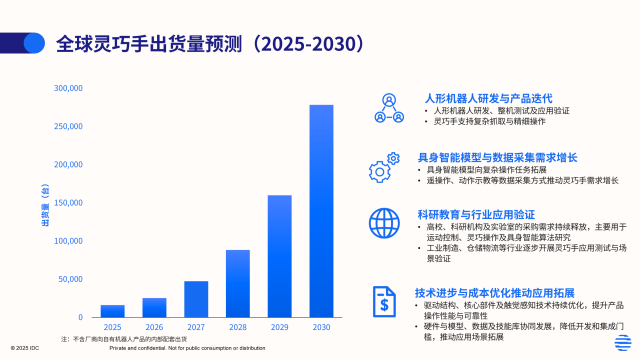 Figure: Global Dexterous Hand Shipment Forecast (2025–2030). Source: IDC Global Embodied AI Market Research Report.
This surging shipment trajectory stems directly from the boom in embodied AI research and development. To train end-to-end foundation models, robotics developers must deploy large fleets of teleoperation and demonstration rigs. For years, academia relied on simplified two-finger parallel grippers for dataset collection—a crude workaround incapable of supporting generalized learning for intricate multi-fingered manipulation.
Chinese vendors captured more than 85% of total shipment volume primarily thanks to mature industrial manufacturing clusters. When Western startups engineer robot hands, they often face high-cost overseas prototyping and outsourcing cycles that stretch over several months. By contrast, hardware teams in Shenzhen and Dongguan can iterate through three revisions of structural skeletons and driver boards in two weeks. Turnaround speed across the local supply chain has become the decisive engine of delivery advantage.
Four Actuation Architectures Compete at Micron Tolerances
The physical blueprint of dexterous end-effectors has yet to converge on a single dominant design. IDC’s report outlines four mainstream actuation paradigms: tendon-driven, direct-drive, linkage-driven, and hybrid actuation. Each topology represents distinct engineering trade-offs across dexterity, packaging volume, torque density, and long-term maintenance costs.
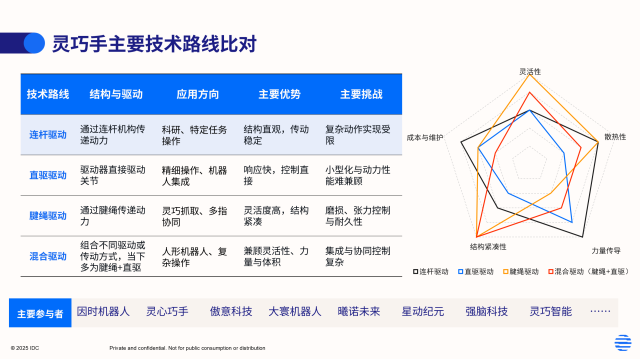 Figure: Comparison of major dexterous hand technical architectures and radar metrics. Source: IDC Global Embodied AI Market Research Report.
Tendon-driven architectures transmit power through high-strength synthetic fiber cables, allowing drive motors to be relocated into the palm or forearm. This design minimizes finger bulk and delivers outstanding multi-finger coordination and flexibility. However, cables are susceptible to mechanical creep and fatigue over sustained use, demanding complex sensor algorithms for real-time tension compensation.
Direct-drive mechanisms place micro-motors directly at individual finger joints, yielding an ultra-short transmission train and near-instantaneous dynamic response. By eliminating intermediate mechanical linkages, direct drive achieves high control precision and straightforward servicing. However, joint volume strictly caps motor dimensions, presenting steep bottlenecks in continuous torque output and thermal dissipation.
Linkage-driven mechanisms rely on rigid linkages for reliable force transmission, though intricate joint kinematics inherently restrict kinematic degrees of freedom. Hybrid actuation attempts to blend the strengths of both worlds—for example, employing direct-drive joints at the base of the palm while delegating fingertip micro-manipulation to tendon lines. Chinese robotics teams such as Inspire-Robots, Lingxin Qiaoshou, and OHand are pushing precision tolerances along their respective design paths.
Integrated Micro-Cylinders and Tactile Arrays Erase the Premium
Historically, the steepest barrier to dexterous hand adoption was heavy reliance on imported core components. Coreless DC motors were long dominated by European suppliers and commanded exorbitant unit prices. For a robotic hand requiring twelve or more active degrees of freedom, the raw bill of materials for motors alone was prohibitive.
Domestic electromechanical suppliers opted for an indigenous breakthrough in micro-motion actuators. Inspire-Robots, for example, integrated brushless DC motors, planetary gearboxes, micro lead-screws, and absolute encoders into an all-in-one linear servo actuator. This highly integrated module replaces disparate off-the-shelf parts, converting an intricate assembly of hundreds of discrete components into modular sub-assemblies.
Localizing core components has cratered procurement barriers. Specialized research setups that once ran tens of thousands of dollars now sit squarely in the $1,500 to $4,500 range (10,000 to 30,000 RMB). With hardware costs drastically reduced, university laboratories and algorithmic researchers can finally procure multi-hand fleets for parallel cluster training.
Engineering breakthroughs in tactile sensing have progressed in tandem. Early mechanical hands relied on single-point fingertip pressure sensors, blind to slip tendencies and micro-scale contact stress distributions. The domestic supply chain has engineered flexible tactile skin arrays. Vision-based and matrix tactile modules with millimeter-level spatial resolution now provide closed-loop dynamic force control essential for handling fragile and deformable objects.
Industrial Assembly Lines Reject Fragile Lab Toys
Despite intense momentum across R&D labs, actual real-world deployments show stark structural stratification. According to IDC data, approximately 50% of dexterous hand deliveries currently go to humanoid robot OEMs for prototype integration and testing. Academic research and education account for 25%, model training and data collection represent 15%, while production manufacturing and warehouse logistics claim just 10%.
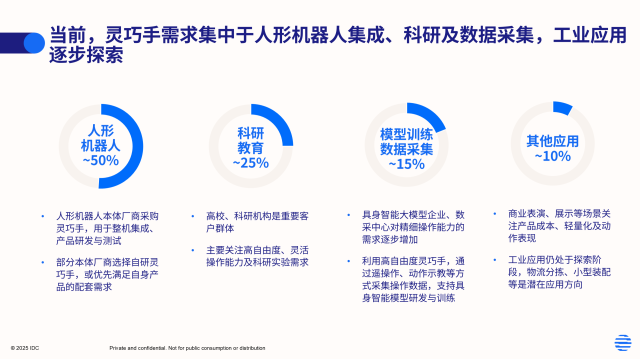 Figure: Dexterous hand demand distribution across application domains. Source: IDC Global Embodied AI Market Research Report.
This demand pattern highlights the pragmatic industrial reality facing end-effectors. On modern factory lines with structured workflows, two-finger parallel pneumatic grippers retain unmatched dominance. Rigid two-finger grippers cost mere hundreds of dollars, boast rugged reliability, and require minimal maintenance. For straightforward pick-and-place cycles, deploying an expensive five-finger hand makes little economic sense.
The true value proposition of dexterous hands lies in unstructured manipulation: sorting soft polybags in e-commerce fulfillment, inserting flexible flat cables on 3C electronics assembly benches, or handling varying tools in domestic service. For uniform, pre-positioned workpieces, rigid grippers maintain an unbeatable cycle-time advantage. Only when handling unknown geometry and operations requiring multi-finger rolling or reorientation does a dexterous hand offer indispensable degrees of freedom.
Factory floors are notoriously unforgiving toward mechanical wear. Fine ambient dust infiltrating moving hinges can seize joints, while high temperatures and humidity induce sensor drift. Micro-fatigue accumulating across hundreds of thousands of cycles risks unplanned assembly line stoppages.
The primary hurdle for end-effectors in industrial settings is operating lifespan: they must run reliably under heavy, high-tempo workloads for thousands of continuous hours without frequent shop repairs.
Engineering Delivery Marks the Decisive Watershed
Moving from laboratory demonstrations to high-volume commercial shipments fundamentally alters the industry’s benchmark. A few years ago, prototypes capable of playing piano or pinching an egg commanded viral attention. Facing a delivery milestone of 25,000 units, industrial buyers evaluate only consistency and mean time between failures (MTBF).
AI model teams no longer pay for one-off peak performance specs; sensor and actuator calibration curves are the real critical asset. If motor output torque drifts by even 5%, policy inferences on end-to-end models fall apart. These demanding tolerances are forcing component factories to institute aerospace-grade quality controls.
The global dexterous hand sector is entering an engineering decider where China’s edge extends far beyond low unit costs. From precision micro-machining to flexible tactile sensor packaging, local factories have constructed an end-to-end industrial base. As algorithmic co-design and hardware optimization accelerate past the 20,000-unit threshold, only architectures that pair robust physical durability with high yield rates will secure a permanent foothold in the physical world.
References:
- IDC Global Embodied AI and Dexterous Hand Market Research Report
- Inspire-Robots Micro Linear Servo Actuator Technical White Paper
- Research Report on China’s Humanoid Robot End-Effector Industry