
On October 27, 2026, Xiaomi unveiled the technical details of its industrial-grade bionic dexterous hand. Armed with 21 degrees of freedom (DoF), 26 driving motors, and 1,500 tactile sensing points, the hardware specifications directly address 1,827 standard operating procedures (SOPs) on automotive assembly lines. Bidding farewell to demo-stage tricks like handing over water bottles, this embodied AI end-effector is heading straight onto high-cadence assembly stations.
Screened Across 1,827 Automotive SOPs: 21 DoF Emerges as the Grasping Sweet Spot
Bipedal humanoid robots are now common fixtures in technology exhibition halls, yet their end-effectors have long been stuck in proof-of-concept limbo. Conventional two-finger pneumatic grippers handle only rigid, uniformly shaped workpieces. When confronting flexible wire harnesses or irregular snap-fit fasteners, rigid pinchers fall short. Meanwhile, laboratory robotic hands tend to be mechanically fragile, lacking exposure to real production line wear and tear and ill-equipped for continuous, heavy-duty cycling.
Xiaomi anchored its R&D inside its pilot production center. Engineers embedded themselves in the Xiaomi EV smart factory, cataloging 2,579 operational routines across 16 representative assembly stations. Evaluating operating frequencies and motion reproducibility, the team distilled 1,827 standard assembly procedures to build a dedicated motion capture dataset covering 70.8% of manual assembly actions.
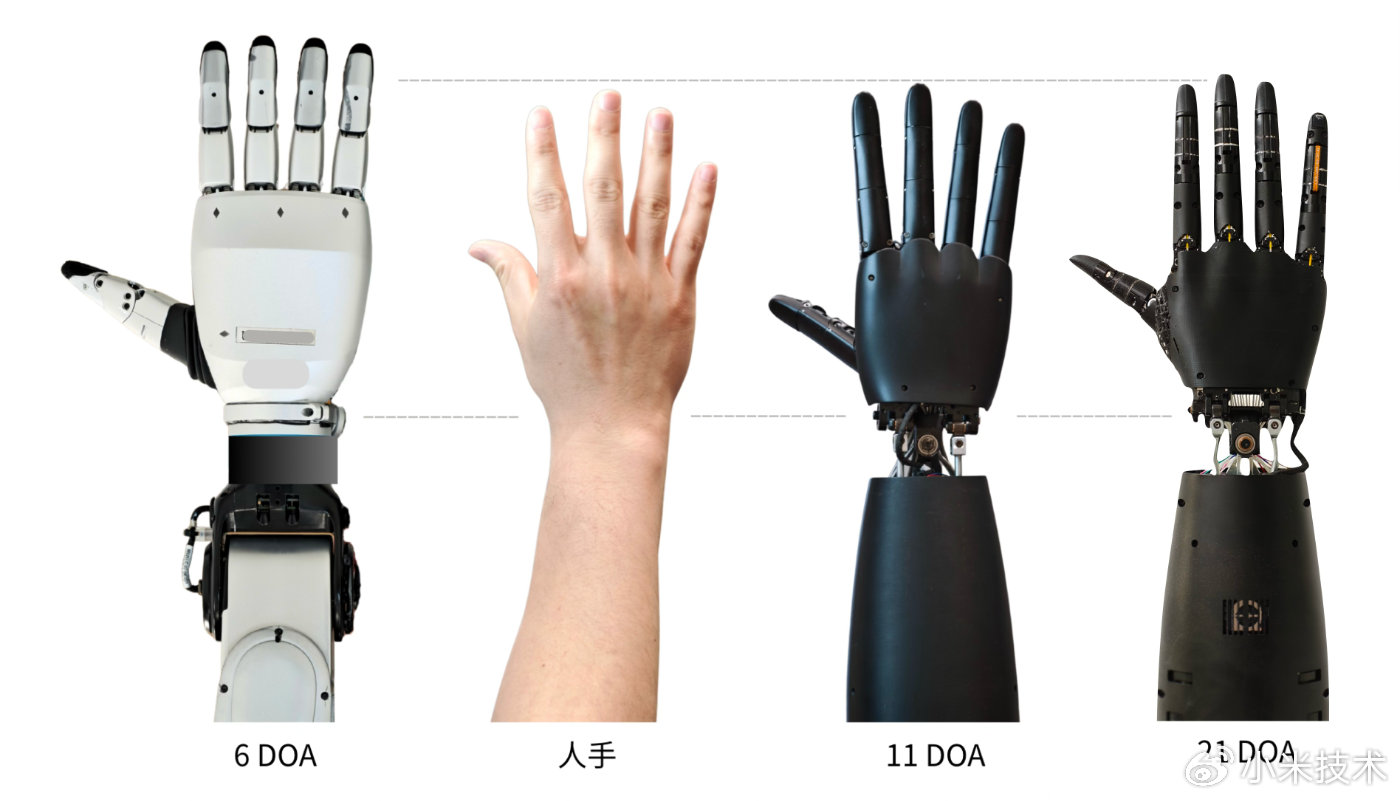
Figure: From left to right: a 6-DoF robotic gripper, a natural human hand, an 11-DoF gripper, and the new 21-DoF bionic dexterous hand. Successive iterations clearly show joint articulation converging toward natural human skeletal morphology. Source: Xiaomi Technology Official Release (Kinematic comparison photo)
This industrial dataset dismantled the assumption that more degrees of freedom are inherently better. Ablation experiments showed that between 6 and 15 DoF, grasping success fluctuated wildly. Stepping up to the 17 to 21 DoF window boosted average stable grasp success by 15% to 38%. However, pushing beyond 23 DoF yielded diminishing returns, with grasp coverage leveling off as mechanical complexity surged.
Consequently, 21 DoF emerged as the quantified sweet spot balancing operational compliance and mechanical complexity. Factory floor empirical data revealed that assembly workers utilize 103% of the index metacarpophalangeal (MCP) lateral abduction range and 102% of the pinky proximal interphalangeal (PIP) flexion-extension range during fine manipulation. Multidirectional joint movement forms the bedrock of precision assembly. These 21 independent joints enable the robotic hand to seamlessly adjust grasping angles inside confined vehicle chassis cavities.
Actuators Relocated to the Forearm: Trimming Palm Weight to 324g with Tension Sensing
Packaging 21 active joints into a compact envelope creates an immediate challenge: end-effector mass. Shoving 26 motors directly into the palm easily pushes the payload over 1 kilogram. Excessive mass at the wrist introduces severe inertia and oscillations during high-speed robotic arm motions, degrading positioning accuracy.
Xiaomi implemented a hybrid topology that separates the drive units. The engineering team housed 16 tendon-driven motor assemblies inside the forearm barrel, retaining only 5 direct-drive motors within the palm for critical posturing. This decentralized layout trims the palm body down to just 324 grams. Minimizing distal inertia preserves high dynamic stiffness when robotic arms execute abrupt stops and rapid directional changes.
In industrial settings, tendon-driven systems suffer from cable stretch and hysteresis. After tens of thousands of continuous pull cycles, polymer cables elongate, drifting joint calibration off-target. This causes finger tracking errors and risks dropping gripped components.
Xiaomi countered this by embedding high-speed tension sensors directly into the transmission path. The closed-loop controller samples cable tension thousands of times per second to dynamically calibrate pre-tensioning. The algorithm automatically compensates for mechanical wear and elongation travel slack. Hardware-level tension feedback ensures consistent torque delivery whether the hand handles delicate wiring looms or heavy structural suspension links.
Millimeter-Level Tactile Coverage Meets Modular Maintenance
Relying solely on computer vision cannot support complex contact-rich assembly. Camera feeds often get occluded by shadows once the gripper presses close against mating surfaces. Blind snap-fit latches and clip engagements rely almost entirely on tactile feedback.
Xiaomi blanketed the dexterous hand’s surface with 1,500 tactile sensing cells, creating a dense sensory matrix across the palm and fingers. Spatial resolution reaches 1 millimeter across the fingertips, finger pads, and finger roots, and 2 millimeters across the central palm. These pressure-sensitive units resolve fine object contours and detect micro-slip trends in real time, preventing parts from accidentally dropping.
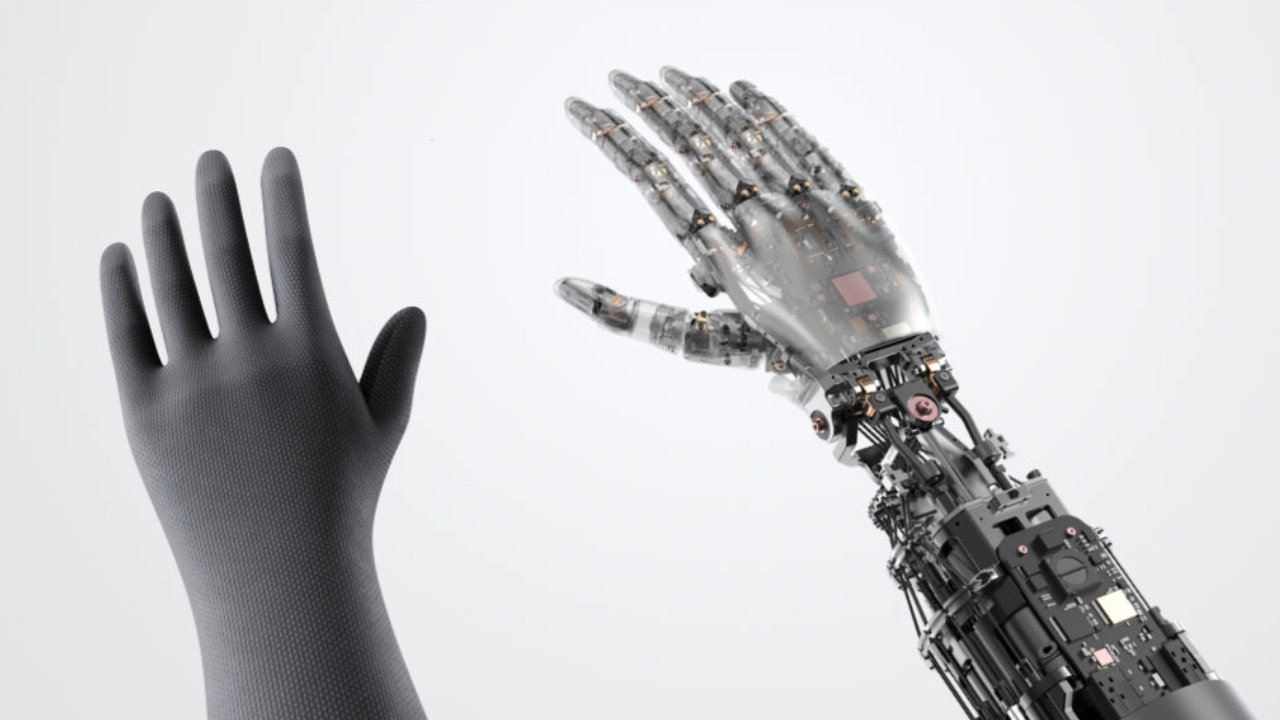
Figure: The bionic dexterous hand (right) shown alongside the high-density data capture glove (left). When operators wear the tactile glove to demonstrate assembly steps, the sensor array maps pressure distribution and joint poses directly to the robotic hand. Source: Xiaomi Technology Official Release (Hardware showcase)
Feeding real-world demonstration data into policy models relies on sensory isomorphism. Xiaomi mirrored the sensor topology between its tactile demonstration glove and the robotic hand. As assembly line workers perform standard operations wearing the glove, palm pressure profiles and joint angles stream directly into digital twin environments. This structural mapping eliminates heavy data-cleaning overhead, dramatically accelerating reinforcement learning convergence for end-to-end manipulation policies.
The harsh reality of industrial workshops also demands easy field serviceability. Floating airborne oil mist and metal dust quickly degrade exposed flexible sensory membranes. Xiaomi partitioned the full-palm tactile array into discrete modular units. If a sensor section on any phalanx wears out, technicians can hot-swap that single module on-site. This eliminates the steep cost of scrapping an entire hand over localized wear.
Thermal Predictive Control Meets 150,000-Cycle Endurance
Sustained operation of dense electromechanical assemblies poses an acute thermal challenge. Dozens of high-rpm micromotors are packed tightly inside the forearm housing. During high-torque operations, such as torquing chassis fasteners or clamping heavy subassemblies, coil temperatures spike rapidly. Excessive heat reduces motor demagnetization thresholds and degrades transmission lubricants.
Alongside metallic conduction channels, Xiaomi deployed an on-device real-time thermal prediction model. Based on instantaneous current input and individual axis velocities, the algorithm forecasts core motor temperature rises 5 to 10 minutes in advance with an error margin within 3°C. The thermal management system dynamically adjusts torque distribution, alternating load-bearing across fingers to stagger peak wattage and suppress localized heat buildup.
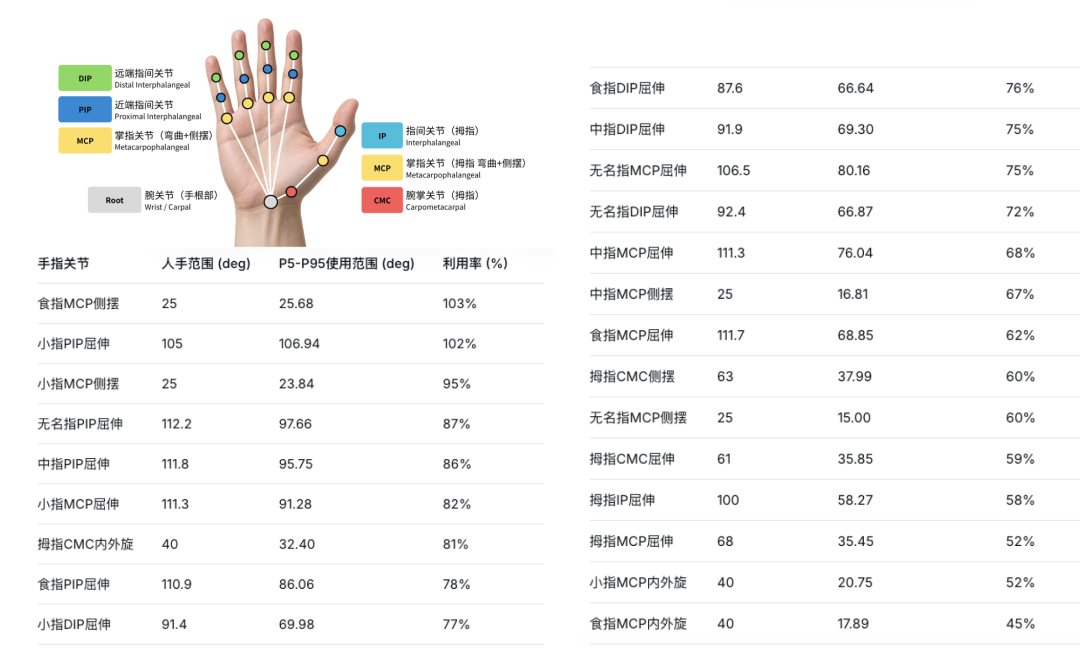
Figure: Finger joint ranges of motion and utilization ablation data gathered from EV factory assembly actions. Utilization exceeding 100% on specific joints—such as index and pinky lateral abduction—served as the empirical foundation for kinematic optimization. Source: Xiaomi Robotics Pilot Production Center (Kinematic evaluation table)
For structural durability, exterior casing seams feature microporous breathable membranes paired with high-thermal-conductivity graphite sheets. The entire dexterous hand completed over 150,000 high-intensity grasp fatigue cycles. Stress testing demonstrated that internal tendon cables and bearings maintain mechanical integrity under cyclic strain, withstanding dust intrusion and continuous operational vibration.
Custom Pneumatics vs. Anthropomorphic Hands: The Battle for Flexible Assembly
The embodied manipulation ecosystem sits at an architectural crossroad. Traditional automation engineers champion custom pneumatic grippers: they cost only a few thousand yuan, boast mean-time-between-failures (MTBF) in the millions of cycles, and offer unmatched mechanical reliability. From this viewpoint, a 21-DoF anthropomorphic hand is needlessly intricate, where adding 26 motors introduces 26 potential points of failure.
Yet flexible manufacturing imperatives are shifting the assembly paradigm. Mixed-model assembly lines and customized vehicle trims have become industry standards. Automotive lines undergo frequent model changeovers. With dedicated tooling, every new car model demands custom dies, physical retrofits, and prolonged downtime, creating bloated fixture inventories and mounting sunk costs. When dealing with deformable hoses or non-rigid harnesses, two-finger grippers simply cannot handle variable approach vectors.
Xiaomi’s focus on 1,827 concrete automotive SOPs demonstrates an ambition to commercialize general-purpose end-effectors. If a single bionic hand can grasp hundreds of disparate components, retooling for a new model requires only deploying updated neural network policies rather than rebuilding mechanical end-of-arm tooling. The resulting labor savings and capital equipment reuse gradually offset initial hardware development costs.
Compared to traditional industrial benchmarks demanding millions of maintenance-free cycles, 150,000 cycles remains an intermediate milestone requiring ongoing manufacturing refinement. Yet stepping out of showroom demos into tolerance-stacked factory lines marks a decisive step toward truly practical humanoid robotics.
References:
- Xiaomi Technology Official: Industrial Bionic Dexterous Hand R&D Findings
- Xiaomi Robotics Pilot Production Center: Automotive Manufacturing Process Ablation Analysis Data