A smartphone starting at just $218 that manages to squeeze in a 6,000 mAh battery and a 6.9-inch 120Hz high-refresh display: on October 3, 2026, Xiaomi officially rolled out the Redmi 17C 5G in India. The base configuration with 4GB RAM and 128GB internal storage is priced at INR 20,999 (roughly $218).
Squeezing a 6,000 mAh Battery and 120Hz Display into a $218 Frame
The headline attraction of the Redmi 17C 5G is undoubtedly its massive 6,000 mAh battery. It supports 33W wired charging alongside 10W reverse wired charging, effectively allowing the phone to double as an emergency power bank. Xiaomi officially claims the cell retains over 80% of its initial capacity even after 1,000 complete charge cycles. Turning a budget phone into a portable power bank is hardly an industry first, but packaging such an expansive battery inside a chassis measuring 7.9 mm in thickness and weighing 211 grams underscores mature supply-chain engineering and aggressive bill-of-materials cost control.
 Figure: The Redmi 17C 5G features a dual rear camera setup. Source: Xiaomi India
On the display side, the device features a 6.9-inch IPS LCD panel with a resolution of 1600x720, supporting a 120Hz refresh rate and DC dimming. While a 720p resolution stretched across nearly 7 inches inevitably results in lower pixel density, for entry-level smartphone buyers the perceptual fluidity delivered by 120Hz is far more immediately compelling than microscopic panel sharpness.
MediaTek Dimensity 6300 Delivers Baseline Everyday Compute
Under the hood, the device is powered by MediaTek’s 6nm Dimensity 6300 chipset, paired with up to 6GB of LPDDR4X RAM. While this silicon is hardly meant to handle compute-heavy 3D gaming or intensive rendering, it provides ample headroom for everyday scrolling, social apps, and media streaming on the factory-installed HyperOS 3. Trickling down modern 6nm fabrication nodes into budget tiers continues to steadily alleviate the historical sluggishness that once plagued entry-level Android devices.
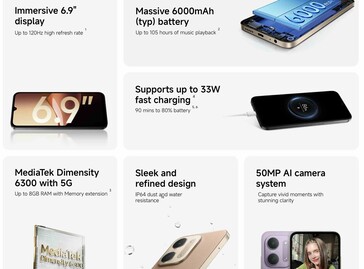 Figure: Marketing assets highlight the phone’s primary hardware specifications. Source: Xiaomi India
The phone also integrates Google’s latest on-device AI features, including Circle to Search and Gemini Live. On-device AI is no longer the exclusive preserve of flagship devices commanding four-figure price tags; it is rapidly trickling down to mass-market price tiers with minimal hardware overhead.
Building Competitive Moats with Aggressive Hardware Stacking
Beyond core processing and battery specs, the Redmi 17C 5G includes a 50MP main camera with an f/1.8 aperture, a side-mounted fingerprint sensor, a 3.5mm headphone jack, and IP64 dust and splash resistance. The upgraded 6GB+128GB tier retails for just INR 22,999 (around $239). In the sub-$250 segment, no amount of bespoke software tuning provides the immediate peace of mind of a genuine 6,000 mAh battery.
Xiaomi’s strategy here is unambiguous: leverage supply chain scale to make high-capacity batteries and 120Hz displays standard baseline table stakes in the budget segment. The Redmi 17C 5G sets a high hardware bar for entry-level 5G competition. As 120Hz panels and 6,000 mAh batteries become expected minimums, competing manufacturers relying solely on lightweight software skin optimizations without hardware parity will find their room for survival shrinking fast.
Reference Links:
- Notebookcheck Report