Ditching Video Feeds: On-Device Intelligence Takes Over Environmental Sensing
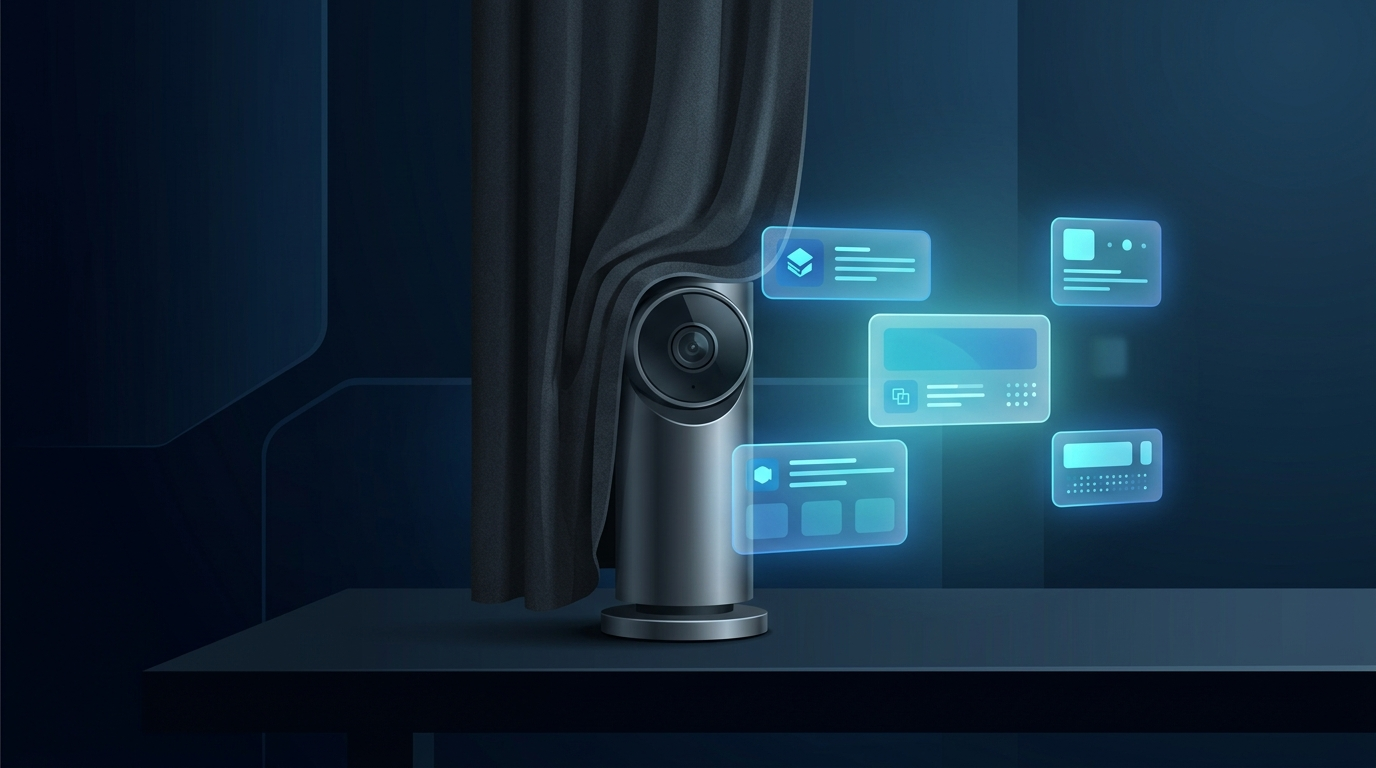
In early October 2026, Bloomberg reporter Mark Gurman revealed details on Apple’s smart home project codenamed J450. Shaped like a sleek metal lip balm tube, this indoor security device makes an unconventional design choice: it strips out video streaming entirely and offers no cloud recording. The only feedback users receive on their phones is text. The system parses visual input locally and generates real-time textual descriptions of the surrounding environment.
In mainstream smart home markets, security cameras have long competed on resolution, field of view, and night-vision fidelity. Manufacturers relentlessly stack 4K sensors and upsell cloud storage tiers. Apple’s low-frame-rate camera takes the opposite approach by leaning entirely on local computation. Running vision models on an onboard chip, it translates recognized faces or specific actions directly into text logs. At no point does the device transmit raw imagery to the outside world.
 Figure: Apple’s smart home ecosystem roadmap as reported in foreign tech media. Source: The Verge
Physically Isolating Imagery to Cut Off Data Leaks
Traditional security systems have an inherent vulnerability in their data pipelines. Amazon Ring made headlines over scandals where employees improperly accessed customer video feeds. Countless home surveillance clips have surfaced on dark web marketplaces. As long as video feeds travel across the network, they remain vulnerable to interception. Rich visual data itself constitutes a direct threat to privacy.
Apple’s J450 architecture severs this data-leak pipeline at the hardware level. Gurman noted that this philosophy mirrors Apple’s ongoing development of camera-equipped AirPods. Once the sensor captures environmental information, analysis occurs entirely at the edge. The moment the device recognizes that someone has entered the room, raw image frames are instantly purged from memory.
This approach guards against worst-case scenarios. Even if a hacker breaches the home router, all they could potentially intercept are dry text records. Because hardware constraints limit it to low frame rates, the device lacks the physical capability to stream high-definition video in the first place. Network-level data hijacking is rendered utterly useless.
Introducing Face Recognition: A Visual Alternative to mmWave Radar
Traditional presence sensors rely heavily on millimeter-wave (mmWave) radar. While mmWave can detect human occupancy in a room, it cannot identify who is there. This leaves smart home setups feeling clumsy in multi-member households. Apple introduced visual sensors specifically to address this identity blind spot.
According to leaks, the J450 camera features built-in facial recognition. It can accurately distinguish between homeowners and pets. Combining image sensors with on-device inference, it achieves far finer granularity of perception than mmWave radar—categorizing household members in the background without retaining a single frame of footage.
Replacing mmWave radar with vision requires higher compute budgets and component costs, but Apple’s design neatly sidesteps the privacy trap. After extracting facial features, the device merely outputs an identity label to higher-level applications. Users get the precision of facial recognition without the liabilities of stored footage.
 Figure: HomeKit’s existing activity state detection interface. Source: The Verge
Bypassing Hardware Red Oceans: Capitalizing on Privacy Anxiety
The consumer security market is already saturated by established giants. Standard cloud-based smart cameras struggle to survive cutthroat price wars. Apple has turned “not recording footage” into its central product differentiator, targeting increment-minded users who are deeply sensitive to privacy.
A vast number of consumers flatly refuse to install security cameras in bedrooms, living rooms, and private quarters due to cybersecurity anxieties. A metal cylinder that outputs only text carries far less psychological intrusion than a glass lens glowing with infrared LEDs. By expanding where security devices can comfortably live, Apple is organically penetrating intimate corners where traditional cameras cannot venture.
Serving as Sensory Endpoints for Home Automation
This camera is a cornerstone of Apple’s broader HomeKit overhaul. Reports indicate that J450 also serves as a companion device to the upcoming J490 smart display hub. Apple positions these devices as distributed sensory endpoints scattered throughout the home, feeding dynamic input directly into the home automation network.
Apple’s HomeKit Secure Video already offers a conceptual predecessor: users can enable an activity detection mode that halts video streaming on existing cameras and only tracks motion. J450 takes that software feature and crystallizes it into dedicated hardware.
With real-time AI processing visual input, the system precisely maps out household routines. When it identifies a user stepping into the study, it silently turns on the desk lamp and activates the speaker. The central hub never needs to see high-resolution video; it only requires the presence signal emitted from the edge device.
While competitors stack multi-camera arrays, Apple is charting an alternative path. Replacing a live video feed with text alerts may seem like a step backward in functionality. Yet in home security, storing video footage is rarely a genuine necessity. Once algorithms can accurately ascertain what is happening, sensitive visual data can be eradicated on the hardware itself. It represents a substantial reboot of smart home security fundamentals.
Reference Links:
- Apple’s reportedly developing a smart home camera that doesn’t record video