On October 1, 2026, Cloudflare officially open-sourced two multimodal decision models: Clef and Clef-flash. Rather than opting for Llama or Mistral as their backbone, Cloudflare directly co-trained and optimized against Alibaba’s Qwen3.8-27B and Qwen3.5-9B. A cloud provider built on edge computing and CDN infrastructure has stepped directly into the arena to train dedicated decision classifiers.
Historically, enterprises offloaded business logic and classification tasks to massive cloud-hosted LLMs. Every content moderation check or malicious traffic mitigation incurred expensive time-to-first-token latencies. Tasking a hundred-billion-parameter generalist model with binary routing is structurally inefficient and costly. Cloudflare’s countermeasure is straightforward: bring a dedicated decision engine directly to the network edge.
Native Vision Encoders: Unlocking Multimodal Decision-Making
Prior to Clef’s debut, Typesafe AI’s Jev served as the primary performance benchmark for open decision models. However, Jev supported only text-based classification and was strictly capped at a 32k context window. When evaluating requests accompanied by screenshots or documents, developers were forced to bolt on external OCR pipelines. Visual data had to be clumsily serialized into text before the model could make an assessment.
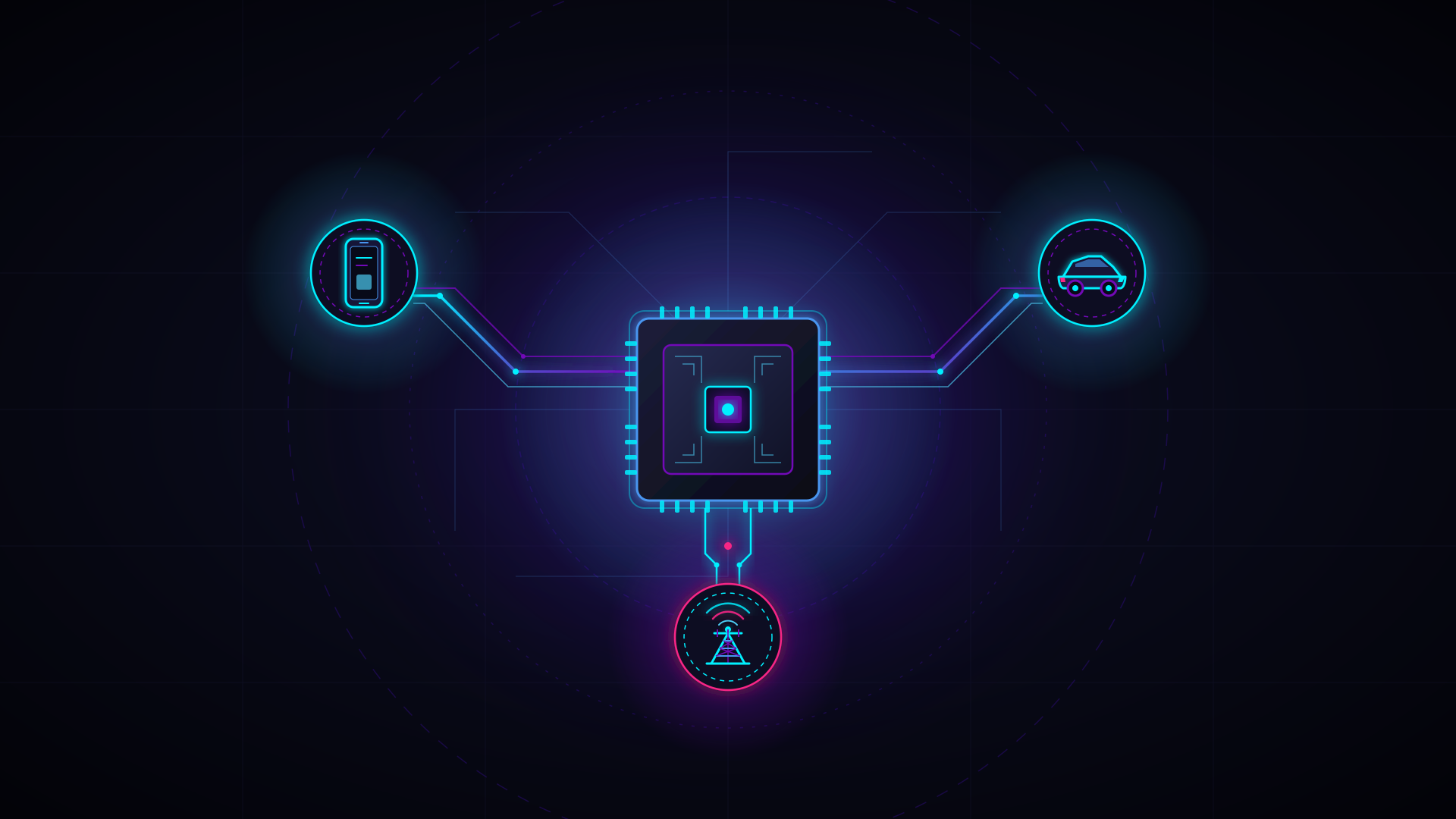
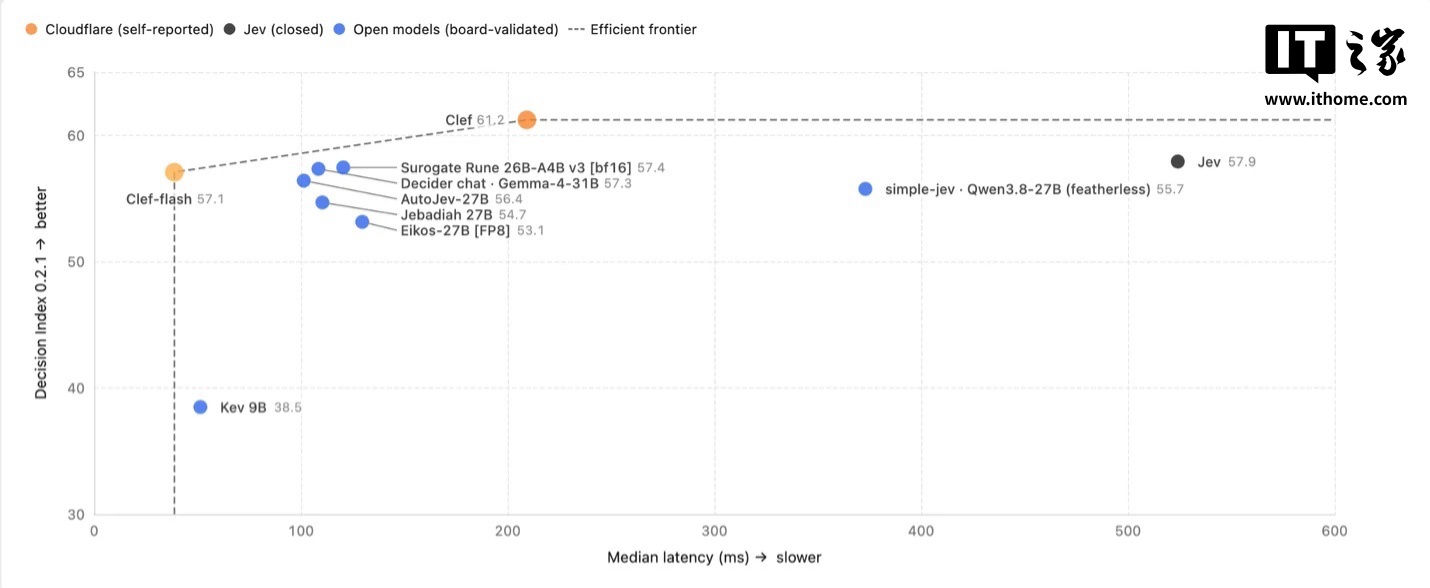 Figure: Clef model execution logic diagram. Source: Cloudflare Blog
Clef integrates a native vision encoder directly, expanding the input capacity to 64k tokens. The model ingests and analyzes visual data natively, eliminating the latency and fidelity loss of intermediate text conversion. Developers can now pack significantly richer system states and telemetry into the 64k window. By establishing an end-to-end multimodal decision pathway at the edge, visual comprehension is no longer the exclusive domain of monolithic cloud models.
Eliminating Text Generation for Precise Probability Calibration
To mold Qwen into a high-frequency classifier, Cloudflare’s engineering team made deliberate architectural trade-offs. They froze the core layers of Qwen3.8-27B and Qwen3.5-9B, introducing only a rank-256 low-rank adapter (LoRA) for fine-tuning. Pairing Brier score loss for fine-grained probability calibration with label-smoothed cross-entropy, the team completely eliminated Clef’s generative text capabilities.
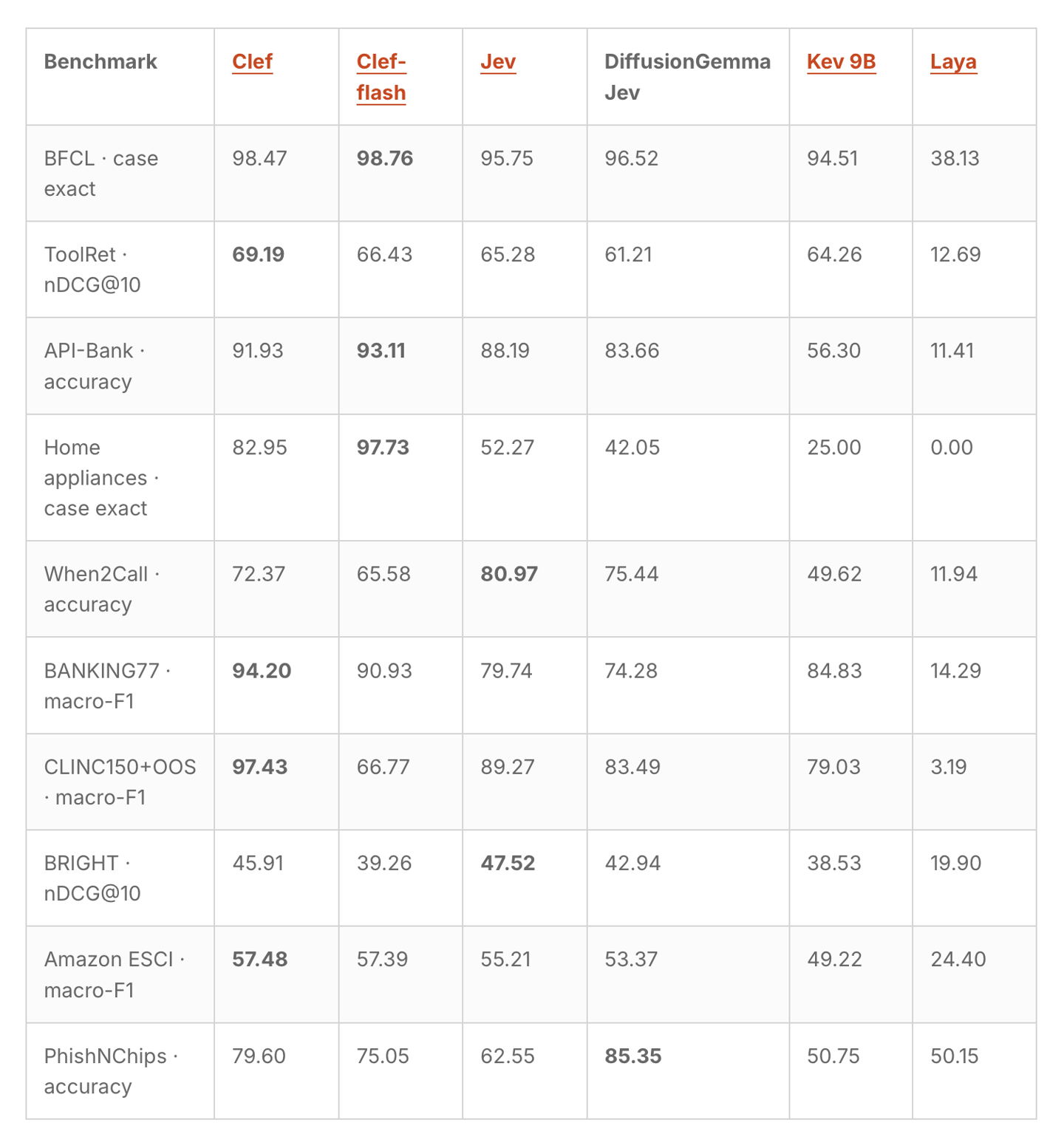 Figure: Clef performance benchmarks compared to peer models such as Jev and Kev. Source: Cloudflare Blog
During inference, the model never outputs explanatory conversational prose. Instead, it is constrained to emit calibrated probability distributions over predefined schemas. This physical constraint on output formatting delivers a dramatic boost in decision accuracy.
In the Jev Decision Index (version 0.2.1) benchmark, Clef scored 98.47 points while Clef-flash achieved 98.76 points. Both scores surpassed Jev’s 95.75, leaving Kev 9B far behind. All available compute is channeled exclusively into classification verification. Sacrificing open-ended chat for single-digit millisecond responses hits the exact engineering requirements of high-throughput operational workloads.
Synthetic Data Stress-Testing the Baseline of Robustness
Underpinning this high-precision scoring mechanism is a synthetic dataset generated internally by Cloudflare. During training, the team deliberately perturbed field ordering, system prompts, and schema structures. This deliberate stress-testing hardened the models against erratic, adversarial edge requests.
The team also incorporated Reinforcement Learning from Categorical Distributions (RLCD) as a secondary optimization objective. RLCD allocates partial credit across adjacent ordinal classes while rewarding exact schema formatting. Concurrently, a reference penalty prevents distributional drift. Leveraging reinforcement learning to correct calibration bias gives Clef the reliability required to handle enterprise ticket triage and real-time security policies directly.
Bundling Fine-Tuning Pipelines to Capture Edge Traffic
Releasing open-weight models is merely the opening gambit; Cloudflare’s ultimate strategy centers on its companion fine-tuning platform. Enterprise customers can capture production traffic directly through Cloudflare AI Gateway. This real-world telemetry is fed into sandboxed Containers to train customized Clef adapters. Once fine-tuned, models are deployed seamlessly to the Workers AI global edge network via the Bring Your Own (BYO) Model service.
Cloudflare’s internal teams have already battle-tested this workflow. Trust & Safety uses it to score user reports. Customer Support relies on it to triage and route inbound service tickets. Bot management teams employ it to identify and neutralize shifting network traffic patterns in real time.
By bundling the fine-tuning environment, data ingestion, and edge inference within its own walls, the cloud vendor achieves complete traffic retention. Enterprises no longer need to route edge telemetry to external third-party model APIs.
Cloudflare’s decision to build on Qwen underscores the growing maturity of the open-source model ecosystem, while Clef highlights the inexorable move toward domain-specific model distillation. When 27B and 9B models are stripped of generative chit-chat, equipped with native vision, and tied directly into edge deployment workflows, vertical classifiers begin eating into general-purpose LLM workloads. Developers no longer have to pay for unnecessary token generation overhead. In the end, compute is billed solely for the decision probability itself.
Reference Links:
- Cloudflare Blog
- Hugging Face Model Hub