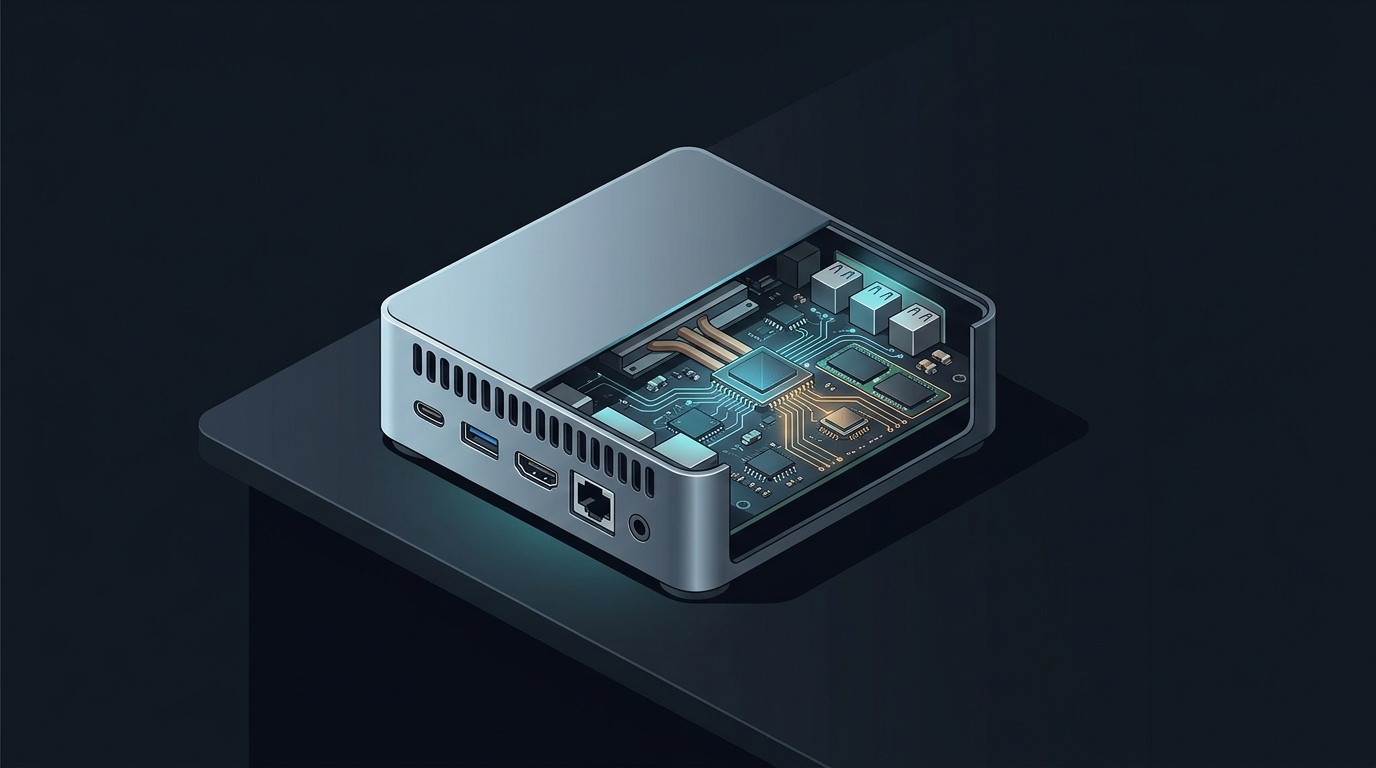
On November 19, 2026, Mechrevo officially launched its enterprise AI desktop, the “Master X10.” Measuring roughly 15 cm on each side and weighing just 1.42 kg, the ultra-compact machine packs NVIDIA’s RTX Spark superchip, sustaining a thermal output of up to 140W.
The base configuration includes 64GB of unified memory and a 1TB SSD, priced at 32,999 RMB (approx. $4,550). A higher-tier model offers 128GB of memory and 2TB of storage for 49,999 RMB (approx. $6,900). With this release, the hardware maker packs a large-model compute unit into a 1.25-liter aluminum box.
Starting at 32,999 RMB: Moving Enterprise AI from Server Rooms to the Desk
Deploying large language models in enterprises has long been constrained by physical infrastructure. Previously, teams running frontier models faced two choices: purchase rack servers or lease cloud computing clusters. Physical racks require dedicated server rooms, high-power distribution, and soundproofing, while cloud services raise persistent concerns over data sovereignty and API latency queues.
Traditional rackmount equipment demands stringent electrical infrastructure. A standard 2U server typically requires a dedicated 16A breaker and a climate-controlled room. The Master X10, by contrast, peaks at just 140W of total system power, plugging directly into a standard 10A desktop wall socket. This enables small and mid-sized teams to deploy local LLM environments without rewiring office electrical circuits.
The Master X10 offers a practical middle ground. Its 32,999 RMB initial outlay is comparable to a high-end workstation, but eliminates server room construction costs entirely. The device operates at a standard workstation right out of the box, with no acoustic dampening cabinet required.
This form factor transforms the delivery mechanism of private AI. Design teams and quantitative trading groups can execute inference pipelines locally. Critical codebase assets and proprietary business data stay entirely within the local area network, with response latencies immune to public internet jitter.
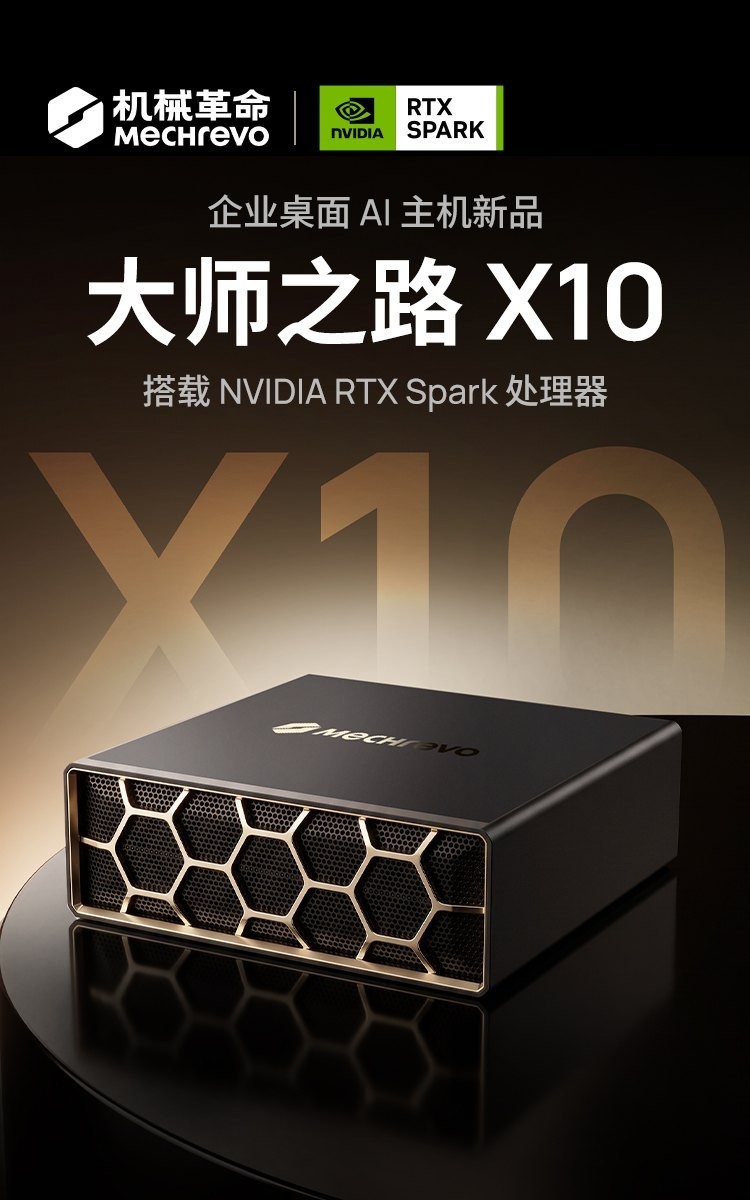 Figure: Mechrevo Master X10 enterprise desktop AI PC specifications and chassis overview. Source: Mechrevo official release.
140W Thermal Dissipation in 1.25L: Dual Blowers Tame Dense Compute
Sustaining high wattage inside a miniature chassis poses serious airflow engineering challenges. The Master X10 measures 155×158×51 mm, yielding a total volume of just 1.25 liters. Compared to traditional multi-liter server chassis, its physical footprint is roughly that of a hardcover book.
Mechrevo crafted the chassis using full-metal CNC machining. The front panel features a gold aluminum frame paired with a honeycomb intake grille to maximize airflow. The unibody metal exterior functions as an active heat sink, dissipating thermal load away from internal components.
Internally, the system integrates dual blower fans with 70 cooling fins. An array of composite heat pipes spreads thermal load across copper alloy radiator stacks. Even under sustained dense matrix math workloads, this airflow design reliably dissipates 140W of heat, exhausting hot air rapidly to prevent thermal throttling.
The intake grille features an open-aperture ratio exceeding 60%, accelerating airflow velocity. Fluid dynamic bearings in the dual fans suppress mechanical resonance at elevated RPMs.
High-speed server fans frequently generate noise in excess of 65 dBA. The Master X10 rebalances static pressure and airflow resistance, keeping idle and moderate inference noise at standard office ambient levels. Engineers can write code right next to the running unit without intrusive low-frequency hum.
Unified Memory Erases the PCIe Bottleneck: 300GB/s Bandwidth for LLMs
At the heart of the system lies NVIDIA’s RTX Spark superchip, delivering 1 Pflops of sparse FP4 compute and supporting the latest generation of Tensor Core instructions. Low-precision floating-point acceleration substantially increases token throughput during LLM inference.
Its primary architectural advantage is 300GB/s of unified memory bandwidth. In traditional modular desktop workstations, GPU VRAM and CPU system RAM are physically separated. Model weight parameters must traverse the motherboard bus between memory and VRAM, creating a severe bottleneck across PCIe slots.
Even with the latest PCIe 5.0 x16 interface, unidirectional bandwidth maxes out at 64GB/s. Paging large model weights back and forth between system RAM and GPU memory creates substantial latency overhead. The on-die fabric of the RTX Spark eliminates this gap entirely.
The RTX Spark integrates high-bandwidth LPDDR5X memory, enabling the CPU and GPU to share a unified physical address space. The 128GB capacity allows the machine to load 70-billion-parameter models natively without complex tensor sharding. Models load virtually instantaneously, and zero-copy data sharing removes bus traversal penalties altogether.
Unified addressing also dramatically lowers the memory footprint of autonomous agents. Multiple background agent runtimes can remain persistent simultaneously, sharing cached model weights in memory. When scheduling concurrent local tasks, the risk of out-of-memory (OOM) crashes is substantially reduced.
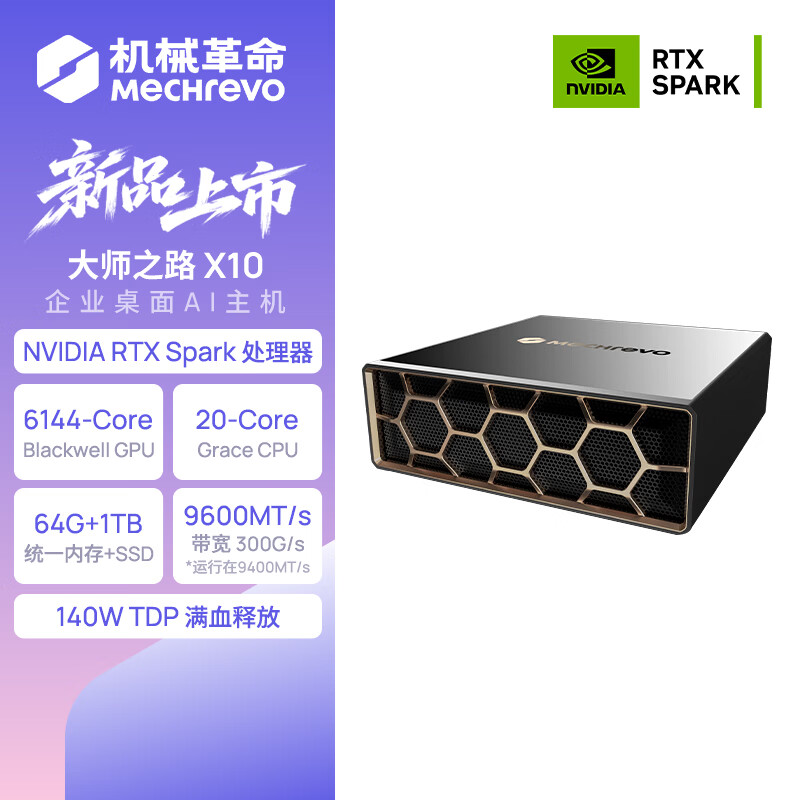 Figure: Mechrevo Master X10 mini PC industrial chassis and port layout. Source: Mechrevo official product imagery.
10GbE and Quad Type-C: Edge Connectivity for Desktop AI Appliances
Edge compute hardware must integrate frictionlessly into local infrastructure. The Master X10 comes standard with a 10GbE (10-Gigabit Ethernet) port, delivering local network transfer rates up to 1.2GB/s—moving a multi-gigabyte model checkpoint takes mere seconds.
This high-speed wired link allows the mini desktop to interface seamlessly with local NAS storage. Engineering teams can centralize their foundational model repositories and LoRA weights on network storage, letting the desktop pull assets on demand without exhausting local NVMe drives.
Peripheral connectivity accommodates extensive expansion. The chassis provides four full-function USB-C ports and one HDMI 2.1 display output. Engineers can simultaneously attach high-speed external NVMe storage arrays and drive high-resolution displays. Wireless connectivity is handled by onboard Wi-Fi 7 and Bluetooth 5.4 adapters.
A Kensington security lock slot is integrated into the side panel. For a multi-thousand-dollar device compact enough to slip into a backpack, physical theft deterrence is essential in open office layouts. Teams can secure hardware assets on the desk without purchasing locking server cabinets.
The software stack is similarly production-ready. NVIDIA provides full native CUDA drivers and the TensorRT-LLM inference engine for the platform. Developers can deploy pre-compiled container environments immediately, bypassing the long and painful adaptation cycles typical of niche hardware platforms.
Appliance-Like Simplicity Lowers O&M Costs, Non-Upgradability Remains the Trade-off
The launch of the Master X10 sparked vigorous debate across the tech community. Proponents emphasize the dramatically lower maintenance overhead. Where maintaining on-premise hardware once required dedicated server room maintenance, a software engineer can now operate local compute like a standard desktop appliance.
Skeptics focus on pricing and hardware upgradability. The 32,999 RMB starting price sits far above typical developer PC budgets. Because LPDDR5X memory is soldered directly onto the substrate, user memory upgrades are impossible. As frontier model parameter sizes continue to scale, the machine faces a hard ceiling on available memory.
Yet the total cost of ownership (TCO) presents a compelling counterargument. Compared against recurring rack leasing fees, precision air-conditioning utility bills, and dedicated system administrator salaries, a desktop micro-appliance drastically cuts hidden operational expenses over a two-to-three-year lifecycle.
The ARM-based architecture also introduces migration considerations. While mainstream AI toolchains are natively supported, legacy enterprise databases and proprietary internal libraries may require recompilation before transitioning to the instruction set.
By packaging enterprise-grade compute into a 1.25L aluminum chassis, Mechrevo showcases the ongoing migration of edge AI onto the desktop. Dense engineering and unified memory dramatically lower the friction of local model deployment. Even with trade-offs in modularity, this plug-and-play desktop format signals the next step in decentralizing enterprise compute.
Reference Links:
- Mechrevo Master X10 Product Specifications
- NVIDIA RTX Spark Architecture Technical Whitepaper
- Mechrevo Official JD.com Flagship Store Listing