On November 19, 2026, Harman Kardon quietly listed the Allure 2 desktop Bluetooth speaker on its official Japanese website. The launch arrived without the fanfare of a global keynote. Conspicuously absent as well is the iconic far-field voice-activation microphone array of its predecessor. Priced at 34,100 JPY (roughly $215), the speaker deliberately pivots its focus toward 360-degree dynamic ambient lighting and Auracast broadcast audio.
This pivot marks a pragmatic realignment in consumer audio hardware. During the peak hype cycle of smart speakers, manufacturers attempted to position tabletop speakers as the primary control hub for the entire connected home. As the technology matured and consumer enthusiasm waned, an always-listening, always-on microphone turned into a psychological burden for many users. By stripping out the voice assistant module, Harman Kardon returns the signature transparent dome silhouette to its true calling: delivering an immersive acoustic and visual atmosphere.
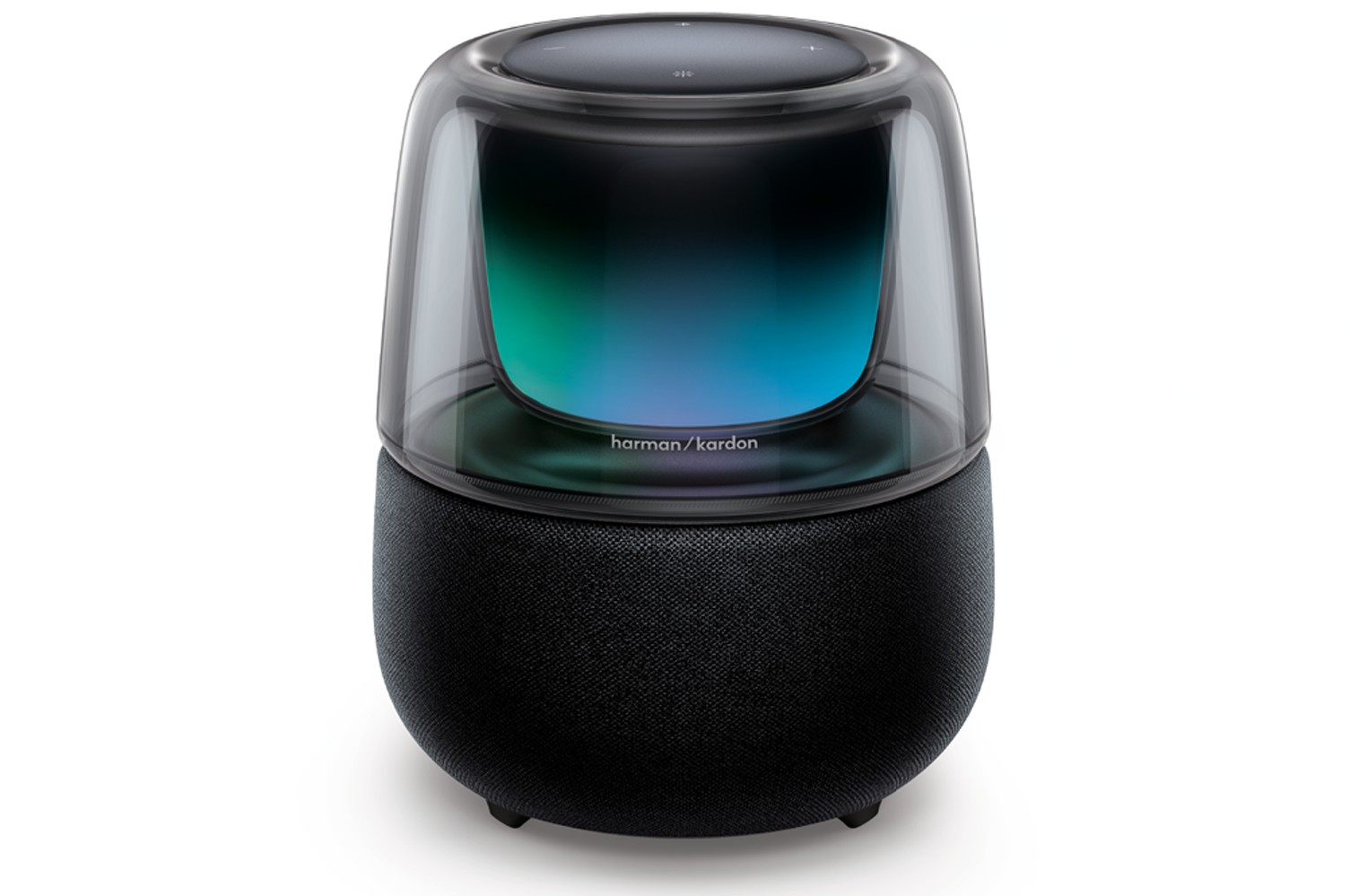 Figure: The Harman Kardon Allure 2 transparent dome enclosure and down-firing subwoofer structure. Source: Harman Kardon (via Notebookcheck).
Dropping Far-Field Microphones: Stepping Back from Smart Home Gatekeeping
Looking back at the original Allure released in autumn 2017, voice interaction was its headline feature. That model integrated Amazon Alexa alongside a four-microphone linear array. Ensuring reliable far-field voice recognition required elaborate noise-cancellation circuitry packed into the upper casing.
Years of real-world usage have since clarified what users actually want from their living spaces. Smartphones and wearable devices have effectively established themselves as the true personal computing hubs. Tabletop speakers simply lost the battle to serve as smart home gateways. When playing music, listeners consistently prefer straightforward, reliable casting from their phones without worrying about privacy intrusion. The constant presence of an active microphone array created palpable consumer wariness.
With the Allure 2, the microphone cutouts have been completely removed from the hardware. The chassis returns to a clean, continuous curved surface. This reductive approach also sharpens cost allocation. Engineering budgets once dedicated to specialized voice DSPs and microphone hardware have been redirected directly into audio amplification and ambient lighting components.
60W Dual Amplification in a 2.2kg Body: Algorithms Tame a Compact Acoustic Enclosure
Compressing industrial dimensions while elevating acoustic fidelity poses serious physical challenges. The Allure 2 measures 16.6 × 16.6 × 20.3 cm and weighs just 2.2 kg. Within this compact cylindrical chassis, engineers managed to fit a full 2.1-channel acoustic layout. The base houses a 3.5-inch (88.9 mm) down-firing subwoofer, encircled by three 1.5-inch (38.1 mm) full-range drivers.
Powering these transducers is a dual-channel dedicated amplifier setup. The low-frequency channel delivers a continuous 30W RMS, matched by another 30W RMS dedicated to the mid-to-high channels, bringing total continuous output to 60W RMS. Frequency response extends down to 40 Hz and reaches up to 20 kHz (-6 dB), boasting an 80 dB signal-to-noise ratio. For a desktop unit with barely two liters of internal displacement, hitting 40 Hz pushes right up against physical limits.
// Harman Kardon Allure 2 Core Acoustic and Electrical Specifications
- Transducers: 3 × 1.5-inch full-range drivers + 1 × 3.5-inch subwoofer
- Rated Output Power: 1 × 30W + 1 × 30W RMS (independent dual-channel amplifiers, 60W total)
- Frequency Response: 40 Hz - 20 kHz (-6 dB)
- Signal-to-Noise Ratio: 80 dB (A-weighted)
- Transmission: Bluetooth 5.4 (supports A2DP V1.4, AVRCP 1.6.2, Auracast broadcast audio)
- Dimensions & Weight: 16.6 × 16.6 × 20.3 cm, net weight 2.2 kg
To eliminate cabinet resonance and distortion when playing loudly within such a small chamber, Harman deployed its proprietary AI Sound Boost algorithm. Running locally on an onboard processor, the algorithm tracks driver excursion limits and voice-coil thermal rise at millisecond intervals. During sudden bass peaks, it dynamically balances signal gain in real time, preventing physical bottoming-out while fully unlocking low-end transient response.
360-Degree Ambient Lighting Tied to EQ: Five Presets Set the Spatial Mood
Raw spec sheets rarely captivate discerning audio buyers on their own. In this price bracket, capable full-range clarity and respectable bass extension are already standard fare. Consumer expectations for desktop audio have evolved from purely functional sound generation to holistic spatial atmosphere.
The Allure 2 binds sound waves tightly with ambient light. Embedded inside the translucent dome is a 360-degree circular light diffusion matrix. It pulses and breathes dynamically to the rhythm and energy of the music. The system comes equipped with five curated thematic lighting presets: Aurora, Blossom, Fireplace, Ocean, and Sunrise.
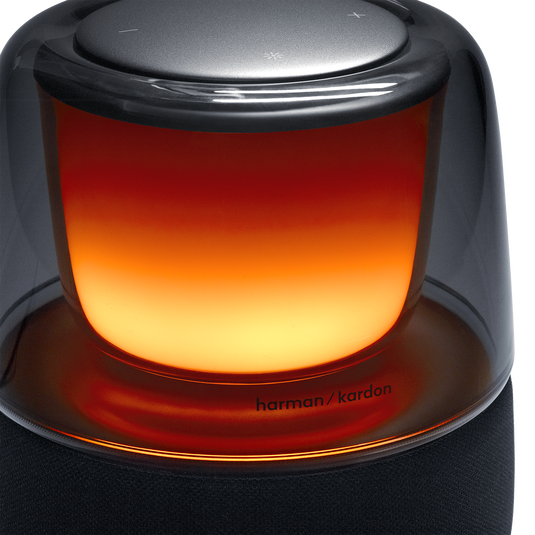 Figure: The 360-degree dynamic ambient lighting produced by the Allure 2. Source: Harman Kardon (via Notebookcheck).
Using the Harman Kardon One companion app, users can dial in fine lighting adjustments. Beyond modifying color flow speeds, specific acoustic sound profiles can be linked directly with lighting modes. For instance, selecting the Fireplace theme prompts the system to warm up lower frequencies while softening the light oscillation. This tight audio-visual harmony directly shapes the mood of a room.
Auracast Replaces Proprietary Protocols: Multi-Speaker Broadcast Without Wi-Fi Bridges
Traditional multi-room audio solutions have long been constrained by closed, proprietary ecosystems. Early high-end setups relied heavily on Wi-Fi networks to construct synchronous multi-room topologies. Owners had to purchase proprietary bridge hardware and costly branded expansion units. Whenever home router bands became congested, devices frequently dropped connections, lost packets, or experienced channel latency.
The Allure 2 adopts Bluetooth 5.4 and Auracast broadcast audio, standardized under the LE Audio umbrella. The hallmark of this technology is lightweight, connectionless transmission. The audio source broadcasts low-latency audio streams omnidirectionally into the surrounding space. Any nearby Auracast-enabled speaker can tune in instantly, bypassing cumbersome manual Bluetooth pairing or local Wi-Fi authentication.
This architecture radically lowers the barrier to multi-speaker environments. Two Allure 2 units can be wirelessly paired into an uncompressed stereo stage without running cables. In larger floor plans, units scattered across living rooms, studies, or corridors can simultaneously play the same broadcast stream. This decentralized networking model finally untangles multi-room audio from complicated local network infrastructure.
Reaching the Limits of Diminishing Returns: Desktop Audio Shifts to Sensory Fusion
At 34,100 JPY, the Allure 2 occupies a clearly defined market position. In Harman Kardon’s product hierarchy, it sits below high-output heavyweights like the 160W Aura Studio 5, and above rugged portable speakers. Tailored specifically for living spaces and home desks, the Allure 2 declines to compete in an endless wattage race.
The acoustic volume of compact desktop speakers is inherently bound by physics. Because conventional tuning improvements now yield diminishing auditory returns, consumer willingness to pay has shifted toward multi-sensory experiences. The continuation of the iconic transparent silhouette, bridgeless multi-speaker clustering, and ambient light that blends into home decor together form a compelling value proposition.
The Allure 2 demonstrates where classic industrial design is heading. By pairing historical design pedigree with next-generation wireless protocols, it casts aside cumbersome smart assistant features and returns the stage to pure sound and light. In an audio market where spec metrics have hit a plateau, this restrained return to domestic aesthetics provides a clear blueprint for modern desktop audio.
Reference Links:
- Notebookcheck Coverage
- Harman Kardon Japan Official Product Specifications