On November 19, 2026, the NetEase UU Remote team published an official monetization roadmap. Starting December 1, the platform will introduce high-tier paid subscriptions, anchoring its annual plan at 238 RMB (approximately $33). Crucially, the team simultaneously issued an explicit pledge: the free baseline will persist indefinitely—with uncapped session durations, unlimited connection counts, zero artificial queueing, and no intrusive popup ads.
This stands in stark contrast to years of monetization tensions across domestic remote desktop services. Rather than squeezing free tier bandwidth, NetEase is preserving 1080p 30fps streaming, remote Wake-on-LAN, and command-line terminal access for all users. The subscription model shifts its focus entirely toward high-fidelity game streaming and professional design workflows.
$33 Annual Pass for Ultra-High Fidelity: Preserving the Free Baseline Without Queues
The newly introduced subscription structure features two tiers. The VIP tier is priced at 238 RMB annually (continuous monthly auto-renewal at 24 RMB, or 30 RMB for a standalone month). For early adopters registered before December 1, NetEase issued a 50% discount coupon for annual passes, driving the effective monthly cost down to just 9.9 RMB.
The VIP tier directly targets enthusiast streaming workloads. It unlocks 4K resolution, 144Hz refresh rates, and a 500Mbps bitrate ceiling, backed by 4:4:4 true color chroma and HDR tonemapping. The bundle also packages multi-channel remote control, wireless secondary displays, virtual monitor emulation, and over 500 game-specific controller mappings. Meanwhile, an SVIP tier aimed at cross-border connections is listed at 758 RMB per year, bundling dedicated global acceleration nodes.
Conversely, the free tier remains robust. Free accounts retain 1080p 30fps clarity alongside high-speed file transfers, Wake-on-LAN (WoL), microphone passthrough, CLI access, and mobile picture-in-picture window sharing. NetEase guarantees no duration caps or session throttles, eliminating artificial waitlists and peak-hour disconnects.
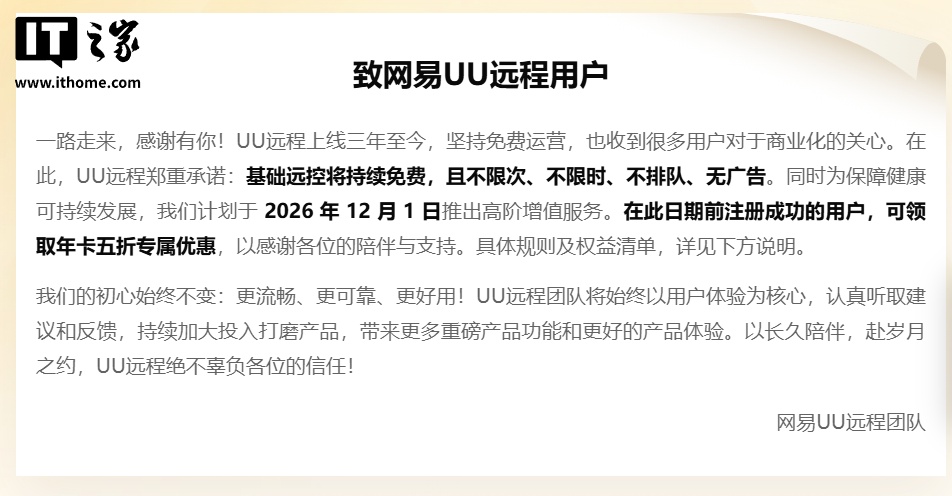 Figure: NetEase UU Remote announces premium tiers starting December 1, 2026, while committing to keep core remote desktop features permanently free. Source: NetEase UU Remote official announcement.
The Backlash of Coercive Monetization: Throttled Durations and Forced Queues
Remote desktop tools have suffered a steady erosion of user trust in recent years. Early-stage market entrants typically subsidized massive install bases under the banner of free access. However, as venture capital cooled and recurring server hosting bills mounted, vendors repeatedly walked back their promises. What was once dependable utility software gradually deteriorated into a paywalled obstacle course filled with nag screens.
Industry incumbents illustrate this trajectory clearly. After securing a commanding market share, ToDesk progressively chipped away at its free entitlements. Free usage was capped at 80 hours per month, with monthly connection counts restricted to 200 sessions. Users exceeding those thresholds encountered sudden disconnections, while peak-hour traffic triggered mandatory queues. Multi-monitor support and high frame rates were subsequently carved out into discrete paid plugins, creating a labyrinth of microtransactions.
Sunlogin (Xiangrikui) took a similar monetization path that drew enduring user criticism. The free version had its streaming bitrate severely throttled, causing aggressive pixelation during fast motion. The client software became heavily cluttered with hardware ads and promo popups. Users seeking stable, fluid visuals were steered toward high-priced gaming or enterprise editions.
This operational philosophy treats free users as pure liabilities. In an aggressive bid to force subscription conversions, vendors systematically degrade the free baseline. Artificially engineered congestion and crippled picture quality coerce users into paying—a tactic that spikes short-term revenue while devastating brand equity.
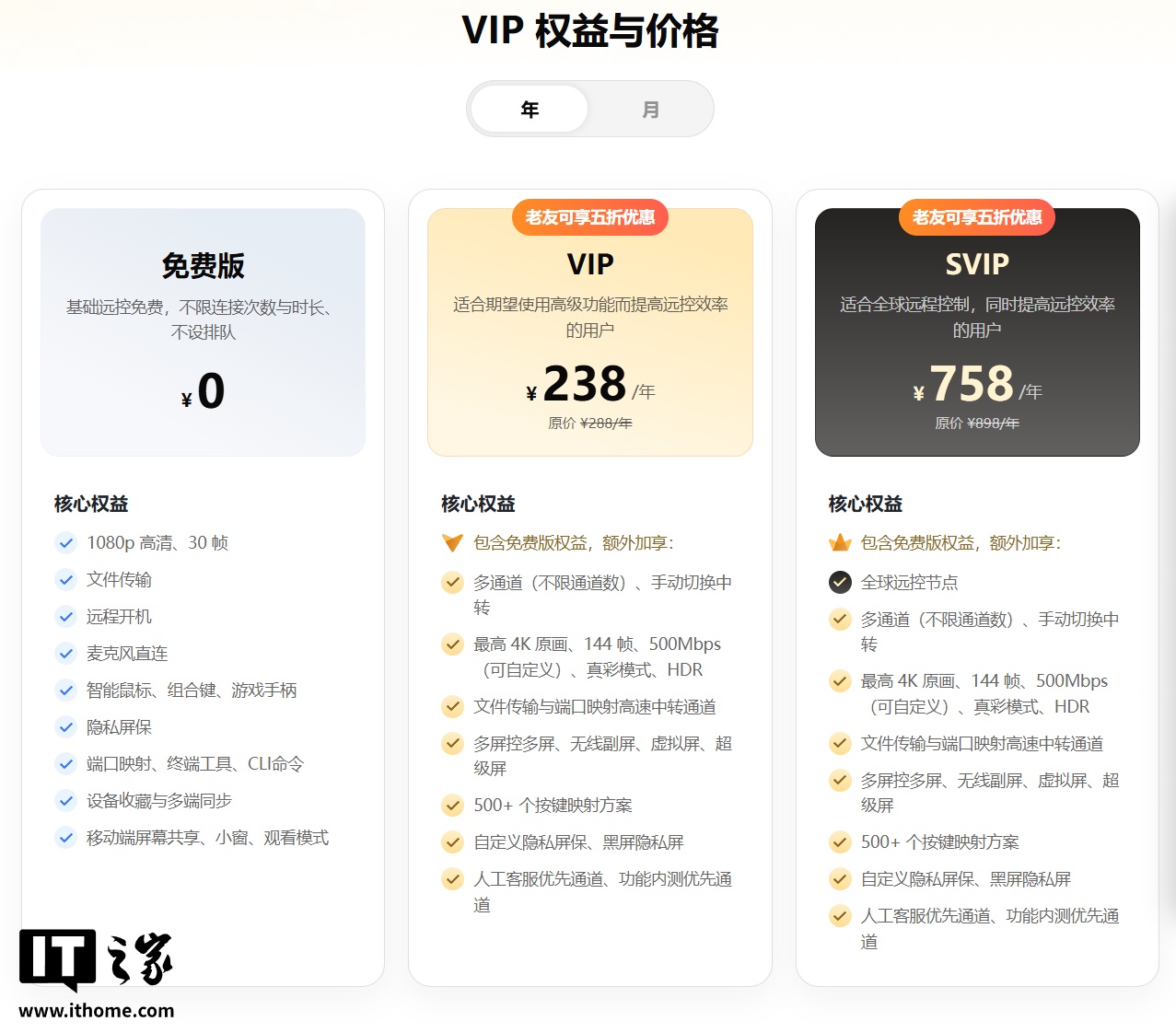 Figure: Feature breakdown across NetEase UU Remote subscription tiers, keeping the foundational suite free while reserving 4K streaming and multi-screen workflows for VIP. Source: NetEase UU Remote official announcement.
Infrastructure Multiplexing: How Big Tech Breaks the Independent Tool Premium
Independent vendors struggle to maintain generous free tiers largely because of relay networking costs. While remote desktop protocols prioritize direct P2P connections, complex symmetric NAT environments inevitably force a substantial portion of traffic through centralized relay servers. Real-time encoded video streams consume massive continuous bandwidth, generating punishing cloud infrastructure bills.
Independent software developers purchase relay bandwidth on public clouds month after month. Each active free user represents an ongoing operational cash drain. Without ancillary high-margin business lines to subsidize infrastructure, these teams must pass their entire bandwidth cost onto subscribers, locking their pricing models into an inflexible corner.
NetEase enters the remote desktop space with an entirely different cost structure. The NetEase UU ecosystem already operates a massive, globally distributed gaming accelerator backbone with extensive BGP dynamic routing reserves. For NetEase, daytime enterprise remote desktop traffic conveniently multiplexes onto spare network capacity that sits idle until evening gaming peak hours.
Multiplexing existing infrastructure drives marginal bandwidth costs down to near zero. Sunk investments in network hardware allow NetEase to operate without throttling free users to balance the ledger. What independent vendors treat as premium high-margin barriers—such as high framerates and pristine fidelity—loses its pricing power when challenged by an incumbent’s cross-subsidized infrastructure.
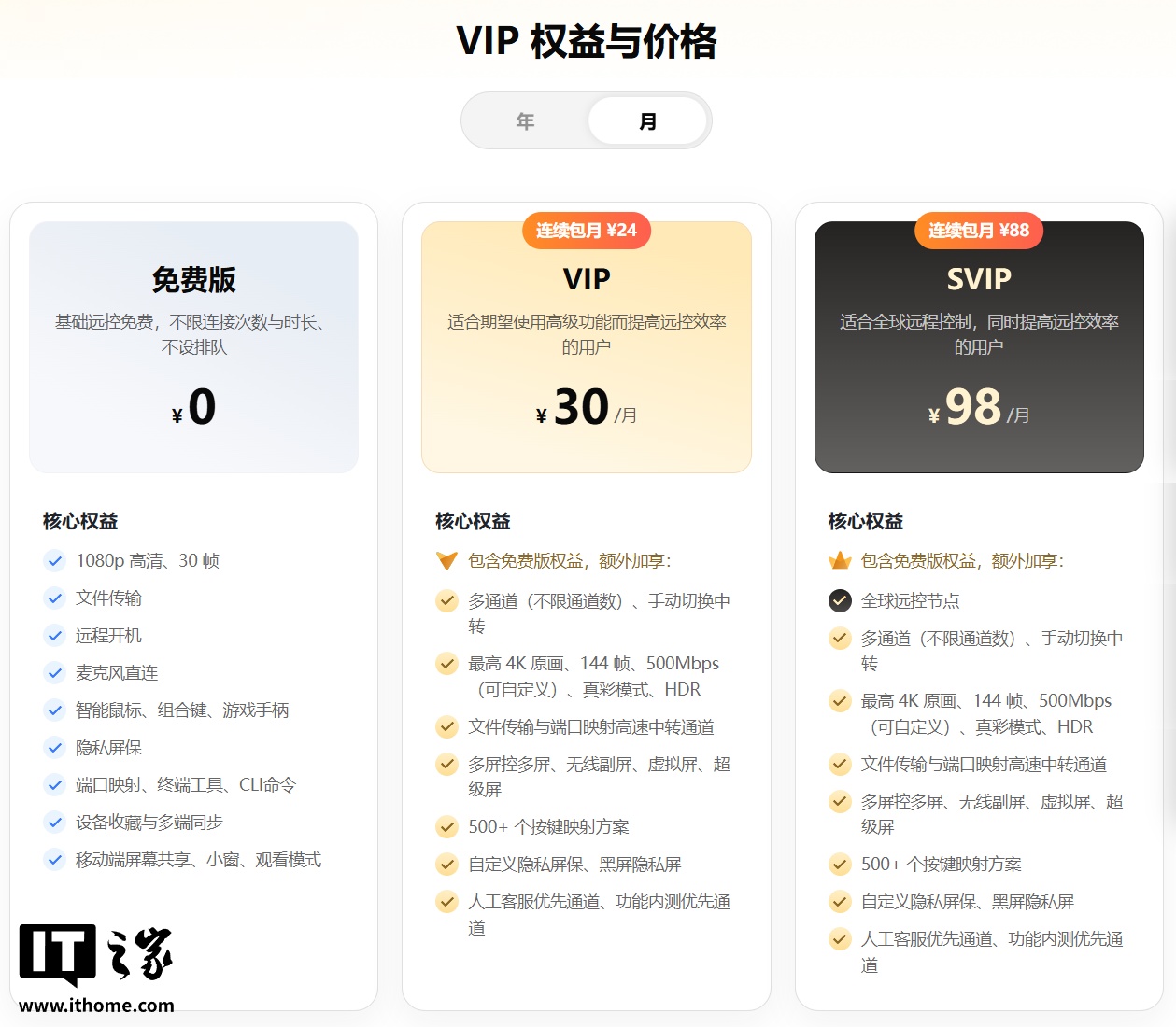 Figure: Pricing breakdown and functional matrix across NetEase UU Remote subscription tiers. Source: NetEase UU Remote official client.
Targeted Feature Segmentation: Free Core Office Use vs. Heavy Gaming Subscriptions
Remote desktop users naturally divide into two distinct cohorts. The first group requires straightforward remote access for lightweight office work, sysadmin troubleshooting, or family tech support. The second comprises hardcore gamers streaming AAA titles from remote rigs, alongside video editors and digital artists. Their latency and visual fidelity requirements differ dramatically.
Lightweight office work and terminal debugging do not demand high frame rates. A 1080p stream at 30fps provides ample clarity for fluid document editing, coding, and command-line diagnostics. By bundling 1080p 30fps streaming, secure file transfers, and CLI terminal sessions into the free tier, NetEase comfortably satisfies standard productivity needs.
The premium tier is meticulously engineered for high-performance workloads. Ultra-low latency 4K 144Hz streaming at 500Mbps ensures crisp responsiveness for fast-paced action titles. The 4:4:4 true color mode eliminates chroma subsampling artifacts around fine text, fulfilling the rigorous color grading demands of designers. Gamepad emulation and low-latency haptic feedback transform smartphones into portable handheld consoles. These advanced capabilities target core enthusiasts who exhibit high willingness to pay.
Tier segmentation is defined by functional depth rather than artificial degradation. Monetization no longer requires hostage-taking of basic utility. Users demanding razor-sharp response times and professional color accuracy get what they pay for, while routine office users avoid aggressive feature stripping.
The Long-Term Test of Freemium: Avoiding Gradual Feature Creep
Despite NetEase’s refreshingly candid strategy, the tech community remains cautious regarding its long-term viability. Software industry history is filled with freemium bait-and-switch patterns: generous free tiers attract rapid adoption, only for ballooning bandwidth costs to prompt quiet cutbacks once user growth plateaus.
A wave of users frustrated by competitor throttling is currently migrating to NetEase, pushing relay server peak loads higher. Maintaining queue-free access and low latencies during peak public internet congestion will rigorously test NetEase’s edge scheduling architecture. Any noticeable decline in connection quality will quickly bring past promises under scrutiny.
Meanwhile, open-source and self-hosted alternatives continue to siphon power users away from proprietary tools. Mature projects like RustDesk empower technical users to deploy lightweight private relay servers on affordable VPS instances, trading minor setup complexity for total end-to-end sovereignty. While self-hosting requires technical fluency, it sets a permanent price-to-performance benchmark for commercial competitors.
NetEase has demonstrated a viable alternative path: rather than crippling foundational features to force upgrades, commercial software can monetize genuine technical depth. Whether this model permanently breaks the cycle of user hostility will depend on NetEase’s gaming ecosystem continuing to absorb the baseline network overhead.
Reference Links:
- NetEase UU Remote Official Announcement: “A Letter to NetEase UU Remote Users”
- NetEase UU Remote Client Edition Comparison and Pricing Plan