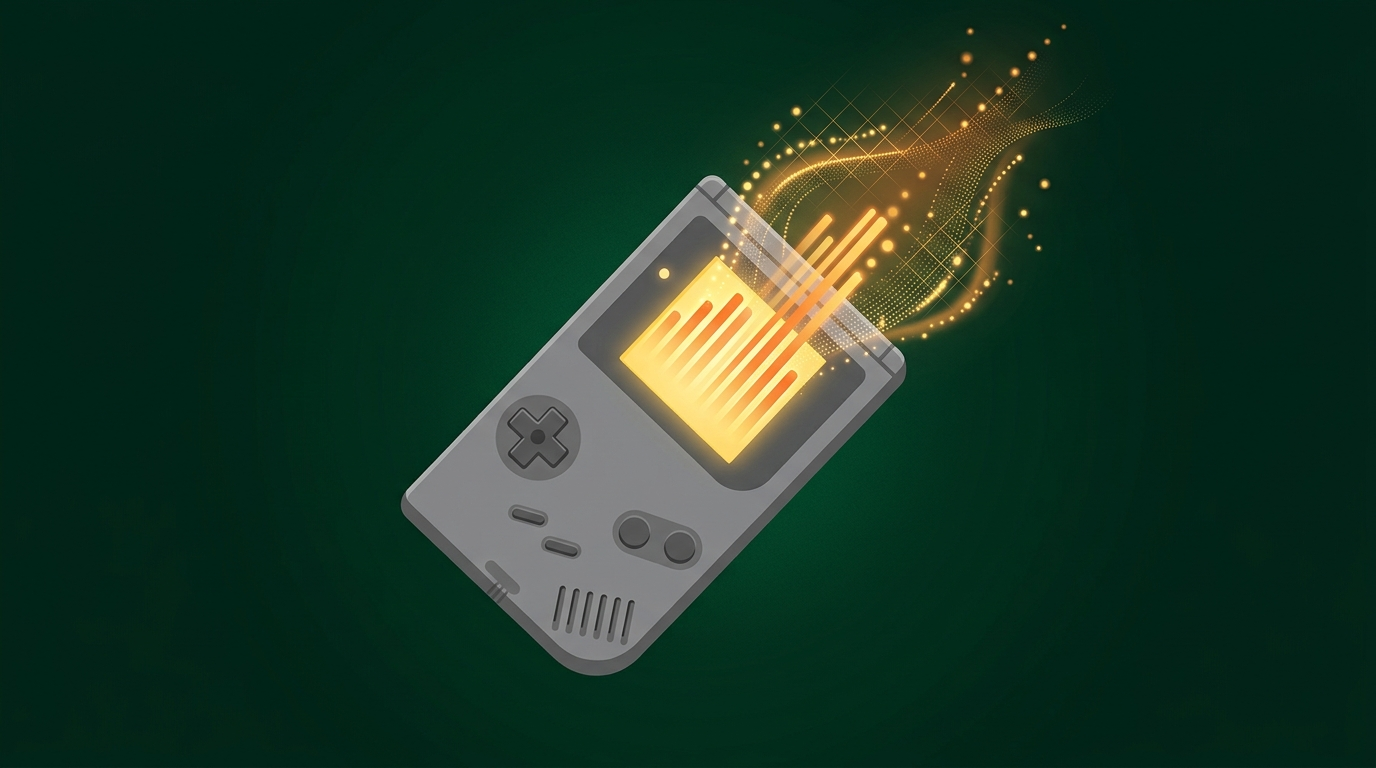
On October 1, 2026, developer audiowanderer officially released Drum Machina Go! (DMGo!), a dedicated music production tool engineered specifically for the original Nintendo Game Boy (DMG-01). Packing a four-channel, 16-step sequencer alongside full ADSR shaping and dedicated filtering options, DMGo! proves that Nintendo’s 1989 monochrome handheld can still satisfy the demands of modern chiptune artists and hardware hackers 37 years after its debut.
Pushing the 4-Channel Audio Engine to Its Limits
The original Game Boy houses a 4-bit audio engine comprising two pulse-width square wave channels, one custom 4-bit wave channel, and a pseudo-random white noise channel. DMGo! equips each of these four distinct channels with its own independent 16-step sequencer, offering up to 16 save slots per track. Rather than settling for simplistic 8-bit blips and bleeps, each channel provides comprehensive mixing controls and pan adjustments.
On individual channels, DMGo! introduces four dedicated effect units: EKO (delay), STU (stutter slicing), and DST (distortion). This architecture immediately pushes producers toward complex rhythmic structures. Forcing four monophonic tracks to shoulder the intricate arrangements of contemporary electronic music squeezes every drop of processing power out of the DMG’s Z80-derived CPU.
 Figure: The DMGo! sequencer interface showing active tracks. Source: audiowanderer
Generative Modulation: Letting Randomness Drive Sound Evolution
Traditional Game Boy trackers such as Little Sound DJ (LSDJ) rely on rigid hexadecimal command tables, requiring producers to manually key in every single sound modulation step by step. DMGo! replaces this labor-intensive workflow with an algorithmic approach. The software embeds an automated modulation engine dubbed AUTO, handing parameter evolution over to real-time generative algorithms.
Under the AUTO engine, critical sound design parameters—including filter cutoff frequencies, ADSR envelope stages, and step trigger probabilities—can be driven in real time by low-frequency oscillators (LFOs) or randomized values. This design frees the handheld’s audio output from mechanical rigidity. Even a basic four-on-the-floor kick pattern can exhibit subtle, organic timbre shifts on every repeating measure.
To inject further unpredictability into live sessions, the developer incorporated a one-click randomizer directly on the channel page. Triggering this command instantly generates an entirely new 16-step sequence alongside a custom sound profile. This sudden injection of randomness shatters repetitive compositional habits, providing performers with raw, unpolished sonic motifs on the fly.
By shifting from micromanaged programming to parameter-guided evolution, DMGo! adopts the generative philosophy of modular synthesis. A producer’s role pivots from plotting individual notes to sculpting the boundaries within which parameters drift. The inherent computing bottlenecks of vintage silicon are neatly folded away by these self-evolving algorithmic routines.
Crucially, this automated drift never degrades the underlying composition. While parameters fluctuate continuously under the AUTO engine, the musical notes cached in memory remain untouched. Once a climactic live passage resolves, the performer can disable modulation with a single button press, instantly returning the track to its rock-solid, structured groove.
Live Performance: Remapping the D-Pad for Real-Time Destruction
The defining design highlight of DMGo! is its MANGLING FX mode, which leverages the physical ergonomics of Nintendo’s handheld. Entering this mode rebinds the Game Boy’s directional pad and face buttons for tactile live intervention: Up and Down shift step pitch in real time, Left and Right freeze and loop microscopic audio buffers, while A and B stretch or compress loop playback speeds.
Physical buttons offer immediate tactile feedback that touchscreens and computer mice cannot replicate. The software also includes a KAO (chaos) effect that unpredictably blends delay and distortion to shatter the playing pattern. By transforming the directional pad into an expressive controller for non-destructive live sound manipulation, DMGo! makes the handheld feel like a natural extension of the performer’s hands.
 Figure: Playback view in DMGo!, toggling between real-time oscilloscope waveforms and glitch art. Source: audiowanderer
Bridging Retro Hardware to Modern Studio Workflows
The Game Boy is no longer confined to being an isolated retro curiosity. DMGo! takes full advantage of the handheld’s proprietary serial Link Port, offering multi-Game Boy cascading synchronization as well as a dedicated PULSE OUT sync signal.
This pulse sync feature lets the vintage console connect directly to modern desktop synthesizers, such as Teenage Engineering’s Pocket Operators or KORG Volca units. Locking a 1989 handheld into the exact same analog clock grid as modern instruments dissolves the generational divide between vintage gaming hardware and contemporary electronic gear.
Step Tuning and Song Mode: Building Full-Fledged Arrangements
Were it limited to short 16-step loops, DMGo! might simply be dismissed as an entertaining chiptune novelty. What elevates it into a genuine production environment is its robust song organization and pattern management system. Beyond supplying 16 memory slots per channel, the tool exposes fine-grained per-step pitch tuning.
With per-step microtuning, producers can dial in pitch adjustments for each individual note in a sequence. This level of granularity hands melodic composition and syncopated bassline writing back to the artist. Classic chiptune flourishes, such as lightning-fast vintage arpeggios, can now be sculpted directly through precise step-level parameter edits.
For large-scale project management, the dedicated SAVE page functions as a master song arranger. Operators can assemble separate patterns into an ordered playlist, building complete arrangements with clear verse, chorus, and breakdown structures. Disparate rhythmic ideas are transformed into complete, polished electronic tracks within the console itself.
When switched into live performance mode, the Game Boy’s dot-matrix screen moves away from parameter grids. The display renders real-time oscilloscope waveforms across all four channels or switches to high-contrast monochrome glitch visuals. This visual feedback serves both as an operational monitor and as a striking aesthetic element during stage performances.
The distribution model behind the software mirrors its indie hacker roots. The developer offers DMGo! as a free download on their official portal, paired with an open manifesto rejecting military conflict and economic exploitation. Distanced from modern software subscriptions and paywalls, this retro music tool carries a distinctive countercultural spirit.
Drum Machina Go! is far more than a nostalgic exercise. In an era dominated by infinite DAW tracks and bloated plugin suites, physical tactility and the creative friction of four monophonic channels can inspire profound musical focus. When a musician deconstructs a rhythm in real time using a D-pad and locks clock sync with modern analog gear, this 37-year-old console reaffirms its enduring value as a serious creative instrument.
Reference Links:
- Drum Machina Go! As A New Music Tool For The Game Boy
- Drum Machina Go! or …