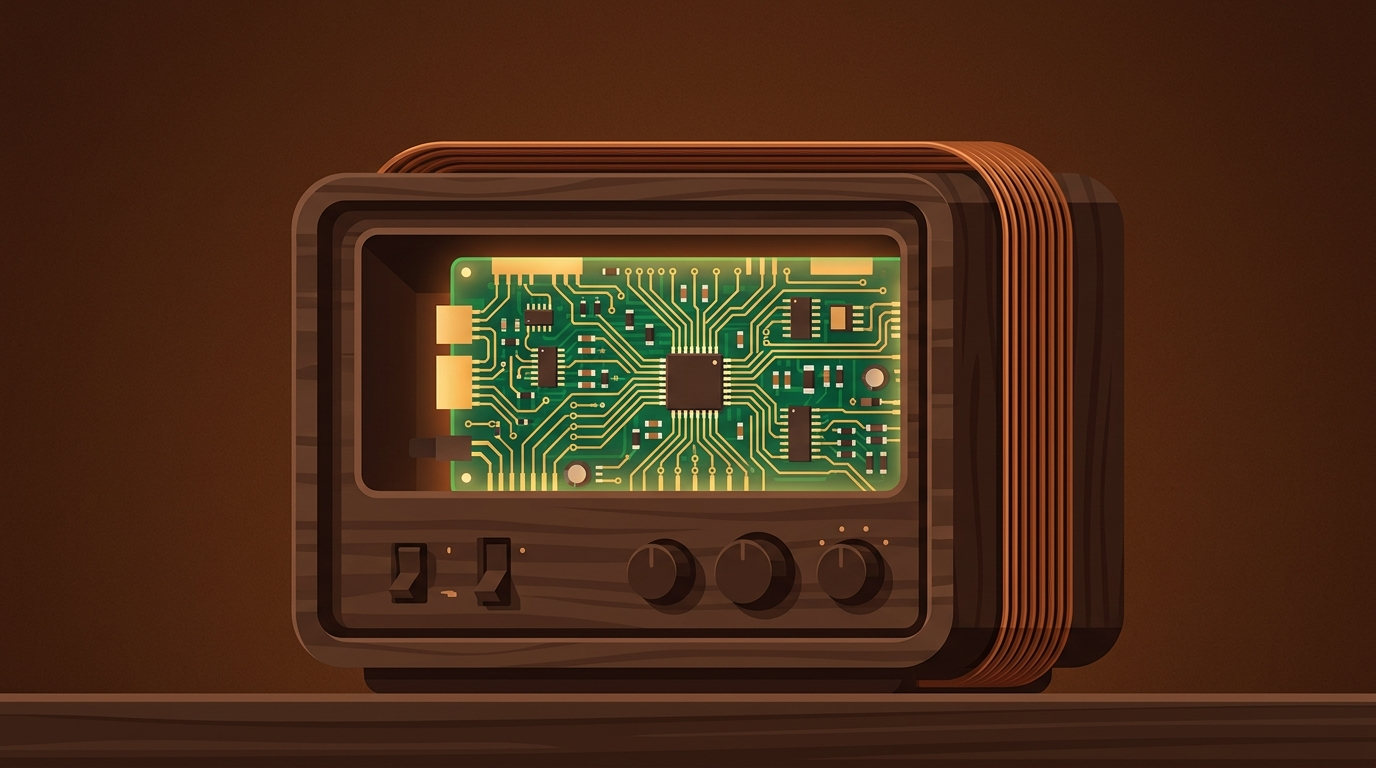
When the BBC announced the impending shutdown of its 198 kHz longwave transmissions, thousands of antique tube radios faced the prospect of becoming inert wooden ornaments. Deprived of analog transmissions drifting through the atmosphere, these century-old artifacts would fall permanently silent. London-based hardware hacker Gareth Davies refused to let them fade away, turning an inexpensive ESP32-S3 into a micro-power AM broadcasting station.
Full AM Broadcast Directly from a Single GPIO Pin
The transmitter’s hardware footprint is compressed to a degree that feels counterintuitive. An ESP32-S3 pulls an internet radio stream over Wi-Fi and synthesizes an amplitude-modulated (AM) longwave carrier at 200 kHz directly on a standard GPIO pin.
There is no external DAC, nor any dedicated analog RF modulator. Davies linearizes the duty-cycle modulation using an arcsine lookup table—an essential step, as direct duty-cycle mapping yields virtually no usable modulation. On the DSP side, the firmware packs a sixth-order low-pass filter, a fractional resampler paired with a buffer fill controller, and a peak limiter. Substituting analog RF circuitry entirely with software algorithms underscores how excess compute in modern microcontrollers can effortlessly emulate obsolete analog protocols.
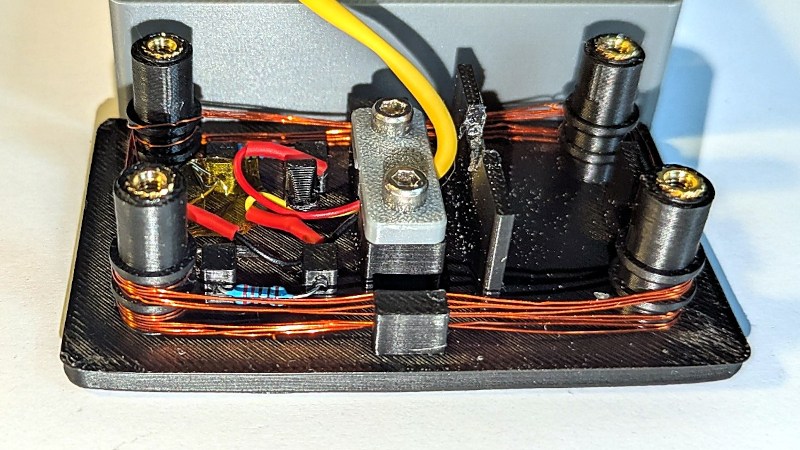 Figure: The minimalist transmitter board, consisting merely of an ESP32 dev board and a few wires. Source: Hackaday
A Five-Turn Coil Serves as the Physical Antenna
The RF output traces a spartan path: straight from the GPIO pin through a 220-ohm current-limiting resistor, and directly into the antenna. Even the antenna itself bypasses off-the-shelf electronic components.
Integrated into the design of the 3D-printed enclosure lid are four vertical plastic standoffs. The developer wound five turns of wire around these pillars before terminating the other end to ground, turning the physical chassis itself into an inductive coil. Embedding the antenna directly into the enclosure lid demonstrates how maker-tier system design dissolves the boundary between hardware and mechanical CAD, folding physical volume directly into the bill of materials.
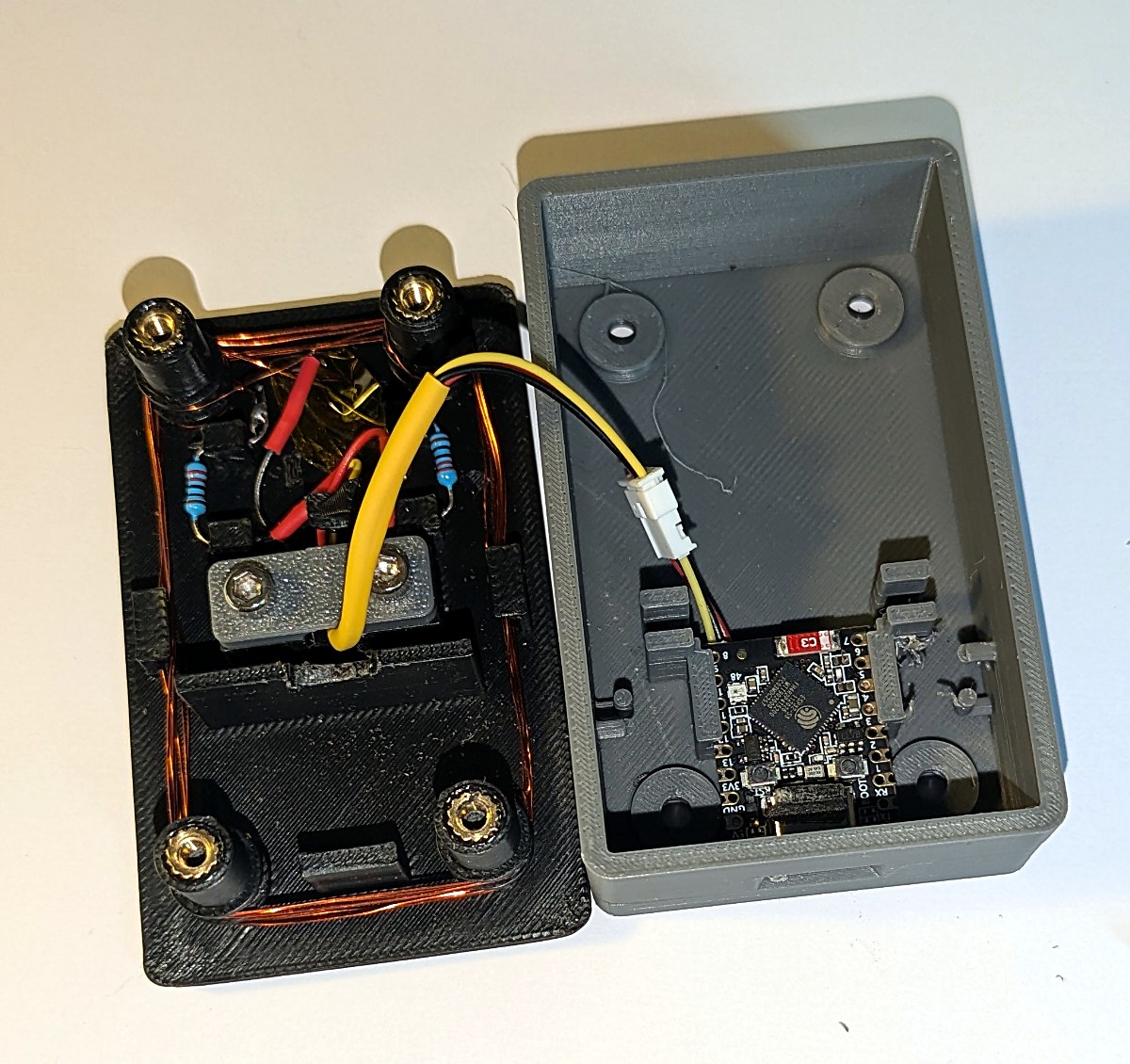 Figure: A five-turn wire loop wound around pillars on the enclosure lid forms the physical antenna. Source: GarethDaviesLondon (GitHub)
Trading Output Filtering for Architectural Minimalism
The 200 kHz carrier emitted by the GPIO is fundamentally a raw square wave. With no output filtering network in the signal path, it unavoidably radiates odd harmonics at 600 kHz, 1 MHz, and higher across the medium-wave spectrum. Furthermore, 200 kHz sits inside a licensed longwave broadcast allocation, where intentional unlicensed radiation is technically illegal. Yet operating power is minuscule; designed to sit directly adjacent to the radio, transmission relies on near-field inductive coupling rather than far-field electromagnetic propagation. Forsaking harmonic filtering in favor of minimal circuitry demonstrates how, in ultra-low-power near-field links, pragmatic engineering tolerances easily outweigh regulatory paper specs.
Two Independent Transmitters on a Single Chip
After fulfilling the primary goal of waking sleeping radios, the ESP32-S3 still commands ample processing headroom.
A single board actually hosts two completely independent transmitters. While sharing the Wi-Fi connection and station list, they broadcast distinct internet radio stations simultaneously on separate carrier frequencies. The microcontroller even hosts a full-fledged web server, letting users browse an online station directory and fine-tune modulation depth, audio low-pass filtering, gain, and loudness AGC from a mobile browser. Fitting a dual-frequency broadcast station with web UI and automatic gain control into a cheap IoT chip illustrates how the open-source hardware ecosystem has shrunk what once required an entire transmitter hall into a fingernail-sized package.
Embedding an ESP32 into a vintage setup gives classic analog radios a second life in the streaming age, bridging the gap left by retiring broadcast infrastructure with commodity silicon. The historic airwaves may go quiet, but within the localized magnetic field of a five-turn coil, century-old vacuum tubes still glow with that familiar warm amber light.
Reference Links:
- Keep That Old Radio Alive With An ESP32
- ESP32-S3 AM Transmitter (GitHub)