At 10:00 AM on October 20, 2026, Xiaomi officially launched the Mijia Pocket Photo Printer Pro Gift Box at a suggested retail price of 799 yuan. Looking back to the debut of the standard Pro version in June 2025, its official launch price was 599 yuan. The core printing module, resolution, and battery capacity remain identical. Simply by bundling an exclusive light-purple chassis, a magnetic storage photo frame, and a compartmentalized carrying pouch, Xiaomi raised the price tag by 200 yuan—a 33.4% markup.
In smartphones and tablets, price hikes are typically justified by generational silicon upgrades. By contrast, bumping the price of a portable peripheral by a third midway through its lifecycle seems counterintuitive. Examining the internal hardware and supplies pricing of this 308-gram device reveals the underlying playbook: Xiaomi’s 799-yuan bundle shifts the portable imaging battlefield from pure specs to emotional gifting premiums and high-retention consumables. Professional dye-sublimation with automatic lamination closes the archival quality gap with commercial photo labs, while gift-ready packaging taps youth social rituals to sustain long-term paper refills.
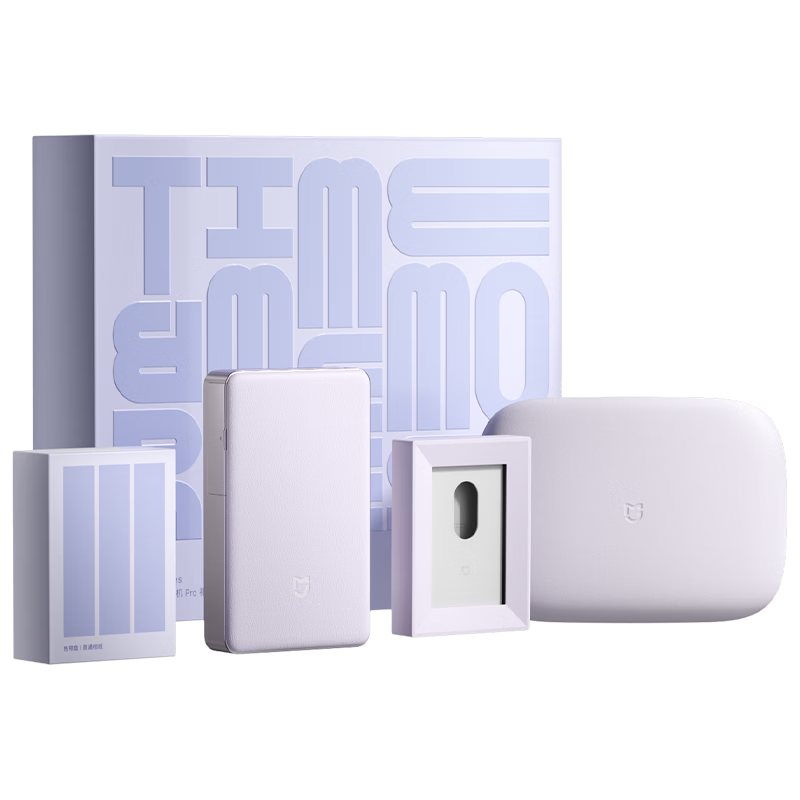 Figure: The gift set includes the exclusive light-purple printer, a magnetic storage frame, a compartmentalized pouch, and a proprietary cartridge kit labeled “Ribbon Cassette | Standard Photo Paper” in the lower left corner. Source: Xiaomi Mall Official Product Page
Dye-Sublimation Replaces ZINK: 1.98 Yuan Per Sheet Locks In Proprietary Paper Refills
In the pocket printer market, Xiaomi long relied on ZINK (Zero Ink) thermal technology. The previous-generation Mijia Pocket Photo Printer 1S retailed for 399 yuan and weighed just 180 grams. It relied on thermal printheads heating embedded microcrystals of yellow, magenta, and cyan dye inside the paper. While ZINK eliminates ribbon cartridges, it suffers from clear physical constraints: a single heating pass struggles to regulate the color saturation of all three crystal layers accurately, resulting in noticeable color casts. Moreover, unprotected thermal emulsions degrade and turn yellow within six to twelve months of exposure to air and UV light.
Developed by Xiaomi ecosystem partner HanTo Technology, the Pro edition transitions to dye-sublimation. Its thermal printhead modulates 256 temperature levels to vaporize solid dyes from a ribbon cassette directly into the receiver layer of the paper. This achieves true continuous tones across 16.7 million colors at a 313×313 DPI resolution. By transcending thermal paper limitations, pocket printers match commercial lab prints in continuous color gradations for the first time.
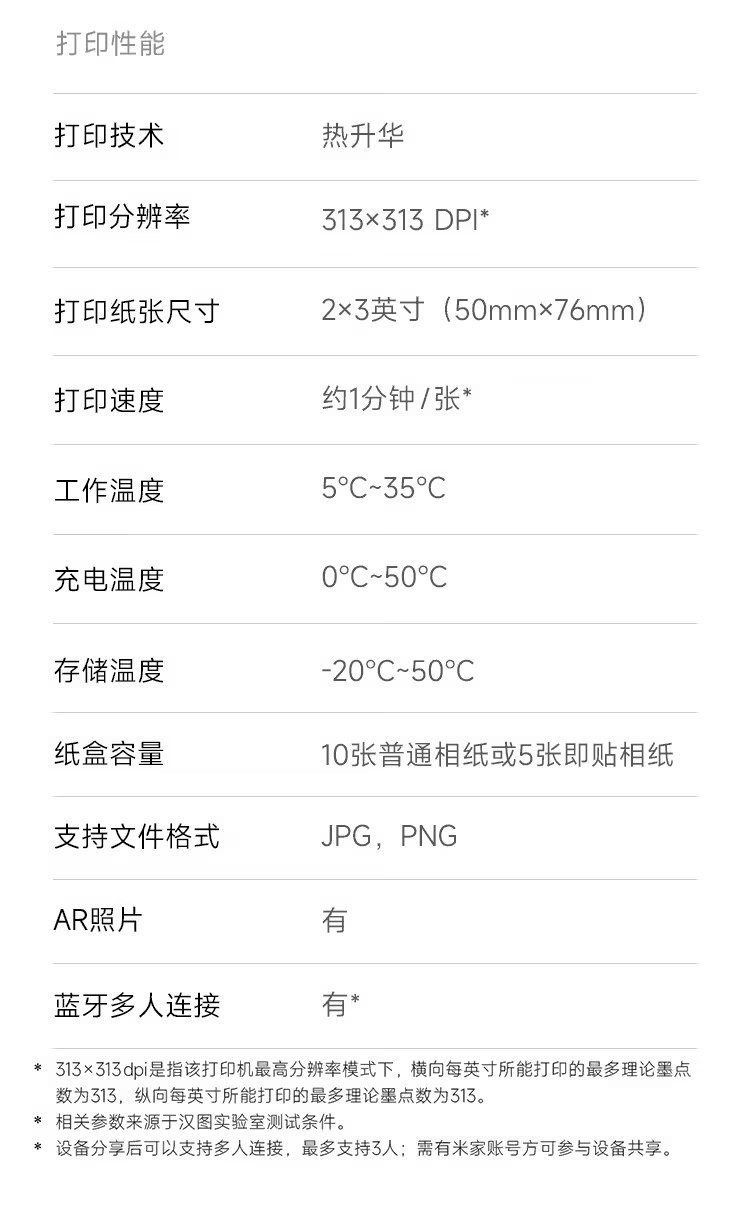 Figure: Fine print notes that the 313×313 DPI ink-dot metric comes from HanTo laboratory tests, and the internal tray enforces distinct capacities for standard photo paper (10 sheets) versus sticky-backed paper (5 sheets). Source: Xiaomi Official Specification Sheet
Switching imaging architectures fundamentally alters the business model for supplies. ZINK printers only require paper sheets, allowing third-party consumables to erode aftermarket profit margins. Dye-sublimation, however, strictly synchronizes paper sheets with ribbon consumption. According to official specifications, the 50-sheet “Dye-Sub Set” includes five 10-sheet packs of 3-inch paper (50 mm × 76 mm) paired with five individual ribbon cassettes. Each ribbon cassette covers exactly 10 prints, preventing cross-brand substitution.
On pricing, Xiaomi set the 50-sheet standard dye-sub pack at 99 yuan (a 20-sheet trial pack sells for 39.6 yuan), working out to 1.98 yuan per print. An adhesive-backed 50-sheet pack includes ten 5-sheet pouches with five ribbon cassettes for 149 yuan, or 2.98 yuan per sheet. Fujifilm’s Instax Mini silver-halide film consistently hovers between 4.2 and 5 yuan per exposure. At 1.98 yuan, Xiaomi cuts the psychological hurdle of daily printing by more than half, while proprietary ribbon cassettes anchor long-term refills squarely within the Mijia ecosystem.
Four-Pass Feed for Automatic Lamination: A 308-Gram Chassis Trades Off Portability
Sharper prints and archival longevity come with tangible engineering compromises. Comparing spec sheets, the Pro version reaches a net weight of 308 grams—a 71.1% increase over the 180-gram 1S. In a jeans pocket, the added heft is unmistakable. This weight surge stems directly from the mechanical feed and peak power demands of dye-sublimation.
Every dye-sub print requires four passes through the paper feed. The ribbon sequentially vaporizes yellow (Y), magenta (M), and cyan (C) dyes onto the paper. The fourth pass applies a transparent protective overcoat. This thermal barrier seals the surface against moisture and fingerprint grease, solving the fading issues that plague untreated thermal prints. However, the four-pass sequence extends printing time to roughly one minute per image, while restricting operating temperatures to between 5°C and 35°C.
To drive high-draw printheads and stepper motors inside a handheld enclosure, the Pro abandons the typical 3.7V single-cell battery. It houses a 7.4V, 880 mAh (approx. 6.51 Wh) dual-cell series lithium pack. Higher operating voltage guarantees uniform thermal dissipation across the printhead during dye vaporization. Even as battery levels drop, finished prints avoid lower-half color banding or broken gradations.
Mechanical and media constraints also dictate paper capacity. Because internal volume must accommodate the ribbon cassette, the paper tray holds at most 10 sheets of standard paper. Switching to thicker adhesive-backed paper with release liners cuts maximum capacity in half to 5 sheets. This explains why the gift set includes a compartmentalized carrying pouch: with zero room for spare supplies inside the chassis, continuous shooting on the go requires carrying extra paper packs and ribbon cartridges.
A 200-Yuan Gift Markup for Emotional Value: Purple Chassis Targets Social Giving
With the standard edition validating the hardware experience at 599 yuan, why did Xiaomi unveil a 799-yuan gift set ahead of the Singles’ Day shopping season? The rationale lies in the actual buyer demographics of pocket printers. Few hardcore tech enthusiasts buy these devices solely for personal utility; the bulk of sales comes from couples, birthday gifts, and graduation keepsakes.
The standard edition’s utilitarian gray-and-white packaging highlights value on e-commerce pages but lacks ceremonial presence as a gift. The 799-yuan bundle bridges that gap with three key adjustments: an embossed “TIME & MEMORIES” lilac gift box, an exclusive light-purple chassis, and bundled accessories including the pouch and magnetic frame. By bundling exclusive colorways and functional accessories into a premium package, Xiaomi eliminates secondary gift-wrapping overhead, reframing utilitarian hardware as a turnkey social gift.
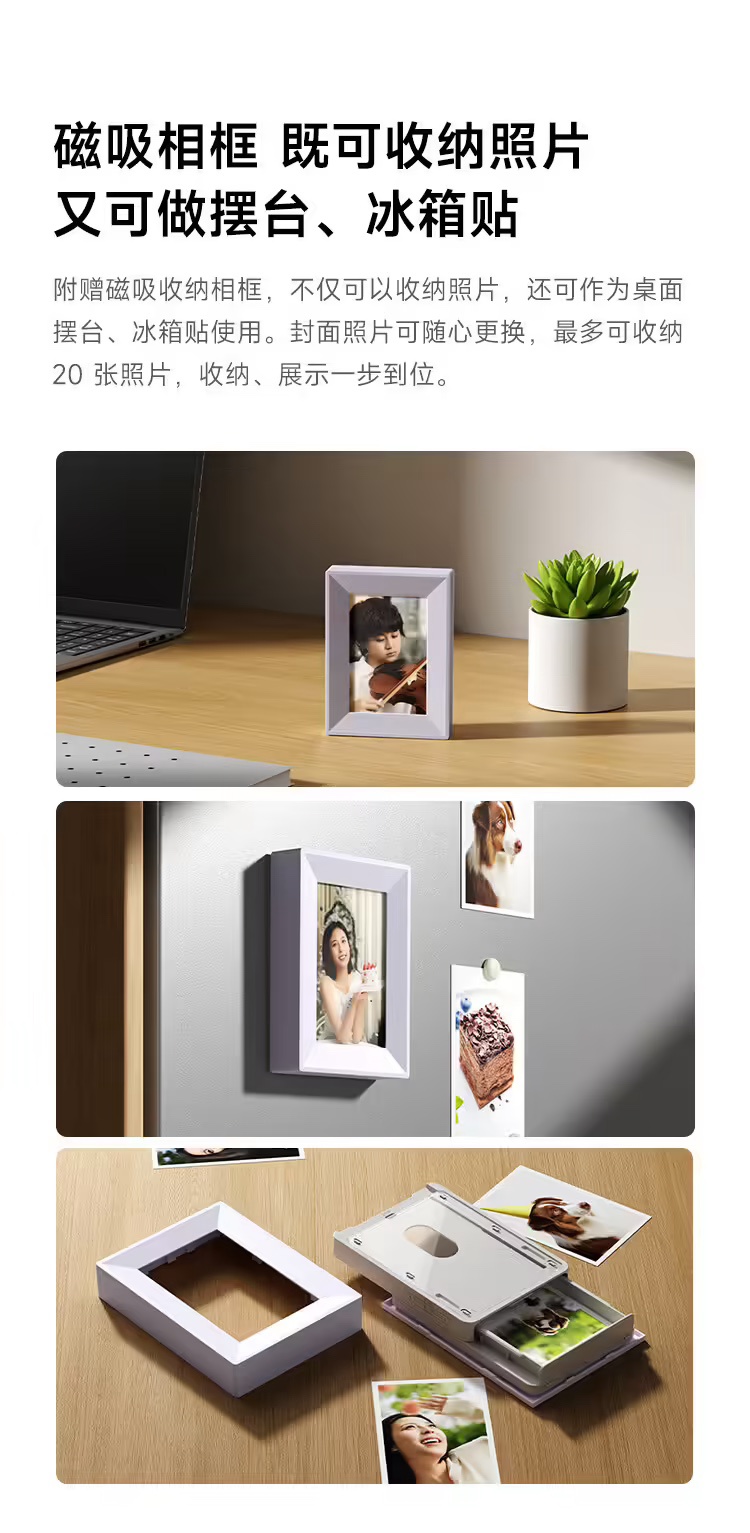 Figure: The magnetic frame doubles as a desktop stand and refrigerator magnet, with an internal slot storing up to 20 photos. Source: Xiaomi Mall Official Product Page
The bundled magnetic frame is engineered to accelerate consumable turnover. Many early adopters let pocket printers gather dust after their first pack of paper simply because loose 3-inch prints have nowhere to go. This magnetic frame functions as both a desk stand and a fridge magnet, featuring a rear drawer that holds up to 20 prints for quick rotation. Turning smartphone photos into tactile displays encourages sustained printing behavior.
For budget-conscious buyers shopping for themselves, paying 200 yuan for a plastic magnetic frame and a fabric case is steep—that difference covers 100 sheets of original paper. But in gift buying, price sensitivity softens considerably. The exclusive purple hue provides visual distinction, separating a generic gadget from a thoughtful gift.
Bluetooth 5.2 and 15-Second AR Video: Cloud Quotas Build Ecosystem Lock-In
Beyond hardware and consumables, the Mijia Pocket Photo Printer Pro secures software-level user retention. Foregoing power-hungry Wi-Fi, it pairs directly with phones or tablets over Bluetooth 5.2, enabling instant printing outdoors without local network configuration. Through Mijia App device sharing, up to three accounts can connect simultaneously, allowing friends to print photos in turns during social gatherings.
A deeper hook lies in the app’s integrated “AR Video Photo” and “Sound Photo” features. Before printing, users can attach up to a 15-second video clip or 60-second audio track. Once the physical photo prints, scanning it with the Mijia App overlays and plays dynamic video and sound directly on the screen. Editing on mobile before printing eliminates wasteful instant-film shots, while imbuing static paper with interactive digital media.
Fine print on official posters reveals that each account receives a default cloud quota of 100 AR photos. This storage ceiling highlights the long-term play of integrated hardware-software ecosystems. Every AR-linked physical print acts as an offline anchor to Xiaomi’s cloud servers. Once a user links dozens of family memories or travel clips, playback depends on their Mijia account. Even if they later consider hardware from Canon or Fujifilm, existing AR assets cannot be exported or migrated.
From the 399-yuan ZINK original to the 599-yuan Pro standard and the 799-yuan purple gift set, Xiaomi’s trajectory is clear. As pocketable hardware reaches thermodynamic and mechanical limits, manufacturers first secure practical value with automatic lamination and sub-2-yuan prints. Layering on exclusive gift bundles captures emotional margins, while proprietary ribbons and cloud-tethered AR memories guarantee recurring revenue—charting a viable escape route from low-margin commodity hardware.
References:
- Xiaomi Mall: Mijia Pocket Photo Printer Pro Gift Box Official Listing & HanTo Laboratory Specifications
- IT Home: Xiaomi Mijia Pocket Photo Printer Pro Gift Box Release Coverage
- Fengchao Tech: Mijia Pocket Photo Printer Pro Dye-Sublimation Technology and Consumables Pricing Analysis