On October 20, 2026, Baseus Security rolled out the PrimeSentinel U2 Pro outdoor 3K dual-camera in North America. Retailing at $269.99 on Amazon after launching in Europe on October 15 for €269.99, the unit carries a noticeable markup. In the competitive wireless dual-lens segment, Anker’s eufy SoloCam S340 sits at an MSRP of $199.99, while Baseus’s own S2 4K solar model retails for the same $199.99. Rather than packing a higher-resolution 4K sensor, the U2 Pro commands a $70 premium—a 35% jump.
The justification for that $70 price hike sits inside the lower motorized gimbal pod. Most consumer security cameras invest their bill of materials in larger apertures and low-light noise reduction algorithms. They excel at documenting a break-in with crisp clarity, yet do virtually nothing to stop property theft as it unfolds. With the U2 Pro, Baseus introduces a motorized spotlight that physically tracks moving targets, nudging consumer security away from passive post-incident evidence collection and toward active, real-time deterrence. While conventional fixed floodlights quickly lose moving intruders in the shadows, on-device AI linked to a high-intensity focused beam directly confronts trespassers and eliminates nighttime blind spots.
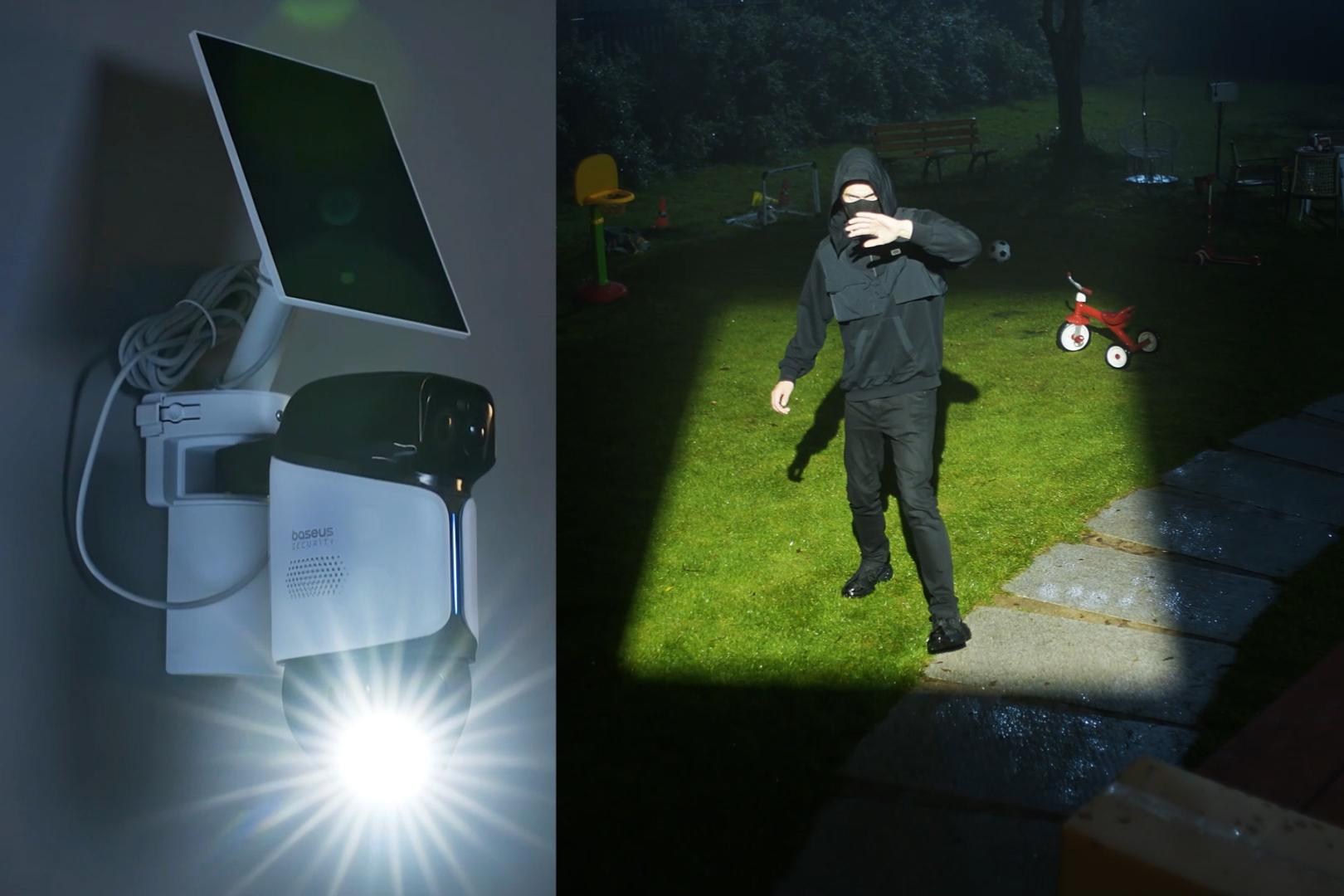 Left: The lower gimbal spotlight illuminated; Right: A rectangular high-intensity beam locks onto an intruder in dark clothing across a backyard, rendering full-color lawn details and forcing the trespasser to shield their eyes while leaving the foreground red tricycle in shadow. Source: Baseus official imagery (via The Verge)
Floodlights Leave Blind Escapes: SpotTrack Locks Moving Targets with a Concentrated Beam
Over the past five years, outdoor security cameras have relied on two primary methods for nighttime monitoring: infrared LEDs outputting monochrome footage, or white floodlights enabling full-color night vision. Both face clear operational shortcomings in home defense. Infrared light is invisible to the human eye; burglars proceed undetected, leaving homeowners to discover recorded break-ins after the fact. Traditional white floodlights do illuminate the scene, but their beam is fixed straight ahead. An intruder hugging a perimeter wall can sprint beyond the illuminated cone in seconds.
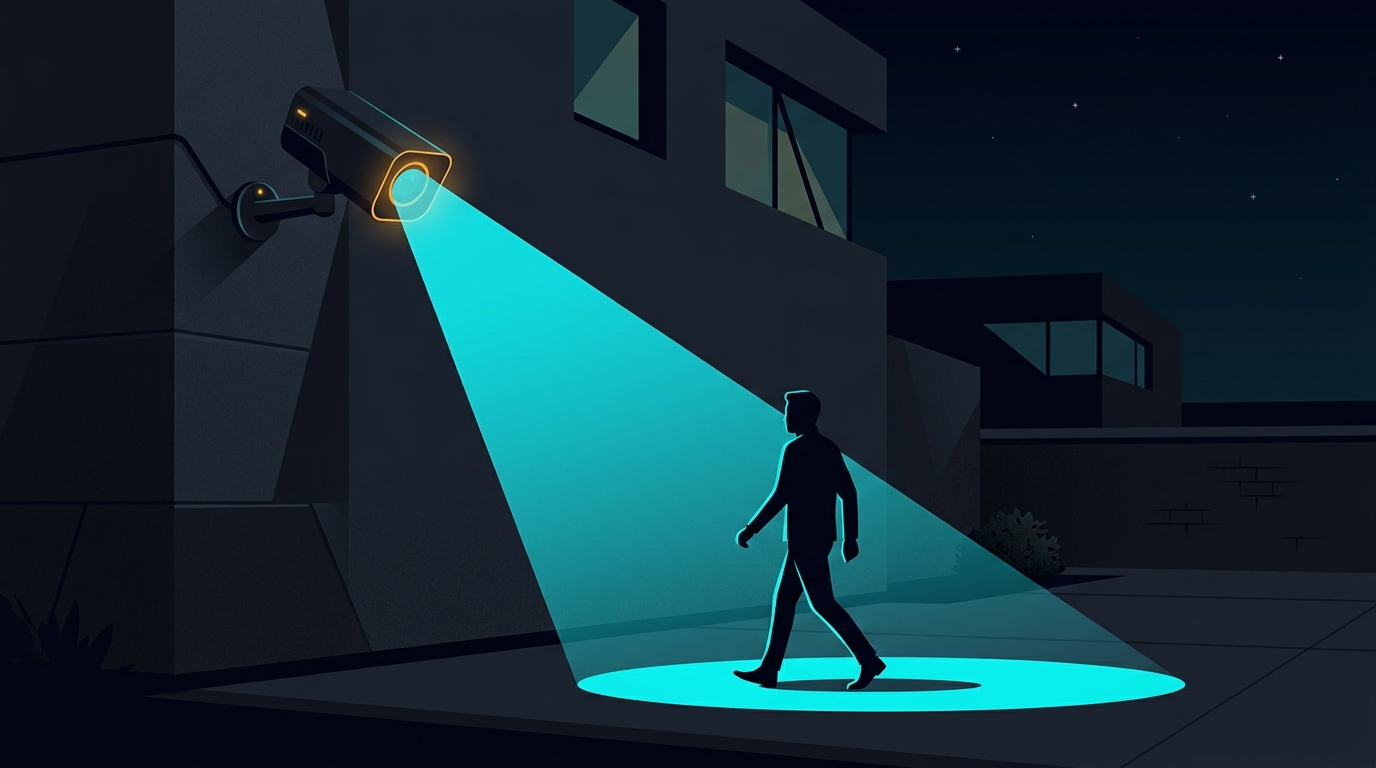
The PrimeSentinel U2 Pro tackles this by borrowing from stage lighting. Tucked beneath the lens in the motorized pod is a deep-cup rectangular spotlight branded the “SpotTrack Active Tracking Spotlight.” Unlike typical floodlights that scatter diffuse light across a wide yard, this reflector gathers the output into a concentrated, high-density rectangular beam. When suspicious motion or sprinting is detected across a lawn, the gimbal’s pan-tilt motors steer the spotlight in lockstep with the subject. The high-intensity pool of light stays pinned to the target. While fixed floodlights illuminate arbitrary perimeter zones, a dynamic tracking beam immediately signals that an intruder has been spotted—transforming the camera from a passive witness into an active psychological deterrent.
That targeted illumination also resolves the persistent problem of motion blur in low light. Fast-moving nighttime subjects often smear because sensors must drag out exposure times to brighten the scene. By concentrating lumens directly onto the moving target, the SpotTrack spotlight drastically increases local lux. Working alongside dual 3K sensors with full-color night vision, the camera can capture sharp frames at higher shutter speeds. Clothing textures, facial features, and vehicle paint tones remain faithful without infrared discoloration. Outside security alerts, the tracking light doubles as an automatic courtesy beam, following family members walking pets down the driveway at night.
Dual 3K Lenses and Dual PIR: Split-Chamber Design Eliminates Pan-Tilt Blind Spots
Keeping a tracking spotlight pinned to a subject requires a vision system that never loses target lock. Early single-lens pan-tilt cameras suffered from an inherent flaw: panning away compromised the main coverage area. If the camera rotated to follow someone near the western fence, the primary driveway or garage entrance was left exposed. If an accomplice slipped in from the blind side, a single motor mechanism could not turn back in time to catch the event.
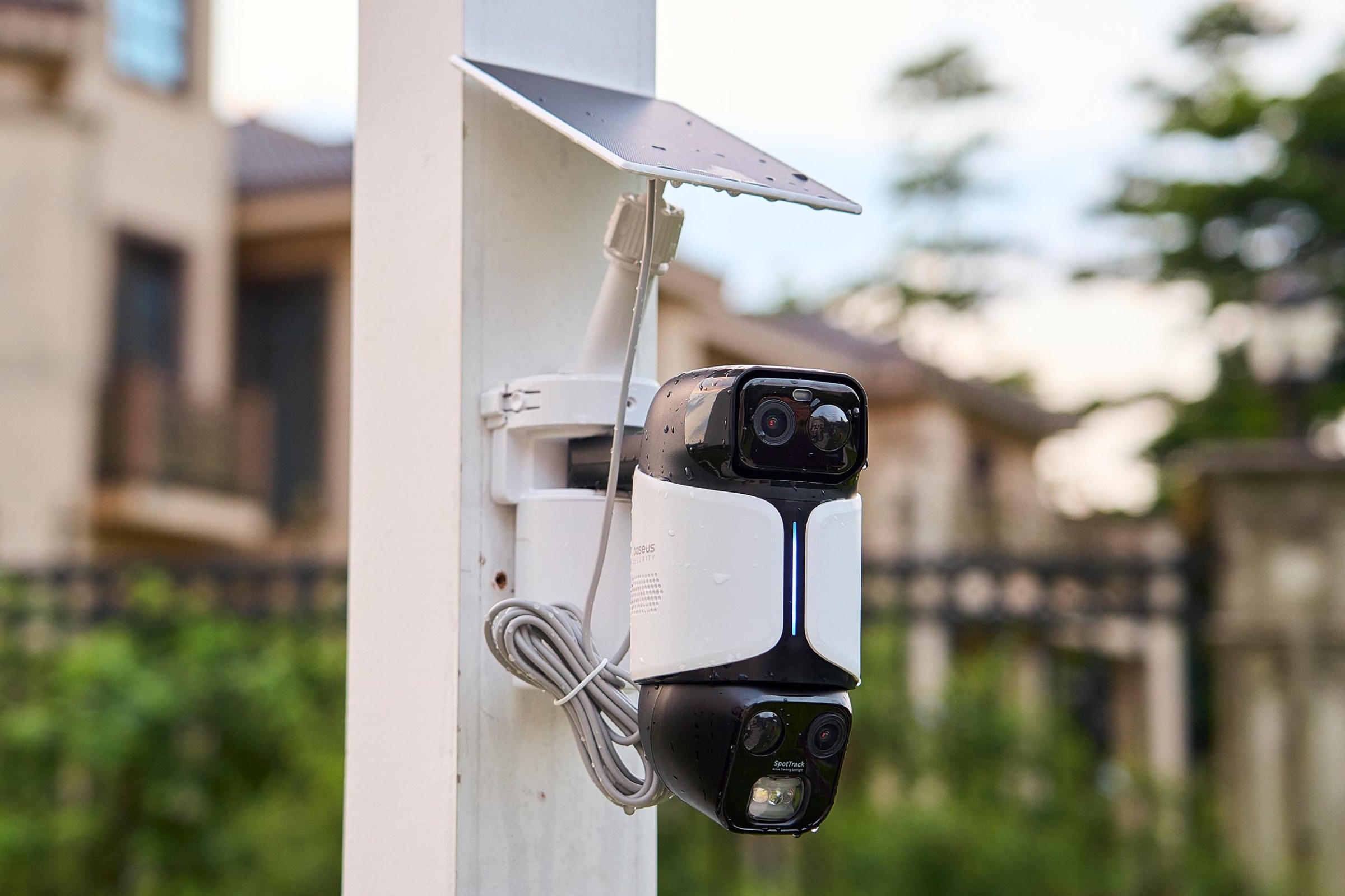 The three-tier chassis features an upper black dome housing the fixed 3K wide-angle lens and spherical PIR window, a white midsection with a speaker grille and vertical blue status LED, and a lower motorized pod integrating the secondary 3K lens, lower PIR window, and “SpotTrack” spotlight, alongside a coiled 3W solar panel extension cable. Source: Baseus official product photo (via The Verge)
Based on the architecture unveiled at IFA 2026 in Berlin, the U2 Pro solves this with a two-tiered “fixed plus PTZ” dual-lens configuration. The upper chamber houses a fixed 3K wide-angle lens dedicated to anchoring critical zones like the front porch and driveway. The lower spherical gimbal holds a second 3K PTZ (pan-tilt-zoom) lens capable of 360-degree horizontal panning, vertical tilt, and zoom. The two cameras coordinate in a relay handoff: the moment motion triggers on the periphery of the upper wide view, the lower PTZ unit pivots and locks on with the tracking spotlight. The upper fixed lens anchors the home’s baseline perimeter, while the lower gimbal mobilizes a 360-degree intercept—effectively eliminating the coverage gap where panning left a property defenseless.
To preserve battery life against constant video processing, the U2 Pro uses a pyroelectric wake-up system. Dual passive infrared (PIR) sensors are positioned alongside each lens chamber, creating an interlocking wide-angle thermal detection grid. The main imaging pipeline wakes up only when thermal signatures corresponding to human body heat enter the zone. Paired with on-device AI, the system classifies familiar faces, strangers, pets, vehicles, and doorstep packages while discarding windblown foliage or routine lighting shifts to prevent notification fatigue.
40 Minutes of Daily Sun for Continuous Power: Mechanical Tracking Tests the 150-Day Battery Budget
Squeezing dual 3K sensors, motorized stepper drives, and a high-draw spotlight into a completely wire-free unit creates major power engineering challenges. Many homeowners in North America balk at the cost of trenching high-voltage wiring or running Power over Ethernet (PoE) through exterior walls. To address this, the U2 Pro runs entirely on Wi-Fi, mounting on walls or eaves within minutes via a quick-release base. An internal rechargeable lithium battery delivers up to 150 days of runtime under standard operating conditions, supplemented by an included 3W solar panel.
Thanks to an extended mounting cable, the 3W photovoltaic panel can snap directly onto the housing or be routed to a sunlit roofline. Baseus claims 40 minutes of direct daily sunlight is sufficient to sustain around-the-clock operation. However, examining the U2 Pro within Baseus’s broader portfolio reveals clear hardware trade-offs. Earlier premium models like the S1 Pro kit ($429.99) and the standalone S2 ($199.99) incorporated motorized sun-tracking solar panels and carried IP67 ingress protection. To offset the manufacturing costs of the motorized spotlight and dual optics, the U2 Pro reverts to a fixed-angle solar panel and lowers weatherproofing to IP65.
This trade-off has drawn contrasting reactions across the smart home community. Proponents emphasize that conventional wired spotlight cameras often require professional installation, where electrician fees easily top $150 per drop. Combining PIR wake-up with a 3W solar panel lowers the barrier to entry, offering maintenance-free uptime in low-traffic backyards. Cautious reviewers, however, point out that active pan-tilt tracking and spotlight bursts consume far more instantaneous current than static recording. In high-traffic street-facing locations or through overcast winter spells, the “40 minutes of direct sunlight” threshold may prove difficult to maintain, jeopardizing the 150-day battery target. Going wire-free eliminates invasive electrical drilling, but it places the full operational burden of dual pan-tilt motors and high-lumen lighting onto a tight daily solar margin.
512GB Encrypted Local Storage Skips Monthly Fees as Cloud AI Summaries Redefine Revenue Streams
Beyond optics and power, the U2 Pro’s storage and service design illustrates ongoing shifts in consumer camera business models. For years, Western incumbents like Amazon Ring and Arlo have leaned heavily on mandatory cloud subscriptions, requiring $50 to $200 in annual recurring fees to unlock clip history on hardware that already costs hundreds upfront. Chinese hardware makers have countered by making local onboard storage a core competitive differentiator.
The U2 Pro adheres to this strategy by supporting local encrypted microSD cards up to 512GB. All motion-triggered 3K event clips are encrypted and saved locally. Users can review historical timelines remotely through the Baseus app with zero mandatory cloud fees, with live streams accessible on Amazon Alexa and Google Home smart displays (Apple HomeKit support is absent). For privacy-conscious consumers averse to endless subscription charges, a 512GB card provides months of rolling high-definition recording.
Yet Baseus’s official IFA 2026 briefings also signal a subtle shift in software monetization. While the earlier S1 Pro and S2 lines marketed “zero monthly fees” with all AI recognition processing locally, the U2 Pro introduces a tiered approach. Core video recording and basic object categorization (person, vehicle, pet) remain entirely free, but newly introduced “AI Event Summaries and Semantic Scene Descriptions” are partitioned behind a premium cloud subscription. By protecting baseline recording with 512GB local storage while paywalling generative event summaries, Baseus is exploring a hybrid revenue path for smart home hardware.
Consumer security cameras spent the past decade climbing from grain-heavy infrared monochrome to 4K color night vision, solving the question of how to document an incident clearly without addressing how to stop it. The Baseus PrimeSentinel U2 Pro couples a dual-lens 3K gimbal with a SpotTrack motorized spotlight to confront intruders directly. At $269.99, paired with an IP65 compromise and premium cloud summaries, it reveals the engineering and commercial balancing act behind wireless active deterrence. As smart cameras learn to swing their spotlights and pin down trespassers, the industry’s focus is pivoting from post-event video forensic proof to real-time psychological prevention.
Reference Links:
- The Verge: Baseus Security Launches PrimeSentinel U2 Pro Outdoor 3K Dual-Camera Tracking Spotlight
- Baseus IFA 2026 Berlin Official Press Announcement (EQS News / PR Newswire)
- Baseus Security Outdoor Camera Lineup Technical Specifications (S1 Pro / S2 / U2 Pro)