
On October 27, 2026, China’s National Radio and Television Administration (NRTA) issued Order No. 18, officially promulgating the Interim Provisions on the Administration of Interactive Personal Television (IPTV) Operational Services. Set to take effect on November 27, the regulation establishes mandatory safeguards for over 300 million IPTV households nationwide: systems must boot directly into full-screen live broadcasts, and boot advertisements are prohibited entirely.
The persistent clutter of living room screen advertisements has finally met legally binding constraints. The long-standing industry playbook—shipping subsidized hardware at cut-rate prices and recouping costs via boot ads—has reached its definitive end.
Zeroing Out 118-Second Startup Ads: Order No. 18 Codifies Rectification into Law
Order No. 18 was reviewed and approved during the NRTA executive meeting on October 23, 2026, and officially signed by Minister Cao Shumin on October 24. Article 11 imposes clear constraints: providers of integrated broadcast control services must adhere to the principle of “live broadcast priority.” Systems must ensure that devices enter full-screen live broadcasts upon powering on, provide accessible catch-up viewing channels, and refrain from displaying boot advertisements under any circumstances. Smart TV sets must also support prioritizing live channels with easily accessible setup menus.
Article 14 introduces further operational standards. Service operators must streamline remote control actions, enabling a one-click return to live broadcast inputs. Hardware manufacturers are also required to optimize terminal performance and substantially reduce overall startup latency.

Figure: NRTA Order No. 18 explicitly requires IPTV terminals to boot directly to full-screen live broadcasts and bans startup advertisements. Source: Policy and Regulation Department of the National Radio and Television Administration.
Behind this outright ban lies a rigorous three-year regulatory overhaul. Prior to the launch of targeted remediation campaigns in 2023, boot advertisements on certain smart TVs and set-top boxes dragged on for up to 118 seconds. Viewers powering on their devices were forced to endure nearly two full minutes of non-skippable promotional content.
The initial phase of rectification by late 2023 compressed boot times down to under 35 seconds. Order No. 18 now elevates these operational gains into formal administrative law. Launching directly into full-screen live broadcasts has advanced from an ad-hoc technical tune-up into a legally enforceable obligation.
Subsidized Hardware for Ad Revenue: The Distorted Monetization Loop Collapses
The stubborn resilience of boot advertisements stemmed directly from the distorted revenue architecture across the large-screen supply chain. Over the past decade, domestic smart TVs and broadband IPTV packages engaged in aggressive price wars. Retail prices for 4K smart TVs dropped into the 1,000-yuan ($140) bracket, while telecom operators distributed set-top boxes practically free of charge via bundled broadband subscriptions.
With slim-to-none hardware profit margins, manufacturers and broadcast control platforms treated the boot sequence as their prime monetization channel. A captive 10-to-20-second startup window guaranteed unskippable exposure. Annual advertising dividends from a single device were often enough to offset the initial hardware discount.
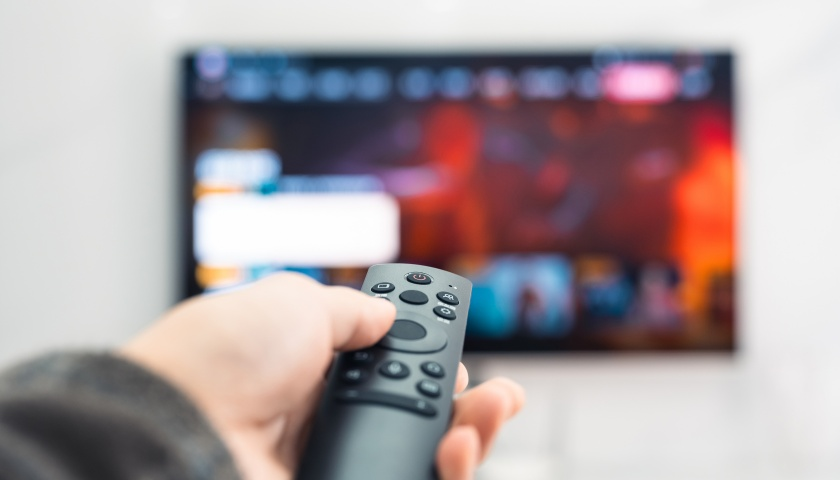
Figure: Smart TV terminal connecting straight to a full-screen live broadcast channel. A simplified boot process eliminates the need to navigate interstitial popups and layered menus. Source: Jiemian News (On-site photo).
The unchecked spread of the ad-driven model also catalyzed predatory subscription nesting. Individual terminals once proliferated with up to 86 separate paid tiers, splintered across film, drama, children’s content, and sports. Consumers powering on their TVs were greeted by a labyrinth of paywalls, severely eroding viewing willingness and active TV usage rates.
The first phase of the national overhaul aggressively streamlined these subscription packages, reducing them by 74.6% across hardware models and capping active pay tiers per device at six. With boot ads now outlawed by administrative fiat, the pipeline of using post-sale viewer traffic to subsidize hardware deficits is severed. Television manufacturers must inevitably pivot back to competing on display quality, acoustic performance, and genuine audiovisual service excellence.
Closing a Twenty-Year Regulatory Vacuum: Equal Standards for Cable and IPTV
As early as 2011, the broadcast authority enacted Order No. 67 for cable television services. Over the subsequent decade of telecommunications and broadcast network convergence, China’s IPTV user base surged past 300 million households. However, dedicated departmental regulations governing operational services remained absent for years.
The sector historically relied on piecemeal provisions, such as regulations governing dedicated audio-visual private networks, leaving a regulatory void regarding consumer operational service standards and viewing rights.

Figure: Horizontal clause comparison between Cable Television and IPTV Operational Service Regulations. Both frameworks align on live-broadcast-first rules and startup advertisement prohibitions. Source: Streaming Network (Policy Research Center).
On September 2, 2026, the NRTA solicited public feedback on two companion regulations. The promulgation of Order No. 18 signals the arrival of the first dedicated administrative regulation governing IPTV operational services.
Cable TV and IPTV are now held to uniform regulatory benchmarks. Seven internet TV integrated broadcast platforms overseeing 180 million terminals across China have been brought under this unified regulatory umbrella. Whether content is delivered over coaxial cables or private telecom IP networks, the mandates remain identical: boot directly to live broadcasts, provide designated free content zones, and maintain transparent, itemized billing. The new rulebook also establishes formal regulatory summons and warning mechanisms, increasing the maximum fine for non-compliance to 100,000 yuan.
Tri-Mode Remotes and Miniaturized Dongles: Re-engineering Large-Screen Usability
Eliminating operational friction goes far beyond simplifying software interfaces; it requires resolving deep-seated hardware fragmentation. For years, ordinary living rooms were plagued by a dual-remote setup—one for the TV display and another for the set-top box. Switching input sources was notoriously convoluted, frequently leaving older family members trapped in confusing black screens.
Hardware accessibility retrofits were rolled out concurrently. The national campaign guided over 200 million users to activate infrared learning functions on their remotes, achieving single-remote control for basic power and channel operations.
For the replacement market, engineering teams engineered unified tri-mode remotes integrating infrared, Bluetooth, and NearLink (StarFlash) protocols. Concurrently, device makers engineered 15 ultra-compact plug-in dongles, alongside built-in set-top tuner modules that have already entered real-world prototyping. Miniaturization eliminates the visual clutter of external converter boxes and dangling cables.
This multi-pronged usability campaign has ignited a measurable viewer rebound. National broadcast monitoring data shows that the average monthly active rate for live channels has climbed back to 62.2%, up 9.6 percentage points compared to levels before the campaign. Paid cable TV subscriptions also posted their first year-over-year net increase in eight years. By peeling away cumbersome layers, living room screens have reasserted their relevance through instant, friction-free live viewing.
Preserving the Public Service Mandate: Reclaiming the Living Room Screen
Article 3 of Order No. 18 explicitly stresses that operational services must balance ideological orientation, public service responsibilities, and technological industrial advancement. The regulation commands platforms to institute prominent free-to-view sections on their home screens, spotlight high-quality cultural programming, and provide preferential subscription rates to low-income households and elderly care facilities.
While commercial monetization and value-added offerings on connected screens are natural, the boot sequence and foundational broadcast channels function as public media infrastructure. Converting essential device startup time into mandatory commercial impressions fundamentally trampled on public consumer experience.
By barring boot advertisements through formal administrative statute, regulators have staked out an inviolable baseline for living room displays. Stripped of intrusive ad subsidies, hardware vendors and telecom carriers can no longer lean on viewer time theft to balance their balance sheets. Only by rebuilding product logic around accessibility and consumer respect can television manufacturers protect their rightful place against competing personal screens.
References:
- NRTA Order No. 18: Interim Provisions on the Administration of Interactive Personal Television (IPTV) Operational Services.
- National Radio and Television Administration: Progress Report on Television Fee Nesting and Operational Complexity Remediation.
- Streaming Network: Comparative Analysis of Cable TV and IPTV Operational Service Regulations.
- Jiemian News: NRTA Issues New Regulation Explicitly Banning Startup Advertisements.