514,800 yen—equivalent to roughly 3,400 USD. In the autumn of 2025, that budget was enough to build a top-tier enthusiast rig in Akihabara, complete with a flagship processor and an RTX 5090 graphics card. By late October 2026, the purchasing power of that same sum at retail counters had eroded dramatically: on store shelves, it now buys only a single kit of CORSAIR DDR5-6000 64GB×2 (128GB total) desktop memory.
According to on-site market tracking by Japanese tech outlet AKIBA PC Hotline!, this memory kit jumped nearly 200,000 yen in just six weeks. Compared to its 59,800 yen launch price twelve months earlier, the year-over-year surge stands at an astonishing 760.9%. Consumer high-capacity memory pricing has decoupled entirely from standard market volatility, fundamentally rewriting the cost calculus of the PC DIY ecosystem.
Retail Prices Breach 510,000 Yen: A Memory Kit That Rivals a Flagship Rig
Major PC hardware retailers across Akihabara updated their shelf price tags on October 24. The CORSAIR DDR5-6000 64GB×2 kit, previously plagued by continuous shortages, reappeared in stock at 514,800 yen. Compared to its last confirmed availability on September 12 at 316,980 yen, this single restocking arrived with a 197,820 yen price hike—a 62.4% leap. For the first time in brick-and-mortar retail history, the shelf price of a consumer RAM kit broke straight through the budget ceiling of a complete liquid-cooled workstation.
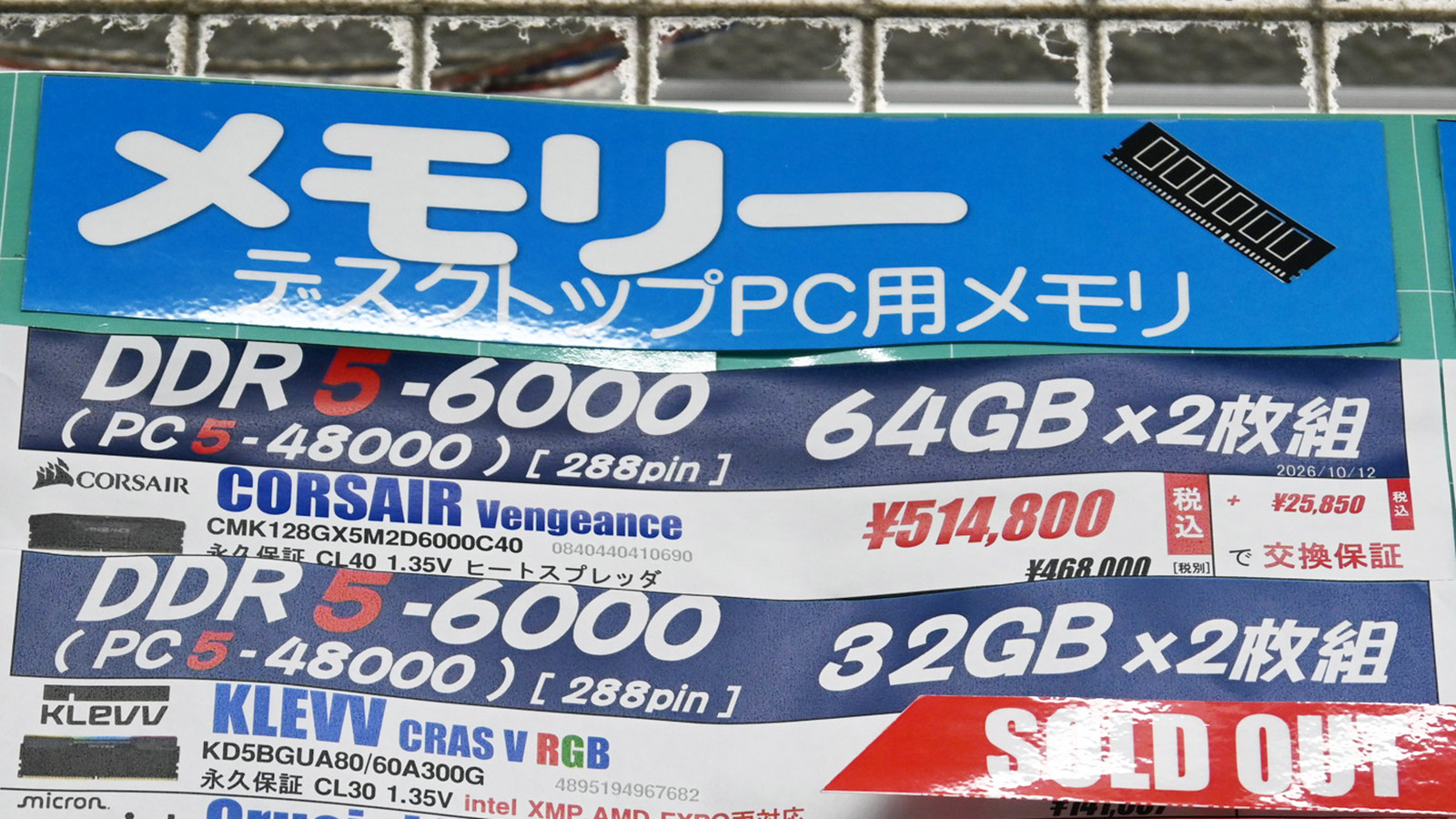 Fig: Retail price tag for a DDR5-6000 64GB×2 kit in Akihabara topping 510,000 yen. Source: AKIBA PC Hotline! on-site survey.
This meteoric rise is far from an isolated incident. Crucial’s equivalent DDR5-5600 64GB×2 kit saw its lowest counter price climb to 399,980 yen, with several storefronts posting tags above 440,000 yen. Compared to the kit’s historical low of 41,980 yen in April 2025, the increase reaches 852.8%. While PC builders once treated system memory as a relatively flexible component in their budget, RAM expenses now routinely eclipse the cost of flagship GPUs.
Laptop upgrade platforms have suffered a similar fate. High-density DDR5 SO-DIMM 5600 64GB×2 kits designed for mobile workstations jumped 72,400 yen in a single week, settling at a new retail high of 439,800 yen. High-density memory modules across every form factor are under immense upward pressure, severely constricting memory capacity upgrade paths across mobile and desktop platforms alike.
A 760% Annual Surge: Spot Stocks of High-Capacity Kits Nearly Evaporate
Behind unchecked price spikes lies a near-total exhaustion of spot retail inventory. Out of more than a dozen major retail chains surveyed in Akihabara, only three stores maintained stable inventory for 64GB×2 kits. Even mainstream gaming 32GB×2 configurations saw the number of stocking retail storefronts drop by half compared to early September.
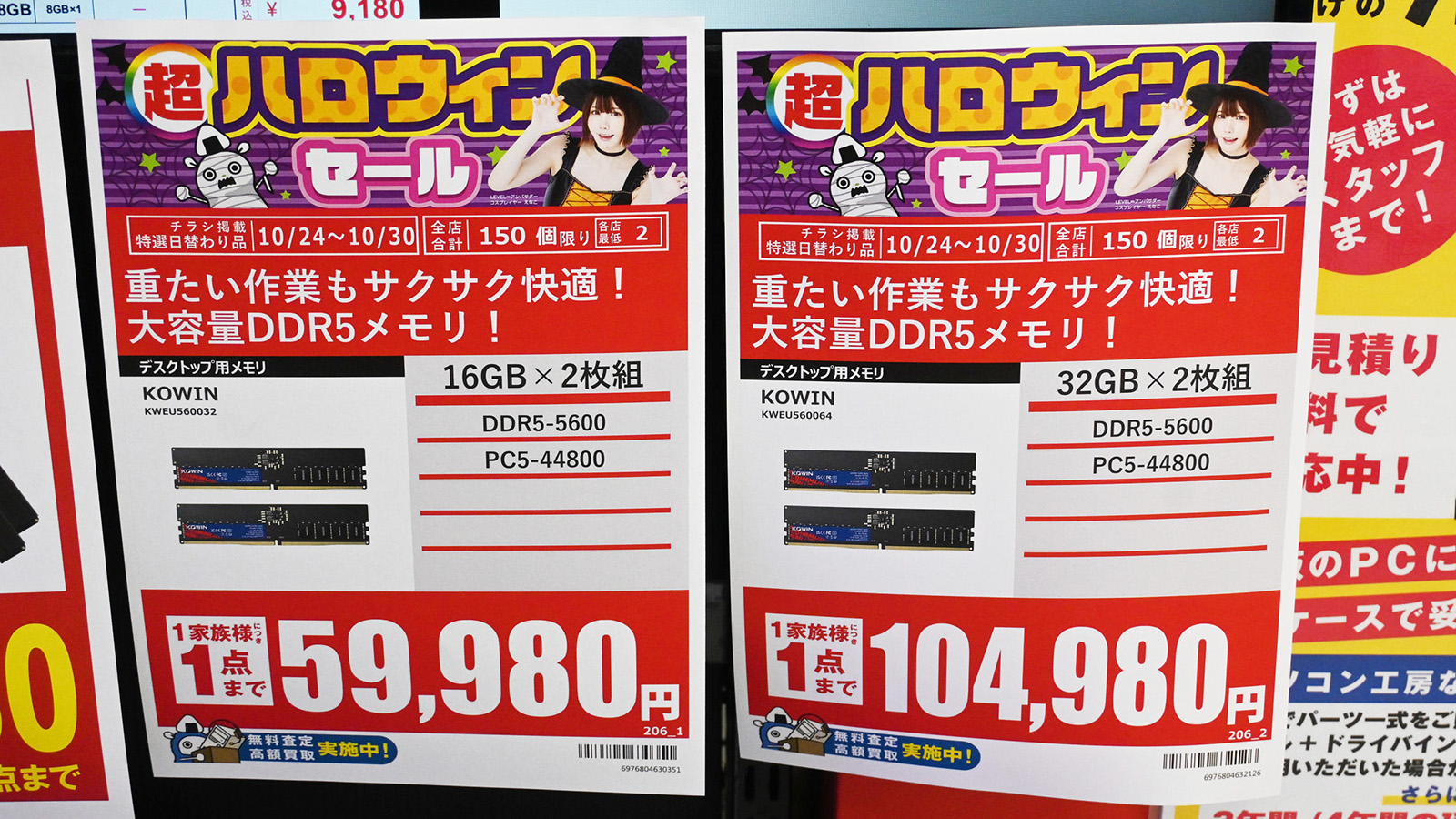 Fig: Mainstream 32GB×2 kit prices crossing the 100,000 yen threshold as stocking merchants dwindle. Source: AKIBA PC Hotline! on-site survey.
Baseline price tiers for mainstream capacities have moved up in lockstep. Entry-level DDR5-4800 32GB×2 kits rose 11,000 yen to reach 125,800 yen; DDR5-5600 32GB×2 climbed to 104,980 yen; and higher-binned DDR5-6400 32GB×2 kits bottomed out at 139,980 yen. Even standard 32GB base kits, outside of select non-overclocked offerings, crossed the 60,000 yen threshold.
Retail channels find themselves trapped in a deadlock of buyer panic and merchant reluctance to sell. Retail staff revealed that wholesale procurement costs for high-density DRAM dies rise every week. Unwilling to carry excessive balance sheet risk, shops have shifted toward strict order-based allocations. To hedge against further price jumps, DIY builders have scaled back capacity targets, retreating to conservative 16GB single-DIMM configurations.
Wafer Capacity Diverted: HBM Consumes 3x the Silicon as Consumer DRAM Takes the Hit
The root cause of consumer RAM market chaos lies upstream in wafer fab line reallocations. SK Hynix, Samsung Electronics, and Micron Technology collectively control more than 95% of global DRAM supply. Since the second half of 2025, the three memory giants have tilted advanced-node wafer capacity decisively toward High Bandwidth Memory (HBM). To produce an equivalent capacity of HBM, manufacturers consume three times the 12-inch wafer area compared to standard DDR5 chips.
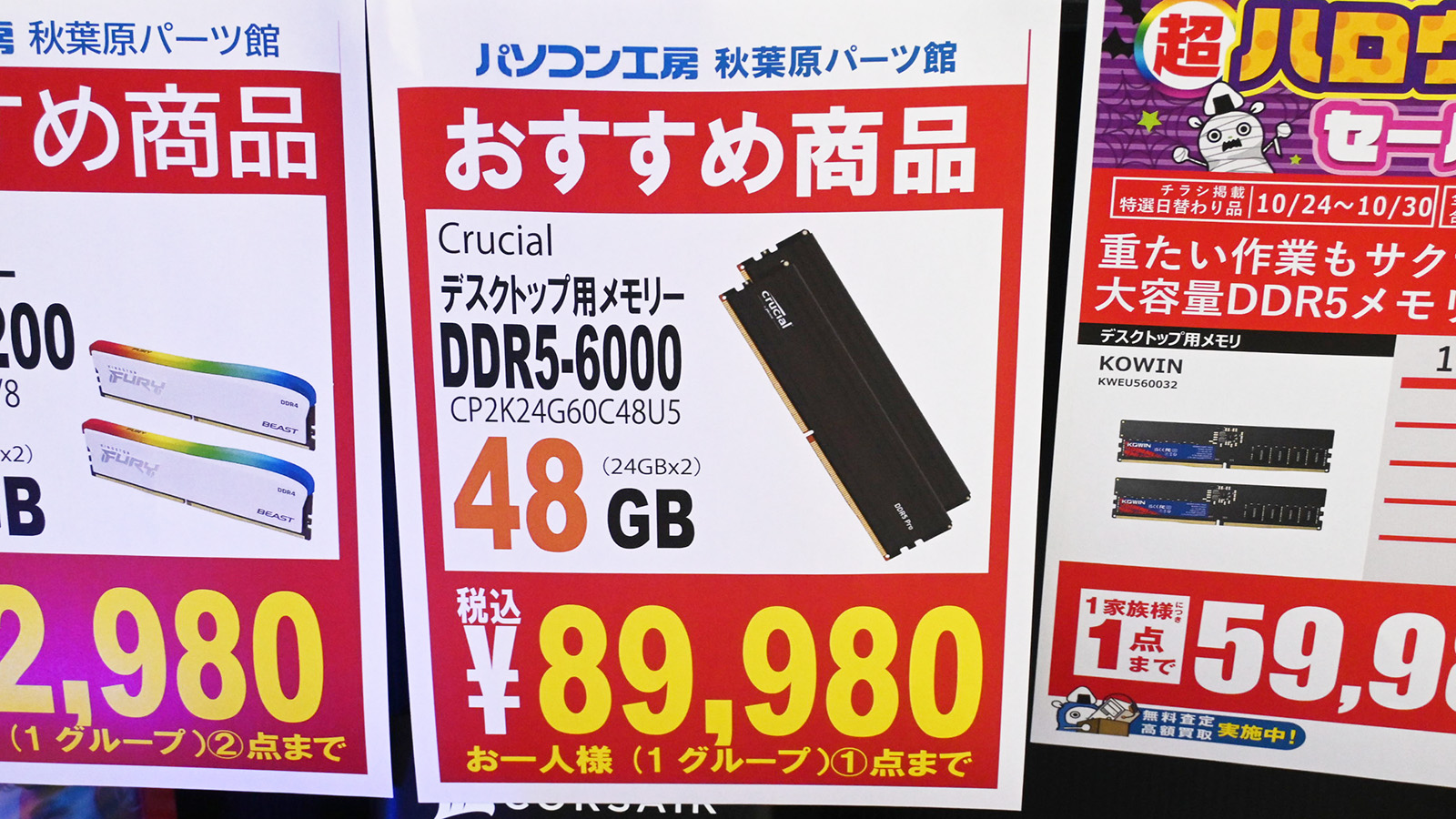 Fig: Dual-channel high-frequency memory inventory inside Akihabara display cases. Source: AKIBA PC Hotline! on-site survey.
Producing equivalent usable storage capacity in stacked HBM dies requires roughly double the wafer silicon of standard DDR5. Beyond the physical silicon footprint consumed by Through-Silicon Vias (TSV), micro-bump soldering defect rates and complex multi-layer stacking yields drive down composite output even further. Memory makers have reallocated entire cleanroom toolsets to HBM lines, directly squeezing out wafer fab runs allocated to standard consumer DRAM.
Packaging complexities further compound physical yield constraints. When cleanroom toolsets previously dedicated to standard DRAM dies are reassigned to HBM lines, the total volume of raw silicon flowing into the consumer market shrinks precipitously.
High-density modules face the brunt of this shock. A single 64GB DIMM requires high-density 16Gb or 24Gb monolithic dies—the exact same physical silicon components prized by enterprise AI training clusters. Consumer module vendors sit at the bottom of foundry priority lists. Retail channels are left fighting over whatever scraps of wafer capacity remain after enterprise orders are fulfilled.
Server Premiums Exceed 4x: Long-Term Enterprise Contracts Leave No Relief for Retail
This capacity migration is propelled by massive gross margin disparities. North American tech giants have locked in multi-year procurement contracts with DRAM foundries. Enterprise HBM and RDIMM contract pricing commands more than a 4x premium over consumer-grade silicon. Guaranteed lucrative, dependable margins, memory manufacturers have little economic incentive to discount or expand production for standard consumer DRAM.
Rapid architectural transitions across hyperscale cloud hardware have accelerated the procurement race. Next-generation server platforms have universally adopted 12-channel memory architectures, requiring dual-socket server nodes to pack up to 24 large-capacity RDIMMs each. Hyperscale data centers are locking down inventories in batches of tens of thousands of kits. The massive margins on enterprise modules ensure that tier-one silicon dies are routed straight to enterprise packaging facilities.
In recent earnings calls, SK Hynix confirmed that its advanced-node DRAM capacity is fully booked for several quarters ahead. Samsung Electronics and Micron have similarly concentrated capital expenditures on high-value nodes. Since constructing new semiconductor fabs takes 18 to 24 months from ground-breaking to full production, spare fab capacity will remain virtually nonexistent in the near term.
Secondary spot market speculation has compounded the shortage. Industrial computing firms and smaller server integrators unable to secure direct allocations from foundries have dispatched procurement buyers to sweep retail consumer channels. The consumer market has effectively become a stopgap buffer for enterprise AI compute shortfalls, making retail components even harder for individual PC builders to source.
Consumers Bear the AI Cost Burden: Resetting the High-End PC Build Threshold
This abrupt pricing shock has completely upended the economics of personal computing hardware. In local LLM deployment and high-end 3D rendering workflows, 128GB of RAM once served as the baseline productivity sweet spot. Today, with that single component topping thousands of dollars, countless independent developers have put hardware upgrade cycles on hold.
The widening DDR5 price chasm has also breathed surprising new life into the aging DDR4 ecosystem in Akihabara. Market data from the same week shows DDR4-3200 16GB×2 kits holding steady at 32,980 yen—roughly half the price of equivalent DDR5 kits. Many consumers who originally planned to transition to next-gen platforms are postponing their upgrades, opting instead to extend current machine lifespans by slotting in legacy RAM. Artificially prolonging hardware lifecycles has emerged as a practical defense against supply chain premiums.
Industry analysts remain sharply divided over future price trajectories. One camp expects supply tightness to ease once newly commissioned fab lines enter production in 2027. Others contend that the AI boom’s insatiable appetite for high-density DRAM represents a permanent structural shift—meaning the era of cheap, abundant high-capacity memory may never truly return.
The 510,000 yen price tags hanging in Akihabara are a stark reminder of semiconductor resource reallocation in the age of AI. Global wafer capacity is coalescing around hyperscale compute hubs. The premiums that consumer PC builders and local developers pay at retail shelves are, in reality, their share of the bill for the global AI compute boom.
References:
- AKIBA PC Hotline! Akihabara Memory Price Trends (Late October 2026)
- AKIBA PC Hotline! Akihabara Memory Price Trends (Early October 2026)
- TrendForce Global DRAM Capacity & HBM Crowding-Out Effect Quarterly Report
- Tom’s Hardware Memory Foundry Capacity Allocation & Spot Price Analysis