
On June 30, 2026, Erin Catto announced his latest project: Box3D, an open-source 3D physics engine.
If you’ve never heard of Erin Catto, that’s fine. But you’ve almost certainly heard the story of his previous project — a story involving one of the most popular mobile games ever made, a very awkward public Q&A, and a red hoodie the author didn’t even like.
What Is a Physics Engine? Giving Game Worlds 「Gravity」
Before we get into why this matters, let’s clarify what a physics engine actually does.
Here’s a simple analogy: when you swipe on your phone screen to launch a bird at a stack of green pigs, the bird’s parabolic arc, the way the wooden planks shatter on impact, the direction the rubble tumbles — all of that is calculated. The piece of software doing those calculations is the physics engine.
In other words, a physics engine is the 「gravity system」 of a game world. Without it, the Angry Birds would just fly in a straight line, nothing would react to impact, planks wouldn’t break, pigs wouldn’t roll — the entire core fun of the game would vanish.
And the physics engine powering Angry Birds? Box2D.

The GDC Moment: A Question That Made the Whole Room Applaud
Rewind to the 2011 Game Developers Conference. Rovio’s marketing chief Peter Vesterbacka was on stage delivering a keynote titled 「Angry Birds — Birth of an Entertainment Brand.」 Rovio was riding high, and the room was packed.
During Q&A, a man stood up and asked: 「Which physics engine does Angry Birds use?」
Vesterbacka answered without hesitation: 「Box2D.」
The questioner continued: 「Then why isn’t it credited anywhere? By the way, I’m Erin Catto — I wrote Box2D.」
According to TechCrunch’s coverage at the time, the room erupted in applause. A former Rovio employee later recalled on Hacker News that Vesterbacka’s response was simply: 「Let’s talk after the session.」
That was it. No confrontation, no cease-and-desist, no lawsuit. After the event, Catto’s name was added to the credits. He reportedly also received a Rovio red hoodie — which Catto later mentioned on a forum that he didn’t actually like the color red.
By this point, Angry Birds was already a global phenomenon. Industry estimates put the franchise’s cumulative revenue above $500 million (roughly ¥3.6 billion RMB), not counting the movie box office and endless merchandising. And for the core physics engine that underpinned that empire, the author received — 「let’s talk after the session.」
Why No Credit? The 「Gentleman’s Agreement」 Inside the MIT License
There’s a technical detail worth explaining here: Rovio did nothing illegal.
Box2D is released under the MIT open-source license. It’s extremely short and permissive. The gist: you can use it however you want, modify it, even bundle it into a commercial product and sell it — you don’t owe me a dime. The only requirement: retain the copyright notice.
And that copyright notice is exactly what Rovio overlooked. Until Catto stood up at a microphone at GDC and asked publicly, the name wasn’t there.
The MIT license literally says: 「an acknowledgment in the product documentation would be appreciated but is not required.」
「Appreciated but not required」 — those four words are the entire story in a footnote.
I’m not here to pass moral judgment. But the numbers speak for themselves: a game generating billions in annual revenue, built on MIT-licensed open source code; the developer didn’t mention it, didn’t credit it, didn’t share a cent. Until the author of that code walked up to the microphone himself.
Box2D: A Side Project That Reshaped an Industry
Box2D’s origin story is itself a tale of unintentional impact.
Erin Catto is a game programmer with a PhD in mathematics. In 2006, he wrote a 2D physics simulation library as a personal project, named it Box2D, and released it under the MIT license on the internet.
What happened next, even Catto himself likely didn’t foresee. Because Box2D was cleanly designed, blazingly fast, and well-documented, it quickly became the go-to physics engine for indie game developers. The list of games powered by Box2D could fill an entire page — from Angry Birds to Limbo, from Incredibots to Happy Wheels. Even OpenAI’s reinforcement learning training environment Gym embeds Box2D-based physics simulation tasks.
It’s fair to say: if you played any 2D game between 2010 and 2020 featuring 「realistic physics collisions,」 Box2D was probably under the hood.
But the MIT license sealed its fate: enormous contribution, zero financial return.
Box3D, Fifteen Years Later: Why Is He Still Writing Open Source?
Which brings us back to the headline: Box3D is here.
Box3D is the 「three-dimensional version」 of Box2D. It extends 2D physics simulation into 3D space — supporting triangle mesh collisions, height field collisions, large-scale world simulation, cross-platform determinism, recording and playback, and a host of new features. The entire codebase is written in C17, maintaining the same minimalist single C API style.
In his blog post, Catto was candid about his two reasons for building Box3D.
The first reason is pragmatic — the game he’s currently making needs it. Catto now works at a studio called Kintsugiyama, developing a survival game titled The Legend of California using Unreal Engine 5. UE5’s built-in Chaos physics system was causing headaches: felled trees would fly off erratically, elongated objects wouldn’t stop spinning, and the system wasn’t efficient enough for massive numbers of entities. Catto tried existing open-source solutions like Jolt, and eventually his friend — Valve physics programmer Dirk Gregorius (author of the Rubikon physics engine used in Half-Life: Alyx) — suggested he fork a simplified version of Rubikon and adapt it himself.
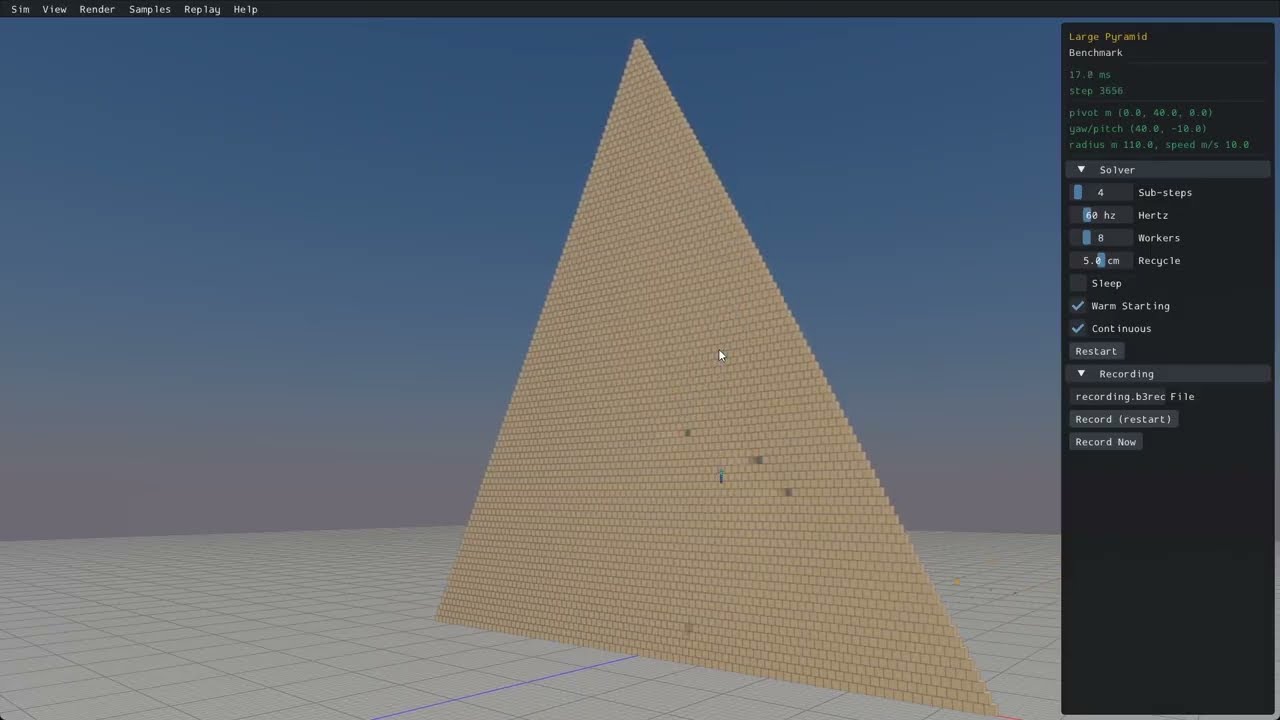
So Catto embedded Rubikon-Lite into Unreal Engine and injected the optimization work he’d accumulated on Box2D v3.0. As he kept going, the fork evolved into Box3D.
The second reason is more personal. Catto wrote in his blog: 「I’ve been working on game physics engines since 2004. Every time I changed jobs, my previous work had to stay behind. That’s part of why I built Box2D in the first place — it’s an open-source project that carries my knowledge and effort forward, so I can keep using it in future work.」
In other words, for Catto, open source is a form of 「knowledge preservation.」
Kintsugiyama allows Catto to develop Box3D on company time and release it as open source. That makes Box3D one of the very few physics engines in the world sustained as a full-time effort by a commercial studio.
An Idealist’s Choice
Reading through all of this, what struck me most was Catto’s attitude.
The Hacker News comment thread went nuclear. One camp argued: the MIT license is the MIT license, Rovio had no legal obligation to pay, that’s how the market works. The other camp shot back: there’s a baseline of decency above the legal baseline — $500 million in revenue and you can’t spare even $1 million?
Catto himself never engaged in that argument. Even his GDC question was remarkably gracious — first ask what engine they used (letting Vesterbacka say Box2D himself), then ask for a credit, and only then reveal your identity. No accusation, no condemnation. Just let the facts speak for themselves.
Fifteen years later, he’s still writing physics engines. From 2D to 3D, from C++ to C17, from a personal project to a studio-supported production. He says: 「Open source isn’t a business for me. I do Box2D and Box3D because I love game physics. Seeing the incredible games people have created with Box2D over the years genuinely makes me happy.」
That kind of attitude feels almost out of step with today’s internet. We’re used to seeing open-source authors burn out, delete their repos, fire off cease-and-desist letters at corporations. Catto chose a different path: just keep writing.
The Bottom Line
A physics engine powered a $500 million gaming empire. The author got a red hoodie — and he didn’t even like red.
Fifteen years later, he shipped Box3D. Still MIT-licensed. Still open source. Still free.
I don’t think this story needs a sentimental ending. It just needs more people to know it: behind those 「realistic physics」 games on your phone is a person whose name you’ve probably never heard.
His name is Erin Catto.
References: