「Honestly, I now believe that 『free speech is the bedrock of society』 was just naive. The internet in 2026 is a broken place.」
On July 1, 2026, a comment appeared on the tech community site Lobsters. Within a day it garnered 116 upvotes — on a site with only tens of thousands of users, that’s about as high as numbers go. The person who wrote it described themselves as a 「former amateur activist from the net neutrality era」: the kind of person who, a dozen years ago, wrote letters to members of Congress, donated money, and marched in the streets chanting slogans.
Their confession had a second half: the internet is no longer a place for their kids to explore, and it’s not even friendly to adults anymore. They weren’t angry. They weren’t calling for action. They were surrendering.
And right below that comment, the second most-upvoted reply (64 upvotes) was even more blunt: 「Ban targeted advertising. Ban algorithmic recommendation feeds. Put CEOs in jail. But it feels like the probability of any of that happening is zero. I can’t even muster hope.」
A surrender post plus a despair post, totaling 180 upvotes. What I wanted to understand was: why are the people who once fought tooth and nail for internet freedom now saying it’s 「not worth saving」? What exactly happened over these last twenty years?
2012: When the Internet Was Still 「Ours」
Let’s go back to a nostalgic moment: January 18, 2012.
That day, the English Wikipedia turned into a black screen with a single line of text — 「Imagine a world without free knowledge.」 On the same day, Reddit, WordPress, Craigslist, and thousands of other sites went dark in a coordinated blackout to protest SOPA, the Stop Online Piracy Act, then advancing through the US Congress.
The bill’s core provision: if a copyright holder merely claimed a website hosted infringing content, the government could 「unplug」 that site from the internet — no court ruling, no prior notice. In plain terms, it was a hammer that big corporations could swing at any website, anytime.
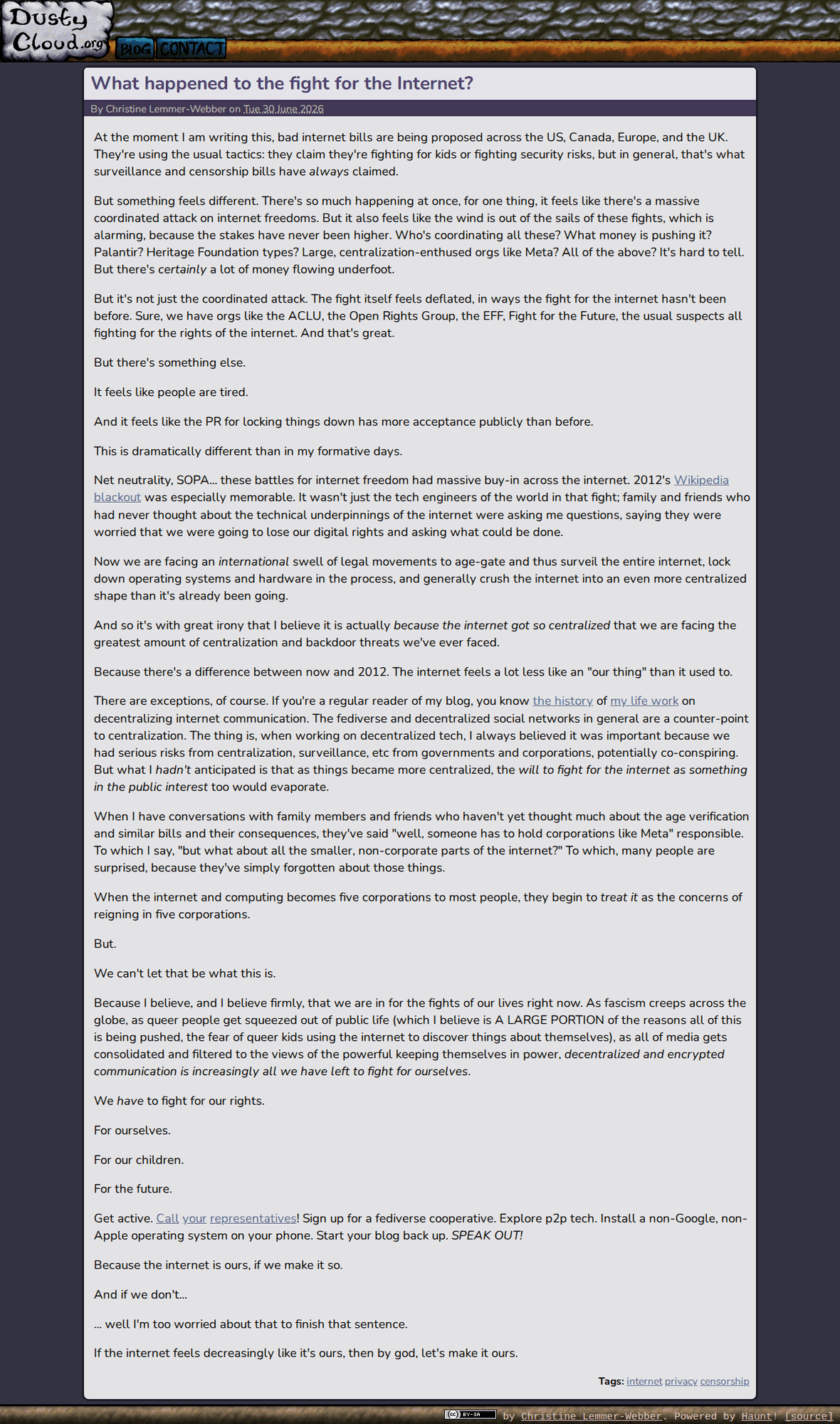
The scale of that protest is almost impossible to replicate today. It wasn’t just programmers and tech enthusiasts shouting — ordinary people got pulled into the debate. Christine Lemmer-Webber — the principal author of the ActivityPub protocol that now underpins Mastodon and all federated social networks — recalled in her blog that even her family members and friends who knew nothing about technology were asking her: are we about to lose the internet? What can we do?
The result? Both bills were withdrawn. It was a classic 「the people won」 moment. Back then, people felt a powerful sense of ownership over the internet: this thing is ours, and we have the power to protect it.
In 2017, the same script played out again — the FCC moved to repeal net neutrality (the principle that ISPs can’t create 「fast lanes」 and 「slow lanes」 for different websites), and once again massive online protests erupted, with hundreds of sites participating in the 「Day of Action to Save Net Neutrality.」
But by 2026, the story had broken.
2026: Nobody Takes to the Streets Anymore
Christine wrote a detail in her blog that, in my view, reveals the root of the entire problem.
When she talked with family and friends about the internet regulation bills now spreading globally, their reaction went something like: 「Well, someone’s got to rein in companies like Meta, right?」
She asked in response: 「What about the small, non-commercial part of the internet?」
They froze. The reason was simple — they had forgotten that part of the internet even existed.
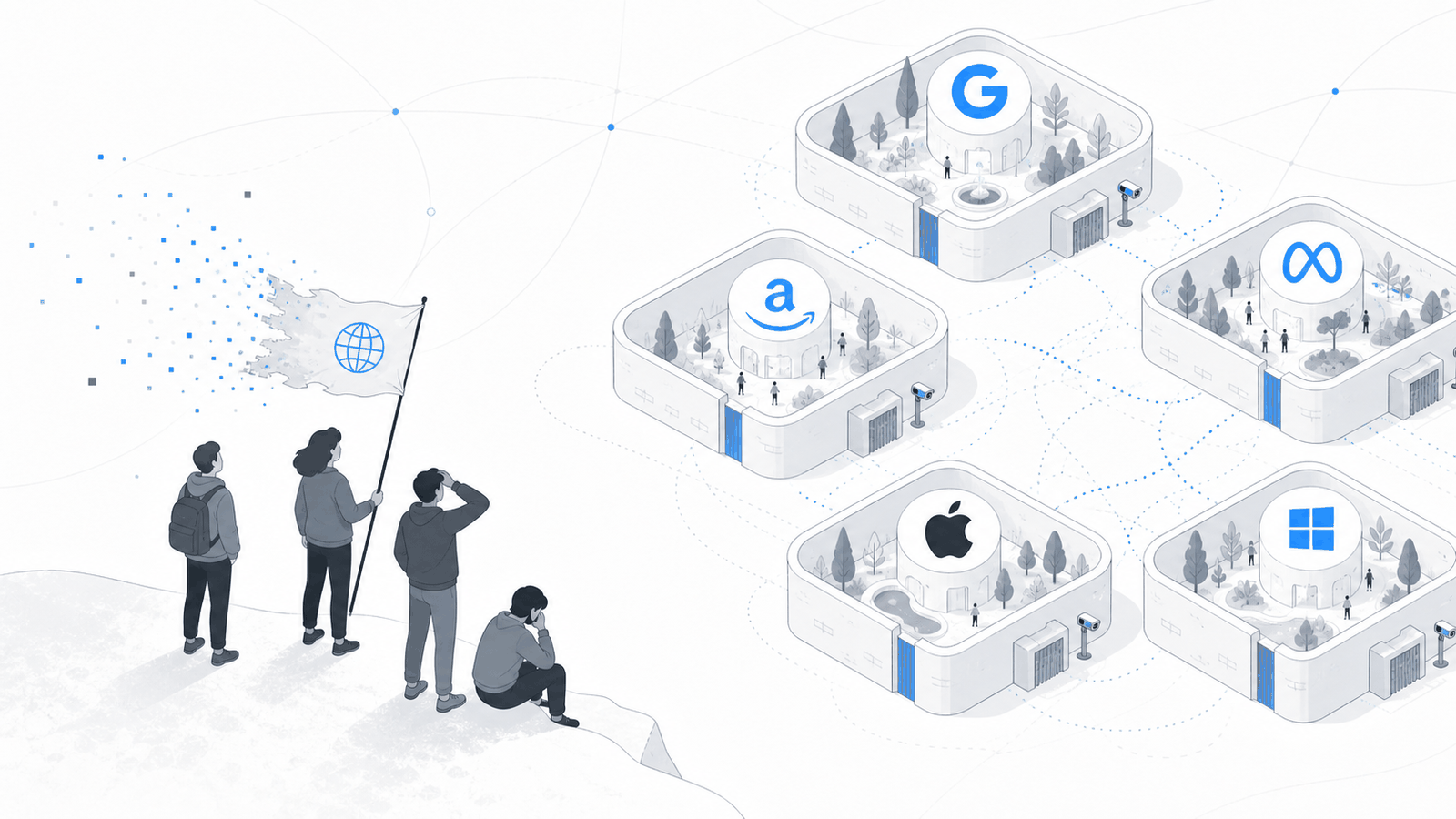
In the mind of most ordinary people, the internet in 2026 is five apps: Google (search), YouTube (video), Facebook/Instagram (social), Amazon (shopping), and TikTok (short video). You unlock your phone every day, switch between these few apps, occasionally use a browser to look something up. For you, the internet is essentially the service interface of these handful of companies.
This isn’t an illusion. The numbers don’t lie:
- Global ad spend in 2026 is projected to surpass $1 trillion for the first time, with digital advertising at roughly $950 billion.
- Google, Meta, and Amazon together capture 51% of global ad revenue. Outside China, that share rises to 61%.
- Google alone crossed a market cap of $4 trillion in July 2026 — exceeding the GDP of most countries.
When the internet is reduced to the product catalog of three to five companies, a deep psychological shift takes hold: people no longer feel the internet is 「their thing.」 When a product has problems, the user’s reaction is 「the manufacturer should fix it.」 Only when you feel something is yours do you take to the streets for it.
Christine put it even more bluntly: 「It’s precisely because the internet has become so centralized that people have lost the will to fight for it. That’s a cruel irony.」
The Real Villain: $950 Billion in Targeted Advertising
So how did the internet become centralized? The antagonist in this story is an economic machine, not a specific person.
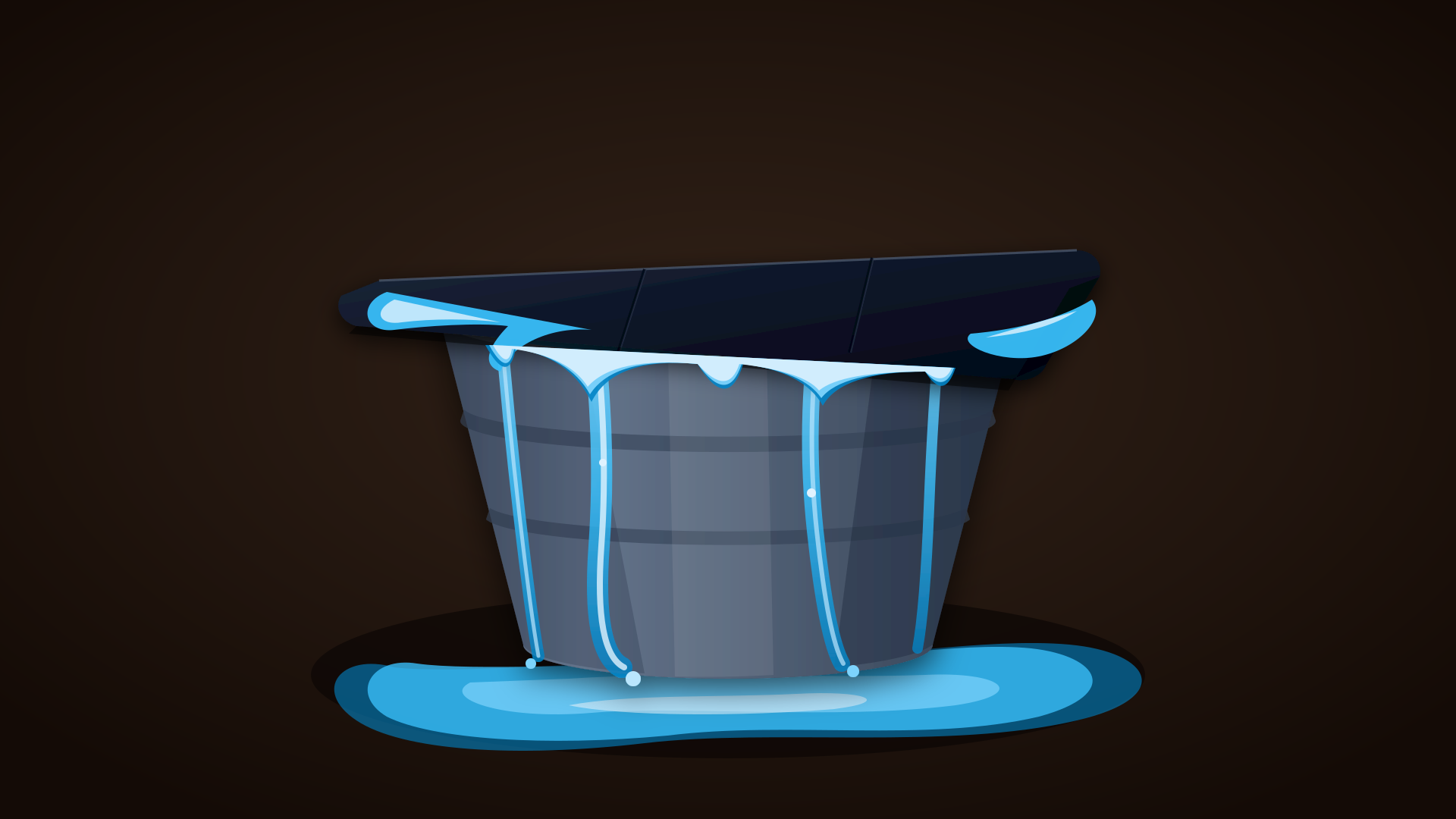
The free apps on your phone screen. The free articles on news sites. The free search results. The word 「free」 sounds wonderful, but it carries a carefully hidden cost: your attention is being sold as a commodity.
Here’s how the machine operates:
- Internet services are offered to users for free;
- That 「free」 is subsidized by collecting your browsing history, click behavior, location data, and social connections;
- The purpose of collecting this data is to sell personalized targeted advertising — you search for 「running shoes」 on Site A, and then no matter whether you open Site B, App C, or Social Platform D, running-shoe ads chase you everywhere;
- The more precise the targeting, the more the platform can charge advertisers;
- The higher the revenue, the more the platform can acquire or squeeze out smaller competitors;
- Eventually, all traffic and revenue concentrate into a few giant platforms.
The critical link in this chain is step three: targeted advertising. It transformed the internet’s economic model from 「help users find good stuff」 into 「help advertisers find users.」
When a platform’s core customer shifts from users to advertisers, every design decision orbits a single goal: extend your dwell time, collect more data about you, show you more ads. That’s the economic logic underlying algorithmic feeds, infinite scroll, and autoplay — they aren’t there to 「make your experience better.」 They’re there to 「make advertisers pay more.」
Shoshana Zuboff, author of The Age of Surveillance Capitalism, calls this economic model 「surveillance capitalism」 — distinct from traditional market exchange because its raw material is human behavioral data, and the collection of that data was never truly voluntary. You can’t 「opt out,」 because refusing to be tracked means opting out of digital life altogether.
When you connect all these dots, a stark realization emerges: 「free」 was the entry point to the entire trap. We enjoyed two decades of a 「free internet,」 and the price we paid wasn’t just our privacy — it included, ultimately, our sense of ownership over the internet itself.
Three Prescriptions, From Moderate to Radical

Faced with this impasse, the Lobsters community proposed three paths, from moderate to radical, forming a complete spectrum.
Prescription One: Ban targeted ads, keep contextual ads.
This is the core proposal behind that 116-upvote comment. Targeted ads 「chase you around」 and require collecting your personal data to function; contextual ads only match based on what you’re currently viewing — for example, a basketball article shows a sneaker ad alongside it, without needing to know who you are, what you searched yesterday, or who your friends are.
The difference is similar to: one waiter sees you walk into a bookstore and recommends a popular new release (contextual ad) — perfectly fine. Another waiter has been following you since you walked in, holding a folder that records every purchase, conversation, and movement you’ve made over the past three months, and then recommends a book you’re 「highly likely to impulse-buy」 (targeted ad) — that’s the problem.
From an engineering perspective, contextual advertising is indeed harder to scale — it requires the ad platform to match each content page individually rather than simply deploying ads against a user profile with one click. But that’s precisely its advantage: it makes 「attention harvesting」 no longer profitable. Because the core mechanism of attention harvesting is building a dynamic psychological profile of you and then using algorithms to predict what content will keep you scrolling longest. Remove personal data as the raw material, and the entire harvesting machine runs out of fuel.
Prescription Two: Ban algorithmic recommendation feeds.
The logic here is also straightforward: if platforms can’t use algorithms to decide what content you see, they can’t precisely manipulate your attention. This view garnered plenty of agreement, but also drew the sharpest rebuttal.
User peter-leonov wrote: 「Before algorithmic recommendations, the internet was nearly unusable. Remember those 『portal sites』? You had to manually dig through a pile of links to find anything useful. Remember those 『recommended website lists』? Google’s PageRank algorithm was a revolution.」
This pushback has merit. I looked it up: before Google (pre-1998), the main ways users found information on the internet were: manually curated directories on portal sites, personally maintained 「friends’ links」 pages, and word of mouth. Even 「search engines」 were basically keyword matching with abysmal result quality.
PageRank itself is undeniably an algorithm — it assesses page importance based on the link relationships between web pages. Strictly speaking, it was the first massively deployed 「information recommendation algorithm」 in history. Without it, the information explosion of the internet would have made searching feel like finding a needle in a haystack.
Of course, PageRank and today’s TikTok algorithm are two different beasts — one is 「tell me what you want and I’ll find it for you」 (search engine), the other is 「I’ll guess what you want and shove it in your face」 (recommendation feed). But the path of technological evolution rarely respects boundaries: when the same algorithmic mindset extends from search into social, sliding from 「help you find」 toward 「choose for you,」 something has gone wrong.
Prescription Three: Put CEOs in jail.
This is the proposal from that 64-upvote comment. It sounds like anger talking, but there’s actually a legal logic behind it: if a company knows its algorithms are driving teen depression, polarizing public discourse, and spreading disinformation — yet chooses inaction because it correlates positively with profit growth — does that constitute a form of 「reckless disregard」?
This logic has precedent in the tobacco and pharmaceutical industries: when company executives knew their products were harmful and deliberately concealed or failed to address it, they could be held personally criminally liable. But in the tech industry, this accountability mechanism barely exists — because 「what the algorithm recommended」 is still treated as a technologically neutral automated process rather than a conscious business decision.
That said, even the strongest advocates of this position hold no hope. The original comment put it plainly: 「It feels like the probability of any of that happening is zero. I can’t even muster hope.」
Conclusion: After 「Can’t Even Muster Hope」
The last line of Christine’s blog post was left unfinished. She wrote: 「If we don’t fight…」 and then stopped. I suspect she was genuinely afraid to write the ending.
She didn’t say 「we will definitely win.」 What she said was: decentralized, encrypted communication is the only thing we have left worth fighting for. We must fight. For ourselves, for our children, for the future.
Fourteen years ago, when people saw that line on Wikipedia’s black screen, what they felt was 「this is ours, we must defend it.」 Today, the Lobsters comment that earned 116 upvotes says: 「this is theirs, and I can’t even muster hope.」
From 「ours」 to 「theirs」 — the twenty years between those two words is the complete journey of the internet from a public square to a casino.
But I noticed something else: beneath that 116-upvote comment, another conversation was unfolding. Someone said, 「the old-school ways of using the internet are being systematically exterminated — legal barriers, AI-generated garbage drowning out search results, unsustainable crawler traffic.」 Someone shot back: 「What legal barriers? My blog has been running since 1999, the HTML hasn’t really changed, and I’m still using CGI scripts.」
One person says the old internet is dying. Another says it never left. Perhaps both are true — for those willing to go the extra mile, the 「wild parts」 of the internet really are still there. But finding them in 2026 takes more effort and luck than it did fourteen years ago.
This isn’t a battle with a winner and a loser. It’s a long, grinding tug-of-war over who the internet truly belongs to. And at least this summer, there are still some people — even if they say 「I can’t even muster hope」 — still tapping out comments in front of their screens.
Reference Links:
- Christine Lemmer-Webber, 「What happened to the fight for the Internet?」 dustycloud.org, 2026-06-30. https://dustycloud.org/blog/what-happened-to-the-fight-for-the-internet/
- Lobsters discussion (172△/110 comments), 2026-07-01. https://lobste.rs/s/rfkmw3
- 「Protests against SOPA and PIPA,」 Wikipedia. https://en.wikipedia.org/wiki/Protests_against_SOPA_and_PIPA
- 「Global Ad Spend Set to Surpass $1 Trillion for the First Time in 2026,」 Dentsu, 2025-12-03. https://www.dentsu.com/news-releases/global-ad-spend-set-to-surpass-one-trillion-for-the-first-time-in-2026-as-the-algorithmic-era-redefines-growth
- 「Google, Meta, Amazon’s combined share of global ad revenues hits 51% in 2024,」 BestMediaInfo, 2024-12-09. https://bestmediainfo.com/insights/google-meta-amazons-combined-share-of-global-ad-revenues-hits-51-in-2024-magna-8326244
- 「Alphabet’s Share Price Lags Peers as Market Value Tops $4 Trillion,」 Bloomberg, 2026-07-01. https://www.bloomberg.com/news/articles/2026-07-01/alphabet-s-2-trillion-gain-turns-rock-star-into-question-mark
- Shoshana Zuboff, 「The Age of Surveillance Capitalism,」 2019. https://en.wikipedia.org/wiki/Surveillance_capitalism
- 「Age Verification Laws Around the World (2026 Guide),」 DeepIDV, 2026-03-24. https://www.deepidv.com/media/articles/age-verification-laws-around-the-world-2026-regulatory-map
Note: The original dustycloud.org post had no usable content images (only the site logo and navigation icons). The images in this article are full-page screenshots of the original pages captured via automated tools. Image 1 is a full screenshot of Christine Lemmer-Webber’s blog post; Image 2 is a screenshot of the Lobsters discussion thread.