On July 1, 2026, in the small town of Reedley in California’s Central Valley, thousands of people lined up before dawn outside an orchard. They weren’t there for a new phone launch. They weren’t collecting free eggs. They were there to pick nectarines. White-flesh nectarines, a variety called Monalise — sweeter and lower in acidity than standard nectarines, the kind of fruit that commands a premium on supermarket shelves.
The farmer, Cesar Mora, stood among the crowd in a T-shirt reading “No Nectarines Wasted,” handing out crate after crate. Within a week, over 125,000 pounds (roughly 57,000 kilograms) of nectarines were gone. He also raised $17,000 on GoFundMe.
Not out of generosity. He did it because those nectarines could not be sold — not a single one. Selling them would be illegal.
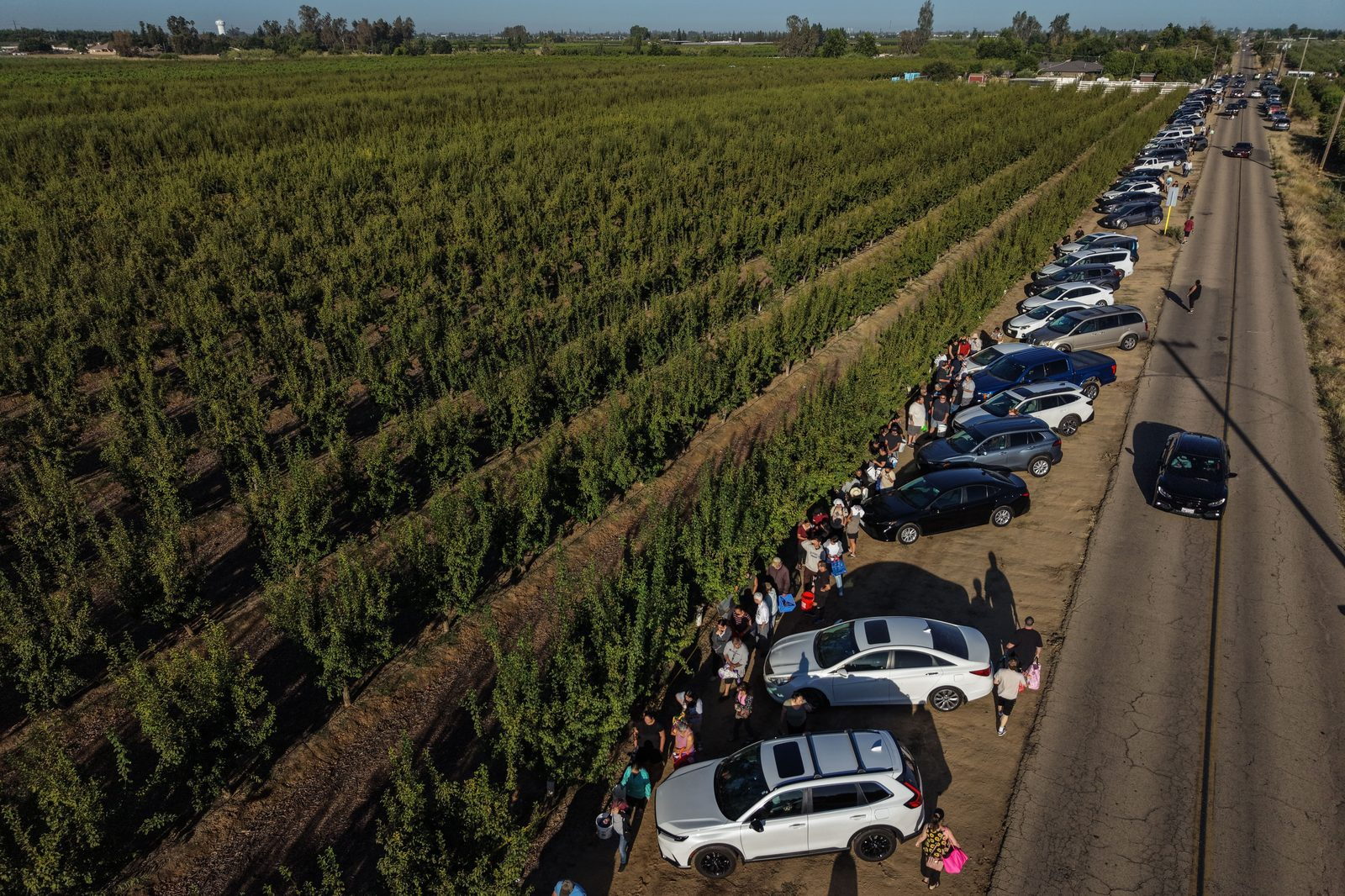
▲ July 1, 2026, Reedley, California. Long lines of people wait to collect free nectarines from Mora’s orchard. Source: AP Photo / Jae C. Hong
1. “The Fruit You Grow Is Not Yours”
Mora is a third-generation farmer. His 7.5-acre orchard grows nectarines, peaches, and plums. In 2017, a major produce distributor called Giumarra Brothers Fruit Co. — a Los Angeles-based operation with national reach — approached him with an offer: grow the Monalise white nectarine variety.
Mora signed two agreements: a planting license (2017) and a marketing agreement (2019). Under the terms, his Monalise nectarines could only be packed and sold through Giumarra. He’d pay $2.50 per tree in variety-use fees, plus 4% of gross sales, plus sales commissions.
“They sold me a hope, a big dream,” Mora later told reporters. “I thought I was going to make money with them.”
But by 2020, things had soured. Mora claims that Giumarra discarded nearly half of the nectarines he shipped that year — citing insufficient cosmetic quality — which meant his income was effectively cut in half. (The company denies this allegation, and a judge ruled that this portion of the claim falls outside the statute of limitations.)
In 2022, Mora discovered that Giumarra had been selling his nectarines to Taiwan. His contract, in black and white, limited sales to the United States and Canada. (Giumarra denies this too.)
By 2023, Mora had had enough. He terminated the relationship and started selling his nectarines to a different packer.
Giumarra sued him. The charge: breach of contract.
From that day forward, Mora’s nectarines became a legal hot potato. Until the lawsuit is resolved, he cannot sell them to anyone.
2. Was There Even a Patent? That’s a Good Question
At first glance, this reads like a straightforward contract dispute — you sign, you comply. But dig into the court filings, and one detail flips the entire story on its head.
When Giumarra recruited Mora, the pitch was clear: Monalise is an “exclusive variety” protected by a patent, which is why the fruit “commands a premium price.” These representations are laid out explicitly in Mora’s cross-complaint.
Yet in court, Giumarra itself conceded that Monalise holds no U.S. plant patent.
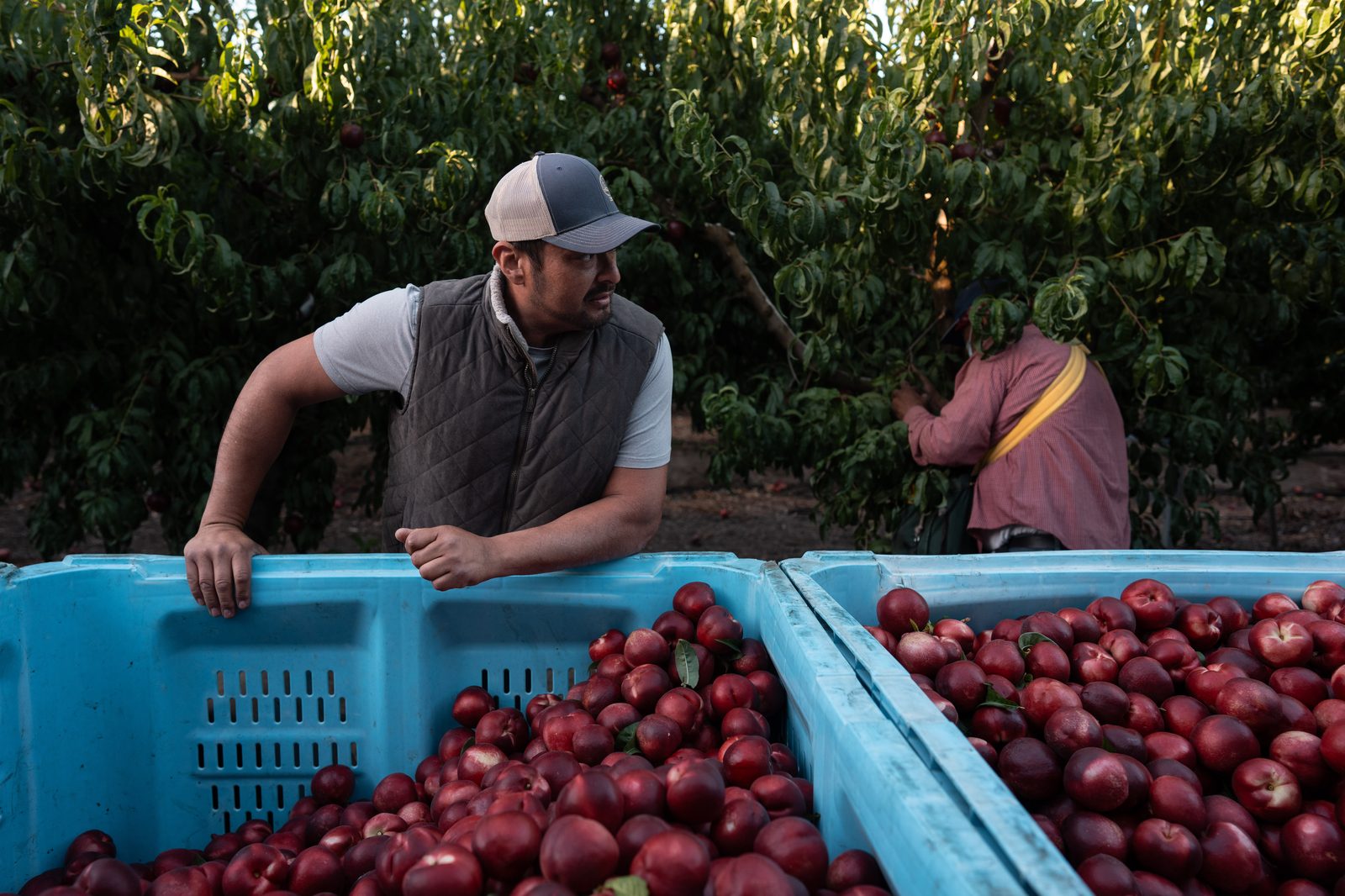
▲ Mora stands beside crates of nectarines as workers harvest the fruit. Source: AP Photo / Jae C. Hong
This is where it gets uncomfortable. In plain language: the distributor told the farmer “this variety is exclusively ours, so the fruit is worth more.” The farmer believed them. He signed. When they ended up in court, the distributor said: “Actually, we don’t have a patent — but that doesn’t affect the contract’s validity.” And the judge — Jon Skiles of the Fresno County Superior Court — ruled in May that whether the contract is enforceable has nothing to do with whether a patent exists. “The License Agreement does not expressly condition its enforceability upon the existence or issuance of a fruit patent.”
Legally, the logic holds. A contract is a contract. A patent is a patent. You signed; you honor it.
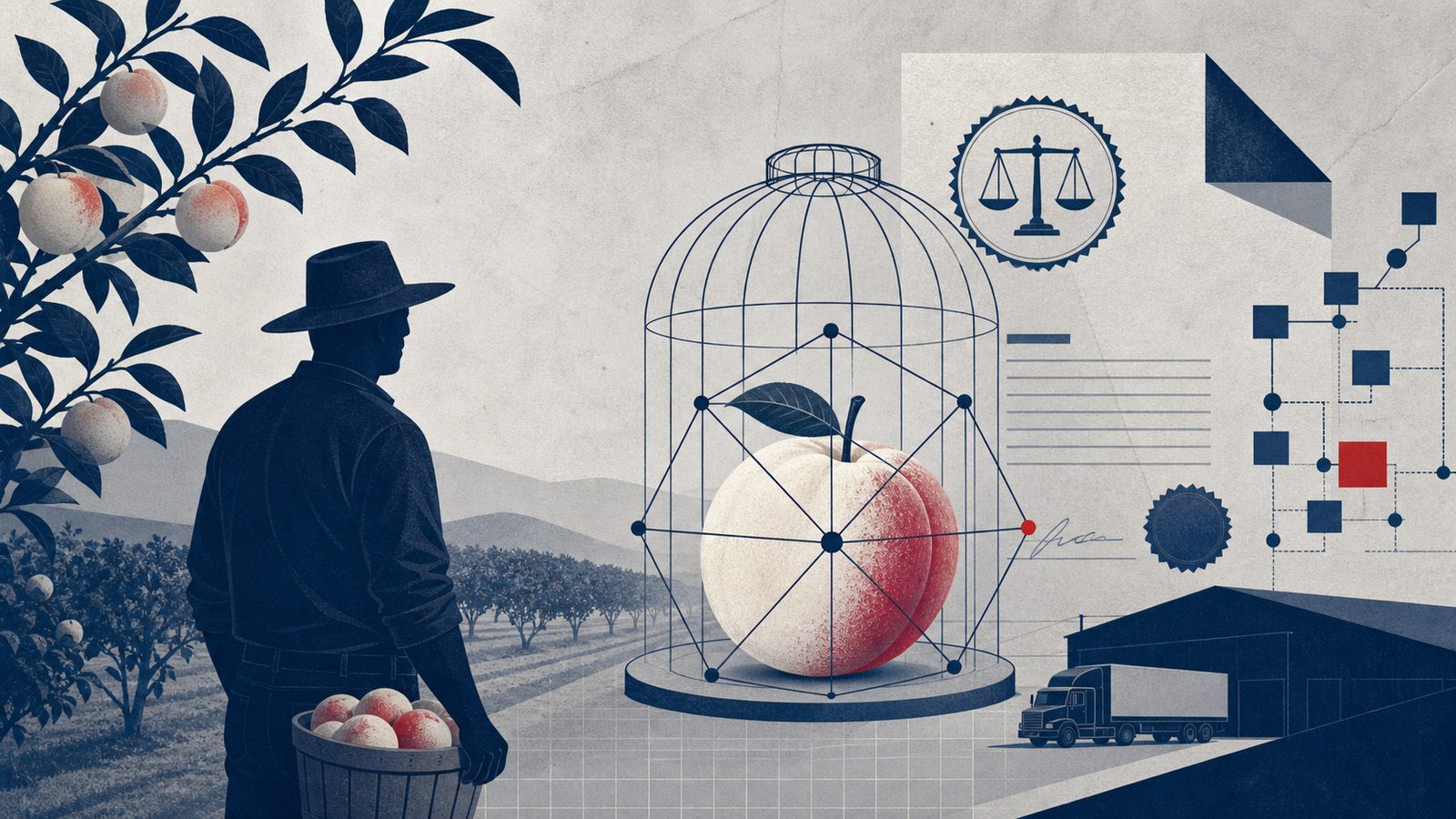
But from the perspective of a farmer who spent a decade working this land, the situation feels like being trapped inside an elaborate legal nesting doll. The outermost layer: a contract that binds you to a single buyer. The middle layer: a story about an “exclusive variety” that makes you believe you’re growing something rare. The innermost layer — the patent itself — doesn’t actually exist. Stack all the layers together, and the practical outcome is this: the fruit you grow, you cannot sell.
3. How Fruit Patents Actually Work
A brief interlude on why anyone can claim to “own” a fruit variety in the first place.
The United States has had a plant patent law since 1930 (35 U.S.C. § 161). The core logic: if someone creates a novel plant variety through breeding — hybridization, selection, discovery of a mutation — and can reproduce it stably through asexual propagation (grafting, cuttings), they can patent it. The patent lasts 20 years. During that period, nobody may propagate or sell the variety without permission.
The logic itself isn’t controversial. It’s the same rationale behind drug patents and semiconductor patents: reward innovation.
But agriculture has a wrinkle: fruit trees are alive. You plant them. You water them, fertilize them, prune them. Over ten years, they grow from saplings into an orchard. You invest incalculable labor and care into that patch of earth. Then someone tells you: sorry, every piece of fruit on these trees belongs, legally speaking, not to you — but to the “variety rights holder.”
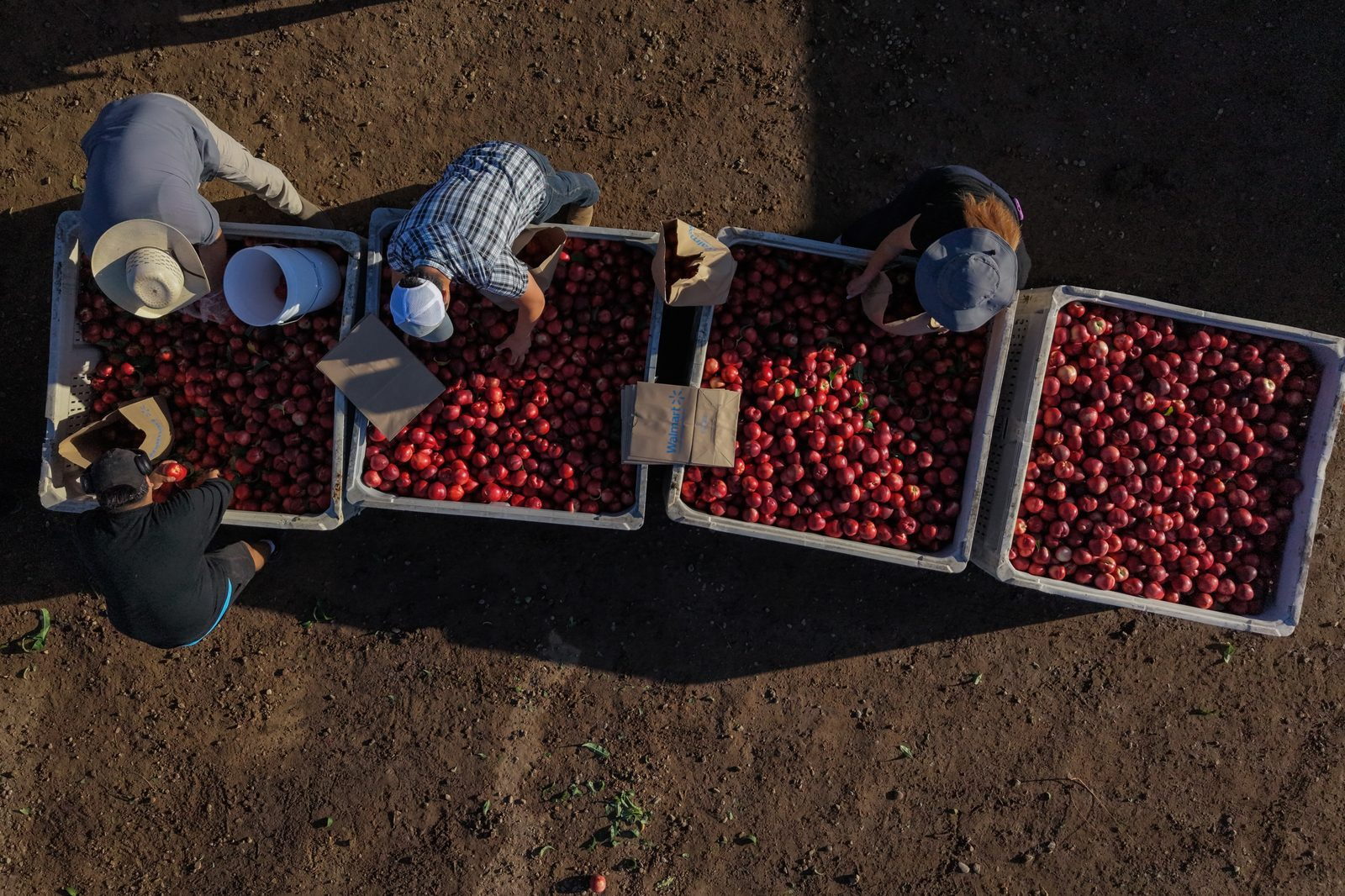
▲ Mora’s family and volunteers bag free nectarines at the orchard for distribution. Source: AP Photo / Jae C. Hong
Bradley Rickard, a professor of food and agricultural economics at Cornell, told reporters that fruit patents are becoming increasingly common. Rights holders can charge in two ways: per tree, or per piece of fruit. Some varieties charge both.
Mora’s contract charges both — $2.50 per tree, plus 4% of gross sales.
And here’s a deeper wrinkle: the true “owner” of Monalise isn’t Giumarra at all. Court documents reveal that all variety rights belong to a French company called Star Fruits Diffusion. Giumarra merely holds a sub-license for the U.S. market. The French company did not respond to media requests for comment. In other words, Mora signed his contract with what amounts to a sub-landlord.
4. This Isn’t the First Time
This case echoes the 2010 “SweeTango apple” episode.
SweeTango is an apple variety developed by the University of Minnesota — similar to Honeycrisp but sweeter. The university granted exclusive planting rights to an orchard called Pepin Heights, which organized a growers’ cooperative to control the market. In 2010, over a dozen excluded apple growers sued the university, arguing: a variety bred with taxpayer money (the university is publicly funded) shouldn’t be handed exclusively to a private company.
The case settled. The university maintained its licensing agreement with the cooperative but allowed more Minnesota orchards to lease trees of the variety.
In both cases, the pattern is the same: variety control sits with institutions. Individual growers are “license holders,” not owners. You can grow it. But you don’t set the terms.
Contrast that with varieties that have entered the public domain — like the Rainier cherry, developed by Washington State University in the 1950s, or Honeycrisp apples, released by the University of Minnesota in the 1990s. Anyone can grow them. Anyone can sell them. No one owes a “variety-use fee” to anyone. The story of Honeycrisp spreading from a university lab to orchards around the world proves that open varieties can generate enormous economic value without turning growers into tenants.
In Mora’s case, the uncomfortable reality is this: even though Monalise has no U.S. patent, Mora still can’t sell his nectarines. Because a contract is a contract. And the contract binds him because he signed it — back when he believed he was joining an “exclusive premium variety” project.
5. Who Actually Wins?
Let me be honest here.
Legally, Giumarra’s case is sound: a contract is a contract, and breach carries consequences. This is not hard to defend. Their public statement is carefully worded: “Giumarra remains committed to serving growers with integrity, fulfilling contractual obligations, and protecting proprietary programs that create value for our grower partners.”
From the farmer’s side, Mora’s situation deserves sympathy, but he is not without responsibility. His attorney raised unfair business practice claims in court, but Mora did, in fact, sign the contract. In an ideal world, a farmer would have a lawyer walk through every clause of a document spanning dozens of pages before putting pen to paper. The reality is that many small-scale farmers in California, faced with these agreements, may not even know what the word “sublicense” means.
But the real issue this case exposes is the systemic asymmetry.
On one side: a distributor with hundreds of millions in annual revenue, an in-house legal team, decades of contracting experience, and industry resources. On the other: a third-generation farmer with 7.5 acres, whose entire legal knowledge base comes from experience and trust.
When variety control concentrates in the hands of a few large distributors, “the fruit you grow does not belong to you” stops being a legal metaphor. It becomes daily reality.
Mora said something in an interview that I’ve read several times now: “During these two years of litigation, I don’t even want to go to the fields anymore.”
He still has income from peaches and plums — varieties he never signed away. But the nectarine operation accounted for a quarter of his total revenue. Two years without sales have pushed a three-generation family farm to the brink. His Instagram account, @NoNectarinesWasted, has drawn over 860,000 views. It could have been a clever PR play. But watching videos of endless lines of people collecting free fruit, my reaction isn’t admiration for the strategy. It’s: this shouldn’t be normal.
6. Why Does This Matter Beyond California?
Some readers may think: an American farmer suing an American company — this has nothing to do with me.
But variety patents are not a U.S.-only phenomenon. China has its Regulations on the Protection of New Varieties of Plants. Europe has Plant Variety Rights. Japan has its Seed and Seedling Law. The global trend of variety control shifting from farmers to corporations and research institutions has been underway for decades.
A closer-to-home example: if you’ve ever bought “Shine Muscat” grapes under a brand name, you may not know that this variety was originally bred in Japan, where it is subject to strict cultivation and export restrictions. When seedlings made their way — through various routes — to China and South Korea, Japanese breeders discovered they had no legal means to stop “unauthorized planting,” because the variety wasn’t patented in those countries. That story is the mirror image of Mora’s: the rights holder lost control of the variety entirely.
Two extremes — locked into an asymmetric contract, or powerless to stop unauthorized cultivation — neither is ideal.
I’m not here to prescribe what “should” happen. This article only attempts to make one thing clear: when a fruit tree has a legal “owner,” the person who waters it every day may no longer be the owner. Mora’s case goes to trial this month. And regardless of the verdict, those 125,000 pounds of nectarines that were given away have already answered the same question more loudly than any legal document ever could: the fruit you grow — whose is it, really?
Reference links:
- https://apnews.com/article/california-farmer-nectarines-lawsuit-patent-4f7bc8ab185e8b9cbdd6d6ad4f2aabd1
- https://news.ycombinator.com/item?id=48778031
- https://abc30.com/post/large-ag-company-sues-reedley-farmer-125000-pounds-nectarines-being-given-away-free/19423922/
- https://www.kvpr.org/business-economy/2026-07-03/a-valley-farmer-was-not-allowed-to-sell-his-nectarines-so-he-gave-them-away-for-free