One: July 16, 2026 — Humanity Found the Air of Another Earth
Over six thousand. That’s the total number of planets humans have found beyond our solar system in the past three decades.
Of those, a few hundred sit in the “habitable zone” — far enough from their star that liquid water could exist on the surface, but not so far it freezes. Dozens are rocky planets — solid surfaces like Earth, not gas giants like Jupiter. But not one, on top of all those conditions, also had an atmosphere.
Until July 16, 2026.
That day, a paper appeared in Science. A team led by Dr. Collin Cherubim of Harvard announced: they had detected an atmosphere on a rocky planet 48 light-years from Earth. Directly observed helium gas escaping from the planet’s upper atmosphere into space — not simulated, not hypothesized, but real photons received by the telescope.
The planet is LHS 1140b. After thirty years of searching, humanity finally touched the air of a “second Earth that might host life.”
Two: LHS 1140b — Not Earth’s Twin, but Close Enough
Don’t rush to imagine blue skies and white clouds. LHS 1140b is nothing like Earth.
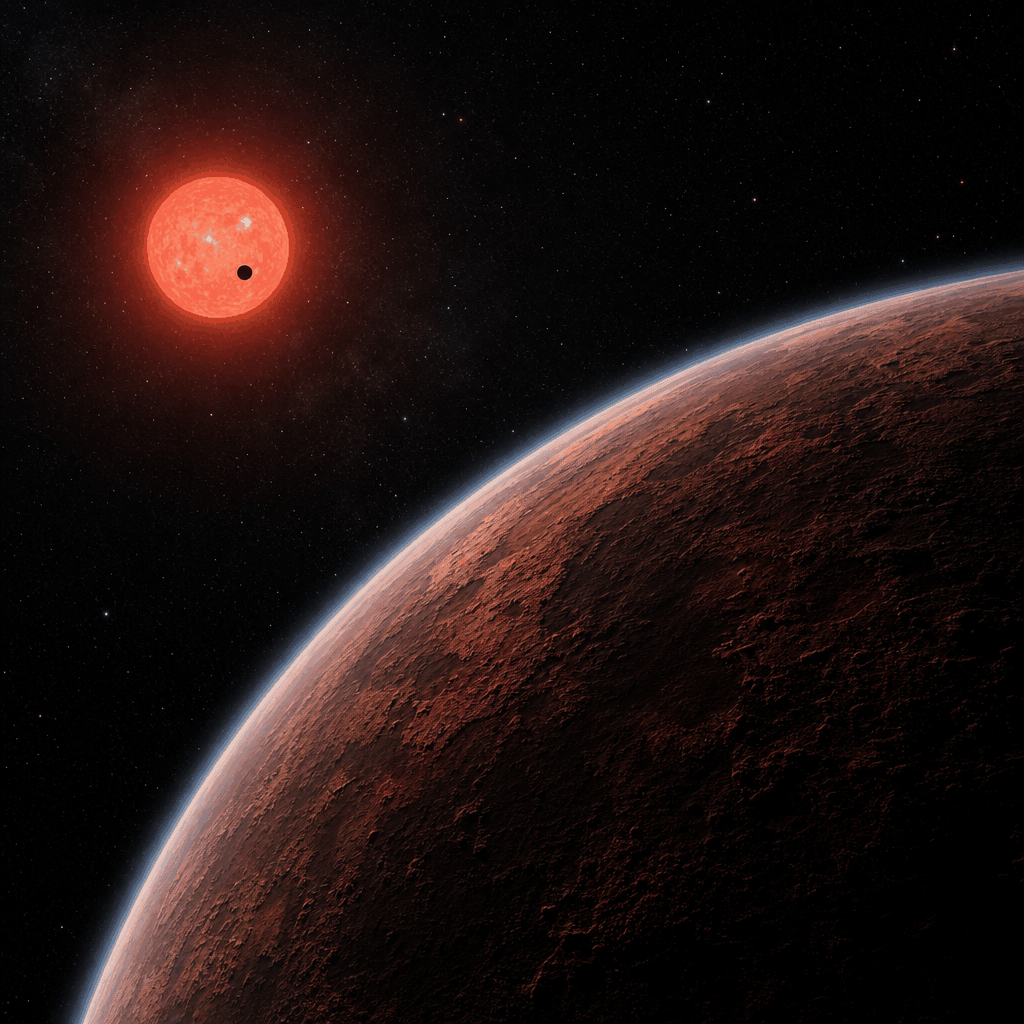
Its mass is 5.6 times Earth’s, its radius 70% larger — astronomers call it a “super-Earth.” It orbits a red dwarf (LHS 1140), far smaller, dimmer, and cooler than the Sun. Its year is just 24.7 days — it sits only 0.0946 astronomical units from its star, about a tenth of the Earth-Sun distance.
So close, it’s tidally locked: one face perpetually toward the star, forever day; the other forever night. The terminator — the day-night boundary — may be temperate, but the extremes on either side make it nothing like Earth’s four seasons.
But on the key points, it matches: a rocky surface, inside the habitable zone, and — as we now know — an atmosphere.
“This is the first time a human being has observationally confirmed an atmosphere on a rocky planet in the habitable zone outside the solar system,” Cherubim said in an interview. “It’s definitely a big deal.”
Three: How Was It Found? — Not JWST, but a Spectrograph Atop a Chilean Mountain
Most people’s first instinct: the James Webb Space Telescope (JWST) did it, right?
No. This time the workhorse was a ground-based telescope.
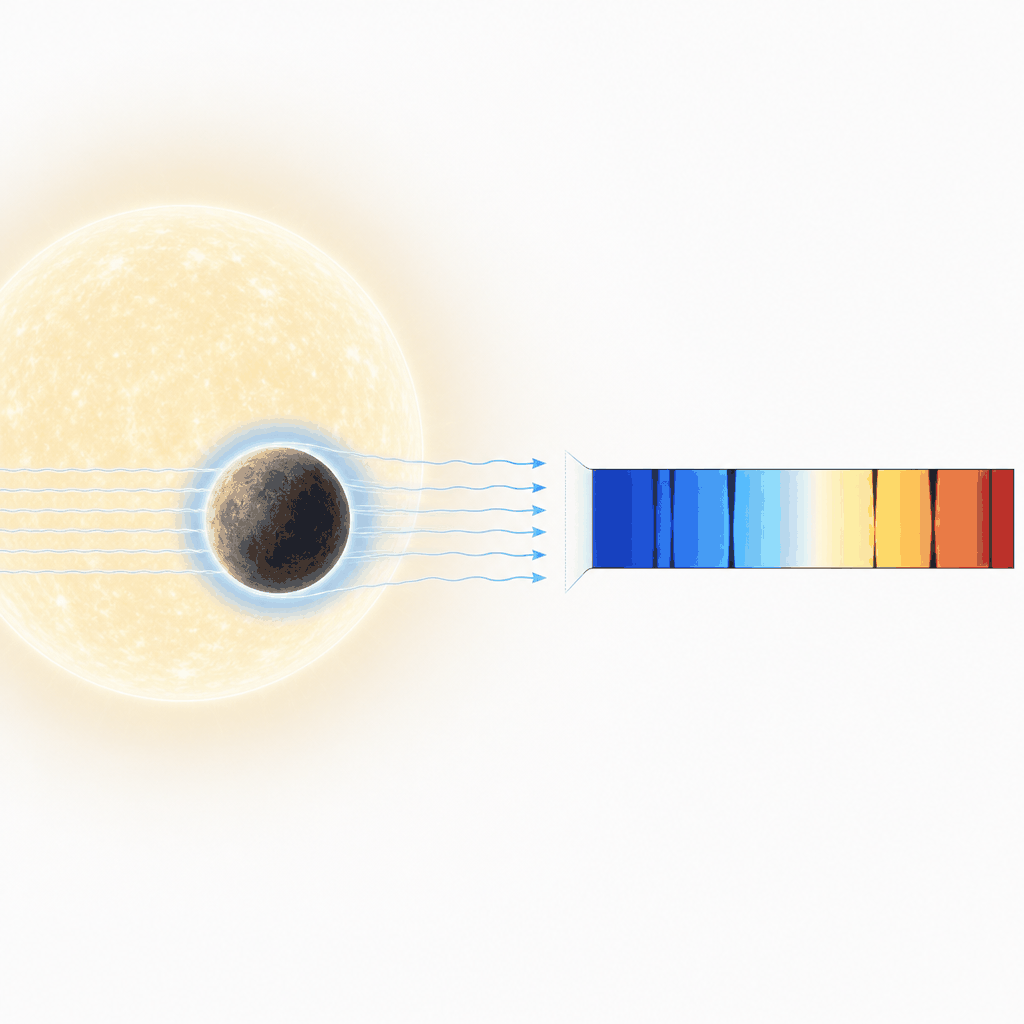
In 2024, the team used the Magellan Clay telescope at Las Campanas Observatory in Chile, equipped with a near-infrared spectrograph called WINERED, to capture the faint signature of starlight passing through the planet’s atmosphere as LHS 1140b transited — passed in front of — its star.
Specifically, they detected an absorption signal from helium atoms at a wavelength of 1083 nanometers. Helium is the universe’s second-most-abundant element; light and easily escaping a planet’s gravity. When the planet’s upper atmosphere is heated by the star’s X-rays and UV, helium atoms are excited, expand, and form a vast “exosphere” that blocks specific wavelengths of starlight during transit.
The signal was extremely faint. But the team ruled out every possible false positive — Earth-atmosphere contamination, stellar activity, instrument noise. Only one conclusion held: LHS 1140b has a slowly evaporating atmosphere.
Interestingly, in follow-up observations in 2025 the helium signal vanished. That didn’t overturn the conclusion — it reinforced it. Helium escape varies over time, depending on the star’s current activity and the planet’s orbital position. A false signal wouldn’t show up and disappear like that.
Four: Why Is an Atmosphere the “Holy Grail”?
In my reading, the search for extraterrestrial life has three nested hardware requirements:
Layer one, a rocky surface. Life needs solid ground; it can’t live on a gas ball.
Layer two, liquid water. You need the right temperature band — too close and it boils off, too far and it freezes. That pins down the “habitable zone.”
Layer three, an atmosphere. Without one, water sublimes straight into space. Mars once had oceans and atmosphere, but when its magnetic field decayed and the solar wind stripped its air away, liquid water vanished, leaving a barren red desert. An atmosphere performs triple duty: it traps heat (greenhouse effect), shields radiation (the ozone layer’s job), and maintains pressure (keeping water liquid).
Before LHS 1140b, astronomers had only detected atmospheres on gas giants (hot Jupiters) and sub-Neptunes — places with no ground to stand on, let alone life. A handful of promising rocky planets — the seven TRAPPIST-1 siblings, the famous K2-18b — either had no atmosphere at all or signals too weak to confirm. JWST’s read on TRAPPIST-1d summed it up in one line: no atmosphere, bare rock.
So the significance here isn’t “we found life” — helium has nothing to do with life. Its significance is: for the first time, humanity has proven that in these distant worlds, air genuinely exists. It’s a breakthrough of “possibility.” It tells us the “rocky + habitable temperature + atmosphere” combination really does occur in the universe.
Five: Thirty Years to Find This One — The “Villain” Is the Universe Itself
I want to spend a moment on the flip side: why did it take so long?
The first exoplanet was found in 1995. In the three decades since, astronomers’ toolbox kept upgrading — from the Keck telescopes on the ground to space-based Kepler and TESS, to the $10-billion JWST. Exoplanets ballooned from single digits to over six thousand.
But detecting a rocky planet’s atmosphere is a problem of a different order of magnitude. The reason is simple: rocky planets are small, their atmospheres smaller still, and the signal is so weak it’s nearly drowned in the star’s glare. If observing a hot Jupiter’s atmosphere is “finding a candle beside a searchlight,” then observing a super-Earth’s atmosphere is “finding a match beside a searchlight.”
Add to that the violence of red dwarfs themselves — young ones are extremely active, flaring constantly with intense X-rays that can strip a nearby planet’s atmosphere bare. That’s why many astronomers previously assumed: even if a rocky planet around a red dwarf once had air, it was long since blown away.
But LHS 1140b’s host star is the exception — it’s extraordinarily quiet. Astronomers call it an “inactive red dwarf,” with very few flares and low radiation. It’s precisely this gentleness that let its planet keep its atmosphere. A Hacker News user, mr_toad, nailed it: “The host star is described as very inactive, which is probably why the atmosphere has been retained.”
This is the universe’s “villain”: sheer vastness itself. We’re like someone standing at the shore trying to count every grain of sand — six thousand planets is only the beginning, and it took us thirty years to find the first rocky, habitable, atmospheric one.
Six: A Rare HN Consensus: Only Excitement, No Controversy
This news hit Hacker News with 345 points and 219 comments — phenomenal heat for an astronomy topic. But the comment-section mood was even more striking.
Usually, any “breakthrough” story on HN draws a flood of skeptics. This time, I read all 219 comments and found a rare consensus: everyone conceded it was a big deal; the only disagreement was over “how big.”
Of course, the level-headed voices were there. User tulio_ribeiro noted: “I hadn’t realized rocky planets in red dwarf habitable zones could retain an atmosphere under intense stellar stripping.” Another user, metalman, cautioned that if the planet really is tidally locked, its dark side would be cold enough to freeze nearly every gas — only helium, with its extremely low boiling point, stays gaseous — “a dead world in a hard vacuum.”
Others invoked Venus to cool the enthusiasm: Venus, too, is a terrestrial planet with an atmosphere, also inside the Sun’s habitable zone — yet its surface temperature hits 465°C, its pressure is 92 times Earth’s, and it rains sulfuric acid. An atmosphere doesn’t equal life.
But these doubts never turned into arguments. They read more like the instinctive reaction of engineers and scientists, thrilled but checking their assumptions, listing the possibilities, then going back to being thrilled.
A user named danieltk76 left a short comment that maybe speaks for most:
“I hope to find other animals on another planet in my lifetime.”
Seven: What Next?
Finding helium is only the first step.
Cherubim’s team has a clear next goal: deeper observations with JWST, hunting for heavier molecules — water vapor, carbon dioxide, methane. These are the “biosignature” gases tied to life. Finding the right combination in LHS 1140b’s atmosphere would be a truly historic moment.
But this path won’t be fast. JWST observation time is brutally scarce — astronomers worldwide queue and compete at over 10-to-1. LHS 1140b’s transit period is just 24.7 days, leaving only a few observation windows each year. And a super-Earth’s atmospheric signal is so faint it needs many stacked observations to extract meaningful data.
There’s an even grander perspective. LHS 1140b is only the first rocky habitable planet confirmed to have an atmosphere. Right now astronomers are pursuing multiple similar targets in parallel — the TRAPPIST-1 system, Proxima b, and the steady stream of new candidates from TESS. Once the first door opens, the second and third will come faster.
If the past thirty years were humanity’s era of “finding planets,” then from July 16, 2026, we’ve entered the era of “examining planets.” We no longer just count stars — we’ve started to smell them.
Finally, back to the oldest question: is there other life in the universe?
I don’t know the answer. But on an ordinary Thursday in the summer of 2026, humanity took the single most important step toward answering it. We now know that, at least on one rocky world 48 light-years away, the air is there. With air, anything is possible.
References:
- BBC News: “First atmosphere found on Earth-like planet in habitable zone of distant star” (Pallab Ghosh, July 17, 2026)
- The Guardian: “Earth-like exoplanet found to have an atmosphere” (Nicola Davis, July 16, 2026)
- Original paper: Cherubim et al., Helium escaping from the atmosphere of a nearby rocky exoplanet, Science (2026)
- Hacker News discussion: https://news.ycombinator.com/item?id=48947560 (345 points / 219 comments)
- NASA Exoplanet Catalog: https://science.nasa.gov/exoplanet-catalog/lhs-1140-b/
- arXiv preprint: https://arxiv.org/abs/2607.14326
- Harvard-Smithsonian CfA press release: https://cfa.harvard.edu