
In September 2026, a study published in the Monthly Notices of the Royal Astronomical Society (DOI 10.1093/mnras/stag1527) presented a striking quantitative scenario: in its infancy, our Sun may have swallowed a super-Earth between 5 and 10 times the mass of Earth. Developed by Professor Mutlu Yildiz of Ege University in Turkey, this quantitative model seeks to resolve multiple observational puzzles that have challenged astrophysicists for decades.
When astronomers survey other star systems, they frequently find large super-Earths in close-in orbits. Yet our Solar System conspicuously lacks planets in this intermediate mass range between Earth and the ice giants. At the same time, when astrophysicists look closely at the Sun itself, they encounter two persistent discrepancies that standard stellar evolution models have long failed to explain.
Two Long-Standing Anomalies Expose Cracks in Solar Models
The first anomaly emerges from helioseismology. By measuring minute acoustic oscillations on the solar surface, astrophysicists infer the Sun’s internal physical state, mapping how sound speed varies with depth. Helioseismic data reflects the propagation speed of acoustic waves across layers of differing plasma densities, where subtle variations in sound speed trace the distribution of matter. Standard stellar evolution models consistently struggle to reproduce the sound-speed profile just below the convection zone. The theoretical values generated by these models maintain a persistent, statistically robust deviation of several percent from actual observational measurements.
The second key anomaly is the Sun’s well-known surface lithium depletion. Lithium is fragile in stellar interiors: once temperatures reach roughly 2.5 million Kelvin, it is destroyed through nuclear burning. The rate at which lithium disappears is intimately tied to the temperature at the base of the convective envelope. Observational data shows that the Sun’s surface lithium abundance is depleted far below the residual levels predicted by standard models. Existing standard models calculate an internal fluid mixing depth that is simply too shallow, failing to pull sufficient surface material down into the deeper, hotter burning zones early in the Sun’s history. Crucially, stellar modellers cannot easily deepen the convective envelope artificially without disrupting the overall energy balance of the star.
For years, researchers attempted to paper over these cracks by tweaking initial helium abundances or adjusting convective parameters, treating the deviations almost as observational noise or calibration uncertainties. Yet the simultaneous presence of two independent anomalies spanning distinct physical regimes points to a deeper reality: the standard evolutionary framework is missing a major restructuring event from our star’s early history.
A Five-to-Ten Earth-Mass Planet Fills the Missing Physical Gap
To identify this missing physical mechanism, Mutlu Yildiz turned to MESA (Modules for Experiments in Stellar Astrophysics), the open-source stellar evolution code. When dealing with extreme boundary conditions, MESA can track energy conservation and chemical abundances layer by layer across hundreds of thousands of evolutionary time steps. The research team used this robust framework to simulate the Sun’s evolutionary trajectory across diverse accretion histories, benchmarking every simulation against modern helioseismic constraints and observed surface elemental abundances.
The complex hydrodynamic calculations converged on a remarkably specific scenario: early in its history, the Sun engulfed a super-Earth between 5 and 10 Earth masses. Rocky planets in a protoplanetary disc possess a chemical composition dramatically enriched in refractory and heavy elements compared to the surrounding protostellar gas. Accreting a massive rocky planetary body early on leaves a profound and enduring chemical imprint deep within the star’s interior.
The simulations outline a clear physical picture. Because the planet was sufficiently massive and dense, it survived its transit through the Sun’s outer layers with minimal mass stripping. Only a dense, massive rocky core could penetrate entirely through the convective envelope, which spans tens of thousands of kilometers. As it plunged inward, its orbital kinetic energy converted into intense internal thermal energy. This impact altered the foundational density distribution of the solar interior and significantly enhanced localized convective mixing. In doing so, the model precisely bridged the theoretical gap in lithium depletion.
As Professor Yildiz stated: “Our new study suggests that a planet several times more massive than Earth may have fallen into the young Sun and left a lasting chemical imprint deep inside it.” With this finding, an astronomical event that might otherwise sound like science fiction was grounded in a rigorous, physics-based chain of empirical constraints.
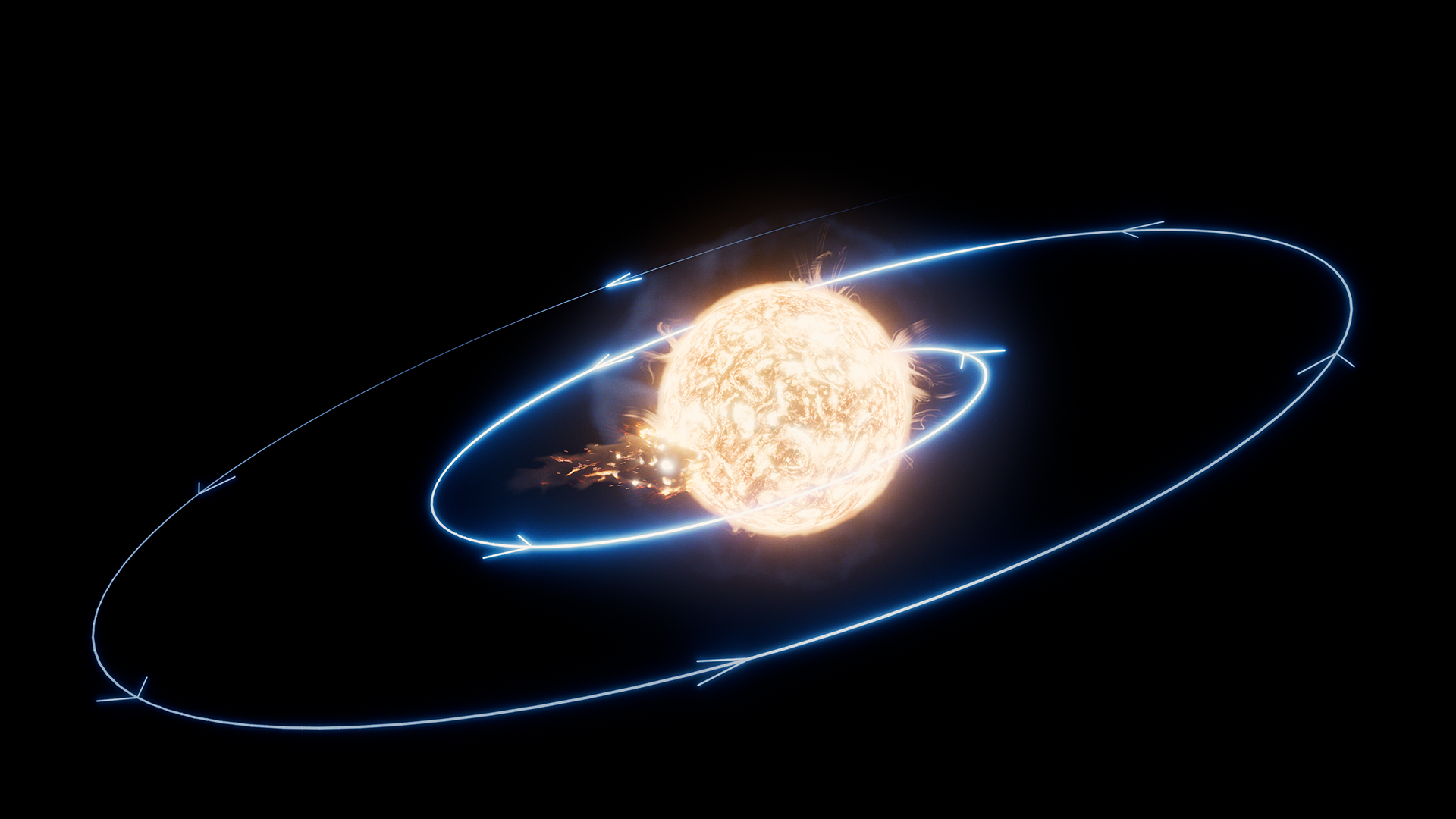 Figure: An artist’s impression of a star engulfing a planet. The blue line traces the inward spiral of the planet. Credit: NASA / ESA / CSA / Ralf Crawford (STScI), CC BY 4.0, Royal Astronomical Society
Exhausting Standard Parameter Tweaks Leaves One Viable Solution
The hypothesis that a massive planet plunged into the host star is built upon rigorous exclusionary testing. The research team did not set out to promote planetary engulfment from the start; rather, they systematically evaluated every conventional adjustment mechanism in mainstream astrophysics.
To establish that this was the sole logically consistent pathway, the team tested modifications to the equation of state, adjusted radiative opacity tables, and altered prescriptions for turbulent and convective mixing boundaries in the code. In traditional stellar physics, fine-tuning these core environmental parameters often suffices on paper to smooth over minor discrepancies between theory and observation.
Yet every conventional mathematical adjustment failed to resolve both problems simultaneously. Only the introduction of planetary engulfment could satisfy multiple independent, high-precision datasets at once. When all internal parameter adjustments proved insufficient, introducing the non-linear perturbation of an external planetary body emerged as the most parsimonious and physically self-consistent solution.
This mathematical certainty derived from extensive computational modeling surpassed the researchers’ initial expectations: “We thought planetary engulfment might affect the solar structure but did not expect the calculations to converge on such a specific super-Earth mass range.” The strong convergence of the simulations on this precise mass window provides a solid logical foundation for what was once speculative theory.
A Decade-Old Theoretical Proposal Enters the Empirical Era
The idea of a massive rocky planet losing orbital stability and spiraling into its parent star is not without precedent. A decade ago, Martin & Livio (2016) used protoplanetary disc hydrodynamics to outline a dynamical pathway for precisely this process.
Their dynamical models showed that super-Earths could readily form inside the present orbit of Mercury during the earliest stages of solar system formation. As gas in the protoplanetary disc cooled and dissipated, key orbital resonances broke down. Under intense aerodynamic drag from the gas disc, these inner planets lost angular momentum, spiraling inward through the disc and ultimately falling into the young Sun. This dynamical mechanism offered a compelling reason why our Solar System lacks the large super-Earths so common elsewhere in the galaxy.
However, while the 2016 paper demonstrated that such an event was physically plausible, it did not require that our Sun had actually swallowed one. The concept remained purely theoretical. Yildiz’s quantitative MESA simulations provide the missing empirical bridge: they show that if this event occurred, it left behind detectable structural and chemical signatures inside the Sun that modern instruments can search for.
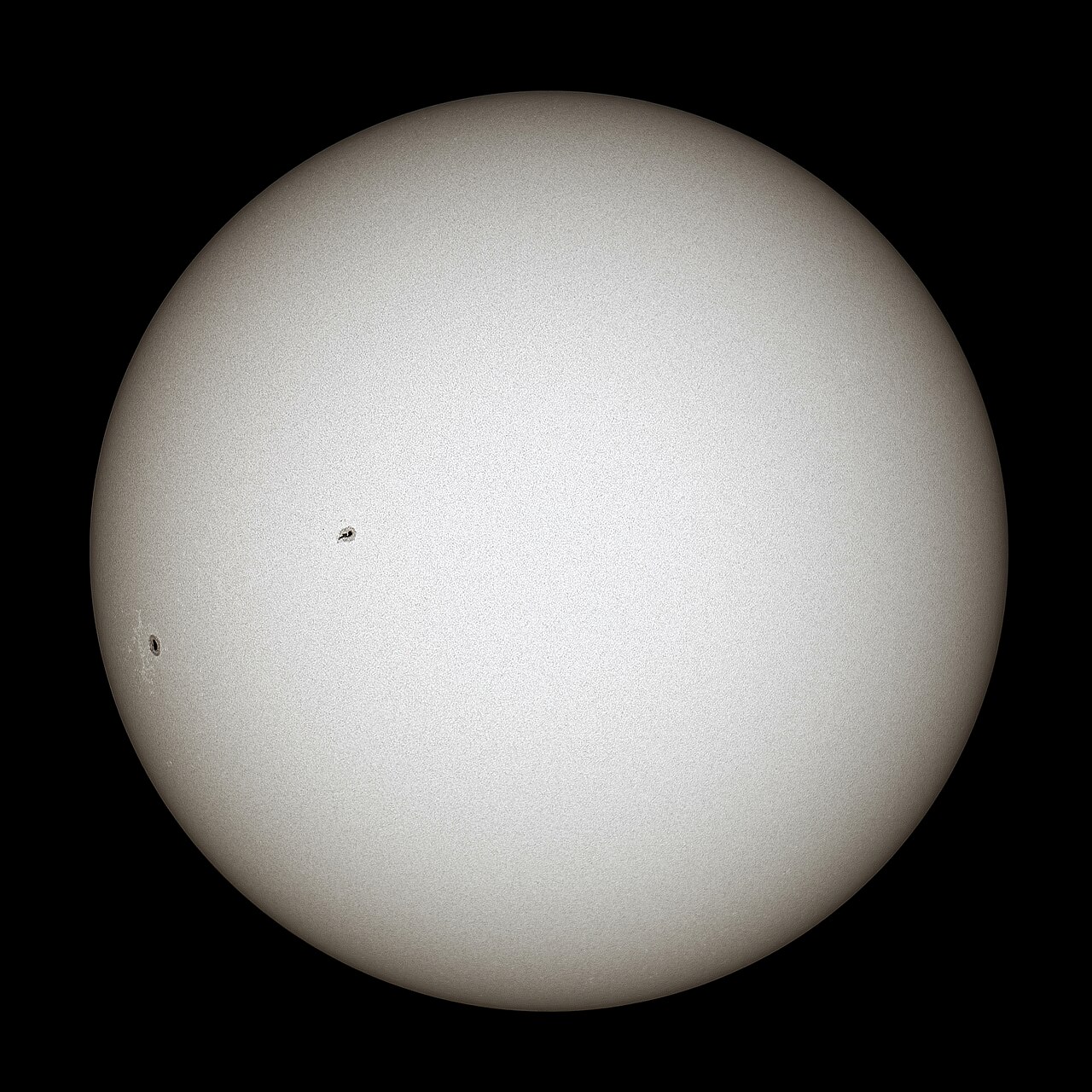 Figure: The Sun observed in white light: serene on the surface, yet potentially harboring relics of an ancient collision deep within. Source: Wikimedia Commons
Probing Deep Solar Profiles for Evidence of a Billions-Year-Old Collision
The true value of any scientific model lies in providing clear, actionable, and falsifiable observational tests. The findings from this latest simulation work operate within defined physical boundaries. In the paper’s conclusion, the author openly acknowledges the limitations of current observational capabilities, noting that definitive direct proof that the Sun swallowed a planet may remain difficult to secure with existing tools.
Nevertheless, Professor Yildiz outlined a concrete observational roadmap: “The next step is to see if these fingerprints can be independently detected.” At present, the findings represent the optimal mathematical solution of stellar models under strict boundary conditions. The astrophysical community must now turn to real telescope data to independently verify the location and magnitude of these chemical fingerprints.
Whether our star truly consumed a super-Earth billions of years ago will ultimately be decided by next-generation instruments. If future high-precision space-based helioseismology missions or advanced spectrometers can isolate these subtle heavy-element signatures from background solar noise, astronomers will hold direct proof of a collision that irrevocably altered the history of our Solar System.
A Falsifiable Scientific Hypothesis Unifies Two Isolated Anomalies
Retracing the interdisciplinary chain of reasoning in this paper reveals the rigor and objectivity of modern astrophysics when confronting conflicting observations. Rather than ignoring the gap between theoretical models and real measurements, the research team adopted a macro-scale planetary engulfment mechanism to unify these long-standing, disparate data points.
This work does not claim to deliver a hasty verdict. Instead, it offers a quantitative framework that couples two solar anomalies that have stood isolated for decades. Its genuine scientific value lies in its explicit falsifiability.
The model not only reconciles helioseismic sound-speed differences and low surface lithium abundance, but also provides an engineering-grade hypothesis for why our Solar System lacks a super-Earth. If future deep solar profiles fail to detect the predicted chemical signatures, the hypothesis will properly yield to other theories. But if that long-dormant fingerprint is confirmed deep within the Sun, science will have completed one of the most dramatic missing chapters in the early evolution of our planetary system.
References:
- Royal Astronomical Society Press Release
- MNRAS Paper (DOI 10.1093/mnras/stag1527)
- Hacker News Discussion (item?id=49683033)
- Martin & Livio (2016)