On July 20, 2026, security researcher Adam Kues opened the GPT-5.6 Sol Ultra API console. He spent $25 in API credits, had the AI read through WordPress’s source code, and a few hours later, the model found a vulnerability that could remotely compromise any WordPress site — the same class of bug exploit brokers price at $500,000 on the gray market.
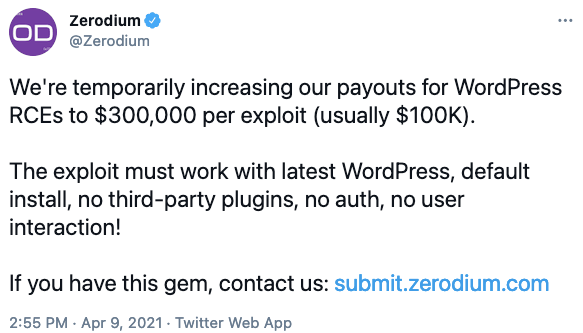
The story quickly sparked 209 comments on Hacker News. Some questioned whether anyone would actually pay $500K for such a bug. Others noted that Zerodium’s public acquisition price for a WordPress RCE was already up to $300,000 back in 2021. But everyone agreed on one thing: the cost structure of vulnerability research is being fundamentally rewritten by AI.
The core question: how does AI collapse the cost from $500K to $25?

Traditional Bug Hunting: An Elite Craft
To understand why $25 is so astonishing, you first need to understand why traditional vulnerability research is so expensive.
Before AI, finding a WordPress-level 0-day required three things: deep technical expertise, months of time, and exhaustive patience. A top security researcher needs to read through hundreds of thousands of lines of PHP code, understand WordPress’s request processing pipeline, database interaction layer, caching mechanisms, REST API framework — each line a potential breakthrough, each line also a potential dead end.
This is fundamentally an elite craft. The number of researchers worldwide who can consistently produce high-value 0-days probably doesn’t exceed four digits. Their time is extremely expensive — a full-time vulnerability researcher’s annual salary typically ranges between $150,000 and $400,000.
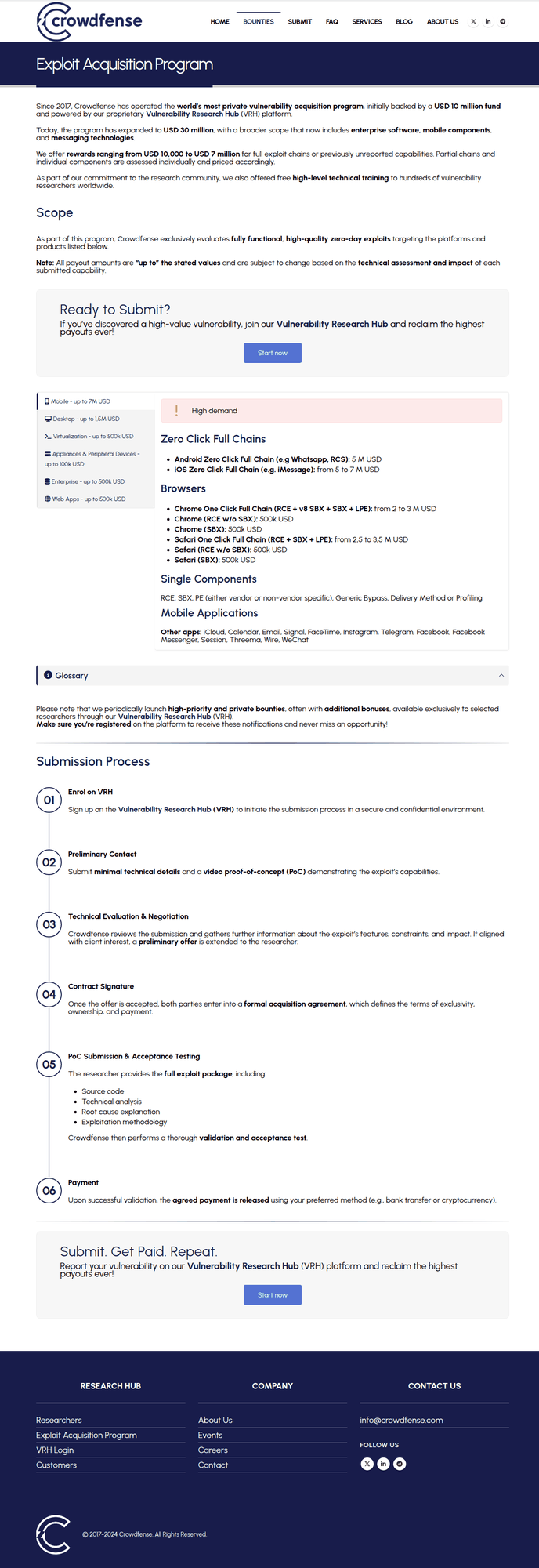
This creates a stable economic model: few bugs → few researchers → high prices. Zerodium’s 2021 acquisition price for WordPress RCE was $300,000; Crowdfense’s 2026 acquisition program still lists web application bugs at a maximum of $500,000.
AI Bug Hunting: From Craft to Scalable Experiment
Adam Kues’s approach completely upends this model.
He didn’t read the code manually. He did three things: first, downloaded the latest WordPress source, stripped the .git directory (preventing the AI from peeking at version history); second, adapted OpenAI’s “multi-agent collaboration” prompt — originally designed for solving math problems — into a vulnerability research version, instructing the AI to spin up up to 4 analysis agents simultaneously, each exploring different attack surfaces (input parsing, character sets, file upload, serialization, cache race conditions, etc.); third, let the AI work for 6 hours.
Total cost: 50% of his weekly quota, roughly $25 at subscription rates.
The result? The AI discovered a chained vulnerability: WordPress’s batch processing API had a desynchronization bug between validation and execution — the validation ran against one request, but execution switched to the next request’s routing. Exploiting this desync allowed bypassing all parameter validation and injecting malicious SQL queries. More remarkably, the AI also found its own path from SQL injection to remote code execution, using WordPress’s caching mechanism and embedded features to forge database rows, ultimately gaining admin privileges through the theme customization change-set system.
From $25 in AI costs to a $500K market price — that’s a four-order-of-magnitude gap. This needs to be understood economically.
Why the Cost Drops by Four Orders of Magnitude
Three fundamental shifts are at work:
First, labor replicability. Traditional bug hunting is “one person, months of work.” The AI version is “one query, a few dollars, 6 hours of runtime.” The model can dispatch 4 “virtual researchers” exploring different directions simultaneously, and if one fails, spin up another with zero marginal human cost. This kind of parallel exploration is impossible for a human.
Second, brute-force coverage of the search space. Kues’s prompt had the AI attempt at least a dozen attack surfaces — from SQL injection to deserialization, from cache race conditions to file upload. A human researcher might need days to go from “guess an entry point” to “confirm feasibility.” The AI can complete that loop in tens of minutes, then autonomously decide which direction to probe next.
Third, breadth of knowledge. More remarkably, the vulnerability chain spanned five independent technology stacks: WordPress’s batch API validation logic, MySQL query construction, PHP object caching, oEmbed’s database writes, and WordPress’s theme customization permission model. Few security researchers are expert in all five domains simultaneously, but the AI had seen them all in its training corpus.
That said, a crucial engineering caveat: AI today excels at efficient combinations of known vulnerability patterns. Its real strength is chaining together “small problems” (validation desync, parameter type confusion, cache poisoning) into an attack chain. True “zero-to-one” vulnerability discovery — finding an entirely new attack surface — remains human territory.
The Controversy: Does Anyone Actually Pay $500K?
After the article went up, Hacker News commenters raised legitimate questions. One self-described industry insider wrote: “There’s zero evidence anyone would pay $500K for a WordPress bug. iOS or Android bugs are worth that because of the sensitive data involved. WordPress sites don’t hold anything valuable.”
But another user, kuroguro, pointed out that the price quote came from Crowdfense’s acquisition program, and that Zerodium had indeed offered $300,000 for WordPress RCE in 2021. They also noted that exploit brokers typically use staged payments — paying out in phases as the exploit continues to work — to prevent researchers from double-selling.
My take on pricing: $500K is closer to a “list price” than a “transaction price,” but it reflects exploit brokers’ strategic valuation of this bug class — especially given that WordPress powers over 40% of websites globally. A remote code execution vulnerability working on default configurations would generate substantial resale revenue for a broker.
But the controversy misses the bigger point: the “manufacturing cost” of something worth hundreds of thousands of dollars is visibly collapsing.
What This Means for Ordinary People
For readers who don’t write code, the signal is simple:
Cybersecurity is undergoing a “dimensionality reduction.” What only elite hackers could do before, a reasonably competent technical person with a good prompt can now attempt. The number of vulnerabilities will increase dramatically. Software vendors will face greater pressure to patch. The cadence of security updates will accelerate.
But the flip side: attackers will use AI too. If a white-hat researcher can find bugs with $25, so can black-hat hackers. The rules of cybersecurity are being rewritten — firewalls and intrusion detection systems only stop known threats, while AI can generate novel attack paths every day.
As for exploit brokers who built their business on exclusive bugs? They may need to rethink their pricing model. When a commodity’s production cost drops by four orders of magnitude, how long can its market price hold? One HN commenter delivered a sharp jab: “Since the prompt itself is being treated like scripture, maybe they should sell the prompt for $500K instead.”
The joke points to a real shift: in the age of AI, knowing what question to ask the AI may be more valuable than the vulnerability itself.
References:
- slcyber.io: Exploit brokers pay $500k for WordPress RCEs. I found one with GPT5.6 Sol Ultra and $25
- Hacker News discussion (item?id=48975665)
- Crowdfense: Exploit Acquisition Program
- SecurityWeek: Zerodium Offering $300,000 for WordPress Exploits