Ian Towle, a biological anthropology researcher at Monash University, published a study in the American Journal of Biological Anthropology proposing to collapse the three core hominin genera on the human family tree into a single unified genus. Textbooks currently divide near-human relatives into three separate genera: Homo, Australopithecus, and Paranthropus. However, extensive anatomical and genomic data comparisons conducted by Towle’s team reveal that these three traditional names were constructed around superficial anatomical similarities and fail to represent true phylogenetic bloodlines.
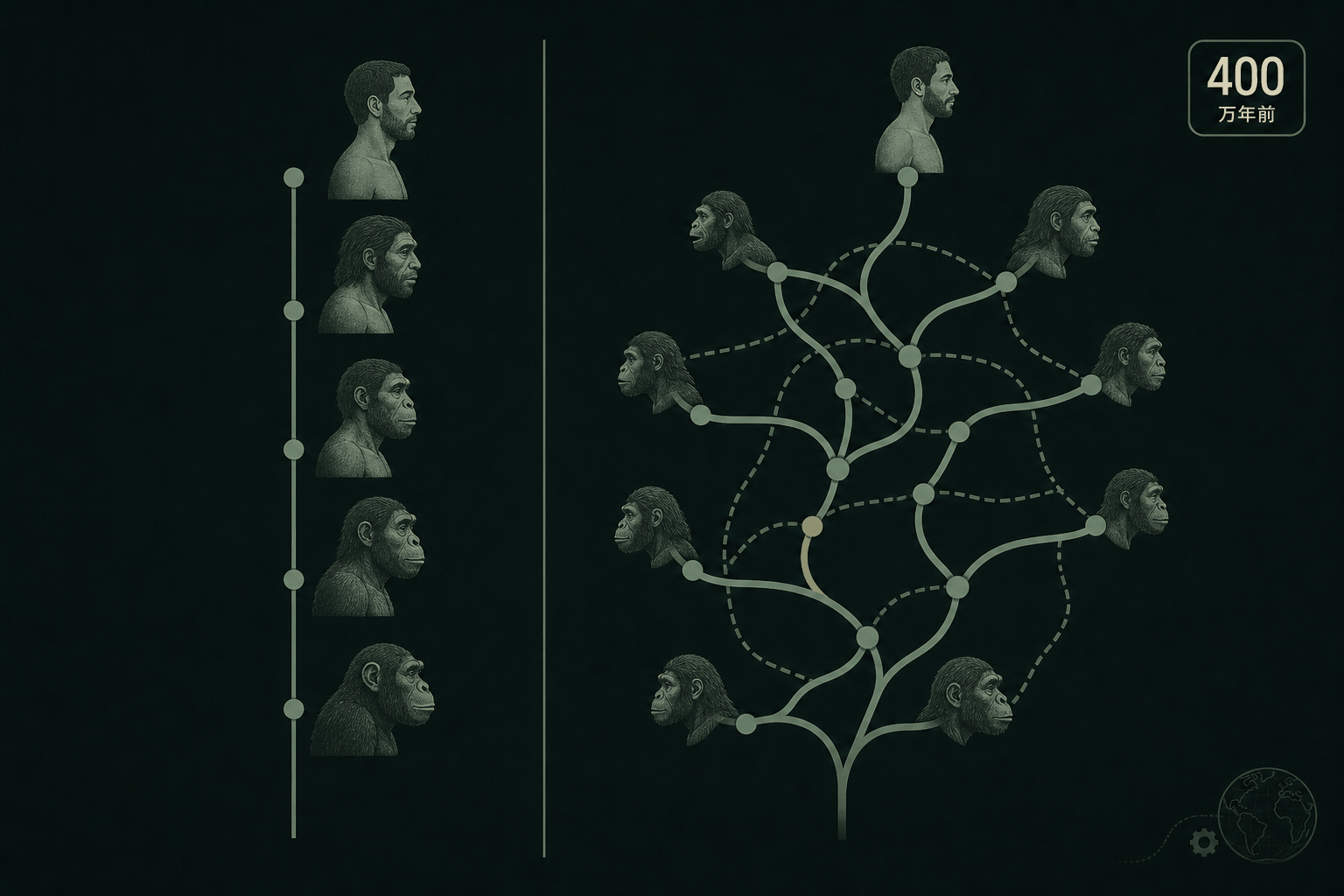
This proposed taxonomic shift strikes directly at one of modern paleoanthropology’s most deeply ingrained misconceptions—simplifying human evolution into a single linear relay from ape to human. For decades, popular illustrations depicted chimpanzee-like apes pacing along a straight line, passing through Australopithecus and Homo habilis, and eventually striding into modern Homo sapiens. Analyzing fossil evidence demonstrates that evolutionary history never followed a predetermined trajectory; merging the three genera marks the complete collapse of that linear illusion.
Beyond Textbooks: The Linear “Relay Race” Is a Taxonomic Illusion
By modern biological standards, a valid genus must constitute a monophyletic clade—meaning it must contain a single common ancestor and all of its descendant lineages. Traditional classification placed the famous “Lucy” skeleton into Australopithecus, hominins with massive jaws and giant molars into Paranthropus, and species with larger cranial capacities into Homo. This artificial method of partitioning species by survival strategy or physical appearance crumbles when subjected to large-scale phylogenetic computation.
Morphological calculations consistently show that Australopithecus lacks unified monophyletic ancestral traits. The category functions more like a human-made wastebasket taxon into which all bipedal hominins with moderate tooth size and average body proportions were dumped. The data reveals that certain species of Australopithecus are far more closely related to Homo than to other species within Australopithecus.
Base classification on physical similarity rather than shared ancestry directly violates the fundamental principles of systematic taxonomy. It is akin to grouping trucks and sedans into the same family simply because both feature four wheels and metal shells, while ignoring fundamental differences in chassis architecture and engine lineage. In the hominin fossil record, external physical similarities frequently obscure true genetic evolutionary pathways.
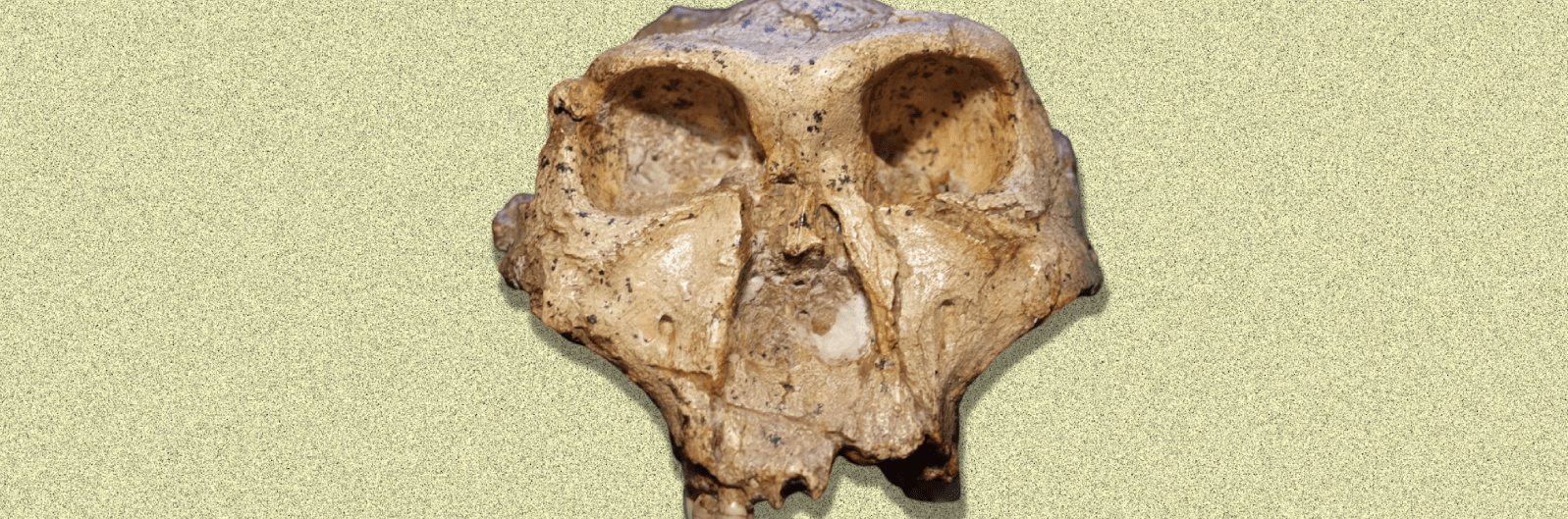 Figure: Comparison between the traditional linear evolutionary path and the complex, intertwined human family bush. Source: Nautilus / Ian Towle, CC BY
Shattering the Benchmark: All Three Hominin Criteria Have Failed
For decades, academia maintained explicit entry benchmarks for the genus Homo: a cranial capacity exceeding 600 cc, the demonstrated ability to manufacture tools, and a fully bipedal gait. These three criteria were enshrined in textbooks as the watershed separating “true humans” from “primitive apes.” However, fossil discoveries over the past twenty years have dismantled each of these artificial thresholds line by line.
Homo naledi, unearthed in South Africa, possessed a cranial volume of only about 500 cc—roughly the size of an orange—yet exhibited wrist and foot anatomies strikingly similar to modern humans. Meanwhile, Homo floresiensis (popularly known as the “Hobbit”), discovered on Flores Island in Indonesia, stood only about one meter tall with a brain volume under 400 cc, yet was found alongside sophisticated stone tool assemblages. This demonstrates that high intelligence and large brain size are not strict prerequisites for tool usage, as different body organs evolve at entirely independent paces.
Biology refers to this phenomenon as mosaic evolution (mosaic evolution), where distinct anatomical regions iterate at different speeds and in different directions. Anatomical data suggests that the earliest members of Homo likely evolved independently as small-brained species from multiple distinct Australopithecus lineages. Once artificial barriers like brain volume and tool manufacture are removed, Homo ceases to possess any unique diagnostic anatomical features.
The Dietary Myth: Paranthropus’s Large Molars Weren’t a Patent for Hard Foods
Another tough nut in hominin taxonomy is Paranthropus. Traditional views held that Paranthropus possessed extremely robust chewing muscles, sagittal crests, and colossal postcanine molars, representing a specialized evolutionary branch dedicated to cracking nuts and hard plant tissues. Because of this extreme ecological adaptation, paleoanthropologists long favored classifying them as an independent genus.
However, recent dental isotope and microwear analyses have upended this consensus. Isotopic spectrum testing revealed vast dietary differences between East African and South African Paranthropus, with neither relying on hard nuts as a primary food source. East African species primarily consumed C4 grasses, whereas South African species maintained a far more opportunistic, omnivorous diet.
This indicates that the massive molars, long venerated as a defining hallmark, were almost certainly parallel anatomical adaptations evolved independently by geographically isolated East and South African populations responding to their respective environments. Mistaking two independent local morphological adaptations for a single evolutionary branch directly caused structural distortion in the human family tree.
Lumping Hominins: Costs and Dividends of Redrawing the Family Tree
Given that anatomical, behavioral, and ecological evidence fails to support a three-way generic split, Ian Towle’s team proposes subsuming both Australopithecus and Paranthropus into Homo. In non-human primate and general mammalian taxonomy, any genus that fails to form a monophyletic clade is routinely revised or merged by law. Splitting human ancestors into three separate genera represents an anthropocentric privilege retained in paleoanthropology.
Collapsing these groups into a single, unified genus also neatly accounts for the frequent gene flow among hominin lineages over the past 4 million years. Paleogenomic studies confirm that early human branches engaged in inter-lineage hybridization throughout their evolutionary history. If these branches were split into strictly isolated genera, explaining their reproductive permeability and genomic introgression would be nearly impossible.
Naturally, revoking generic names carries academic inertia and pain. Field researchers are accustomed to using Paranthropus as shorthand for mega-toothed hominins, and Australopithecus for early transitional forms. However, taxonomic tools must serve phylogenetic reality; there is no need to preserve erroneous evolutionary illusions merely to accommodate linguistic habits.
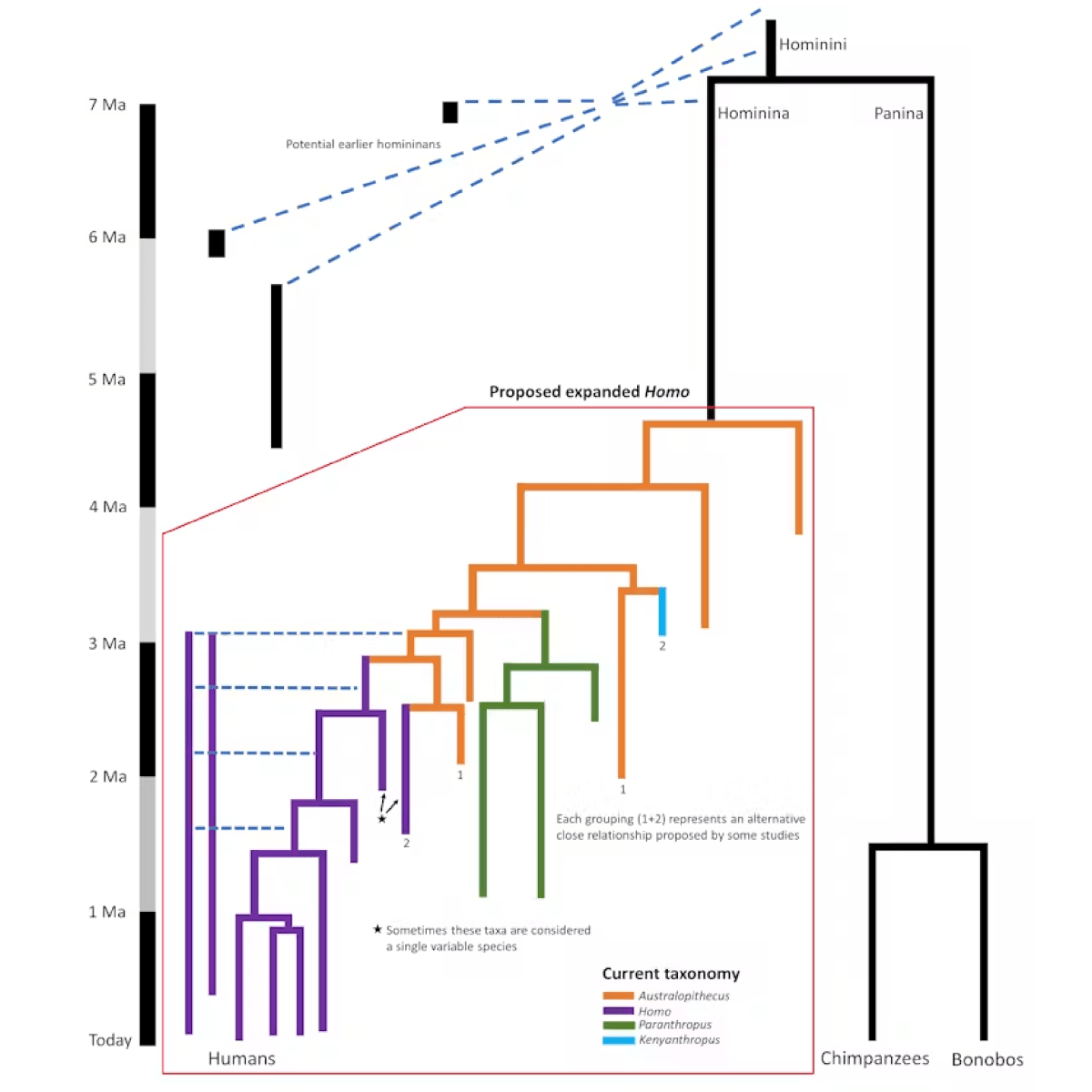 Figure: The newly proposed evolutionary tree structure in the paper, collapsing three traditional genera into a unified genus Homo. Source: Nautilus / Ian Towle, CC BY
Reclassifying Hominids: A Cognitive Leap from Hominidae to an Evolutionary Bush
Re-anchoring the human family tree in taxonomy is not without precedent. Only in recent decades did taxonomists formally recognize humans as members of the great ape family (Hominidae), alongside chimpanzees, gorillas, and orangutans. Similarly, the everyday word “monkey” does not constitute a valid clade in strict evolutionary biology, as New World monkeys and Old World monkeys are far more distantly related than Old World monkeys are to humans.
Beginning around 4 million years ago, the African continent experienced a massive adaptive radiation, giving rise to dozens of hominin populations with varying diets, brain capacities, and modes of locomotion. They resembled sprouting branches on a lush bush, each exploring survival strategies across oscillating drought and forest environments. Some branches developed heavy masticatory apparatuses, while others combined bipedalism with small cranial volumes, all while exchanging genes across crossing paths.
This unified framework reveals an expansive branch network, completely overturning the ladder-like narrative of a hero ascending to the pinnacle. Diverse anatomical forms were simply temporary combinations adapted to specific ecological niches; no single lineage possessed an inherent priority toward becoming Homo sapiens.
Conclusion
Redefining human evolutionary history is fundamentally a humble return to the complexity of life. Only when we stop forcing fossils into artificial three-genus boxes can we clearly perceive our ancestors—a mosaic of populations multiplying in parallel and interbreeding repeatedly over 4 million years. Modern Homo sapiens is not a chosen evolutionary destination; we are merely the last surviving oasis on a massive evolutionary bush, having stumbled through millions of years of harsh environmental filter.
Related links:
- Nautilus
- American Journal of Biological Anthropology
- The Conversation