A Roadside Bucket of Water Reveals an Evolutionary Blind Spot
On September 26, 2026, the lead story in the Science section of The New York Times documented a scene defined by stark contrast. Beneath a roadside pier along a highway in North Carolina, a handful of researchers casually dipped a bucket into brackish water and brought it back to an $80-a-night motel room. They had no cleanroom, nor a multimillion-dollar cryo-electron microscope—only an entry-level optical microscope purchased for roughly $300.
Yet that unassuming bucket of water held the key to one of evolutionary biology’s greatest mysteries. Under the lens, amidst a tangled soup of microbes, the team identified two entirely new species of amoebae: Paulinella marae and Paulinella murrayi. Prior to this discovery, only four photosynthetic species were known across the entire lineage. This single find expanded the roster of known photosynthetic species by 50%, filling in a pivotal missing puzzle piece on the eukaryotic tree of life.
The public often imagines that discovering new species demands deep expeditions into the Amazonian canopy or research vessels anchored over hydrothermal vents at the ocean floor. But this roadside bucket demonstrated how coarse humanity’s sampling of the microbial biosphere remains. In nature, microbial abundance can be remarkably low and cryptically distributed. Countless crucial evolutionary transitional states lurk right on the fringes of human civilization, overlooked merely because dense observation networks never existed to spot them.
This is far more than two new Latin names added to a taxonomic catalog. The breakthrough hinged on a physical nuance invisible to the unassisted eye: in their field of view, the researchers noticed that the protective siliceous scales covering the cells overlapped in opposing spiral directions—one clockwise, the other counterclockwise. That geometric symmetry breaking in scale architecture provided the crucial clue that cracked open the species divergence.
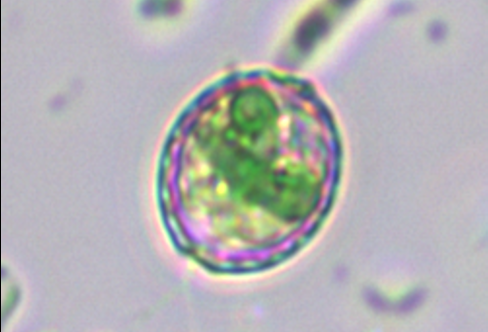 Figure: Microscopic morphology of the new species Paulinella murrayi, showing cell covered in siliceous scales. Source: Van Etten lab, University of Maryland
Twice in a Billion Years: Evolution’s Engulfment Paused in Real Time
To grasp the monumental significance of these two species, one must return to the most transformative threshold in cellular biology: primary endosymbiosis. This is the process whereby one cell engulfs another and, rather than digesting it as prey, domesticates and integrates it into a permanent organelle. Across billions of years of life on Earth, this cross-domain integration has succeeded and persisted into modernity only twice.
The first event gave rise to mitochondria, furnishing eukaryotic cells with extraordinary aerobic energy metabolism; the second gave rise to chloroplasts, empowering plants and algae to harvest sunlight. Both mergers took place well over a billion years ago. Over an eon of evolutionary time, rampant mutations, gene transfers, and structural shuffles have largely wiped clean the earliest mechanistic fingerprints of those transformations. Scientists have been forced to examine finished end-products, left to reconstruct what that rough, initial moment of capture might have looked like.
The Paulinella lineage represents the third known occurrence of this cellular drama. Its photosynthetic organelle—known as a chromatophore—originated only about 100 million years ago. Set against the billion-year tenure of canonical chloroplasts, 100 million years is an evolutionary flash, as if the clock was paused mid-stride. Studying Paulinella gives science a front-row seat to an organelle in the making: a slow-motion video recording of organelle genesis, replacing the guesswork of fragmented fossil records.
It preserves irreplaceable transitional features. The host amoeba is actively wresting genetic control away from the cyanobacterial endosymbiont, while the symbiont is steadily forfeiting its autonomy to live independently. This living snapshot fills an urgent mechanistic void: how an independent prokaryote is systematically tamed into a cellular subservient. Every genomic deep-dive into Paulinella provides an empirical blueprint reconstructing how ancient chloroplasts were forged over a billion years ago.
A $300 Microscope Unmasks Massive Genomic Rearrangements
The research team did not linger at the surface of morphology. In a paper formally accepted on July 27 by the Journal of Phycology, they unpacked the dynamic genomic evolution of these two new species. The researchers assembled complete chromatophore genomes and coupled them with mitochondrial datasets, mobilizing an international consortium spanning four nations and five institutions to conduct deep phylogenetic analyses.
The genomic evidence highlighted striking non-linear patterns of evolution. While the functional gene repertoire of the chromatophore remains exceptionally conserved across species, its structural architecture is turbulent, riddled with extensive genomic rearrangements and inversions. The conserved gene set safeguards the baseline machinery necessary for photosynthesis, whereas the massive structural reshuffling exposes how the symbiont’s chromosomes, severed from independent selective pressures, underwent violent breakage and repair.
Complicating matters further, the phylogenetic signals between nuclear markers and organellar data exhibited sharp incongruencies. Rather than dismissing this as technical artifact or laboratory noise, the authors attributed the discordance to substitution saturation, sparse taxon sampling, and conflicting evolutionary tempos between compartments. The host nucleus and its captured organelle are co-evolving, but dancing to distinctly different rhythms.
This rigorous chain of genomic insights began with a $300 optical setup. In technical discussions on Hacker News and biology forums, observers debated the baseline cost of meaningful microscopy. The authors pointed out that the $300 tier is fully capable of real taxonomic discoveries, with even higher-resolution options available just north of $400. The democratization of consumer optics is quietly eroding elite institutional monopolies, driving the initial screening costs for obscure biodiversity down toward zero.
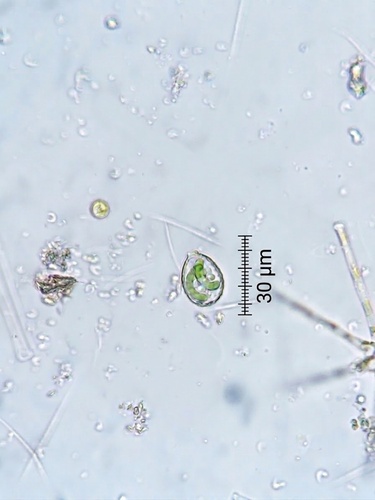 Figure: Living specimen of Paulinella chromatophora sampled from a lake in Armenia. Source: iNaturalist observation @lacrimas
As Federal Grants Freeze, Amateur Networks Take the Sampling Frontier
Equipped with nothing more than a lone microscope, this discovery might have ended as a fluke. What transformed it into a sustained scientific breakthrough was a fundamental pivot in research methodology. When German biologist Robert Lauterborn first documented Paulinella in a tributary of the Rhine on Christmas Eve in 1894, he relied on lone-wolf field excursions. Over the ensuing 125 years, formal academic literature yielded barely a trickle of sightings worldwide.
Yet in just the past five years, field sightings logged by amateur microscopy hobbyists have eclipsed the total volume of scientific literature published over that entire century and a quarter. Although these new species exist in low abundance, they persist reliably across widespread habitats. Combining institutional sampling with community data revealed a paradigm-shifting conclusion: photosynthetic Paulinella is very likely globally distributed. Its perceived rarity had simply been a byproduct of how narrowly academia had cast its net.
This distributed observation network is actively taking over the front lines of microecological prospecting. The Van Etten lab capitalized on this momentum by establishing the Paulinella Consortium, an initiative recruiting amateur naturalists to join the hunt. The project distributes identification guides and streamlines validation workflows. By standardizing community reporting, the consortium is linking thousands of idle microscopes sitting in garages and bedrooms into a planetary-scale biological sensor network.
This shift mirrors deeper structural strains within academic science. The reporting explicitly noted that sudden freezes in U.S. federal research grants caused severe disruption and frustration, effectively locking researchers out of conventional laboratories. Undeterred, they purchased equipment with personal funds and covered motel expenses out of pocket to reach field sites. Institutional austerity inadvertently catalyzed an external crowdsourced scientific model. Grant pipelines can be choked off, but distributed scientific curiosity and compute cannot be contained.
Inside an $80 Motel: The Antidote to the Big Science Era
The light glowing from that North Carolina motel room illuminates far more than an open-access paper. In our current era of capital-intensive “Big Science,” multi-billion-dollar particle colliders, supercomputer clusters, and flagship space telescopes monopolize public perceptions of scientific advance. These capital barriers often create the illusion that without colossal institutional war chests, frontier science cannot progress.
The discovery of Paulinella offers a compelling counter-narrative. It shows that in specific disciplines, the true bottlenecks are sampling breadth and observational tenacity. A $300 piece of consumer hardware coupled with an $80 lodging bill fundamentally lowered the threshold of exploration, extending knowledge generation into civic networks. When top-tier scientific thinkers interface with enthusiastic distributed communities, they unlock a research velocity that outstrips conventional institutional workflows.
Researchers across five institutions in four countries condensed a laboratory into a cheap roadside room, compressing 100 million years of evolutionary history into a single landmark paper. Rather than piecing together hypothetical origins of life from degraded billion-year-old fossil echoes, scientists can now observe live how a host cell captures, domesticates, and converts an organism into an organelle. And the entire journey began because someone simply filled a bucket with murky water at the side of a road.
Reference Links:
- The New York Times Science Report
- Journal of Phycology Paper
- Van Etten Lab Paulinella Consortium
- Hacker News Discussion