
The seaside community of Portobello in Edinburgh, Scotland, recently celebrated a major community milestone. Backed by funding from the Scottish Land Fund, local community group Action Porty purchased the town’s historic police station building, originally constructed in 1877. The stately stone landmark had worn many hats over its nearly 150-year history: beginning as a town hall and court for the Portobello burgh council, it was later repurposed into a public library and ultimately a working police station after the town was incorporated into Edinburgh.
Dozens of eager volunteers descended on the building with toolboxes, stripping away 1970s polystyrene ceiling tiles and peeling layers of wood-chip wallpaper to uncover its Victorian architectural bones. Yet amidst the flurry of renovation, an unexpected technical snag on the top floor stopped everyone cold: nobody had any idea how to change the time on the prominent clock tower. Action Porty took to the internet with an open plea, asking if anyone in the local community possessed the expertise to help keep Portobello on time.
When volunteer engineers grabbed their multimeters and ascended the steep ladders into the dust-choked attic, they did not find a rusted, seized-up cluster of gears. What brought the entire restoration to a grinding halt was something far newer: an undocumented electronic black box retrofitted around 2001, completely devoid of wiring diagrams or manuals.
 Figure: The exterior of the Portobello Police Station, built in 1877. Source: pointinthecloud.com
149-Year-Old Gears: Setting the Time Took Just Lifting a Pawl
Climbing up inside the clock tower revealed an original 1877 mechanical assembly operating on beautifully straightforward physical principles. A small electric motor drives a series of substantial gears that turn a central main shaft rotating exactly once per hour. This central shaft branches off physically in three directions, driving the minute hands on each of the building’s three external dials. Behind each dial, an additional gear reduction mechanism derives the position of the hour hand.
Victorian clockmakers essentially etched their maintenance manual directly into the physical geometry. To set the time, an engineer merely had to locate a small locking pawl resting on one of the primary gears and lift it out of the way. Once disengaged, the entire shaft spun freely by hand with almost no resistance. Even after nearly a century and a half of continuous wear, the operating logic remained transparent and completely self-explanatory.
Adjusting the hands inside the cramped attic did produce a brief, comedic panic. After turning the main shaft, the engineers watched through the glass and momentarily gasped, thinking the hands were running backward. Only after climbing down the ladders and standing on the street corner did they realize their blunder: they had been standing behind the translucent dials, looking out from the reverse side. Setting the time accurately from inside required a bit of three-dimensional mental projection, using the visible internal counterweights to deduce where the unseen hands pointed on the outside faces.
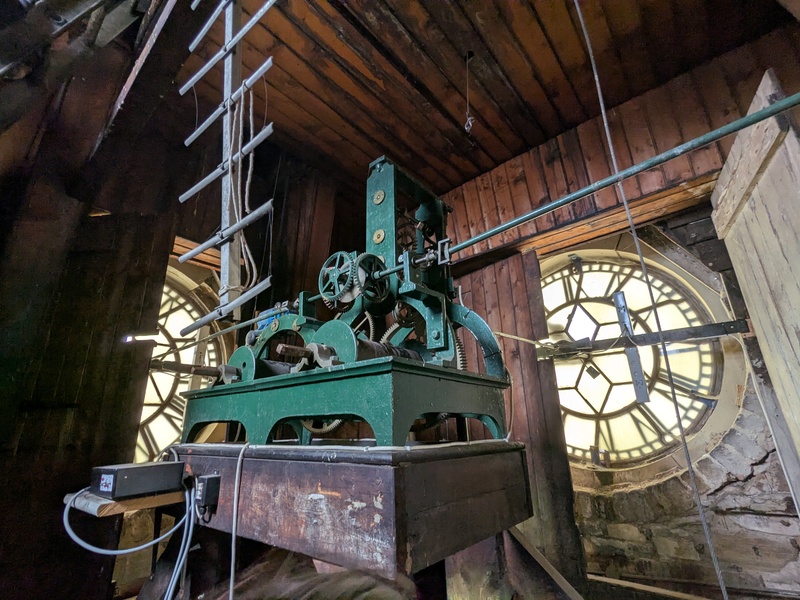 Figure: The clock mechanism inside the tower driving the three dials. Source: pointinthecloud.com
A 2001 Circuit Board Retrofit: Where System Logic Became a Black Box
While the pure mechanical timekeeping train remained fully functional, the real trouble lurked in the auxiliary modules added over the decades. Tracing the wiring from the bell-striking apparatus backward into the main electrical circuit, the engineers uncovered a nondescript gray control box.
Prying open the plastic casing exposed an electronics board centered on a PIC 16F628 microcontroller bearing a 2001 date code. It was flanked by relays, power supply components, and a dedicated charging circuit feeding a small lead-acid backup battery. After nearly a quarter of a century in service, this board displayed no manufacturer name, no part numbers, and not a single shred of documentation. As the author noted on his blog, nobody could tell whether it was an off-the-shelf commercial unit or a bespoke, one-off hobbyist build created specifically for this tower.
If a brass gear from 1877 chips or wears down, any competent mechanic can immediately observe how mechanical force transfers through teeth and axles. But when the software logic flashed into a microcontroller twenty-five years ago is lost, it is truly gone. An onboard status LED blinked an enigmatic, repetitive sequence of long and short pulses that no one could decipher. In the absence of original schematics or firmware source code, facility maintenance instantly degraded into technological archaeology.
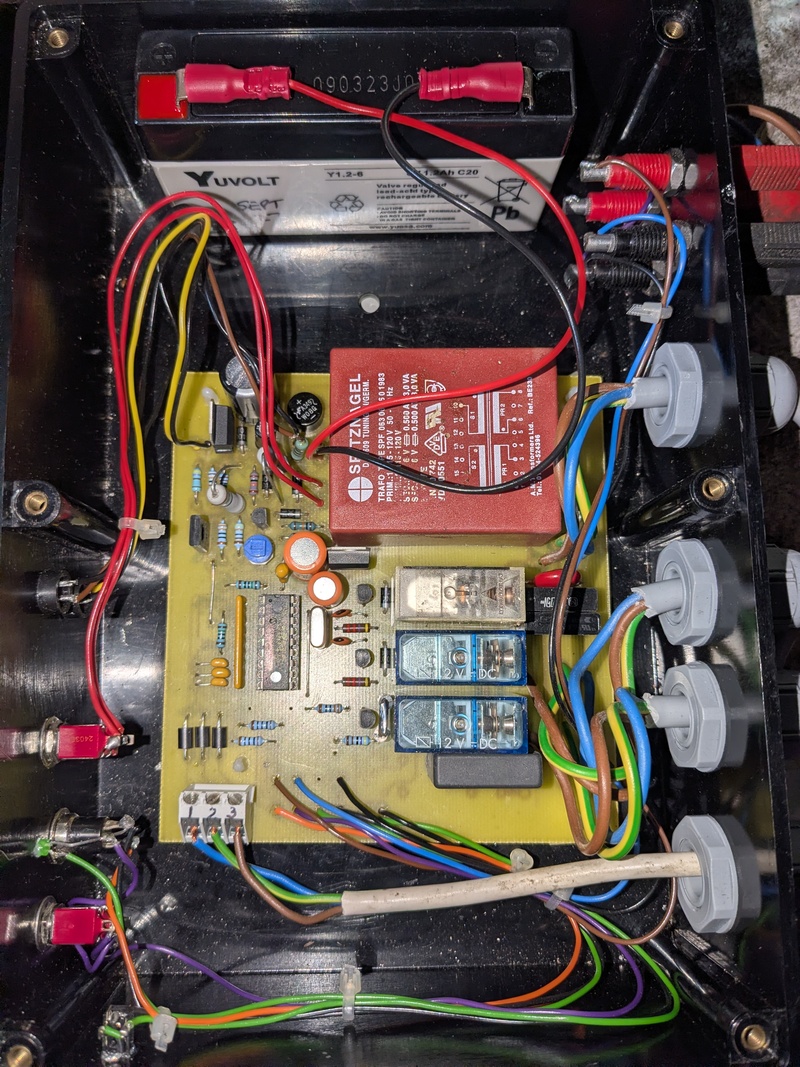 Figure: The unmarked control board inside the clock tower, housing a 2001 microcontroller. Source: pointinthecloud.com
Trial, Error, and an Unresponsive Button: Decoding the Chime
With no viable way to dump or decompile the firmware inside the sealed PIC chip on the spot, the engineers had to reconstruct the unit’s operating principles purely through external probes and brute-force experimentation. By tracing the physical wiring, they confirmed that the control box lacked a real-time clock chip of its own; all timing pulses were driven externally by a mechanical microswitch triggered once per hour by the revolving main shaft.
When the mechanical switch closes on the hour, the control box energizes a mains-powered electric motor that drives the bell striker. A secondary feedback switch on the striker counts the physical hammer blows and signals the microcontroller once the required number of strikes is reached, prompting it to cut power to the motor. The electronics possessed no abstract concept of calendar or daylight hours—only an internal hourly counter that ticked forward in lockstep with the mechanical gear train.
The sole human-machine interface on the entire enclosure was an unassuming push button labeled “advance”. Pressing it initially did nothing at all. Only after repeated fiddling did they uncover its idiosyncratic design: the button had to be held down steadily for several seconds. When released, the bell struck once; pressing and releasing it again advanced the internal strike counter by one hour. The only way to synchronize the strike count with the actual clock hands was blind trial and error—holding the button, waiting for the strike cycle to finish, and repeating the cycle until the number of chimes finally matched the hour shown on the dial.
Dust, Attics, and Explaining Yourself to Airport Security
Restoring aging civic infrastructure requires battling not only digital generational gaps but also grueling physical environments. Spotting clusters of small drill holes across the attic ceiling, some community members initially voiced concern about potential structural integrity issues. Experienced building restorers quickly cleared up the mystery: the perforations were merely remnants from when ceiling plasterboard was fastened to the underside of the rafters, while the structural attic floorboards rested firmly on the upper side, entirely independent.
Such dust-laden, sealed spaces can also spawn bizarre, unforeseen complications. In the technical community discussion following the project, one engineer recalled crawling through a similarly grime-encrusted 19th-century church attic to inspect communication equipment, then heading straight to the airport for an evening flight. During security screening, the automated explosive trace swab repeatedly flagged his carry-on bag, triggering secondary inspections that nearly caused him to miss his departure.
Airport explosive trace detectors (ETDs), built on ion mobility spectrometry (IMS), are exceptionally sensitive instruments that can register notable false-positive rates. They detect ionized chemical fragments—such as nitrates or glycerol compounds frequently found in antique plaster, masonry dust, fertilizers, and common cleaning agents—rather than confirming the presence of actual explosives. The repeated swabbing protocols are designed to purge sensor contamination or rule out instrument false positives, rather than an arbitrary attempt to “keep swabbing until it passes.”
Undocumented Retrofits: Far More Dangerous Than Mechanical Wear
After an entire afternoon of tinkering, the minute hand swept past the twelve at 4:00 PM, and the bell faithfully sounded four loud, resonant chimes. The engineer jokingly suggested setting the striker to ring thirteen times to replicate the dystopian opening of George Orwell’s 1984, but sensible community members gently talked him down. In light of potential complaints from nearby residents about late-night ringing, the restoration team ultimately decided to unplug the striker motor’s mains supply for the time being.
With the clock hands running on time once more, the volunteers gathered for celebratory pints and burgers across the street, brainstorming playful future enhancements: wiring the chime into a front-door buzzer, or replacing the dated fluorescent backlights with programmable RGB LED strips to celebrate holidays.
The saga of the Portobello clock captures the profound cultural fissure between technological eras: how long a system survives depends far less on whether its moving medium is machined brass or etched silicon, and far more on whether its architecture remains transparent to future caretakers.
When civic groups inherit public infrastructure, physical component wear is rarely the fatal blow. An undocumented electronic retrofit instantly severs system maintainability. A damaged gear can be measured with calipers and reproduced on a lathe; but when proprietary logic vanishes inside an unrecorded silicon black box, the moment its original designer walks away, it leaves behind an intractable puzzle for everyone who follows.
Reference Links:
- Action Porty Community Appeal
- Original Write-up on pointinthecloud
- Hacker News Community Discussion