
In early October 2026, the world’s most widely referenced placeholder web page, example.com, underwent two successive overhauls within just three days. A site originally built to serve a single line of plain text not only abandoned its pure static HTML architecture, but offloaded the rendering of its primary documentation to an external JavaScript file. In an era where web performance is measured down to the millisecond, a canonical documentation domain contorted itself into a dynamic component requiring external dependencies—all to chase marginal bandwidth savings.
Across the broader Internet, example.com is rarely treated as a destination for casual reading. Its sole purpose is to serve as a universal placeholder across RFC specifications, technical documentation, and setup manuals. When developers configure Nginx or test DNS resolution, boilerplate snippets from official documentation are frequently copy-pasted directly into configuration files. If an engineer forgets to replace the placeholder with their production address, those requests strike IANA’s servers directly. The vast majority of incoming traffic is not human; it consists of automated test suites, health check probes, and misconfigured bots incessantly scraping the page.
In an email reply on September 30 to developer Oliver Dunk, IANA Vice President Kim Davies laid out the primary motivation behind the overhaul: reducing the aggregate bandwidth required to serve the domain. This skewed traffic distribution creates operational trade-offs vastly different from conventional websites. When the overwhelming majority of visitors are simple machine scripts that never request secondary assets, stripping out the explanatory text from the root HTML payload prevents billions of bytes of unnecessary transit. Keeping that text behind an external asset effectively acts as a protocol-level degradation targeting non-browser clients.
Static Architecture Yields to External Dependencies
Before September 28, the page preserved its intuitive, time-tested simplicity. It was a pure static HTML document whose body contained little more than an Example Domain heading, a concise advisory notice—“This domain is for use in documentation examples without needing permission. Avoid use in operations.”—and a “Learn more” hyperlink pointing to IANA’s official website. That advisory had only been added to the page within the past year. Around 2020, the wording was a longer sentence granting permission for literature, while before 2015 the language had been even more permissive.
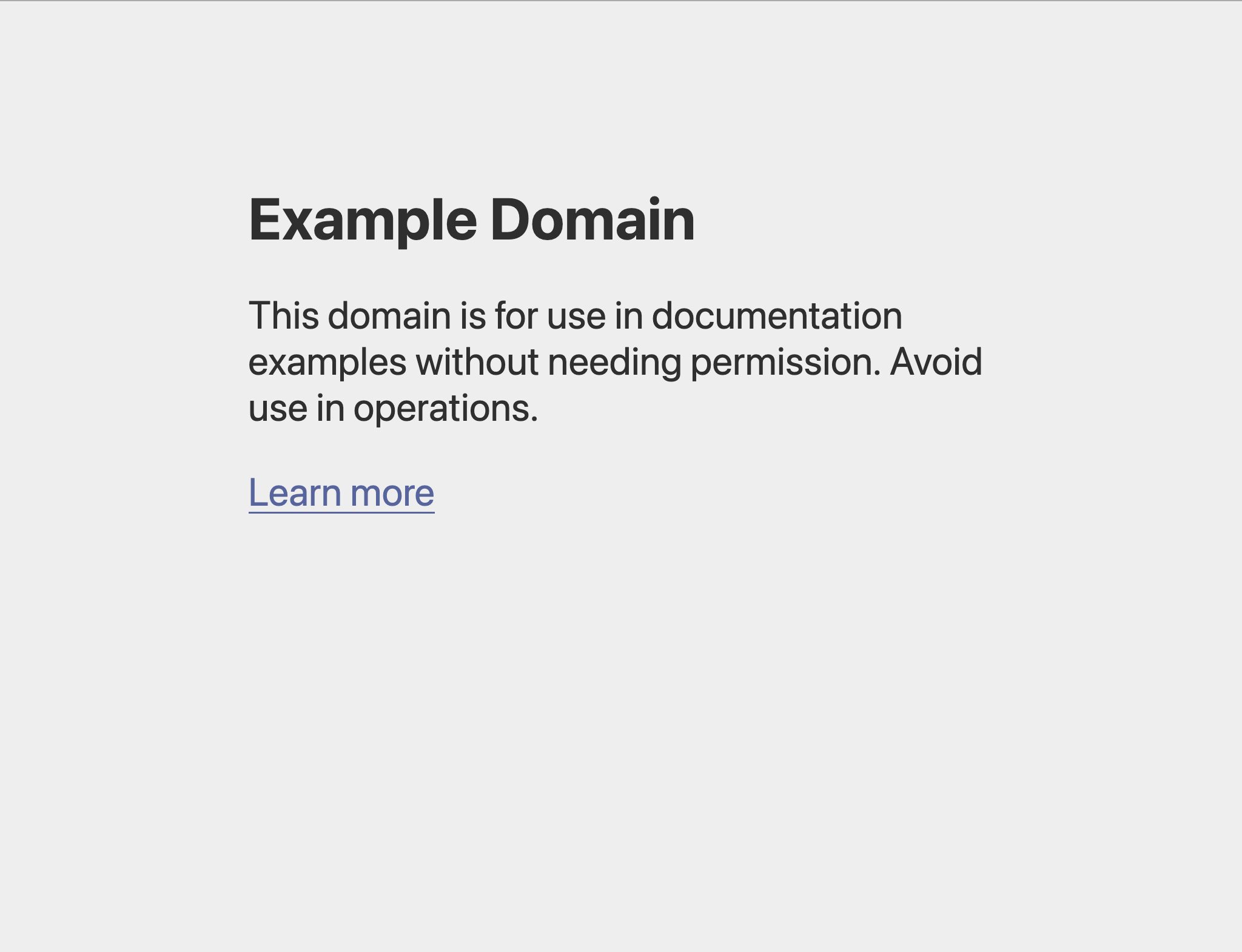 Figure: The archived September 28 version, displaying “Avoid use in operations” and “Learn more”. Source: Henry Catalinismith’s blog
That streamlined DOM structure had long stood as a benchmark for baseline infrastructure responsiveness. An HTTP payload of mere dozens of bytes, paired with instantaneous browser parsing, meant the page rendered effortlessly under any network condition. For sysadmins troubleshooting firewall egress rules, curling the domain from a terminal and seeing full plain text return was the cleanest proof of connectivity. If a minimalist static structure had carried production traffic reliably for decades, introducing dependencies on external assets inherently introduced architectural complexity and fragility.
A 3.2-Millisecond Delay That Broke Copy-Paste
In late September, IANA deployed its first redesign. The update introduced a contentious rendering mechanism: every single text character was wrapped in an individual tag, each configured with an incrementally staggered animation delay. Glyphs faded in sequentially from complete transparency. Developers inspecting the DOM tree in online forums noticed that the per-character delays were calculated with mathematical precision: 0ms, 3.20513ms, 6.41026ms, and so on.
Fading in text at roughly 3.205 milliseconds per glyph produced a faux typewriter visual effect. While micro-interactions have their place on consumer landing pages to convey polish, forcing render-blocking animations onto a core infrastructure placeholder was entirely at odds with its purpose. Fracturing dozens of characters into stateful DOM node clusters turned what once required a single paint operation into an unnecessary frame-rate drag on the browser’s rendering pipeline.
Hijacking the browser rendering pipeline triggered immediate regressions. Most egregiously, text could not be selected with a cursor during or even after the fade-in animation completed, completely breaking standard copy-and-paste workflows. Frontend engineers promptly archived the broken state, classifying it as a violation of WCAG 2.2.2 criteria (Pause, Stop, Hide). A multi-second, unskippable animation with no user controls created a hostile, disorienting experience, particularly for users with vestibular disorders.
Stripping Core Text for a 2.15 KB Roundtrip
Facing intense pushback from the technical community, IANA rolled out a second revision on October 3. Fetching the current page source via curl reveals a stripped-down skeleton:
<p>This domain is for use in documentation examples without needing permission. This is not a service; avoid relying on it for testing and monitoring purposes.</p><script src=/s.js></script>The per-character typewriter animation has been eliminated. The dense swarm of single-character tags and staggered animation delays are gone, but the fundamental decision to offload documentation text into an external asset remains.
The external script carrying the remaining page content spans 1,579 characters. Its client-side responsibilities are straightforward: first, it injects translated explanatory blurbs across five languages—Arabic, Chinese, French, Russian, and Spanish—and appends a “Learn more” link. Second, it inspects system language preferences (navigator.languages) to dynamically reorder and promote the matching language blurb to the top of the list. Finally, it injects a stylesheet and an inline SVG book icon into the document.
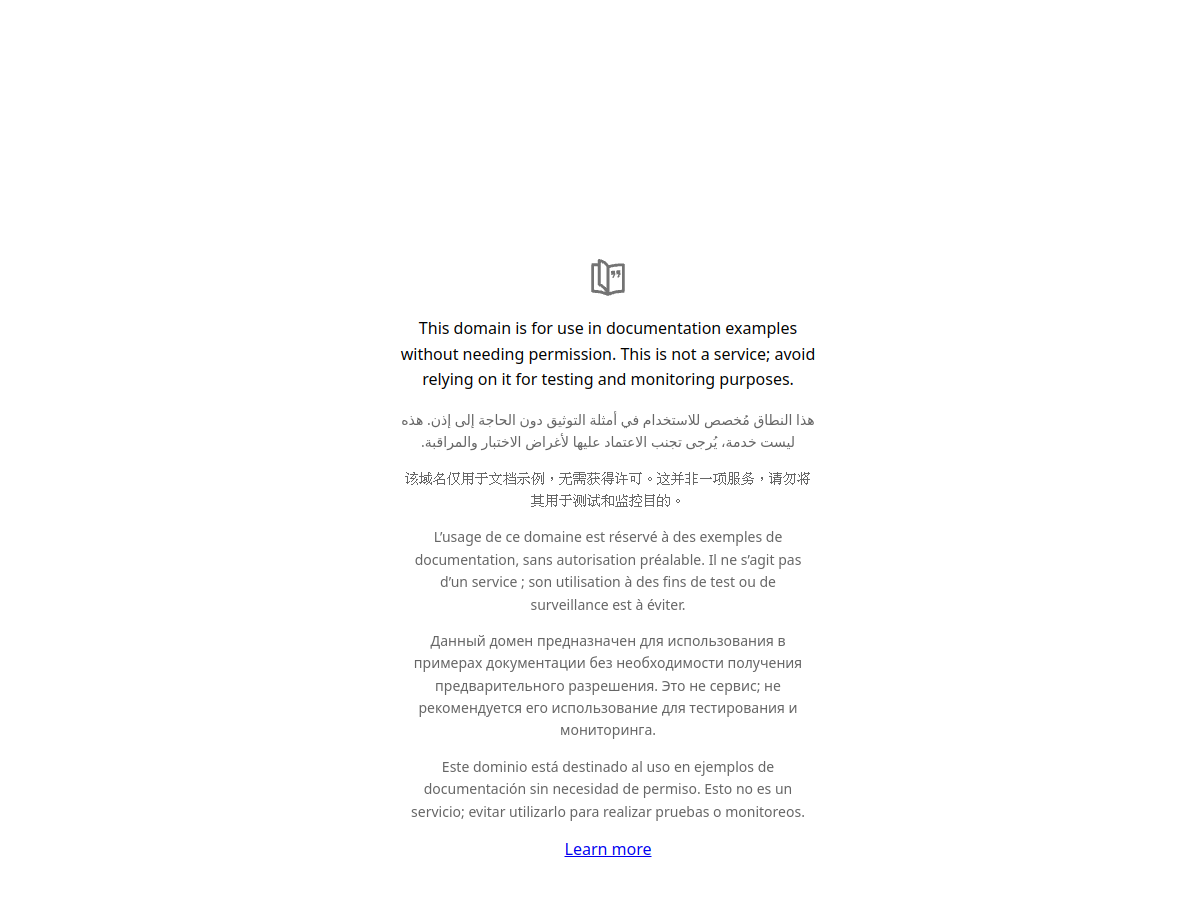 Figure: The live rendering of example.com today: a single primary advisory followed by five localized translations, with all secondary content injected by /s.js. Source: Third-party live screenshot via thum.io
This highlights the central irony of the redesign. Network panel inspections revealed that the standalone script and its associated response headers total roughly 2.15 KB. In an attempt to reduce crawler bandwidth, IANA shaved a few hundred bytes of static text from the root HTML payload. Yet for real human visitors using web browsers, reading those relocated sentences requires establishing a separate HTTP connection and downloading more than two kilobytes of script code. Shaving bytes from non-browser traffic by imposing a heavier burden on legitimate visitors is an optimization that sacrifices delivery efficiency in practice.
The open-source community remains divided on the matter. Proponents acknowledge the operational pressures outlined by Kim Davies: the domain was never intended to serve as a public health check endpoint, and providing HTTP responses is done purely as an operational courtesy, making defensive traffic-shaping justified. Critics, however, maintain that even as a courtesy, there is no need to transform a pristine web page into an over-engineered component requiring external dependencies. Some engineers even argued that if payload minimization was truly the goal, IANA should have dropped doctype declarations and html/body tags altogether, serving nothing but raw text.
Offloading the Bandwidth Bill to Human Visitors
Throughout the evolution of Internet infrastructure, architectural choices have always balanced transit costs against baseline user experience. The two hurried overhauls of example.com may appear to be minor frontend tweaks, but they expose a deeper dilemma in infrastructure maintenance. When resource consumption is dominated by unintended client behavior, maintainers risk optimizing for proxy metrics in isolation. Hiding content behind dynamic client scripts may make bandwidth numbers look better on an operational dashboard, but those savings come directly at the expense of client-side performance and latency for human users.
The veteran web page has now been restructured into 6 paragraphs, 22 DOM elements, and an initial payload of 1,977 bytes. IANA succeeded in cutting off crawlers from cheap, direct document streams by imposing an external script dependency. Yet human developers seeking documentation guidance are left paying the price through layout shifts, delayed repaints, and extra network roundtrips. Trading browser rendering efficiency for lower server bandwidth simply shifts the infrastructure bill from the host to human end-users.
References:
- Oliver Dunk’s Blog: IANA’s Reply
- Lobsters Discussion: IANA’s Email on Why example.com Changed
- Henry Catalinismith: Pause, Stop, Hide Analysis