
“Captain M— is in possession of a great curiosity viz. a stone precipitated from a Thunder-cloud near the village of Cokurrgaum three days ago (the 6th August). It weighs I should think four pounds at least, is very heavy for its size, being greatly impregnated with iron, and coated with a thin black crust, as if Gunpowder had exploded around it.”
This short paragraph, buried inside the December 19, 1812 issue of the Java Government Gazette (page 3, column 2), was brought to light by a locally run AI workflow. If verified by experts, this meteorite fall near the village of Cokurrgaum in Maharashtra, India would push back the region’s earliest recorded meteorite fall by 26 years.
Software engineer Jesse Waites pointed this automated workflow at 4.35 million pages of Dutch East India Company (VOC) archives and two centuries of American and Dutch newspapers. For a human reading eight hours a day at two minutes per page, wading through this corpus would take roughly 70 years. Waites’s pipeline chewed through the entire archive in a single twelve-hour overnight run.
The pipeline didn’t stop there. It also brought back records of three rhinoceroses that died en route to Ceylon, along with three major volcanic eruptions missing from standard global vulcanological catalogues. The entire system rested on two strict engineering rules: verify the known before hunting for the unknown, and anchor every single finding to an original, verifiable scan.
Establishing Controls Before Hunting the Unknown
Turning large language models loose on millions of historical documents in search of novel discoveries is an invitation to hallucination. Designing robust baseline control tests became the primary defense against false positives.
Historian Benjamin Breen had previously used Opus 5.5 on VOC records to uncover a 1615 eyewitness account of sailors catching dodos on Mauritius. Waites first reproduced that exact discovery to calibrate his pipeline’s baseline retrieval capabilities.
Next, the system successfully located the 1711 eruption of Mount Awu in the Sangihe Islands, extracting the death toll of 138 casualties—a figure that matched the Smithsonian Global Volcanism Program’s catalog down to the exact day.
Passing these control tests proved an essential point: the pipeline was capable of extracting verifiable historical facts from scattered personal accounts and cross-referencing them against modern scientific catalogues. Only after passing these tests did the pipeline earn the right to search for uncompiled candidate events.
Taming Compute Costs with a Three-Tier Pipeline
In 17th-century Dutch, the word “rhinoceros” had around fifteen different spellings. Plain keyword queries would have missed almost everything from the start.
Waites broke down the 4.35 million archive pages into 5.7 million semantic chunks. By generating vector embeddings, the system mapped historical spelling variations to neighboring clusters in high-dimensional vector space, searching for conceptual meaning rather than exact strings.
The real bottleneck was cost-effectively filtering candidate facts from tens of thousands of semantic hits. To manage compute costs, Waites deployed a three-tier reading pipeline. The first layer utilized a tiny, fast “System One” decision model named Jev, tasked exclusively with answering narrow questions (such as “Is this a real animal? Is it wild? Where is it?”). Processing 59,000 elephant-related passages through Jev cost just $3.
Passages flagged by Jev then flowed to the second layer, where Claude Haiku closely analyzed the text, translated the Dutch passages, and extracted dates and locations. Finally, a Claude Code agent pulled the original digitized scans to verify transcriptions against the handwritten source pages and cross-referenced them against specialist domain catalogues.
Three Rhinoceroses That Never Reached Ceylon
The pipeline pieced together a fascinating record of 18th-century diplomatic animal trade gone wrong. In 1738, the VOC captured a live Javan rhinoceros to present to the King of Kandy in Sri Lanka, whose goodwill was essential to maintaining the lucrative cinnamon trade.
The rhino made it across the Indian Ocean to Colombo but never made it up the mountains to Kandy. In the Company’s 1740 ledger under De Paardenstal (“the horse stable”), an entry recorded: “1 rhinoceros short, died in the horse stable in the year 1738.” The Colombo governor sheepishly reported the animal’s sudden death to Batavia and sent a Persian riding horse as a substitute.
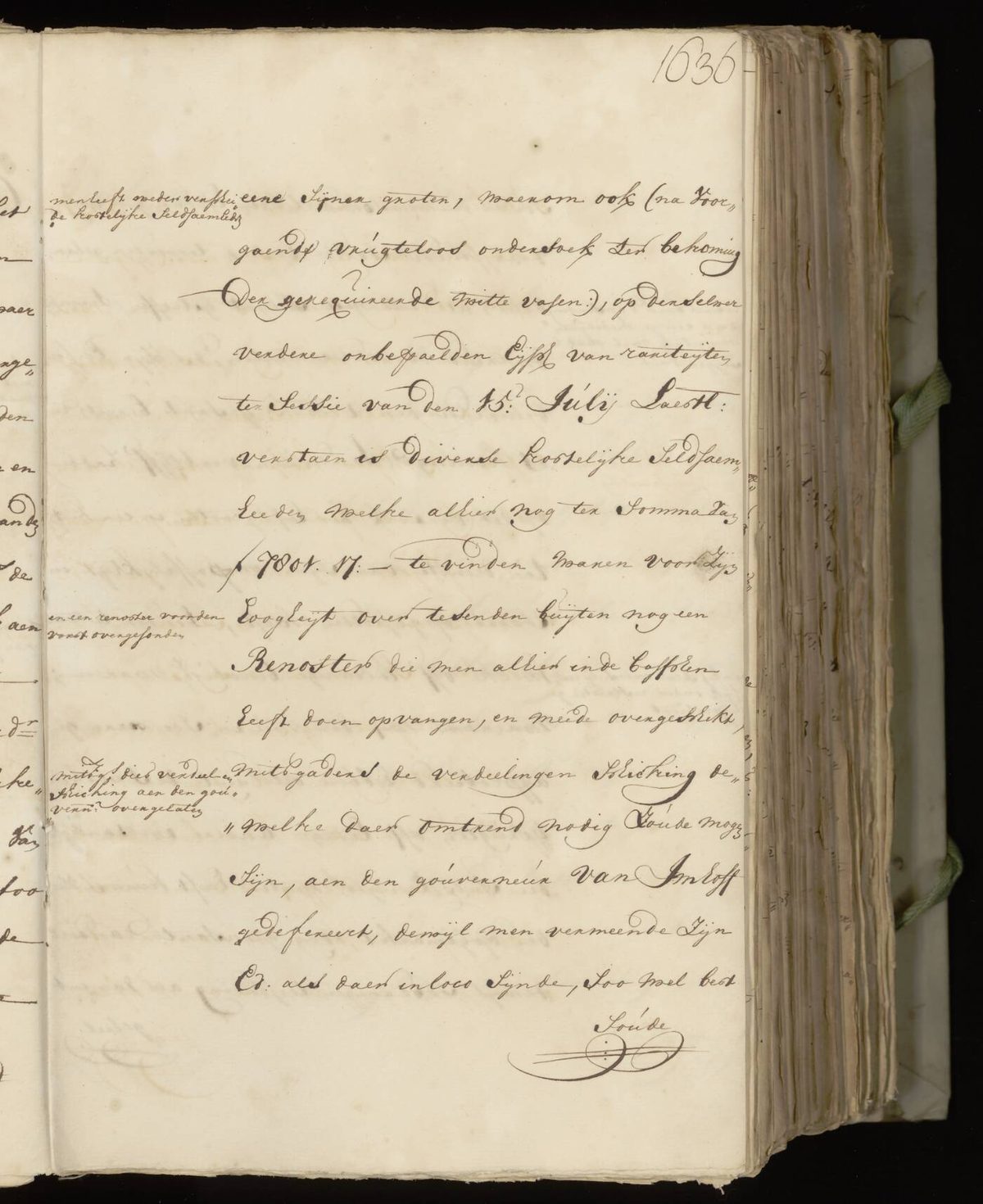 Figure: Original manuscript scan referencing the rhinoceros from the VOC archives. Source: Nationaal Archief (National Archives of the Netherlands).
On July 5, 1740, the ship Loverendaal departed Batavia for Ceylon carrying two more rhinos—a male and a female. Three days into the voyage, the male died; ten days later, the female (‘t wijfje) died as well. The ship’s officers, boatswain, and gunner appeared before the Colombo court, swearing under oath to their accounts without altering a word.
The governor’s subsequent instructions to his envoys at Kandy carried an apologetic tone. He dispatched several Dutch pigs (a young boar and two sows) and formally reported the rhinoceroses’ demise with “particular regret.” Three years later, envoys at the court of Ramnad in southern India demanded “a young rhinoceros to be sent, as was done for the King of Kandy.” The undelivered gift had inadvertently turned into diplomatic leverage.
Three Eruptions Missing from the Smithsonian Catalogue
Several candidate discoveries pointed directly to blind spots in modern Earth science records. Beyond the black-crusted meteorite—which was absent from Chladni’s 1819 catalog, the British Museum registers, the 1933 List of Indian Meteorites, and today’s Meteoritical Bulletin—the system uncovered three documented volcanic eruptions.
The first was the February 3, 1722 eruption of Gamkonora. In a letter dated July 7 of that year, the Governor of Ternate attached an on-site survey by sergeant-cartographer Jacob Engels documenting “the mountain blown open.”
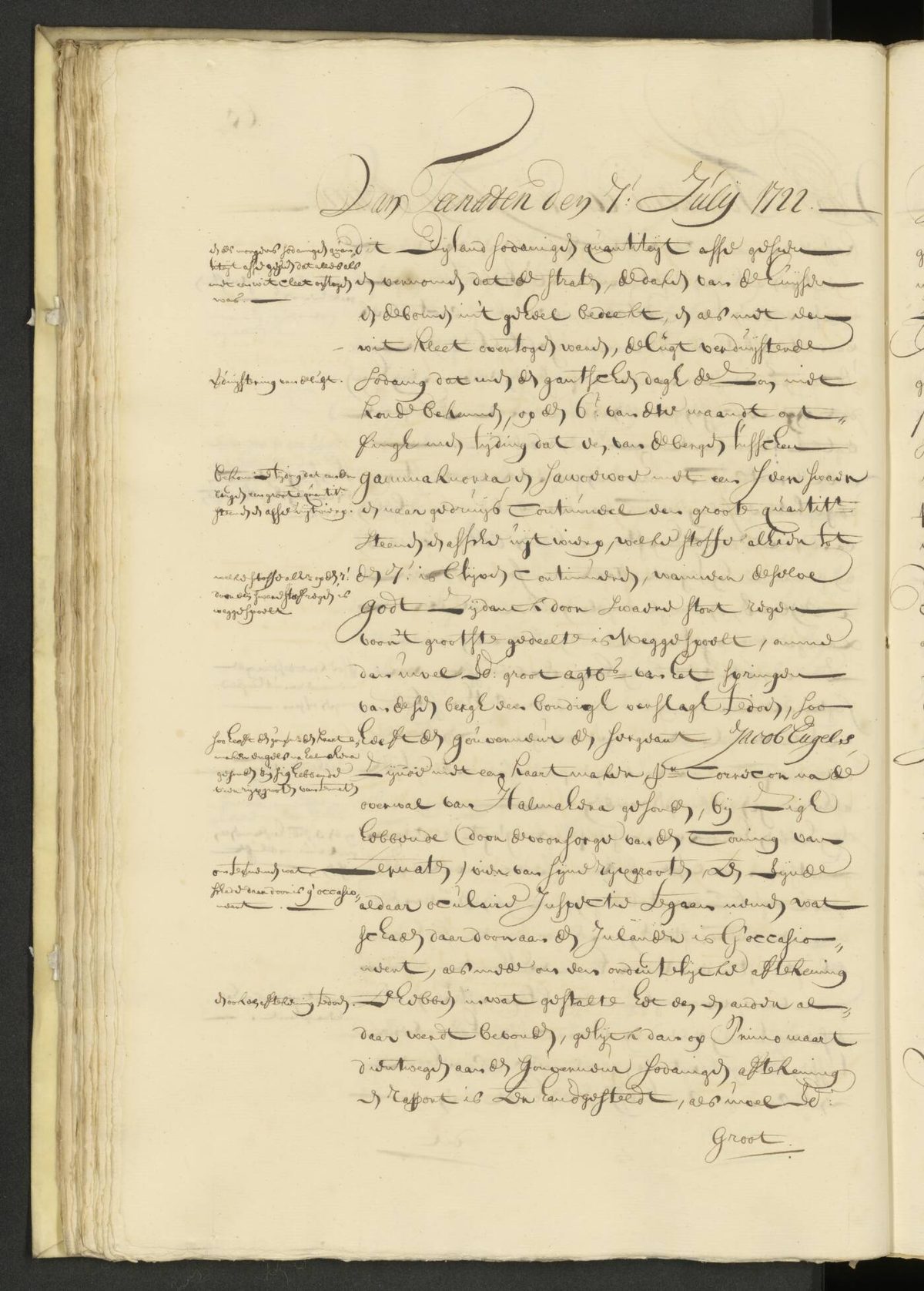 Figure: Handwritten Dutch letter dated July 7, 1722 from Ternate, preserved in a bound archive volume, recording the Gamkonora eruption. Source: Nationaal Archief (National Archives of the Netherlands).
The second was the early 1712 eruption of Mount Ciremai in West Java. Thick smoke billowed across the region for weeks “without visible flames,” depositing a fine layer of bluish-gray ash across the southeastern countryside. The archives recorded widespread crop destruction and cattle refusing to graze on ash-laden pastures, with local princes recalling a similar past occurrence. The third was the unusual activity of Mount Slamet in Central Java in February 1780, noted as “the formerly burning mountain of Tegal” erupting “so strongly as no one here remembers.”
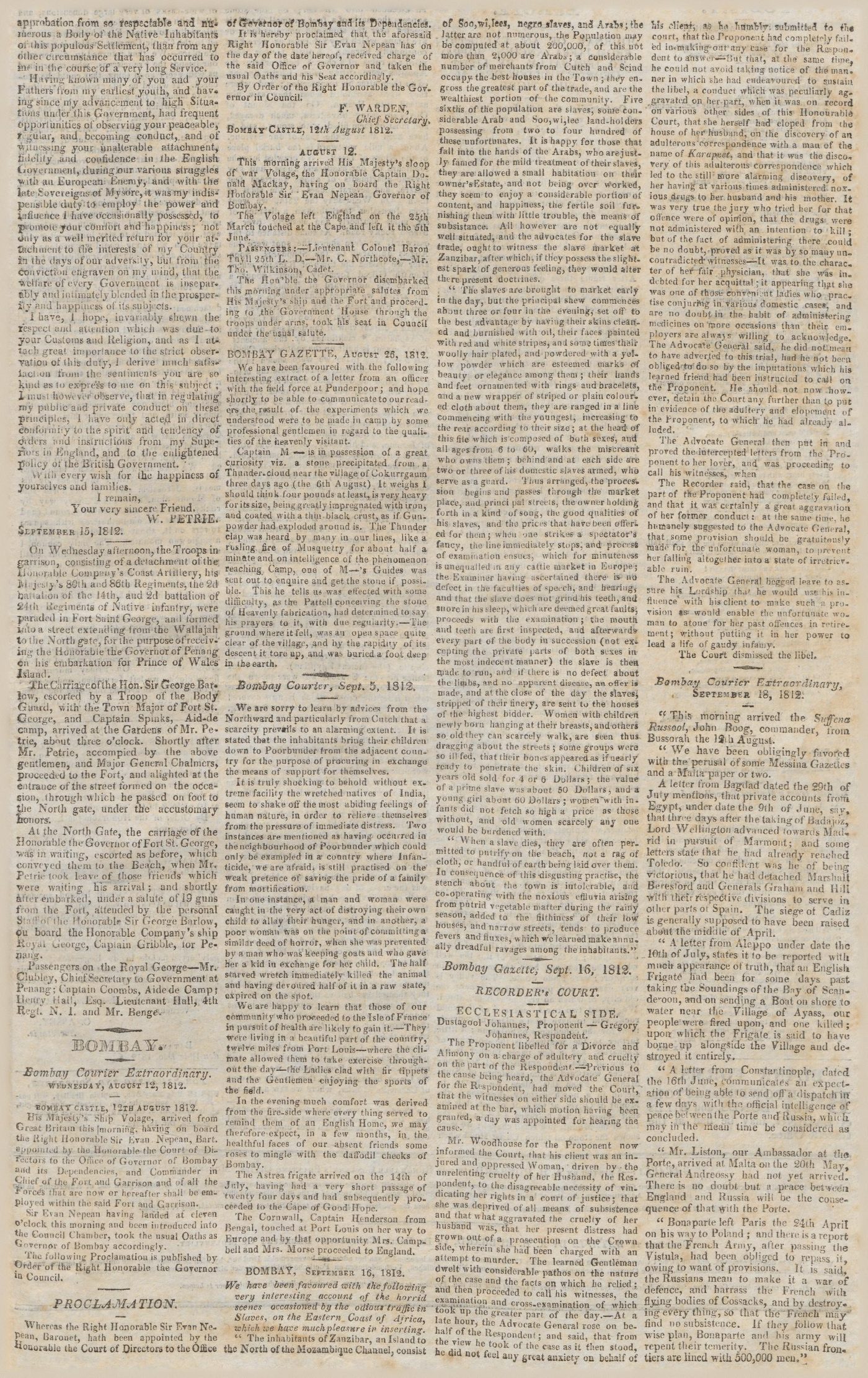 Figure: Excerpt from the Java Government Gazette (December 19, 1812, p. 3, col. 2), reprinting Captain M’s meteorite account from the Bombay Gazette of August 26, 1812. Source: Delpher / National Library of the Netherlands.
Cross-checking against the Smithsonian Global Volcanism Program catalog revealed that these three eruptions, witnessed and recorded on paper at the time, had been missing from scientific registries for three centuries. For now, they remain classified as candidate discoveries. Waites has contacted meteorite curators, historian Kees Rookmaaker, and volcanologists for formal scholarly review.
Striking Out on the 1809 Mystery Eruption
Despite these breakthroughs, the pipeline is far from omnipotent. When Waites attempted to investigate the mysterious “Unknown” eruption of 1808/09, the system came up empty.
Ice core samples indicate that a massive eruption occurred around 1808–1809, ranking among the largest volcanic events of the past five centuries, yet its location remains unknown. Waites aimed the entire workflow at American and Dutch newspapers, ship logs, South American colonial gazettes, and all 633 articles in Batavia’s earliest newspaper. The result: absolute silence.
Yet this failure provided its own form of engineering certainty. Because the exact same pipeline reliably caught the Awu, Gamkonora, and Ciremai events, drawing a blank on the 1809 mystery pointed toward a high-probability conclusion: no one in those regions wrote down accounts of an unusual sky in 1809. The best remaining hope lies in 1,235 untranscribed East India Company logbooks.
Waites has open-sourced the workflow as a lightweight toolkit called Antiquity. The experiment demonstrates a simple but poignant truth: he and Breen explored the exact same archives. Breen went looking for dodos and found a 1615 sighting; Waites went looking for meteorites and lost eruptions, and found black stones and shattered mountains.
Millions of archival pages sit completely motionless, waiting to be read. An archive never speaks of its own accord; it only answers the questions an engineer thinks to ask.
Reference Links:
- I pointed AI at 400 years of archives


