In August 2024, at USENIX Security in Philadelphia, a joint research team from Hunan University, UC San Diego, and Michigan State University unveiled a breakthrough counter-surveillance technology. Named Eye of Sauron (ESauron), the system neither scans local Wi-Fi networks nor searches for optical lens glints. Instead, it captures the faint electromagnetic radiation leaked by internal chips during operation, successfully detecting and localizing 50 commercial hidden spy cameras from up to 20 meters away.
This paradigm shift fundamentally alters counter-surveillance strategy. Rather than tracing wireless network packets, investigators now inspect the unavoidable physical traces hardware leaves behind in the physical world.
Cutting the Cord: Why Traditional Detection Goes Blind Offline
In hotels and vacation rentals, hidden spy cameras have long been a persistent privacy nightmare for travelers. Many guests routinely use smartphone apps to scan local Wi-Fi networks for suspicious connected devices upon check-in. Others sweep rooms with handheld infrared detectors, flashing light across wall outlets and smoke alarms in search of lens reflections.
These counter-measures were only effective against earlier generations of surveillance hardware. Older devices relied on Wi-Fi connectivity to stream video to cloud servers, continuously broadcasting RF signals. Once a detection tool intercepted those communication packets, the camera was immediately exposed.
The illicit surveillance industry rapidly iterated. A massive influx of offline cameras without wireless antennas flooded the market. Unconnected to Wi-Fi and lacking cellular SIM cards, these devices record video solely to internal TF/microSD cards.
Once the network connection is severed, conventional detection tools instantly go blind. Mobile apps cannot spot offline devices, and handheld RF meters register zero wireless transmissions. The moment a spy camera unplugs from the network, any security perimeter built on wireless signatures collapses immediately.
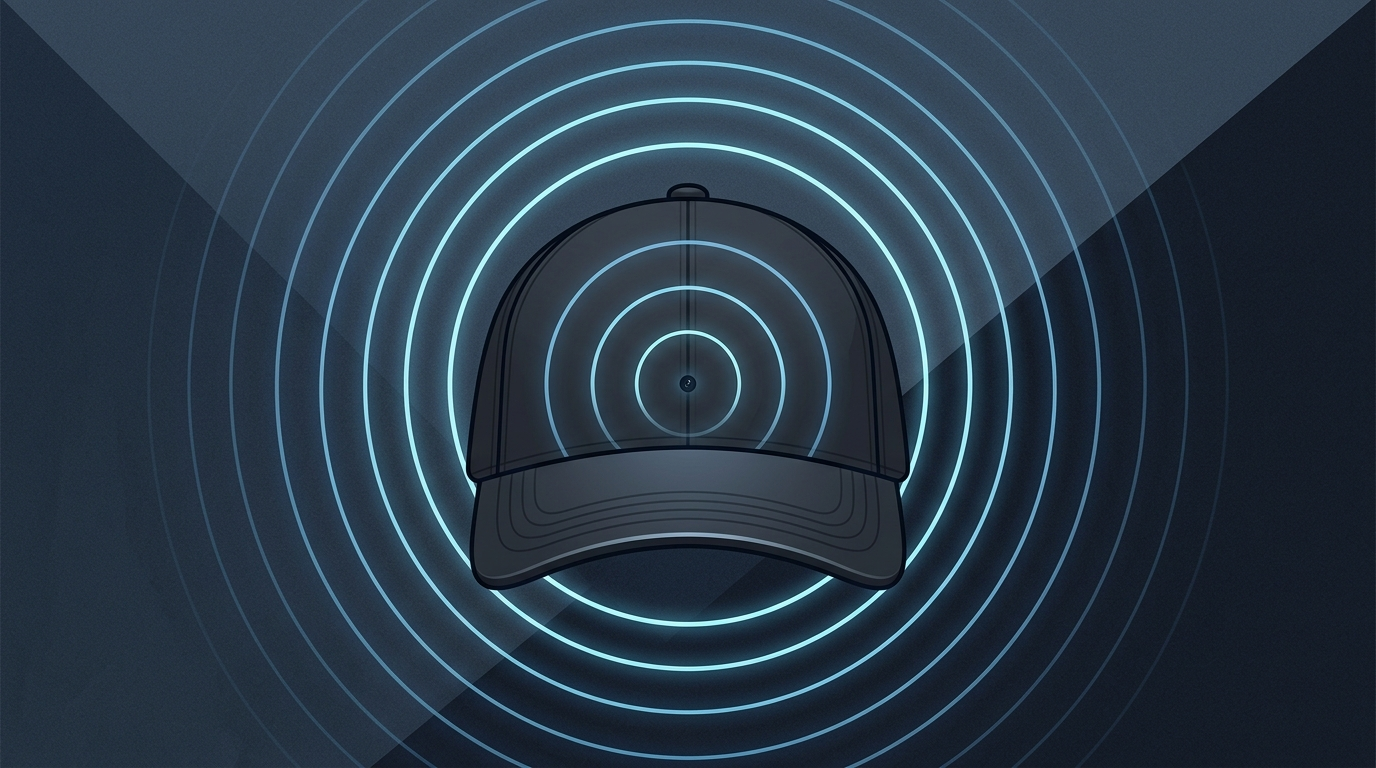
 Figure: A pinhole camera concealed inside a hat. By severing wireless connections and relying solely on onboard memory cards, such devices stay invisible to conventional network and RF detectors. Source: Wikimedia Commons
Relying on naked-eye optical reflection checks also presents critical blind spots. If the lens is concealed behind a dark optical filter or viewed from an angle tilted just 15 degrees off-axis, reflection drops drastically. Offline covert recording has thus remained an exceedingly difficult security challenge to resolve.
Physics Cannot Be Hidden: Video Compression Leaks Memory EM Radiation
While perpetrators can strip away antennas, they cannot remove the image processing silicon. Any camera capturing video must execute the same fundamental computational pipeline: the optical sensor captures light and continuously streams raw pixel data.
This raw pixel stream cannot be written directly to flash storage. For uncompressed 1080p video at 30 frames per second, the raw data rate consumes hundreds of megabytes of bandwidth each second. MicroSD cards cannot sustain such high write speeds and would be exhausted within minutes. The processing chip must therefore apply high-ratio compression to the raw video before storage.
The image processor and onboard memory shoulder this computational load. The sensor feeds raw frames into memory buffers, where the SoC invokes compression algorithms to repeatedly compare frame-to-frame differences. The video volume is compressed to a fraction of its original size before finally being written to the flash card.
Fundamental hardware physics takes over here. Internal memory relies on high-frequency clock synchronization, while switching voltage regulators adjust power delivery to match computational loads. As bits rapidly toggle across memory cells, instantaneous supply current spikes inevitably occur. These high-frequency switching currents traverse PCB circuit traces, unintentionally radiating electromagnetic waves into surrounding space at specific frequencies.
The frequency of this electromagnetic radiation locks tightly onto the memory clock. Even without any wireless antenna, the PCB traces act as unintentional micro-transmitters, radiating subtle electromagnetic fluctuations outwards. As long as a chip compresses video frames in memory, the laws of physics dictate that electromagnetic leakage cannot be suppressed.
The strategic foundation of this cat-and-mouse game has shifted. Detectors no longer care whether a device is connected to the internet; as long as silicon is digesting incoming frames, its physical operation cannot be masked.
Four Optical Pulses: Pinpointing Physical Coordinates from 20 Meters Away
Capturing these faint emissions in real-world environments is far from trivial. A typical hotel room is not an RF-shielded anechoic chamber: televisions, Wi-Fi routers, and power adapters all emit stray electromagnetic noise. Amidst noisy ambient interference, faint memory leakage signals can easily be overwhelmed.
The joint research team tackled this by turning ESauron into an active probing system. They exploited a key mechanism of video compression: inter-frame prediction. When a scene remains static, processor workload stays minimal. But when the scene changes dramatically, the chip must mobilize substantial memory bandwidth to recalculate keyframes, causing throughput to surge.
ESauron abandons passive listening in favor of projecting rhythmic, pulsating patterns of light across the room. Phone chargers do not react to light, turned-off appliances remain silent, but the spy camera is compelled to capture the shifting scene before it. To encode the fluctuating frames, the camera’s image processor instantly spikes into a high-workload state.
This computational surge induces distinctive, rhythmic electromagnetic pulses. Even against chaotic background noise, this pulse train—locked synchronously to the external optical pattern—stands out with high clarity. Using directional antennas, researchers need only four optical pulses to cleanly extract the target signal from background noise.
 Figure: The ESauron detection prototype presented at USENIX Security ‘24. The research team used directional antennas in experimental setups to capture faint EM leakage from onboard memory. Source: USENIX Association
After establishing a device’s presence, the system pinpoints its exact physical location. Multiple receiving antennas detect minute phase differences in the arriving electromagnetic waves, allowing algorithms to compute the source’s spatial coordinates. Even through wooden walls and partitions, the detection range surpasses 20 meters while delivering precise three-dimensional coordinates.
Beyond the Lab: 3 Obstacles After Testing 50 Commercial Devices
To evaluate real-world universality, the team acquired 50 commercial spy cameras from public marketplaces. These devices spanned diverse form factors—including wall sockets, smoke alarms, wall clocks, and screws—and covered mainstream image processors and offline storage designs. Under controlled testing, the system achieved a 100% detection and localization rate across all 50 models.
A 100% detection rate showcases tremendous technological promise, but it does not mean consumer-grade devices will hit store shelves tomorrow. Bridging the gap from a laboratory prototype to everyday consumer hardware requires overcoming three practical hurdles.
The first hurdle is hardware bulk and bill of materials. Capturing nanowatt-level signals from 20 meters requires high-end Software Defined Radios (SDRs) and specialized antenna arrays. The current hardware setup is bulky and costly—far beyond what commodity smartphone chips can handle.
The second hurdle is complex real-world electromagnetic interference. While laboratory environments can shield out ambient noise, real hotel rooms feature noisy, unpredictable RF conditions. Harmonics generated by air conditioners, hair dryers, and low-grade chargers can easily drown out faint memory pulses, significantly raising the difficulty of signal extraction.
The third hurdle lies in the practical constraints of active optical probing. Flashing light patterns in public or semi-private spaces can be intrusive and draw unwanted attention. If a hidden camera incorporates optical filters, light-induced memory fluctuations will be dampened. Furthermore, if manufacturers encase spy cameras in metal shielding, the detection range will shrink drastically.
The struggle between covert surveillance and privacy protection is fundamentally an asymmetric information war. Illicit hardware long leveraged offline recording to build a stealth advantage, rendering network-centric tools ineffective.
The core value of the ESauron prototype lies in dismantling the myth that offline surveillance hardware is undetectable. As long as hardware records physical reality, transistors and memory must shuttle data. The resulting electromagnetic radiation is an inescapable physical cost of active computation.
Defenders no longer need to chase shifting wireless protocols; they can target the unalterable physical characteristics of silicon in action. Counter-surveillance has dropped to the micro-hardware layer: hidden pinhole cameras, even with their cords cut, cannot erase the physical signatures they cast across electromagnetic space.
Reference Links:
- USENIX Security ‘24 Paper and Presentation (Eye of Sauron: Long-Range Hidden Spy Camera Detection and Positioning with Inbuilt Memory EM Radiation)
- HN Discussion (item?id=49997481)